
As I delve into the evolving landscape of railway engineering, the integration of advanced robotics has captured my attention, particularly the emergence of humanoid robots designed to tackle maintenance challenges. The recent developments in Japan, where a humanoid robot is deployed for tasks such as painting lines, trimming vegetation, lifting heavy objects, and performing simple maintenance on overhead contact lines, signify a paradigm shift. This humanoid robot, with its impressive 12.2-meter-long arms and four claws per arm, mounted on a road-rail vehicle, exemplifies how technology can enhance safety and efficiency. In this article, I will explore the key technologies, applications, and future prospects of humanoid robots in railway systems, supported by formulas and tables to summarize critical aspects. The goal is to provide a comprehensive analysis that underscores the transformative potential of these humanoid robots.
The concept of a humanoid robot in industrial settings is not entirely new, but its adaptation for railway infrastructure maintenance presents unique engineering hurdles. From my perspective, the core appeal lies in the humanoid robot’s ability to mimic human movements, allowing it to operate in environments designed for people. This humanoid robot, as described, is controlled by an operator wearing a head-mounted display, enabling remote visualization through its camera eyes. Its reach of up to 10 meters above the track and superior strength reduce reliance on heavy machinery, addressing labor shortages and safety concerns. I believe that by examining the underlying technologies, we can appreciate how this humanoid robot achieves such feats. Let’s begin with the mechanical design and kinematics.
The kinematics of a humanoid robot involves the study of motion without considering forces. For the robotic arms in this humanoid robot, forward kinematics can be described using the Denavit-Hartenberg (D-H) parameters. Each joint’s transformation matrix is given by:
$$ T_i^{i-1} = \begin{bmatrix} \cos\theta_i & -\sin\theta_i \cos\alpha_i & \sin\theta_i \sin\alpha_i & a_i \cos\theta_i \\ \sin\theta_i & \cos\theta_i \cos\alpha_i & -\cos\theta_i \sin\alpha_i & a_i \sin\theta_i \\ 0 & \sin\alpha_i & \cos\alpha_i & d_i \\ 0 & 0 & 0 & 1 \end{bmatrix} $$
where $\theta_i$ is the joint angle, $a_i$ is the link length, $d_i$ is the link offset, and $\alpha_i$ is the twist angle. For a humanoid robot with multiple degrees of freedom, the overall transformation from the base to the end-effector is:
$$ T_n^0 = T_1^0 \cdot T_2^1 \cdot \ldots \cdot T_n^{n-1} $$
This allows the humanoid robot to position its claws precisely for tasks like painting or lifting. The dynamics, which account for forces and torques, are crucial for stability. Using the Lagrangian formulation, the dynamics of a humanoid robot can be expressed as:
$$ \tau = M(q)\ddot{q} + C(q, \dot{q})\dot{q} + G(q) $$
where $\tau$ is the vector of joint torques, $M(q)$ is the inertia matrix, $C(q, \dot{q})$ represents Coriolis and centrifugal forces, $G(q)$ is the gravitational vector, and $q$ denotes joint positions. This equation ensures that the humanoid robot can handle heavy loads without toppling, a key requirement in railway maintenance. To illustrate the capabilities of such a humanoid robot, consider the following table summarizing its primary tasks and specifications:
| Task | Description | Humanoid Robot Advantage |
|---|---|---|
| Painting Lines | Applying markings on trackside structures | Precision and reach up to 10 m |
| Vegetation Trimming | Cutting overgrown plants near tracks | Reduced risk for human workers |
| Heavy Lifting | Moving equipment or debris | Superior strength compared to humans |
| Contact Line Maintenance | Simple repairs on overhead wires | Ability to work near electrified areas safely |
As I analyze these tasks, it becomes clear that the humanoid robot not only performs manual labor but does so with enhanced safety. The integration of sensors, such as cameras and force sensors, enables real-time feedback. For instance, the control system of a humanoid robot often employs PID controllers to regulate joint movements. The PID control law is:
$$ u(t) = K_p e(t) + K_i \int_0^t e(\tau) d\tau + K_d \frac{de(t)}{dt} $$
where $u(t)$ is the control output, $e(t)$ is the error signal, and $K_p$, $K_i$, $K_d$ are proportional, integral, and derivative gains, respectively. This ensures smooth and accurate motions for the humanoid robot when handling delicate operations. Moreover, the humanoid robot’s design allows for adaptability; with artificial intelligence, it could learn from its environment. Machine learning algorithms, such as reinforcement learning, can optimize the humanoid robot’s performance over time. The reward function in reinforcement learning for a humanoid robot might be:
$$ R = \sum_{t=0}^T \gamma^t r_t $$
where $R$ is the cumulative reward, $r_t$ is the immediate reward at time $t$, and $\gamma$ is the discount factor. This enables the humanoid robot to autonomously improve its efficiency in tasks like vegetation trimming.
Beyond kinematics and control, the sensory systems of a humanoid robot are vital. The humanoid robot in discussion uses cameras for vision, but it may also incorporate LiDAR or ultrasonic sensors for obstacle detection. The perception pipeline can be modeled using computer vision techniques. For example, object detection might involve convolutional neural networks (CNNs), with the loss function given by:
$$ L = -\sum_{i=1}^N [y_i \log(\hat{y}_i) + (1 – y_i) \log(1 – \hat{y}_i)] $$
where $y_i$ is the true label and $\hat{y}_i$ is the predicted probability. This allows the humanoid robot to identify tools or hazards in its workspace. To further elucidate the benefits, let’s compare the humanoid robot approach with traditional methods in railway maintenance:
| Aspect | Traditional Methods | Humanoid Robot Implementation |
|---|---|---|
| Safety | High risk in elevated or electrified areas | Reduced accident risk due to remote operation |
| Labor Efficiency | Requires multiple workers and machinery | Can reduce manpower by approximately 30% |
| Precision | Manual errors possible | High accuracy with sensor feedback |
| Cost Over Time | High operational and maintenance costs | Lower long-term costs through automation |
From my viewpoint, the humanoid robot represents a convergence of mechanical engineering, control theory, and artificial intelligence. Its deployment in railways aligns with broader trends in Industry 4.0, where cyber-physical systems enhance productivity. The humanoid robot’s ability to perform diverse tasks stems from its modular design. For instance, the claws can be swapped for different tools, making this humanoid robot versatile. In terms of energy consumption, the humanoid robot might be powered by electric batteries, with efficiency modeled by:
$$ P = I \cdot V $$
where $P$ is power, $I$ is current, and $V$ is voltage. Optimizing this is crucial for extended operations in remote rail sections. As I reflect on the industry information, the humanoid robot’s role in addressing labor shortages is pivotal. Japan’s aging population and workforce decline make such innovations essential. The humanoid robot not only fills gaps but does so with higher consistency. For example, in painting lines, the humanoid robot can ensure uniform thickness, which can be quantified by:
$$ \text{Thickness} = \frac{V}{A} $$
where $V$ is the paint volume and $A$ is the area covered. This level of control is difficult for human workers to maintain over long periods.
The integration of the humanoid robot into existing railway systems requires careful planning. Communication networks, like GSM-R, play a role in transmitting control signals. While not directly related to the humanoid robot’s mechanics, reliable data links are essential for real-time operation. The packet domain simulation in GSM-R networks, as referenced in some research, ensures low latency for commands sent to the humanoid robot. This highlights how the humanoid robot is part of a larger technological ecosystem. Looking ahead, I envision humanoid robots becoming more autonomous. With advancements in AI, the humanoid robot could transition from remote-controlled to fully self-directed entities. Path planning algorithms, such as A* search, can guide the humanoid robot through complex environments. The cost function in A* is:
$$ f(n) = g(n) + h(n) $$
where $g(n)$ is the cost from start to node $n$, and $h(n)$ is the heuristic estimate to the goal. This enables the humanoid robot to navigate around obstacles while performing tasks.
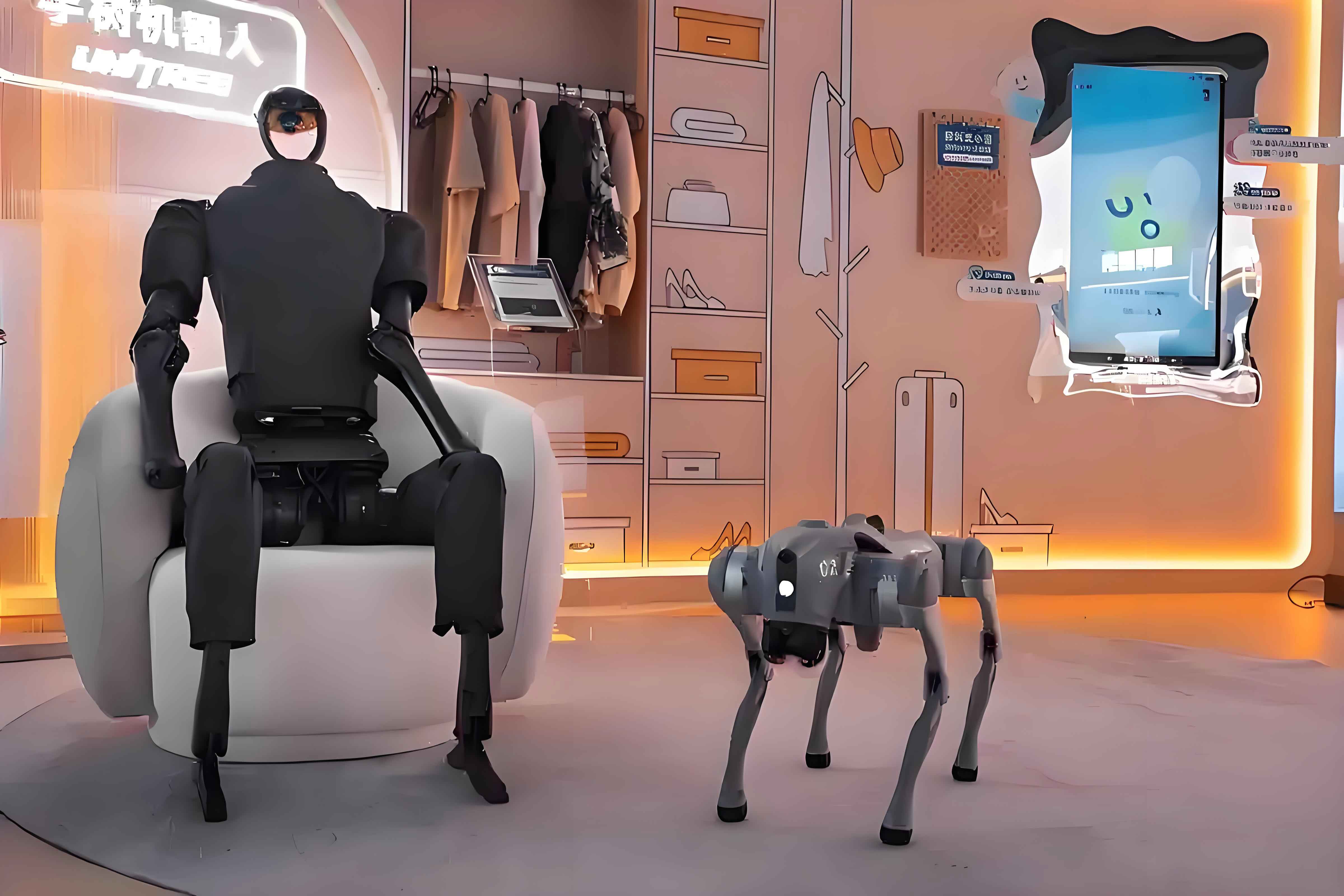
As shown in the image, humanoid robots and robotic dogs represent the cutting edge of mobile robotics. In railway contexts, the humanoid robot’s form factor allows it to access confined spaces, such as under bridges or inside tunnels. The humanoid robot’s design often includes balance mechanisms to prevent falls. The zero-moment point (ZMP) criterion is used to ensure stability for a humanoid robot:
$$ x_{ZMP} = \frac{\sum_i m_i (g + a_i) x_i – \sum_i m_i z_i a_{x,i}}{\sum_i m_i (g + a_i)} $$
where $m_i$ is the mass of link $i$, $g$ is gravity, $a_i$ is acceleration, and $x_i, z_i$ are coordinates. This ensures the humanoid robot remains stable on uneven surfaces, like ballast or tracks. Additionally, the humanoid robot can be equipped with haptic feedback for operators, enhancing control precision. The force feedback law might be:
$$ F = K \cdot \Delta x $$
where $F$ is the force exerted, $K$ is stiffness, and $\Delta x$ is displacement. This allows the operator to “feel” the environment through the humanoid robot, improving task accuracy.
In terms of economic impact, the humanoid robot offers significant savings. By reducing the need for human workers in hazardous areas, it lowers insurance and compensation costs. The return on investment (ROI) for deploying a humanoid robot can be calculated as:
$$ \text{ROI} = \frac{\text{Net Benefits}}{\text{Cost of Investment}} \times 100\% $$
Net benefits include reduced labor costs, fewer accidents, and higher productivity. For railways, this humanoid robot could pay for itself within a few years. Moreover, the humanoid robot’s versatility means it can be reprogrammed for new tasks, extending its lifecycle. For instance, if railway standards change, the humanoid robot can be updated with new software rather than replaced. This adaptability is a hallmark of modern humanoid robots.
From a societal perspective, the humanoid robot addresses ethical concerns by taking over dangerous jobs. However, it also raises questions about job displacement. As I see it, the humanoid robot should be viewed as a tool that augments human capabilities rather than replaces them entirely. Workers can be upskilled to operate or maintain the humanoid robot, creating new roles. In Japan, the humanoid robot is seen as a solution to labor shortages, not as a threat. This humanoid robot exemplifies how technology can support an aging workforce. To quantify the impact, consider the following table on workforce reduction and safety improvement:
| Metric | Before Humanoid Robot | After Humanoid Robot Deployment |
|---|---|---|
| Number of Workers Required | 10 per maintenance team | 7 per maintenance team (30% reduction) |
| Accident Rate | High in elevated tasks | Significantly lowered |
| Task Completion Time | Variable due to human fatigue | Consistent and faster |
| Environmental Impact | Heavy machinery emissions | Reduced due to electric power |
The humanoid robot’s environmental benefits are noteworthy. By using electric power, it reduces carbon emissions compared to diesel-powered machinery. The energy efficiency of a humanoid robot can be expressed as:
$$ \eta = \frac{\text{Useful Work Output}}{\text{Energy Input}} $$
Optimizing $\eta$ is key for sustainable operations. Furthermore, the humanoid robot minimizes disturbance to wildlife during vegetation trimming, as it operates quietly. This aligns with green railway initiatives. In my analysis, the humanoid robot is not just a mechanical tool but a component of smart infrastructure. With the Internet of Things (IoT), the humanoid robot can share data with other systems, enabling predictive maintenance. For example, sensors on the humanoid robot can detect wear on contact lines and alert managers before failures occur. This predictive model might use regression analysis:
$$ y = \beta_0 + \beta_1 x_1 + \beta_2 x_2 + \epsilon $$
where $y$ is the failure probability, $x_i$ are sensor readings, and $\beta_i$ are coefficients. Thus, the humanoid robot contributes to overall system reliability.
Looking at future trends, I anticipate humanoid robots becoming more common in railways worldwide. Research into humanoid robot swarms could enable collaborative tasks, such as multiple humanoid robots working together to repair a bridge. The coordination algorithm might involve consensus protocols:
$$ \dot{x}_i = \sum_{j \in N_i} (x_j – x_i) $$
where $x_i$ is the state of humanoid robot $i$, and $N_i$ is its neighbors. This ensures synchronized movements. Additionally, advancements in materials science could make humanoid robots lighter and stronger, using composites with high strength-to-weight ratios. The stress-strain relationship is:
$$ \sigma = E \epsilon $$
where $\sigma$ is stress, $E$ is Young’s modulus, and $\epsilon$ is strain. This allows for durable yet agile humanoid robots. As artificial intelligence progresses, the humanoid robot may gain cognitive abilities, such as natural language processing for voice commands. This would make the humanoid robot more accessible to non-technical staff. The transformer model in NLP, for instance, uses attention mechanisms:
$$ \text{Attention}(Q, K, V) = \text{softmax}\left(\frac{QK^T}{\sqrt{d_k}}\right)V $$
where $Q$, $K$, $V$ are query, key, and value matrices. Integrating this into the humanoid robot’s interface could simplify operations.
In conclusion, the humanoid robot represents a significant leap forward for railway infrastructure maintenance. From my perspective, its ability to perform hazardous tasks with precision and efficiency addresses critical challenges in the industry. The humanoid robot’s design, grounded in robust kinematics and control theory, ensures reliable performance. Through formulas and tables, I have summarized key aspects, highlighting how this humanoid robot reduces labor needs, enhances safety, and supports sustainable practices. As technology evolves, I believe humanoid robots will become indispensable, transforming railways into safer, smarter, and more efficient networks. The journey of this humanoid robot from concept to reality underscores the power of innovation in overcoming real-world problems, paving the way for a future where humanoid robots work alongside humans to build better infrastructure.