
The humanoid robot sector is experiencing rapid industrialization, driven by technological advancements, capital influx, and expanding applications. According to Wind data, in the first half of 2025, the humanoid robot sector index surged by 28.66%, significantly outperforming other technology sectors like artificial intelligence and new energy vehicles. The total market capitalization of the humanoid robot industry skyrocketed from 1.17 trillion yuan to 6.03 trillion yuan, marking a staggering half-year increase of 415%. In the Jiangsu region, a key hub for humanoid robot development, performance disparities have emerged, characterized by robust growth in core components and challenges in system integration. Among 16 major listed companies, 12 reported profits while 4 faced losses, with combined R&D investments totaling 689 million yuan. This分化 reflects the varying technical barriers and profitability across the humanoid robot supply chain, underscoring the sector’s evolution toward maturity.
-
Performance Differentiation: Core Component Companies Lead the Way
The humanoid robot industry’s performance split highlights the advantages of core零部件 manufacturers over system integrators. Companies specializing in critical components such as reducers, motors, and lead screws have demonstrated superior profitability, with gross margins generally exceeding 35%. In contrast, system integration firms grapple with high R&D costs, extended payment cycles, and intense competition. The functionality of embodied intelligent humanoid robots heavily relies on the performance of key parts like planetary roller screws, six-dimensional torque sensors, and harmonic reducers. These components present significant technical barriers, necessitating high-precision manufacturing equipment for breakthroughs.
Leading the charge in harmonic reducers, Lead of Harmonic Drive reported double-digit growth in both revenue and net profit in the first half of the year. The company has consistently increased R&D spending, with its proprietary technology achieving a tested lifespan of 12,000 hours for harmonic reducers and reducing costs by 30-50% compared to imported alternatives. Its products have passed certifications from Tesla and Figure AI and are now supplied to整机 manufacturers such as Tesla’s Optimus, Yushu, and Ubtech. This success underscores the critical role of core components in advancing humanoid robot capabilities.
Jiangsu Leili, focused on producing the “joint-dexterous hand,” a key component accounting for 20-30% of a humanoid robot’s total cost and second only to motors in value, has made significant strides. A subsidiary established last year has developed and launched two “dexterous hand” models with 22 degrees of freedom. According to its 2025 interim report, the company’s R&D expenses reached 86.77 million yuan in the first half, a 14.51% year-on-year increase, primarily directed toward cutting-edge technologies like hollow cup motors and planetary roller screws. These investments are pivotal for enhancing the agility and efficiency of humanoid robots.
恒立液压 has identified emerging sectors as a “second curve” for growth, with its industrial lead screw products beginning production and small-scale shipments in the first half of last year. Institutional forecasts project its revenue from this segment to reach 80-100 million yuan this year, highlighting the growing demand for precision components in humanoid robot applications. Conversely, system integration and本体 manufacturing face substantial pressures. Jiangsu Beiren reported a net profit decline of over 37 million yuan in the first half, with R&D expenses amounting to 19.76 million yuan, or 9.6% of revenue, due to extended debugging cycles for its bipedal walking control algorithm prototype. Yijiahe, driven by its power robot business, saw an 88.8% year-on-year increase in revenue and is expanding into non-power sectors such as firefighting robots (for search and rescue, and fire suppression) and medical robots (e.g., orthopedic surgical navigation), gradually building a diversified revenue structure to mitigate risks in the humanoid robot market.
The differentiation in performance among humanoid robot companies emphasizes the importance of technological innovation in core components. As the humanoid robot industry evolves, companies with strong R&D capabilities in critical parts are better positioned to capitalize on the growing adoption of humanoid robots across various fields. This trend is expected to continue, with further investments in components like sensors and actuators driving the next wave of humanoid robot advancements.
-
Industry Acceleration: Self-Developed Breakthroughs Drive Multi-Scenario Applications
The humanoid robot sector is gaining momentum, fueled by policy support, capital investment, and technological breakthroughs. Humanoid robots, as next-generation automation solutions capable of adapting to unstructured environments and performing complex tasks, are finding extensive “testing grounds” and market opportunities in Jiangsu’s diverse scenarios. This acceleration is evident in the rapid deployment and innovation across industrial and service domains.
Estun, which incubated Estun Cuzo in 2022, has released two humanoid robot models, Codroid01 and Codroid02, primarily applied in industrial settings. In June this year, the company established the “Embodied Intelligent Robot Innovation Center,” positioned as a pilot and process validation platform for mass production of humanoid robots. In its Hong Kong IPO prospectus, Estun explicitly stated plans to integrate embodied intelligence technology into existing industrial robots and allocate part of the raised funds to “supplement R&D capital,” underscoring its commitment to advancing humanoid robot capabilities.
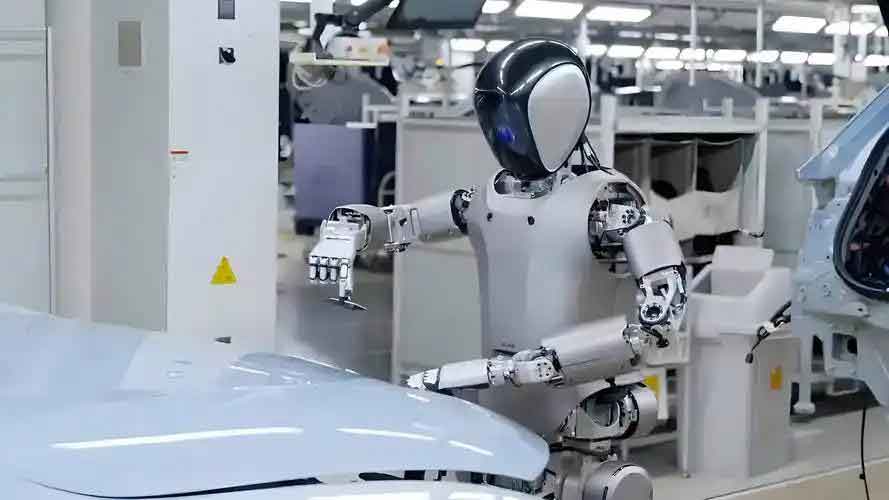
Recently, Tianqi股份 delivered an order for embodied intelligent robots to a leading domestic automotive group, marking the start of small-batch deliveries of humanoid robots in industrial scenarios. Tianqi股份 has set up a humanoid robot business division and formed a joint venture with Galaxy General to promote the application of embodied intelligent robots in industrial manufacturing. Additionally, it established the Wuxi Industrial Data Collection and Training Center, focusing on the automotive and new energy industries. These initiatives highlight the expanding role of humanoid robots in enhancing productivity and efficiency.
The application exploration of humanoid robots is extending significantly from industrial to service sectors. Industrial scenarios predominantly include automotive manufacturing and logistics warehousing, while service applications encompass energy inspection, elderly companionship, and more. Liu Shuang, founder and chairman of Tianchuang Robot, predicts that 2025-2027 will be a critical period for humanoid robots in specialized operations, where surviving enterprises will have the opportunity to apply their technologies to broader commercial service areas. The company’s latest product, the “Tiansuan Multi-modal Recognition and Diagnosis AI Large Model All-in-One Machine,” is plug-and-play, enabling inspection humanoid robots to become operational immediately upon deployment, improving application efficiency and action accuracy. This innovation is set to revolutionize how humanoid robots are integrated into real-world tasks.
Yijiahe, as an ecosystem partner of Huawei Cloud’s embodied intelligence, is advancing a “robot + industry” development strategy, expanding from traditional power sectors to commercial cleaning, rail transit, and new energy industries. The AI emotion recognition accuracy of its products has increased to 92%, facilitating the deployment of Pepper robots in elderly care institutions. This demonstrates the potential of humanoid robots to enhance quality of life in service-oriented roles.
Listed companies are actively布局 through industrial investment funds. Baoxin Technology recently announced plans to invest 18 million yuan in participating in the capital increase and expansion of Suzhou Jicui Intelligent Manufacturing Robot Co., Ltd. After the transaction, it will hold 81.82% of the latter’s equity, strengthening its position in key components and core technologies for humanoid robots. Such moves indicate a strategic shift toward consolidating resources in the humanoid robot ecosystem.
The acceleration of the humanoid robot industry is not just about technological prowess but also about creating sustainable business models. As more companies invest in self-developed breakthroughs, the humanoid robot market is poised for exponential growth, with applications becoming increasingly diverse and integrated into daily operations.
-
Expanding Application Scenarios: New Players Reshape the Industrial Ecosystem
Capital markets are highly attentive to the development of emerging tracks in the humanoid robot sector. Jiang Lei, chief scientist of the National-Local Co-constructed Humanoid Robot Innovation Center, recently revealed that the number of humanoid robot整机 platforms in China has exceeded 160. As of July 2025, industry financing amounts have surpassed 24 billion yuan, exceeding the total for the entire previous year, indicating sustained market enthusiasm. This influx of capital is driving innovation and competition among new entrants in the humanoid robot space.
New forces in the整机 field are rapidly emerging. Digital Huaxia’s Pre-A round financing attracted market attention, with dozens of investment institutions actively participating. Company founder Shen Jian stated that technological research and development have achieved a leap from interactive intelligence and operational intelligence to embodied intelligence, with multiple humanoid robot products already deployed in scenarios such as banking, telecommunications, elderly care, and education. “Our humanoid robots can not only perform guided tours and business consultations but also assist in teaching, conduct popular science courses, and patrol campuses, truly achieving multi-purpose use,” Shen said. This versatility is key to the widespread adoption of humanoid robots.
Recently, over 40 hotels and institutions in Suzhou conducted group inspections of Youliqi. The company’s founder, Yang Fengyu, noted that cleaning scenarios have a relatively high fault tolerance, and related skills can be transferred to diversified settings such as households and catering. Currently, Youliqi has entered the small-scale delivery stage, cooperating with multiple hotel groups, property companies, and elderly care communities. This expansion into service industries highlights the adaptability of humanoid robots to various environments.
Minzhijie Sensing, established just three years ago, has completed three rounds of financing. Its six-dimensional force sensor, developed based on silicon-based strain gauge glass micro-melting technology, has undergone 13 iterations and achieved global leading levels in sensitivity, stability, and mass production capability. Founder Zhao Xiaodong revealed, “Through automotive-grade batch structured design and process control, our fully automated production line can produce one six-dimensional force sensor every ten minutes, with costs controlled to extremely low levels.” Such advancements are crucial for reducing the overall cost of humanoid robots and making them more accessible.
However, new force companies still face dual tests of technological iteration and mass production progress. With Tesla’s Optimus mass production plan advancing, industry chain standards are forming, making technology route selection a critical decision. The capital market’s valuation logic for humanoid robot enterprises is shifting from “concept speculation” to “performance realization,” with规模化 revenue and positive cash flow capabilities becoming important evaluation indicators. This transition underscores the need for sustainable business models in the humanoid robot industry.
The rise of new players is重构 the industrial ecosystem of humanoid robots, fostering innovation and competition. As application scenarios extend from industrial to service sectors, humanoid robots are becoming integral to modern automation. The continuous development of humanoid robot technologies promises to transform industries, improve efficiency, and create new opportunities for growth. With ongoing investments and breakthroughs, the humanoid robot market is set to expand further, solidifying its role in the global technology landscape.
In summary, the humanoid robot industry is at a pivotal juncture, with performance differentiation, self-developed breakthroughs, and expanding applications driving its acceleration. Core component manufacturers are leading in profitability, while system integrators face challenges, highlighting the importance of innovation in key areas. The humanoid robot sector’s growth is supported by substantial capital inflows and policy initiatives, enabling rapid deployment across industrial and service scenarios. New entrants are reshaping the ecosystem, though they must navigate technological and production hurdles to achieve scale. As the humanoid robot market evolves, a focus on performance realization and sustainable models will be crucial for long-term success. The future of humanoid robots looks promising, with potential to revolutionize automation and enhance human-machine collaboration worldwide.