
At the 2026 World Robot Conference, a vivid picture of daily life unfolded across recreated living rooms, pharmacies, convenience stores and kitchens. Humanoid robots and other intelligent machines were put to work in these realistic settings, folding clothes, picking up waste, retrieving goods and cooking. The conference, now in its twelfth year, placed the spotlight on a broader transformation: humanoid robots are moving from the execution of simple movements to the completion of complex instructions, and from high-end equipment on production lines to practical helpers woven into everyday life.
The questions raised by this shift are not only technical. They are also social. What new possibilities will humanoid robots create? And behind the rapid changes, what principles must remain unchanged? The 2026 World Robot Conference offered possible answers through demonstrations, forums and governance discussions. Across the exhibition halls, humanoid robots appeared not as isolated laboratory curiosities but as systems being tested against real demands. They were shown in public services, industrial settings, special operations and domestic environments. The conference made clear that the next phase of development will depend on whether humanoid robots can move from impressive demonstrations to reliable, safe and useful work.
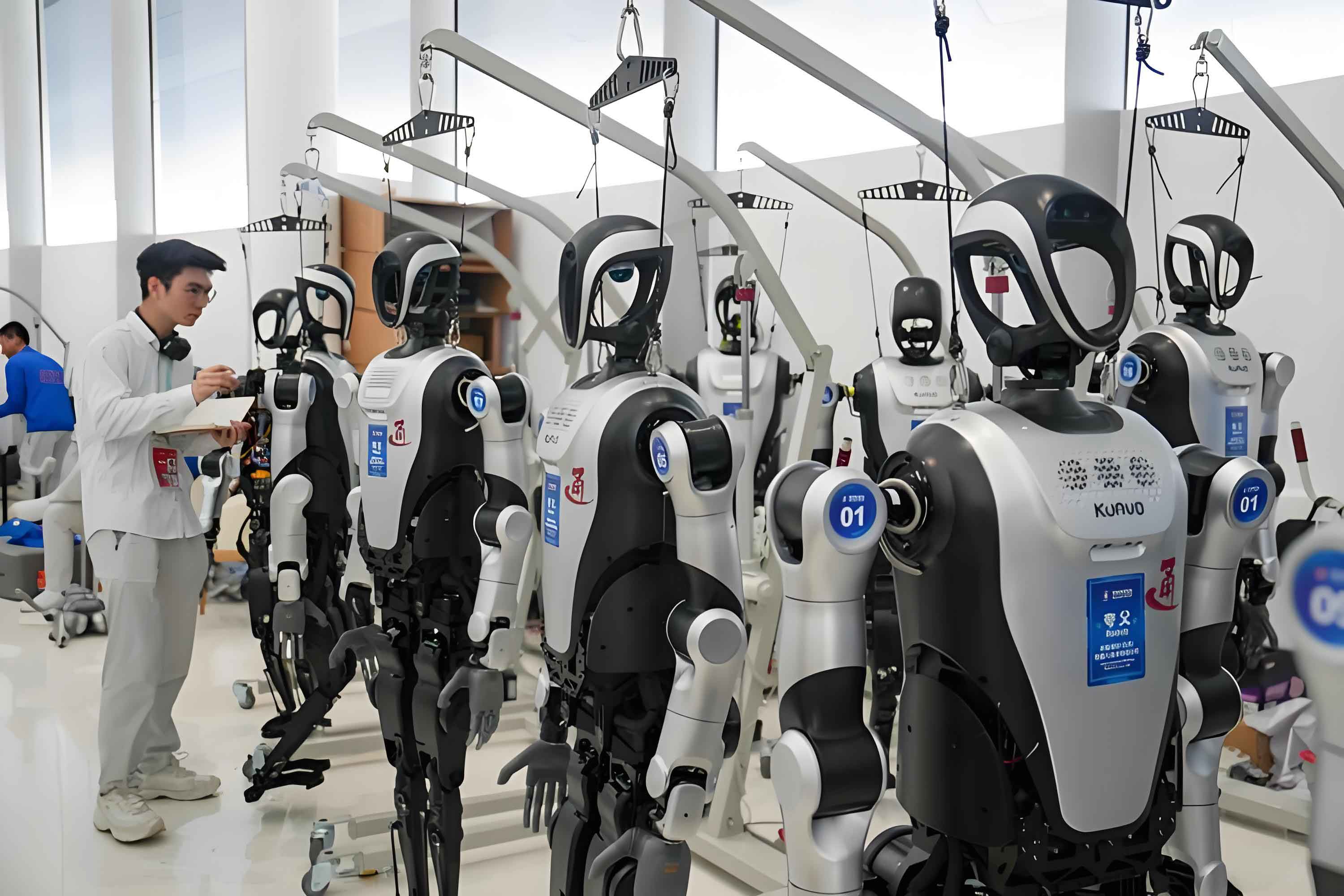
- Applications Expand Across a Growing Range of Industries
How far can the application scenarios of humanoid robots extend? In a keynote report at the main forum, Xu Xiaolan, chairwoman of the Chinese Institute of Electronics, said that embodied intelligence has entered a critical window for scaled application. At present, embodied intelligence products are at a key turning point from small-batch trials to large-scale deployment. That statement framed much of the conference, where humanoid robots appeared not only as technical prototypes but as workers in realistic environments. The recreated living rooms, pharmacies, shops and kitchens were designed to show that humanoid robots are being asked to handle ordinary tasks that people perform every day.
One of the most visible examples was a group of robot traffic police. Standing on steering wheel bases, they watched road conditions closely and made hand gestures according to changing signal lights, directing pedestrians and vehicles. The “Smart Police” robot does not need remote control. It can autonomously navigate from a police station to a work site and can meet a duty requirement of four to five hours. The company said it has already cooperated with traffic management departments in several places, and this intelligent robot has been put into operation in cities such as Beijing, Ordos, Hefei and Wuhu.
Why introduce intelligent robots into traffic management? The company explained that many regions still face a shortage of police personnel, especially in remote areas. In addition, traffic police work outdoors in severe cold and intense heat. The deployment of the “Smart Police” robot can help address these problems, allowing human officers to focus on tasks that require judgment, communication and authority while humanoid robots and other robotic systems handle repeated, prolonged or hazardous duties. The example also shows how humanoid robots can be designed for a specific public service role rather than for general-purpose work.
Another striking exhibit was a robotic horse. A visitor sat on its back, held the handles and rode it across the center of the venue, attracting many onlookers. The machine is an all-terrain quadruped robotic horse with a dynamic load capacity of up to 300 kilograms. Supported by advanced algorithms and strong mobility, it can walk freely on sand, gravel and other complex terrains. The robotic horse has already demonstrated high reliability in extreme environments. It can carry out all-weather inspection tasks, participate in practical drills for firefighting and rescue in super high-rise buildings, locate fire sources, search for people, and identify equipment damage and hidden dangers such as toxic gas leaks in high-temperature and corrosive environments.
Xu Xiaolan said that the deployment of embodied intelligence products shows four characteristics: applications in the livelihood services sector are leading the way; industrial manufacturing offers broad application scenarios; special operations have urgent application needs; and agricultural operations have enormous application potential. These four directions provide a useful map for understanding where humanoid robots and broader embodied intelligence systems may first gain traction. They also suggest that humanoid robots will not follow a single path. Different industries will adopt them at different speeds, for different tasks and under different regulatory conditions.
Data offer the strongest evidence that the applications of humanoid robots continue to expand. In the first half of 2026, China’s humanoid robot shipments exceeded 40,000 units, and the global share further rose to 97 percent. This figure was reported in the context of the conference and reflects the scale that humanoid robots have begun to reach as they move from laboratories and exhibition halls toward real workplaces. The number does not mean that all challenges have been solved. It does show that humanoid robots are no longer a marginal experimental field. They are becoming part of the industrial and service landscape.
| Application field | Reported direction at the conference | Examples and implications for humanoid robots |
|---|---|---|
| Livelihood services | Leading deployment | Recreated living rooms, pharmacies, convenience stores and kitchens; folding clothes, picking up waste, retrieving goods and cooking |
| Industrial manufacturing | Broad scenarios | Factory work such as continuous goods picking; humanoid robots must adapt to changing light, temperature, equipment and system integration |
| Special operations | Urgent demand | All-terrain robotic horse for inspections, firefighting and rescue drills, fire source location, search and rescue, and detection of equipment damage or toxic gas leaks |
| Agriculture | Large potential | Identified as a field with significant future application potential for embodied intelligence and humanoid robots |
The traffic police robot and the robotic horse show that humanoid robots and other embodied systems are not confined to a single industry. They can enter public services, emergency response, inspection, logistics, domestic work and many other settings. The conference’s “real reproduction” of living rooms, pharmacies, small shops and kitchens was designed to show that humanoid robots are being tested against the messiness of ordinary life, not only against controlled laboratory tasks. A robot that can fold a shirt in a demonstration may still struggle with a different fabric, a button, a zipper or a pile of mixed clothing. A robot that can retrieve goods in a quiet booth may face crowded aisles, moving people and unexpected obstacles in a real store.
This expansion also changes expectations. When humanoid robots fold clothes, pick up garbage, retrieve goods or cook, they are no longer remote scientific exhibits. They are presented as practical helpers. That shift from spectacle to service is one of the defining themes of the 2026 World Robot Conference. It also raises the bar for reliability, safety and usefulness. A robot that performs well in a demonstration may still struggle when the environment changes, when objects vary, or when human behavior is unpredictable. The more humanoid robots enter everyday settings, the more they must meet standards that ordinary people expect from tools and appliances.
For industry, the movement toward more scenarios means that humanoid robots must be integrated into workflows, not simply placed beside them. In a factory, a humanoid robot may need to communicate with production systems, follow safety rules and coordinate with human workers. In a pharmacy or shop, it may need to identify products, handle inventory and interact with customers. In a kitchen, it may need to manage heat, sharp tools and food safety. In a public service role, it may need to operate outdoors, follow traffic rules and respond to unpredictable situations. Each scenario adds requirements that cannot be solved by a single breakthrough in hardware or software alone.
For users, the expansion of humanoid robots raises questions about trust. People may be willing to accept a robot that folds clothes or retrieves goods, but they may also worry about privacy, safety and job displacement. The conference did not ignore these concerns. It placed them alongside technical discussions, recognizing that adoption depends on social acceptance as much as on engineering performance. Humanoid robots must be understandable and predictable. They must respect personal space and data. They must be accountable when something goes wrong. These expectations will shape which applications succeed and which remain limited.
- Why Making Humanoid Robots Work Better Remains Difficult
During interviews at the conference, many company leaders touched on a common problem: robots often perform excellently in the laboratory but remain unsatisfactory after entering real scenarios. This issue was visible inside the venue as well. For example, a housework robot that could fold clothes quickly and well in a demonstration froze in place when faced with different types of clothing provided by visitors. The scene illustrated the gap between narrow success and general competence. It also showed why humanoid robots must be tested with variety, not only with repeated examples of the same task.
Why is it so difficult to make humanoid robots work better? At the main forum on “application traction,” Wang Xingxing, founder and chairman of Unitree Robotics, said that the biggest bottleneck in moving robots from exhibits to products remains efficiency, generalization ability, and the precise alignment between models and the real world. In other words, humanoid robots must not only complete a task once under favorable conditions; they must complete it repeatedly, efficiently and reliably across changing conditions. They must understand what to do, how to do it, and when to stop or ask for help.
At one company’s booth, a robot was continuously picking up goods. Behind it, a display screen showed numbers jumping clearly, recording the robot’s working hours and the number of items picked. The company leader said that this robot had already been put to work in a factory and had received positive feedback from its “employer.” But he also acknowledged that there is still a large distance between achieving 99 percent in the laboratory and achieving 99 percent in a factory. Real factories have continuously changing lighting, temperature and environments. Humanoid robots must also deal with the influence of large equipment, integration with factory systems, and many engineering problems. These are key to completing the “last mile” of embodied intelligence.
For this reason, he said, much adaptation work must be done on the robot’s cerebellum and brain, including algorithm and engineering optimization. The goal is to make the robot’s brain more intelligent and its cerebellum more stable. In general, the brain of a robot is responsible for decision-making: it uses large models to understand and analyze tasks. The cerebellum is responsible for movement: it responds to tasks, controls actions and avoids obstacles. If either part fails, humanoid robots cannot become dependable workers. A smart decision without stable movement leads to failure. Stable movement without intelligent decision-making leads to limited usefulness.
The brain-cerebellum distinction helps explain why humanoid robots are difficult to build. The brain must interpret a short instruction and turn it into a sequence of goals. It must understand context, identify relevant objects, decide priorities and adapt when something goes wrong. The cerebellum must translate those decisions into precise motor commands. It must control balance, force, speed, grip and trajectory. It must avoid collisions with people, equipment and fragile objects. A failure in either layer can make the whole system appear incompetent. This is why companies at the conference emphasized adaptation work on both brain and cerebellum rather than focusing on a single model or a single hardware component.
At the conference, many companies highlighted the long-duration working ability of robots. With only a short instruction, the robot analyzes the logic by itself, breaks down the steps and carries out the task. Even when situations outside the preset conditions appear, the robot’s judgment and execution ability are not affected. This is a significant advance for humanoid robots because real environments rarely unfold exactly as scripted. A factory robot may encounter a misplaced package. A domestic robot may face a new piece of clothing. A public service robot may encounter a sudden crowd. The ability to handle such variation is central to generalization.
“One brain, multiple machines” has also become an industry trend. Under this approach, one set of large models can adapt to different brands and multiple forms of robots to complete tasks in different scenarios. A “general brain” would effectively reduce the cost of deployment across multiple scenarios and improve the competitiveness of enterprises. For humanoid robots, such a general brain could make it easier to transfer skills learned in one setting to another and to manage fleets of machines with different bodies but shared intelligence. It could also allow updates and improvements to be distributed more efficiently.
The “one brain, multiple machines” trend adds another layer of complexity. If one large model can adapt to different brands and forms of robots, then knowledge and skills can be shared across a fleet. This could reduce deployment costs and increase competitiveness. But it also raises questions about standardization, interoperability and safety. If many humanoid robots share a general brain, how are updates managed? How are errors traced? How are different bodies calibrated to the same model? These questions were not fully answered at the conference, but they are part of the industry’s agenda. They point to the need for robust testing, clear accountability and common technical standards.
Wang Xingxing suggested that the industry needs massive amounts of high-quality human and real-machine data. It also needs to establish a self-evolution closed loop composed of large-model programming, simulation training, real-machine testing and human-machine evaluation. This closed loop would allow humanoid robots to learn from both simulated and real experience, with human evaluation helping to guide improvement. The combination of data, simulation, real-world testing and human judgment is presented as a path toward more capable and reliable embodied intelligence.
The proposed self-evolution closed loop includes several stages, each with a distinct role. Large-model programming can help generate plans and behaviors. Simulation training can create many variations faster and at lower cost. Real-machine testing can reveal the gap between simulation and reality. Human-machine evaluation can assess whether the robot’s behavior is safe, useful and acceptable. For humanoid robots, this closed loop is especially important because real-world tasks are open-ended. A robot may face a new piece of clothing, a misplaced object, a sudden obstacle or a human request that was not in the training data. Without a feedback loop, it cannot improve.
Data quality is as important as data quantity. Humanoid robots need data that reflects the real world, including different objects, surfaces, lighting conditions, temperatures, human behaviors and unexpected events. They also need data from real machines, because simulation alone may not capture friction, deformation, sensor noise, timing delays and wear. The conference’s emphasis on high-quality human and real-machine data suggests that the industry recognizes the limits of purely simulated learning. Simulation can accelerate training, but real-world testing is necessary to validate performance.
Regarding the shortcomings in the ability of embodied intelligence technology to adapt to the real world, Xu Xiaolan said that application should be used as traction to drive product iteration and optimization. It is necessary to promote deep integration and two-way empowerment between production and demand, help accelerate the deployment of applications in various fields, help embodied intelligence cross the “real-scene operation pass,” and accelerate empowerment across thousands of industries. For humanoid robots, this means that progress will not come only from better algorithms in isolation. It will come from repeated deployment, feedback from users, and improvement in actual work environments.
| Challenge | What the conference highlighted | Implication for humanoid robots |
|---|---|---|
| Efficiency | Humanoid robots must work continuously and productively, not just complete a single demonstration | Factory and service tasks require speed, uptime and consistent output |
| Generalization | A housework robot froze when clothing types changed, despite folding clothes well in a controlled setting | Humanoid robots must handle varied objects, environments and human behavior |
| Model-world alignment | Models must precisely align with the real world, according to Wang Xingxing | Simulation and laboratory success do not automatically transfer to real workplaces |
| Real-world conditions | Factories have changing light, temperature and environments, plus large equipment and system integration | Humanoid robots need engineering optimization and adaptation to dynamic sites |
| Brain and cerebellum | The brain handles decision-making with large models; the cerebellum controls movement and obstacle avoidance | Both intelligence and stability must improve together |
| Data and evaluation | The industry needs high-quality human and real-machine data and a closed loop of programming, simulation, testing and human-machine evaluation | Humanoid robots require continuous learning and evaluation to improve |
The difficulty of making humanoid robots work better is therefore not a single technical problem. It is a system problem. It involves hardware, algorithms, data, simulation, engineering, user experience and safety. A humanoid robot may be able to grasp an object in a demonstration, but in a real factory it must know when to grasp, how much force to use, what to do if the object slips, how to avoid people and machines, and how to coordinate with a production system. In a home, it must cope with soft clothes, fragile items, pets, children and unpredictable requests. In a special operation, it must function under heat, corrosion, smoke or toxic hazards. Each setting imposes different requirements.
The conference’s emphasis on application as a driver of iteration reflects a growing understanding that real-world deployment is not the final step after innovation. It is part of innovation itself. Humanoid robots become better by working, encountering failures, receiving feedback and being improved. The “last mile” is therefore not a short final stretch but a long process of adaptation. Companies are testing how to make the brain more intelligent and the cerebellum more stable, while also building the data and evaluation loops that allow humanoid robots to learn from experience.
This process also requires patience. A humanoid robot that works in one factory may not work in another. A robot that succeeds in one home may fail in another. A robot that performs well in a demonstration may need months of tuning before it is reliable in daily operation. The conference did not present these difficulties as reasons to stop. It presented them as the practical work that must be done. The companies that can solve these integration problems may be the ones that turn humanoid robots from impressive prototypes into durable products.
- Governance Must Keep Pace with Humanoid Robots
As robots demonstrated their capabilities inside the exhibition halls and worked busily on tasks, a deeper issue was repeatedly raised: as embodied intelligence evolves rapidly, is it still controllable? Can it always move in a direction beneficial to human civilization? These questions are especially important for humanoid robots because their human-like form and potential social roles may make them more acceptable, but also more consequential. A machine that looks human may invite trust. That trust must be earned and protected.
At the conference, the Chinese Institute of Electronics and the World Robot Cooperation Organization, together with 268 international institutions and enterprises, jointly released the Initiative for the Upward and Beneficial Development of Intelligent Robots. The initiative gave a clear answer: take improving people’s livelihood and well-being as the goal, ensure social safety and respect individual rights as preconditions, rely on multi-stakeholder participation and internationally recognized mechanisms, promote the formulation of ethical guidelines and safety standards, and ensure that intelligent robots always develop in a direction conducive to the progress of human civilization.
As one of the star products of the robot conference, bionic robots produced by various companies have long been a focus of public attention. A company leader said that compared with a steel exterior, a bionic robot with a human face appears warmer, and users find it easier to accept. When training the model, the company deliberately avoided deep emotional links or “romantic partner” functions. This is an expression of the concept of “technology for good” in application. The statement suggests that humanoid robots can be designed to support human well-being without simulating intimate relationships or encouraging unhealthy attachment.
In addition, many companies have made great efforts to make robots “human-like.” The skin and hair of robots are produced to be delicate and realistic, with pores and lines clearly visible. When discussing boundaries and safety awareness, a company leader said that bionic robots must be designed, produced and used within the framework of laws, regulations and standards. The pursuit of human likeness, in other words, must not outrun legal and ethical boundaries. A human-like appearance can improve acceptance, but it also raises expectations about behavior, privacy and emotional safety.
At the main forum of the World Robot Conference, several experts offered recommendations. Liang Zheng, a professor at the School of Public Policy and Management at Tsinghua University and vice dean of the Institute for AI International Governance at Tsinghua University, said that technical red lines should not be determined only by engineering indicators. They should also come from social consensus and be implemented through standards, evaluation, law, policy and corporate responsibility. This view places humanoid robots within a broader governance ecosystem. Safety is not only a matter of sensors or emergency stop buttons; it is also a matter of public values, accountability and enforceable rules.
Zhang Jianwei, a foreign academician of the Chinese Academy of Engineering and an academician of the German National Academy of Science and Engineering, suggested that safety and ethics should be embedded from the stages of institution, perception, interaction and model training. For example, robots should learn the hazard boundaries of tool use, force control rules and responsible operation. Before entering homes, they should receive moral safety training similar to school education and qualification certification. This recommendation is particularly relevant to humanoid robots, which may one day work alongside people in homes, hospitals, schools, factories and public spaces.
The specific suggestion to embed safety and ethics in perception and interaction is important. A humanoid robot may perceive a person’s face, voice, movement and emotional cues. It may interact through speech, gesture and physical movement. Safety must therefore be part of perception, not only a separate module. The robot should recognize when a tool is dangerous, when force is excessive, when a person is vulnerable, or when a task should be refused. Zhang Jianwei’s proposal that robots learn hazard boundaries, force control rules and responsible operation points in this direction. Pre-deployment moral safety training and qualification certification for home robots would add a layer of assurance before humanoid robots enter private spaces.
The governance discussion at the conference did not treat ethics as an obstacle to innovation. Instead, it treated ethics and safety as preconditions for sustainable innovation. If humanoid robots are to be trusted, they must be understandable, accountable and aligned with social norms. The Initiative for the Upward and Beneficial Development of Intelligent Robots and the experts’ proposals point toward a shared direction: humanoid robots should be developed with human welfare at the center, with safety and rights protected, and with international norms and multi-stakeholder participation helping to guide the way.
The initiative’s emphasis on internationally recognized mechanisms is significant. Humanoid robots are being developed and traded across borders. Their supply chains, software updates and data flows cross jurisdictions. A patchwork of incompatible rules could slow innovation and create safety gaps. Multi-stakeholder participation can bring together governments, companies, researchers, civil society and users. Ethical guidelines and safety standards can provide common expectations. Laws and policies can provide enforceable obligations. Corporate responsibility can translate principles into design and deployment decisions. For humanoid robots, this combination is likely to be more effective than any single measure.
| Governance priority | Conference message | Relevance to humanoid robots |
|---|---|---|
| Human well-being | Improve livelihood and well-being as the goal | Humanoid robots should serve human needs rather than replace or manipulate people |
| Safety and rights | Ensure social safety and respect individual rights | Human-like machines require strong safeguards in homes, workplaces and public spaces |
| Ethical guidelines and safety standards | Promote formulation through multi-stakeholder participation and internationally recognized mechanisms | Humanoid robots need common rules across borders and industries |
| Social consensus | Technical red lines should come from social consensus, not only engineering indicators | Public values must shape what humanoid robots are allowed to do |
| Embedded safety and ethics | Embed safety and ethics in institutions, perception, interaction and model training | Humanoid robots should learn hazard boundaries, force control rules and responsible operation |
| Pre-deployment training | Robots entering homes should receive moral safety training and qualification certification | Humanoid robots in domestic settings need verified readiness and accountability |
The conference thus presented two parallel tracks. One track is technical: improving efficiency, generalization, model-world alignment, data quality and engineering robustness. The other track is normative: ensuring that humanoid robots remain controllable, beneficial and aligned with human values. Neither track can succeed alone. A highly capable humanoid robot without safety and ethics may create risk. A heavily restricted robot without practical capability may fail to deliver benefits. The challenge is to advance both together.
This balance is especially delicate because humanoid robots are designed to operate in human environments. They may share sidewalks, stores, factories, hospitals and homes with people. They may handle objects that are sharp, hot, fragile or dangerous. They may collect data through cameras, microphones and other sensors. They may make decisions that affect human safety and convenience. Governance must therefore address not only what humanoid robots can do, but also what they should not do, who is responsible when they fail, and how people can seek redress.
- From Exhibition Halls to Real Workplaces
The journey of humanoid robots from exhibition halls to real workplaces is already visible. Robot traffic police are directing vehicles in several cities. A robotic horse is carrying loads, inspecting environments and participating in rescue drills. Factory robots are picking goods and accumulating working hours. Housework robots are attempting to fold clothes and handle domestic tasks. These examples do not mean that all technical problems are solved. They do mean that humanoid robots are being tested against real demands.
That testing process is revealing where value can be created. In public services, humanoid robots may help address labor shortages and reduce exposure to harsh conditions. In industrial manufacturing, they may support flexible production and repetitive tasks. In special operations, they may enter dangerous environments where human safety is at risk. In agriculture, they may eventually take on tasks that are labor-intensive or difficult to automate. In homes, they may assist with chores and support daily life. Each application brings different requirements and different risks.
For humanoid robots to succeed, they must be more than human-shaped. They must be useful, reliable, safe and affordable. They must fit into existing workflows and systems. They must be accepted by the people who use them and the people who work alongside them. They must respect privacy and personal boundaries. They must be governed by clear rules. These are not secondary concerns. They are central to whether humanoid robots can move from impressive demonstrations to widespread deployment.
The 2026 World Robot Conference showed that the industry is aware of this. Companies are working on brains and cerebellums, algorithms and engineering, data and evaluation. Policymakers and experts are discussing standards, laws, ethics and social consensus. International organizations and enterprises are joining initiatives. The direction is clear: humanoid robots should develop in a way that is both upward in capability and beneficial in purpose.
| Conference fact | Reported information |
|---|---|
| Conference edition | The 12th World Robot Conference |
| Humanoid robot shipments in China, first half of 2026 | More than 40,000 units |
| Global share | 97 percent |
| Partners in the initiative | 268 international institutions and enterprises |
| Smart Police duty duration | 4 to 5 hours |
| Robotic horse dynamic load | Up to 300 kilograms |
- Toward Human-Machine Coexistence and Shared Benefits
When technology moves “upward” and “toward good” in parallel, the vision of human-machine coexistence and deep integration between production and demand can become a reality that benefits everyone. That is the hopeful message from the 2026 World Robot Conference. It is not a promise that humanoid robots will solve every problem. It is a direction for research, industry, policy and society.
The conference demonstrated that humanoid robots are entering more application scenarios. They are folding clothes, picking up waste, retrieving goods, cooking, directing traffic, carrying loads and performing inspections. They are being tested in living rooms, pharmacies, convenience stores, kitchens, factories and extreme environments. The data reported at the conference, including more than 40,000 humanoid robot shipments in China in the first half of 2026 and a global share of 97 percent, show that the scale of deployment is growing.
Yet the conference also made clear that scale alone is not success. Humanoid robots must work efficiently, generalize across situations, align models with the real world, and remain stable in changing environments. They must overcome the gap between laboratory performance and real-world performance. They must be supported by high-quality data, simulation training, real-machine testing and human-machine evaluation. They must be governed by ethical guidelines, safety standards and legal frameworks. They must be designed for human well-being and social trust.
The future of humanoid robots will be shaped by many actors: researchers, engineers, companies, regulators, international organizations, users and the public. The conference’s discussions suggest that progress will depend on collaboration. Technical innovation must be matched by governance innovation. Product iteration must be driven by application. Safety and ethics must be embedded from the beginning, not added at the end. International mechanisms and social consensus must help define red lines.
If these conditions are met, humanoid robots can become practical helpers in more areas of life. They can assist with dangerous, repetitive or labor-intensive work. They can support public services where personnel are scarce. They can enter environments that are hazardous to humans. They can help improve productivity and quality of life. They can do so while respecting human rights, social safety and ethical boundaries.
The 2026 World Robot Conference offered no simple final answer, because the story of humanoid robots is still unfolding. But it offered a clear framework. Innovation should continue. Application should drive improvement. Data and evaluation should support learning. Governance should keep pace. Human well-being should remain the goal. With these principles, the movement of humanoid robots into more application scenarios can be both ambitious and responsible. The vision of human-machine coexistence and shared benefits can move from a conference hall to the everyday world.