
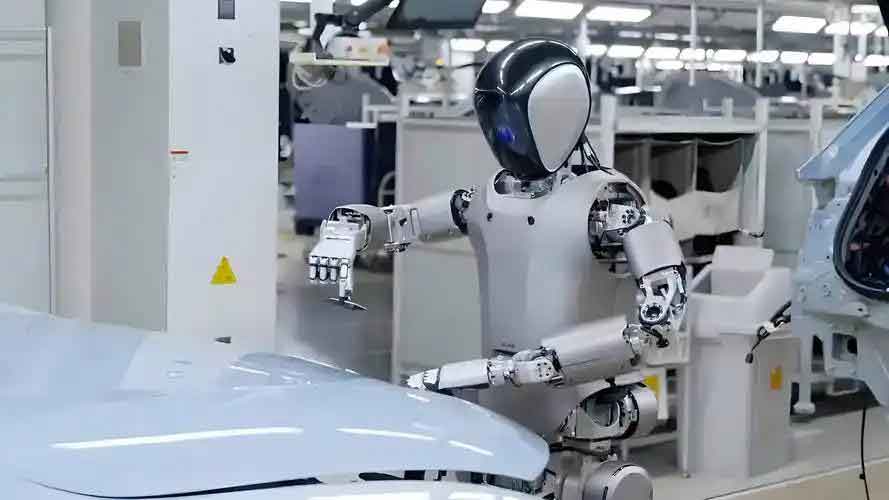
In a significant development within the robotics industry, multiple leading embodied intelligence companies have recently disclosed substantial purchase orders, primarily from manufacturing enterprises, with deployment scenarios overwhelmingly focused on industrial applications. The trend of humanoid robots entering factory environments has sparked intense discussions about their current capabilities, commercial viability, and the strategic reasons behind their adoption. While these humanoid robots are being tasked with various functions on production lines, industry experts emphasize that this movement is fundamentally about connecting to real-world data to drive technological iterations and upgrades, rather than immediate cost-effectiveness.
- Surge in High-Value Orders for Humanoid Robots
The market for humanoid robots has witnessed a remarkable influx of major orders, with several companies announcing deals valued in the billions of yuan or involving thousands of units. Incomplete statistics indicate that at least seven humanoid robot firms have publicly declared such significant contracts, including Ubtech, Zhiyuan Robotics, Yushu Technology, Zhipingfang, Xingchen Intelligent, Songyan Power, and Yuanli Wuxian. These announcements highlight a growing, albeit cautious, commitment from industrial buyers to integrate humanoid robots into their operations.
In October, Ubtech reported that its Walker series of humanoid robots had secured orders exceeding 6.3 billion yuan for the full year, marking one of the largest publicly disclosed deals in the sector. Similarly, Zhiyuan Robotics obtained a multi-billion yuan order from Longqi Technology, a prominent intelligent product ODM company, for its G2 humanoid robots. This partnership is set to initially focus on deploying these humanoid robots in tablet computer production lines, aiming for batch implementation in consumer electronics assembly scenarios. Concurrently, Yuanli Wuxian, a venture founded by former Alibaba executives, signed a 2.6 billion yuan agreement with Shihua Wenlv Holding Group, expanding the application scope of humanoid robots. Songyan Power also revealed that it had garnered over 2,000 commercial orders in the first half of the year, with total contract values projected to surpass 1 billion yuan, demonstrating the scaling potential for humanoid robots.
The previous month, September, saw Xingchen Intelligent enter a strategic collaboration with Xianwang Intelligent for a thousand-unit order for humanoid robots, which media estimates valued at approximately 5 billion yuan. Additionally, Zhipingfang partnered with Shenzhen Huizhi Wulian to deploy more than 1,000 embodied intelligent robots over three years across HKC’s global production bases, with order amounts close to 5 billion yuan. These humanoid robots, such as the wheeled dual-arm AlphaBot series, are designed to manage comprehensive processes including warehouse logistics, material handling, component assembly, and quality inspection, showcasing the versatile roles humanoid robots can play in manufacturing ecosystems.
The buyers behind these orders are predominantly manufacturing companies, with additional clients comprising universities and government entities. The primary deployment environments for these humanoid robots are industrial settings, while secondary applications include academic research, entertainment guidance, commercial sales,仓储 logistics, and traffic management. For instance, Ubtech has secured multiple orders from automotive manufacturers, including Dongfeng Liuzhou, which announced the deployment of 20 Ubtech industrial humanoid robots, the Walker S1 model, within its automobile manufacturing plant earlier this year. Yushu Technology’s order portfolio is also business-to-business oriented, involving research universities, government agencies, and enterprises in sectors like media, public safety, and supply chain. Third-party analyses of Yushu’s bid wins from April 2021 to March 2025 indicate that nearly 30 higher education institutions procured its humanoid robots through open tenders, covering the entire spectrum of robotics research and development, which underscores the importance of humanoid robots in advancing academic and industrial innovation.
- Factory Deployment of Humanoid Robots: A Strategic Step for Data Iteration
Industrial scenarios are widely perceived as the most suitable testing grounds for the commercial deployment of humanoid robots. However, the integration of humanoid robots into factory workflows is met with skepticism due to concerns about their efficiency compared to human labor, cost competitiveness, and the unresolved questions surrounding general-purpose technological breakthroughs. Despite these debates, many industry stakeholders, including investors and manufacturers, argue that business-to-business adoption is an essential transitional phase. The core objective is not merely to replace human workers but to accumulate high-quality, real-world operational data that can fuel the iterative development and enhancement of humanoid robot technologies.
Zhang Lei, a partner at Aixiang Investment, expressed that the progression towards robotic automation is an irreversible trend. Both producers and purchasers of humanoid robots are investing in the future potential of these machines, acknowledging that full-scale, economically viable deployment will require additional time. Factories are primarily seeking effective automation solutions rather than being intrinsically committed to the humanoid form factor. For example, augmenting established robotic platforms like wheeled or tracked robots with additional manipulative capabilities, such as robotic arms, can reduce research and development costs as well as scenario integration expenses, providing a pragmatic pathway for incorporating advanced functionalities without the full complexity of humanoid robots.
A senior executive from a primary investment institution elaborated that within factory environments, the humanoid morphology itself is not the critical deciding factor. There is broad consensus that the upper body of humanoid robots can effectively serve as a multifunctional operational terminal; the primary contention lies in the lower body’s locomotion system—specifically, the choice between bipedal and wheeled configurations. Wheeled humanoid robots offer advantages in terms of lower initial cost, superior stability on even surfaces, and generally longer operational endurance, making them well-suited for facilities with flat, unobstructed floors. In contrast, bipedal humanoid robots have benefited from substantial capital inflows and a rapidly maturing supply chain, leading to accelerated cost reductions. Some bipedal humanoid robot models are now approaching the cost levels of their wheeled counterparts, while their dynamic stability is improving at a rapid pace, increasing their attractiveness for industrial applications that may involve irregular or constrained environments.
Yao Maoqing, Partner and Senior Vice President at Zhiyuan Robotics, provided clarity on this distinction during recent media engagements. He explained that legged humanoid robots and wheeled humanoid robots occupy different niches within industrial settings. Wheeled humanoid robots demonstrate clear advantages in factories with平整 terrain and high accessibility, offering benefits such as extended battery life, robust reliability, and lower cost structures. Conversely, legged humanoid robots are more adaptable in environments with poor accessibility, such as those with steps, obstacles, or uneven flooring. The current strategic imperative for deploying humanoid robots in authentic scenarios is to gather high-fidelity, real-machine data, which is indispensable for the continuous refinement of algorithms and hardware, a cornerstone of Zhiyuan’s technological roadmap for advancing humanoid robots.
Echoing this data-centric perspective, Guo Yandong, Founder and CEO of Zhipingfang, has publicly stated that the competitive landscape for humanoid robots over the next three years will be determined by which companies can establish “closed-loop real scenarios.” Those enterprises that successfully deploy humanoid robots in genuine commercial environments, where the robots can perform tangible work and generate a continuous stream of operational data to feed back into model training and hardware optimization cycles, will build significant and durable competitive moats. This underscores the critical importance of practical, in-field experience for the evolution of humanoid robots.
- Significant Hurdles and Challenges for Humanoid Robot Commercialization
Despite the encouraging news of large orders and strategic factory entries, the current generation of humanoid robots is not yet capable of reliably handling a diverse array of general-purpose tasks. Numerous obstacles remain across domains such as mass production, core technology maturation, and the identification of compelling application scenarios that must be addressed before humanoid robots can achieve widespread commercial success.
Tian Feng, Founding Dean of the Kuaisi Mansiang Research Institute, pinpointed four major bottlenecks currently impeding domestic humanoid robot manufacturers: quality control gaps, mass production limitations, talent shortages, and ethical considerations. These challenges represent substantial barriers that the industry for humanoid robots must overcome to reach maturity.
Concerning quality control, the规模化 manufacturing of high-performance core components—such as actuators, sensors, and processors—demands extreme consistency in precision, torque output, and operational lifespan. A significant chasm exists between small-batch prototype production and large-volume commercial manufacturing for humanoid robots, often resulting in performance variations and reliability issues that can undermine user confidence. Pertaining to mass production, the systemic integration and comprehensive testing of humanoid robots present immense complexities. A single humanoid robot comprises hundreds or even thousands of individual components forming a highly dynamic system. The industry currently lacks mature, standardized processes for calibration, debugging, accelerated aging tests, and automated fault diagnosis. This immaturity leads to protracted product delivery timelines and elevated long-term maintenance costs for humanoid robots, hindering their economic feasibility.
The lack of fundamentally necessary application scenarios is another pervasive challenge plaguing the humanoid robot sector. Zhang Lei highlighted that the quintessential bottleneck is the insufficient “necessity” of many proposed use cases for humanoid robots. This deficiency disrupts the essential virtuous cycle where strong scenario demand drives higher sales volumes, which in turn enables economies of scale and lower production costs, making humanoid robots more affordable and thus stimulating further demand. Without scenarios where humanoid robots provide indispensable value that cannot be easily met by other solutions, sales figures remain subdued. This low sales volume perpetuates high per-unit costs, which further suppresses market appetite. Moreover, the scarcity of deployment scenarios starves the development process of the rich, diverse operational data required for rapid iterative improvement of humanoid robots, thereby preventing the closure of a sustainable commercial loop.
On the technological front, persistent issues with reliability and specific functional capabilities await solutions. Recent industry developments illustrate these hurdles; for example, Tesla’s Optimus humanoid robot project has reportedly encountered delays in finalizing the design of its third-generation platform, partly due to ongoing challenges in perfecting the dexterity and reliability of its robotic hands, potentially pushing its official release into the next year. Similarly, when Ubtech unveiled its new full-size industrial humanoid robot, the Walker S2, in July, company representatives openly acknowledged that data acquisition and utilization, model adaptation to specific tasks, and achieving the required efficiency on fast-paced production lines remain significant bottlenecks for the successful factory integration of humanoid robots.
Jiao Jichao, Vice President and Head of Ubtech’s Research Institute, provided a candid assessment of the difficulties encountered in precision assembly applications, using automotive final assembly workshops as a prime example. In such environments, humanoid robots face two formidable challenges. First, the development of sufficiently dexterous end-effectors (hands) is required to execute fine motor tasks like picking up small components, precise insertion, and screw tightening. This involves not only mechanical sophistication but also advanced visual recognition and positional awareness capabilities. Second, modern production lines operate under extremely strict cycle time constraints for each workstation. Programming and enabling humanoid robots to perform complex operations reliably within these short, fixed time windows presents a major engineering hurdle that has not yet been fully surmounted for humanoid robots.
Tian Feng also offered his perspective on the perceived “bubbles” within the humanoid robot industry, characterizing them as a typical and even expected phenomenon in the period preceding major technological breakthroughs. The willingness of manufacturing corporations to place bets and place orders for humanoid robots reflects strategic, forward-looking investments by hard technology capital, positioning for a anticipated transformation in future labor markets. The genuine risk, he cautioned, does not necessarily lie in market over-enthusiasm, but rather in the possibility that some companies developing humanoid robots may fail to cross the “engineering death valley”—a critical phase where profound engineering challenges must be successfully resolved to transition from promising prototypes to reliable, commercially viable products.
He strongly emphasized that the current wave of orders for humanoid robots should be understood primarily as “pilot verification” projects. These initiatives are inherently distant from demonstrating immediate commercial cost-effectiveness or delivering a positive return on investment in the short term. The fundamental purpose of these pilot deployments is not to calculate financial ROI, but to facilitate a collaborative process between developers and end-users to define the future technical specifications, performance benchmarks, and operational boundaries for the next generation of scalable humanoid robot products.
In summary, the entry of humanoid robots into factory settings, backed by substantial orders, represents a pivotal, data-driven phase in their evolution. While this marks significant progress, the path to genuine, broad-based commercial adoption for humanoid robots is fraught with challenges related to production scalability, technological reliability, and economic necessity. The industry’s current focus remains firmly on leveraging real-world deployments to gather critical data for iterative improvement. Overcoming the outlined obstacles will be essential for humanoid robots to transition from promising pilots to indispensable assets in the global industrial landscape.