
Humanoid robots are recording extraordinary shipment growth, yet their presence in ordinary households remains remarkably limited. That contrast has become one of the most closely watched contradictions in the robotics industry. While humanoid robots are increasingly visible in performances, research laboratories, exhibitions, retail guidance, data collection, and selected industrial settings, the family home remains a difficult frontier. The reasons are not mysterious. Two barriers stand out: price and space. A high-performance humanoid robot currently carries a hardware cost of 300,000 to 600,000 yuan, according to available industry data. Even if that cost falls, humanoid robots must still cope with the messy, irregular, and unpredictable realities of domestic life. That second challenge is pushing home-furnishing companies into an unexpected role: they are trying to prepare homes for humanoid robots before the robots themselves are ready for mass adoption.
IDC data show that global humanoid robots shipments reached about 18,000 units in 2025, an increase of about 508 percent year on year. The growth rate is striking, but the absolute base remains small. More importantly, the application mix reveals how far humanoid robots are from household service. In 2025, entertainment and commercial performances accounted for 36.8 percent of global humanoid robots shipments, while education and research accounted for 24.6 percent. Data collection, guide and shopping, and industrial manufacturing followed. Household services represented a very low share. In other words, humanoid robots are still being deployed mainly in controlled, commercial, or research-oriented environments. The home, despite decades of speculation, remains a marginal use case.
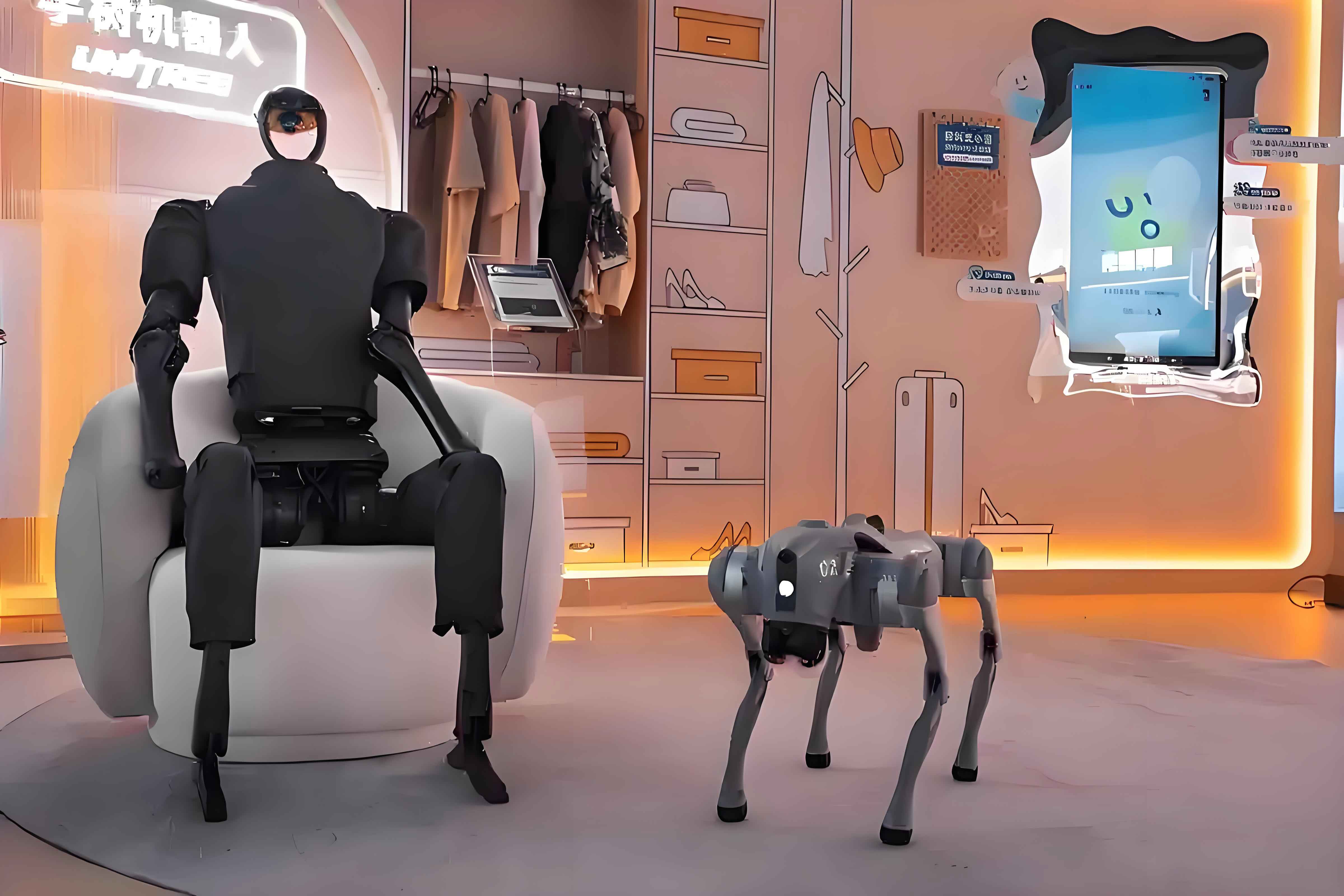
The geographic concentration of humanoid robots shipments adds another layer to the story. According to a 2026 humanoid robots industry development report from the Chinese Electronic Society, China shipped more than 40,000 humanoid robots in the first half of 2026. That raised China’s share of global humanoid robots shipments to 97 percent. Such figures underline the speed of industrial clustering and supply-chain development. They also show that humanoid robots are no longer a purely experimental category. Yet rapid shipment growth does not automatically translate into household penetration. A humanoid robot may leave a factory, a showroom, or a stage, but it does not necessarily enter a living room. The distance between shipment volume and family adoption remains wide, and it is measured not only in price but in spatial compatibility, safety, and data readiness.
- Shipment Boom Meets a Household Adoption Gap
The shipment boom for humanoid robots is real, but the household adoption gap is equally real. IDC data for 2025 show that global humanoid robots shipments were concentrated in applications far removed from daily domestic life. Entertainment and commercial performances were the largest category at 36.8 percent, followed by education and research at 24.6 percent. Data collection, guide and shopping, and industrial manufacturing came next. Household services accounted for a very low proportion. This application structure suggests that humanoid robots are currently valued more for spectacle, experimentation, and controlled commercial tasks than for routine domestic assistance.
| Application scenario in 2025 | Share of global humanoid robots shipments |
|---|---|
| Entertainment and commercial performances | 36.8% |
| Education and research | 24.6% |
| Data collection, guide and shopping, and industrial manufacturing | Remaining share |
| Household services | Very low share |
For humanoid robots, the household market is attractive because it promises daily, recurring, and deeply personal use. A humanoid robot that can move through a home, find objects, respond to spoken requests, assist children, remind older adults to take medicine, and support sleep routines would represent a far more intimate form of automation than a robot on a stage. But the same intimacy creates difficulty. Homes are not factories. They are not laboratories. They are not exhibition halls. They are lived-in spaces shaped by irregular layouts, shifting furniture, uneven lighting, floor hazards, pets, children, and countless small objects. Humanoid robots must navigate all of this while remaining safe and useful. The shipment data show that the industry has not yet solved that problem at scale.
Price is one obvious obstacle. A high-performance humanoid robot with the hardware required for advanced perception, manipulation, mobility, and interaction can cost between 300,000 and 600,000 yuan in hardware alone. That figure does not include software development, maintenance, service, or the cost of adapting a home. For most families, such a price is prohibitive. Price reduction depends on supply-chain scale, component standardization, and domestic substitution. As humanoid robots move from small-batch production to larger-scale manufacturing, costs may decline. But even a cheaper humanoid robot must still fit into a home. If it cannot operate reliably in a real domestic environment, lower cost alone will not produce mass adoption.
The space adaptation problem is therefore not secondary. It is central. Humanoid robots are often tested in structured environments where objects have known positions, routes are predictable, and human behavior is controlled. A home is the opposite. Every household is different. Every floor plan has its own bottlenecks. Furniture is arranged according to habit, not robot convenience. Lighting changes throughout the day. Floors may be wet. Pets may move unpredictably. Children may leave toys in pathways. A humanoid robot that works well in a demonstration may fail in a real home because the environment has too many variables. The industry is discovering that humanoid robots need not only better bodies and brains but also better environments.
- The Performance Cliff in Real Homes
The gap between simulation and reality is one of the most striking findings in the humanoid robots sector. The Stanford Institute for Human-Centered Artificial Intelligence, in its AI Index 2026 report, disclosed a set of critical data: humanoid robots achieved an operation success rate of 89.4 percent in controlled software simulation environments. Once they entered real home settings, the success rate for fully and safely completing tasks fell to about 12 percent. That is a decline of 77 percentage points. The figure has become a shorthand for the difficulty of moving humanoid robots from virtual training to domestic reality.
| Environment | Task completion rate for humanoid robots |
|---|---|
| Controlled software simulation | 89.4% |
| Real home environment | 12% |
| Performance drop | 77 percentage points |
The 77-percentage-point performance evaporation points directly to a core issue: the non-structured nature of the home environment far exceeds that of laboratories and simulation environments. A simulation can be designed, simplified, repeated, and controlled. A home cannot. Different floor plans, different furniture placements, slippery floors, running pets, and toys dropped on the ground are not edge cases in domestic life. They are ordinary events. For humanoid robots, these everyday uncertainties are precisely why they often fail to adapt. A humanoid robot may know how to grasp a cup in simulation, but in a real home it must also know whether the cup is behind a chair, whether a child is nearby, whether the floor is dry, and whether the route to the kitchen is blocked.
At a physical experience store, a home-furnishing practitioner explained that unlike factories and other generally standardized environments, every household differs in layout, lighting, and obstacle distribution. The number of variables in a family setting is extremely high. This is not a minor engineering detail. It is a fundamental barrier for humanoid robots. The home is not one environment. It is millions of slightly different environments. Each one can create a new failure mode. Humanoid robots must therefore be robust to variation, not merely optimized for a single demonstration.
Behind this difficulty is a shortage of home-based multimodal training data. A research note from Guosheng Securities analyzed that data is a core barrier to the industrialization of embodied intelligence, and that household scenarios urgently need real-space adaptation. At present, humanoid robots hardware technology is gradually maturing, but the core contradiction blocking large-scale household entry is a severe shortage of real home scenario data. There is a large performance gap between laboratory simulation environments and real homes. According to the research note, the industry’s shortage of high-quality real-scene interaction data is more than 20 times the available supply. For humanoid robots, data is not just fuel. It is the map that allows them to understand the irregular terrain of domestic life.
This data problem cannot be solved by simply collecting more videos or more simulated episodes. Humanoid robots need multimodal data that captures how homes actually work: how drawers open, how objects are placed, how people move, how pets react, how lighting changes, how clutter accumulates, and how safety constraints shift from moment to moment. The more humanoid robots encounter real homes, the more they can learn. But sending humanoid robots into homes at scale is difficult precisely because they are not yet reliable enough. This creates a circular challenge. The industry needs real-home data to improve humanoid robots, but humanoid robots need to be better before they can be deployed widely in real homes. Breaking that circle requires new partnerships, new testing environments, and new ways of designing homes themselves.
- Home-Furnishing Firms Move Toward Robot-Ready Homes
A group of home-furnishing companies is now trying to break that circle by entering the humanoid robots ecosystem from the built-environment side. Their goal is not necessarily to build humanoid robots themselves. Instead, they want to make homes more compatible with humanoid robots. That shift is significant. It means the home itself is being treated as part of the robotics stack. If humanoid robots cannot easily adapt to existing homes, then homes can be designed, modified, or equipped to adapt to humanoid robots. This is the logic behind the emerging concept of a robot-friendly home.
On September 5, at a Robot-Ready Home physical experience store opened by Shangpin Home Collection and Qiyuan Robotics, a unit of Shangwei New Materials, a demonstration showed how this concept might work. A user said, “Q1, please help me find the thermos.” The Q1 humanoid robot then began searching the living room. It eventually used a central control system to open a sideboard drawer remotely and successfully found the thermos. The scene was designed to show that humanoid robots can interact with home infrastructure, not just with people. The robot did not need to manually pull open every drawer. It used the home’s central system to gain access. That kind of integration could reduce the difficulty of manipulation and improve reliability for humanoid robots in domestic settings.
Shangpin Home Collection and Qiyuan Robotics signed a strategic cooperation agreement in July during the 2026 World Artificial Intelligence Conference. The cooperation focused on building a Robot-Ready Home ecosystem. In September, the partnership moved from a framework intention to substantive implementation. The two sides formally established a joint venture called Shangyuan Zhiqi (Guangzhou) Robotics Technology Co., Ltd. Qiyuan Robotics also developed two consumer-grade embodied intelligent humanoid robots in 2026: Q1 and T1. The company opened public preorders in late August, with the first batch of products planned for September delivery. The specific price has not been fully announced. Even so, the move shows that humanoid robots are moving toward consumer-facing commercialization, albeit cautiously.
At the physical experience store, humanoid robots operated in a real furnished home space. They could autonomously navigate, transfer items across spaces, precisely find objects, provide guidance and interaction, help children learn English, deliver nighttime medication reminders, and guide sleep routines. These tasks are not yet a complete domestic labor solution, but they illustrate the direction. Humanoid robots are being positioned as home companions and assistants rather than as industrial machines. The home-furnishing industry sees an opportunity to integrate robot requirements into interior design from the beginning, rather than treating humanoid robots as aftermarket devices that must somehow fit into an unprepared space.
Other companies in the broader home-furnishing sector are also exploring the space. In August, Golden Home reached a strategic cooperation agreement with Tuoyuan (Guangzhou) Smart Technology Co., Ltd., focusing on artificial intelligence applications in family scenarios and jointly promoting the deployment of home service humanoid robots. Sofia spent 30 million yuan in the first half of the year to establish a digital intelligence technology subsidiary. Industry analysis suggests that this move represents a systematic integration and extension of Sofia’s existing digital capabilities. The paths differ, but the direction is similar: companies want to secure an entry point into the home scenario. For humanoid robots, that entry point may determine which platforms, standards, and service ecosystems win in the long run.
On September 5, Zhou Weijia, brand co-general manager of Shangpin Home Collection and general manager of Shangyuan Zhiqi Robotics, said, “When we talk about a beautiful home today, it is not only a room with complete functions and outstanding design, but also a home that can perceive, respond, and accompany. We want humanoid robots to become warm companions that can enter the living room, bedroom, and kitchen and become a new partner in family life.” The statement reflects a broader ambition. Home-furnishing companies are not merely selling furniture or cabinets. They are trying to sell an environment in which humanoid robots can function, interact, and provide services.
- Designing for Humanoid Robots Before They Arrive
Shangpin Home Collection’s approach is to move robot requirements forward into the design stage. The company says it has accumulated more than 3 million real floor plans and more than 30 million design solutions through its work in the home-furnishing sector. It can convert these static home-decoration drawings into a digital spatial foundation that humanoid robots can recognize and use for training. From the source of whole-home customization, the company aims to plan robot passage routes, autonomous charging points, and human-robot interaction interfaces in advance. This addresses the non-standard environment adaptation problem that humanoid robots face when entering homes.
This is a notable inversion of the usual robotics development model. In the traditional model, humanoid robots are built first, then engineers search for environments where they can operate. In the Robot-Ready Home model, the environment is designed with humanoid robots in mind. Doorways can be made wide enough. Charging stations can be placed strategically. Cabinets can be equipped with central control mechanisms. Sensors can be embedded in furniture. Lighting can be adjusted for machine vision. Pathways can be kept clear. Human-robot interaction points can be standardized. None of these changes alone solves the entire problem, but together they could reduce the variability that causes humanoid robots to fail in real homes.
The potential value of this approach is substantial. If humanoid robots can rely on home infrastructure, they do not need to solve every physical problem with their own hardware. They do not need to open every drawer manually if the drawer can be opened through a central system. They do not need to find a charging outlet by vision alone if a charging point is integrated into the room. They do not need to understand every possible piece of furniture if the home’s digital model already provides semantic labels. This division of labor between robot intelligence and environmental intelligence could accelerate the deployment of humanoid robots in households. It could also lower the hardware cost required to achieve a given level of reliability, because the home itself is contributing to the task.
However, the Robot-Ready Home concept also raises questions. Standardization across different home-furnishing brands, appliance makers, and robotics companies will be difficult. A humanoid robot from one company may not understand the central control system of another. Data privacy and security become more complex when homes are instrumented with sensors and connected systems. Retrofitting existing homes may be expensive and disruptive. New homes may be easier to design for humanoid robots, but most families live in older homes. The industry will need retrofit solutions, open interfaces, and clear safety standards. Without them, robot-friendly homes could remain premium showrooms rather than mainstream realities for humanoid robots.
Even so, the entry of home-furnishing companies changes the conversation. Humanoid robots are no longer only a robotics problem. They are also an interior design problem, a construction problem, a data problem, and a service problem. The companies that understand home layouts, user habits, and renovation workflows may have an advantage in making humanoid robots practical. They can collect real spatial data, test humanoid robots in furnished environments, and iterate on design rules. In that sense, the home-furnishing industry may become an unexpected enabler for humanoid robots. It can help create the physical and digital conditions that humanoid robots need to move from demonstration to daily use.
- Data Bottleneck and the Long Road to Mass Adoption
The data bottleneck remains the hardest issue. Guosheng Securities noted that data is a core barrier to the industrialization of embodied intelligence and that home scenarios urgently need real-space adaptation. The current shortage of high-quality real-scene interaction data is estimated at more than 20 times the available supply. This gap cannot be closed by simulation alone. Simulation is useful for pre-training and safety testing, but it cannot fully reproduce the complexity of a lived-in home. Real homes contain unpredictable combinations of objects, movements, sounds, lighting, and human intentions. Humanoid robots must learn from those combinations if they are to become reliable. The performance drop from 89.4 percent in simulation to 12 percent in real homes shows how much remains to be learned.
| Barrier for humanoid robots in the home | Evidence from available data |
|---|---|
| Price | Hardware cost for a high-performance humanoid robot: 300,000 to 600,000 yuan |
| Space adaptation | 89.4% task completion in controlled software simulation vs. 12% in real homes |
| Data shortage | High-quality real-world interaction data gap of more than 20 times |
| Household penetration | Household services account for a very low share of global humanoid robots shipments |
The timeline for humanoid robots entering ordinary homes is therefore cautious. During the 2026 World Robot Conference, Qian Dongqi, chairman of Ecovacs Group, said that humanoid robots entering the family would take an optimistic three years or a pessimistic five years. That estimate is far shorter than some long-range forecasts, but it still indicates that mass household adoption is not imminent. Even the optimistic scenario requires major progress in reliability, safety, cost, and data. The pessimistic scenario acknowledges that homes are among the most difficult environments for humanoid robots. A robot that can perform a scripted task in a showroom is not the same as a robot that can live safely with a family every day.
Puyin International offered a similarly measured view. In a research analysis, it noted that home service scenarios have characteristics such as environmental non-structure and many long-tail scenarios. They place extremely high demands on safety and intelligence. Over the long term, the family scenario will become an important growth pole for the humanoid robots market, but large-scale普及 is expected only after 2030. That word “after 2030” matters. It means the current phase is about preparation, experimentation, and infrastructure. The companies now entering the home-furnishing side of humanoid robots are not expecting immediate mass sales. They are positioning themselves for a future market in which homes, robots, and services are integrated.
For humanoid robots, the home is not simply another vertical. It is the ultimate unstructured environment. Factories can be rearranged. Warehouses can be standardized. Retail stores can be designed around robot navigation. Homes are different because they are personal. People do not want to live in factories. They want homes that reflect their habits, tastes, and family needs. Humanoid robots must adapt to that reality, not the other way around. This is why the Robot-Ready Home concept is both promising and limited. It can reduce some friction by designing for humanoid robots, but it cannot eliminate the need for humanoid robots to be robust, safe, and intelligent in unpredictable settings.
The next phase of humanoid robots development will likely involve several parallel efforts. One is cost reduction through supply-chain scale and domestic substitution. Another is hardware improvement in dexterity, mobility, sensing, and battery life. A third is data collection in real homes, possibly through limited pilot programs, partnerships with home-furnishing companies, and simulation-to-reality transfer. A fourth is the development of home infrastructure that supports humanoid robots without requiring every home to be rebuilt. A fifth is regulation and safety standards for humanoid robots operating near children, older adults, pets, and personal property. Progress in all five areas is necessary before humanoid robots can move from low household penetration to meaningful adoption.
Home-furnishing companies may play a catalytic role in several of these areas. They already possess large libraries of floor plans and design solutions. They understand how families use space. They manage renovation and installation processes. They can embed charging points, central control systems, and interaction interfaces into furniture and cabinetry. They can also collect data on how humanoid robots perform in furnished environments. If these capabilities are combined with robotics expertise, they could shorten the learning curve for humanoid robots. But the effort will require open standards and cooperation across industries. A fragmented market of proprietary robot-friendly homes would limit the value for humanoid robots and for consumers.
The current evidence suggests that humanoid robots will first become common in commercial, educational, entertainment, and industrial settings before they become common in households. IDC data for 2025 show that these non-household applications dominate global humanoid robots shipments. The Chinese market’s rapid shipment growth, with more than 40,000 humanoid robots shipped in the first half of 2026 and a 97 percent share of global shipments, indicates strong manufacturing momentum. But the household share remains very low. The transition from shipment growth to household penetration will depend less on how many humanoid robots are produced and more on whether humanoid robots can safely and reliably perform useful tasks in real homes.
That is why the spatial adaptation challenge is so important. Price can fall. Hardware can improve. Software can be updated. But if humanoid robots cannot handle the non-structured home environment, they will remain guests rather than residents. The industry’s performance cliff—from 89.4 percent success in simulation to 12 percent in real homes—is a warning. The data shortage, estimated at more than 20 times the available supply, is a bottleneck. The cautious timelines from industry leaders, including the optimistic three years and pessimistic five years for humanoid robots entering families, reflect the scale of the remaining work. The expectation that large-scale household adoption will occur after 2030 gives the industry time to prepare, but it also sets a high bar.
In the meantime, home-furnishing companies are trying to啃下 the hard bone of space adaptation. They are not waiting for humanoid robots to become perfect. Instead, they are redesigning the home environment to meet humanoid robots halfway. They are converting floor plans into digital spatial foundations, planning robot routes, embedding charging points, and creating human-robot interaction interfaces. They are opening experience stores where humanoid robots can perform tasks in furnished settings. They are forming joint ventures and strategic partnerships. These efforts may not immediately produce a mass-market humanoid robots revolution, but they are building the groundwork for one. If humanoid robots are ever to become everyday household partners, the home itself will have to become part of the solution.
The larger lesson is that the future of humanoid robots will not be determined by robotics alone. It will be shaped by pricing, data, safety, standards, interior design, and consumer trust. Humanoid robots must earn their place in the home by proving that they can operate safely amid clutter, children, pets, and unpredictable human behavior. They must show that they can be useful without being intrusive. They must become affordable without becoming unreliable. They must learn from real homes without violating privacy. And they must fit into spaces that were never designed for them—or inspire a new generation of homes that are. The race to make humanoid robots household-ready is only beginning, but the entry of home-furnishing companies suggests that the next phase will be fought not only in laboratories and factories but also in living rooms, kitchens, bedrooms, and design studios.