
The 2026 World Manufacturing Convention opens in Hefei, Anhui Province, on September 20, 2026, with a preview of the exhibition halls indicating that humanoid robots and embodied intelligence will be among the most closely watched displays. In Hall 2 of the Hefei Binhu International Convention and Exhibition Center, a robot and embodied intelligence exhibition area of nearly 2,000 square meters has already drawn attention before the formal opening. The preview presented a wide range of humanoid robot applications, from calligraphy and music to boxing, public interaction, and industrial teamwork. The central message is clear: the humanoid robot is moving from a standalone exhibit toward a platform for services, entertainment, cultural experiences, and manufacturing collaboration.
The exhibition area brings together leading humanoid robot developers, embodied intelligence companies, and application-oriented robot platforms. A humanoid robot that recently won a world championship in pitch-pot, a wheeled biomimetic humanoid robot dressed in a traditional female-scholar opera costume, and a newly introduced humanoid robot named Mo Bao are among the displays. These humanoid robot demonstrations are not arranged as isolated technical novelties. They are presented as examples of how humanoid robot systems can enter real application scenarios and how embodied intelligence can connect perception, motion, interaction, and task execution.
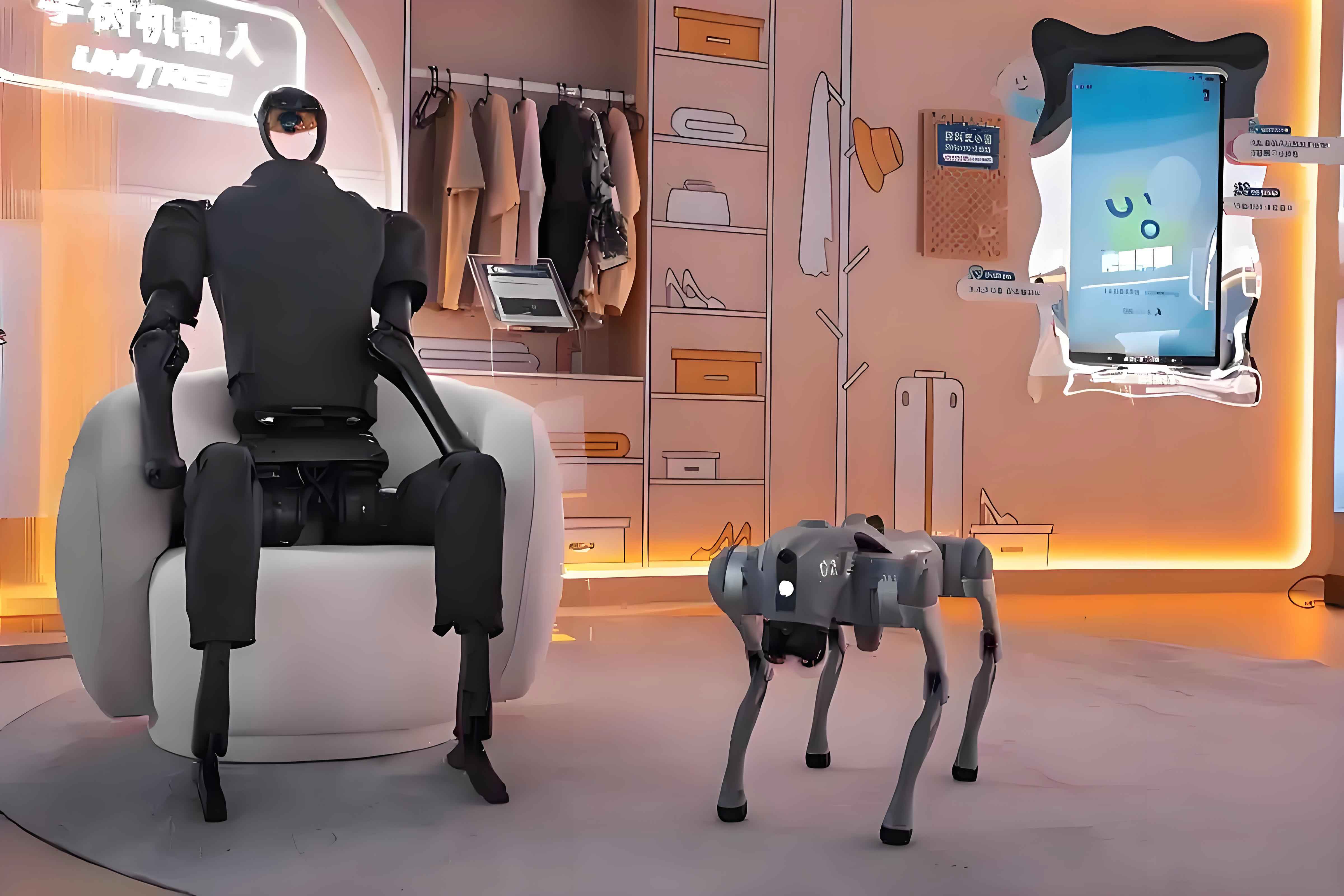
The preview shows that the humanoid robot is being positioned as a versatile interface between digital intelligence and physical work. Some humanoid robot exhibits emphasize cultural expression and public engagement. Others focus on industrial reliability, multi-robot coordination, and safety in human-robot collaboration. The range of displays reflects a broader shift in the robotics sector: the humanoid robot is no longer defined only by its shape, but by its ability to combine mobility, manipulation, sensing, and decision-making in real environments.
- Mo Yin and Mo Bao: Humanoid Robot Calligraphy and Public Interaction
At the entrance to the robot and embodied intelligence exhibition area, a humanoid robot named Mo Yin attracts attention with a floral jacket and a small red cap. The humanoid robot holds a brush, dips it in ink, and writes with a suspended wrist. The brush moves slowly and deliberately across the paper, producing horizontal and vertical strokes with control and consistency. The humanoid robot writes the words “Anhui Manufacturing” in one continuous effort, with the final characters presented in a neat and orderly form. The demonstration combines fine motor control, visual feedback, and programmed motion into a public display of precision.
Mo Yin comes from Anhui Moja Intelligent Robot Technology Co., Ltd. in Wuhu. Beside Mo Yin, a smaller humanoid robot named Mo Bao serves as a lively companion for the display. As a light cha-cha melody plays, Mo Bao twists its waist and shifts its steps with flexible rhythm. The movements are continuous and smooth, drawing crowds to watch the humanoid robot respond to music and space. The demonstration is designed to show that a humanoid robot can be approachable, expressive, and capable of interacting with people in public settings.
Mo Bao is introduced for the first time at the 2026 World Manufacturing Convention. It is a consumer-facing humanoid robot standing about 0.8 meters tall. The humanoid robot carries a VLM vision-language large model and can perform multimodal interaction. This means the humanoid robot can combine visual information, language input, and interactive behavior in a single exchange. For visitors, the humanoid robot appears as a small but capable platform that can dance, respond, and communicate in ways that feel natural and engaging.
Moja Robotics is an embodied intelligence brand incubated by Chery Group. The company focuses on the research and development, production, and commercialization of embodied intelligence robots. Its humanoid robot products and related platforms have already entered more than 60 countries and regions. They have been used in sales stores, government service halls, intelligent transportation, security, education, healthcare, and other practical application scenarios. The presence of Mo Yin and Mo Bao at the convention illustrates how a humanoid robot can be adapted for both cultural display and consumer interaction while remaining connected to a broader commercial and service ecosystem.
The calligraphy demonstration also highlights the importance of fine manipulation in humanoid robot development. Writing with a brush requires more than moving an arm from one point to another. The humanoid robot must manage contact force, brush angle, ink flow, stroke timing, and visual alignment. Each stroke becomes a test of coordination between perception and motion. When a humanoid robot writes “Anhui Manufacturing,” the display is not merely a performance; it is a visible demonstration of how a humanoid robot can execute a delicate task that combines mechanics, control, and sensing.
- The 169 Robot Band: Humanoid Robot Performance and the 9N Center
Near the calligraphy display, a familiar melody draws visitors toward a robot band. The 169 Robot Band is made up of multiple robots, including a keyboard player, a drummer, and a guitarist. The band performs “Glorious Years,” with mechanical arms striking the drums in a precise and powerful rhythm. The string section moves in a way that is visibly mechanical, yet the performance carries its own futuristic appeal. The humanoid robot and robotic musician displays show that performance can be a serious application area for embodied intelligence, requiring timing, coordination, and synchronized control.
The performance is presented by the 9N Center as a special program for the 2026 World Manufacturing Convention. The 9N Center is described as Anhui Province’s first comprehensive complex for robot full-life-cycle services and immersive experiences. It began operations in Yaohai District, Hefei, in April. The center is not only a sales and exhibition venue. It functions as a robot supermarket that brings together hundreds of robots across humanoid, service, medical, and industrial categories. The center connects first-time displays with scenario-based deployment, creating a bridge between exhibition and practical use.
At the convention, the 9N Center brings many of its main exhibits to the site. In addition to the robot band, visitors can see intelligent coffee robots, inspection robot dogs, indoor and outdoor cleaning robots, Hongjia robots, and exoskeleton equipment. The humanoid robot is one part of a wider robot ecosystem, but it plays a distinctive role because it can combine mobility, interaction, and manipulation in a human-oriented environment. The 9N Center display allows visitors to experience how a humanoid robot and other robotic systems can work alongside people in everyday settings.
The band performance also demonstrates the value of synchronized multi-robot control. A drummer robot must maintain rhythm, a keyboard robot must follow timing, and a guitar robot must coordinate its movements with the overall musical structure. When these robot performers operate together, the result is a public-facing example of multi-agent coordination. The humanoid robot and robotic musician displays therefore extend beyond entertainment. They show how embodied systems can coordinate actions, follow timing constraints, and deliver a shared experience to an audience.
- Yuyi: Humanoid Robot Boxing and Flexible Perception for Cultural Tourism
Beside the robot band, a boxing ring is being prepared. Two humanoid robots stand in the center of the ring and, under staff adjustment, begin a robot boxing match. The display is built around the Yuyi robot, which uses a Unitree robot as its base and is designed for cultural tourism scenarios. The humanoid robot boxing platform carries multi-degree-of-freedom high-torque servo joints and reproduces a full set of professional boxing motions. Straight punches, hooks, and kicking motions flow in a continuous sequence, while the humanoid robot maintains stable footwork and flexible movement. The setup is intended for interactive ring experiences in cultural tourism venues.
The boxing demonstration shows how a humanoid robot can combine dynamic balance, force control, and preprogrammed motion into an engaging public experience. A humanoid robot that can throw a controlled punch and recover its posture must manage stability while moving quickly. The display is not only about combat simulation. It is about creating a safe, repeatable, and interactive performance that can attract visitors and illustrate the physical capabilities of a humanoid robot in a controlled environment.
More interesting than the boxing match is another humanoid robot dressed in a black outer layer. This is the Yuyi global flexible-perception robot. Its key feature is a flexible “skin” that covers the body and enables tactile perception. At present, most mainstream humanoid robots and general robots have perception capabilities at selected points, leaving many areas of the body as perception blind spots. The Yuyi humanoid robot introduces an ultra-flexible distributed tactile sensing array that provides 360-degree flexible tactile perception coverage across the whole body. This design improves safety in human-robot collaboration and supports fine operation tasks.
The flexible skin concept is important for the next stage of humanoid robot development. A humanoid robot that works near people must be able to detect contact, pressure, and proximity across its body. If a humanoid robot can sense touch on its arms, torso, and other surfaces, it can respond more safely when a person stands close or when the robot moves through a crowded space. In cultural tourism settings, this kind of humanoid robot can support interactive exhibits, guided experiences, and public engagement while reducing the risk of accidental contact.
The Yuyi display therefore connects two themes. The first is performance: a humanoid robot can box, move, and entertain. The second is perception: a humanoid robot can feel its surroundings through distributed tactile sensing. Together, these themes show how a humanoid robot can become a safer and more capable participant in public environments. The humanoid robot is not only a machine that performs a scripted action. It is a sensing platform that can adapt its behavior based on physical contact and environmental context.
- Xifeng: Humanoid Robot Teams in Industrial Collaboration
If the earlier displays are lively and performance-oriented, the Youibot booth presents a quieter and more industrial scene. Several robots stand among simulated shelves as if inside a real factory workshop. Five humanoid wheel-arm robots named Xifeng are positioned between the shelves, accompanied by a mobile transport robot. There is no spotlight and no music. The humanoid robot team is completing a silent collaborative operation. The Xifeng humanoid robots use visual recognition to pick materials from the shelves with precision, while the mobile robot carries and transfers the materials in sync. The entire sequence flows smoothly without human intervention.
This is an industrial-native humanoid robot cluster operation scenario presented by Hefei-based Youibot. The system uses one brain to dispatch multiple forms of robots. Tasks are automatically decomposed and automatically assigned. The “one brain, multiple forms” architecture is intended to break the industry problem described as “single-machine intelligence, multi-machine conflict.” In other words, the humanoid robot does not work alone. It becomes part of a coordinated fleet in which different robot forms receive tasks, share context, and execute their roles without stepping on one another.
The Xifeng humanoid robot is designed with basic action capabilities at the factory. It requires only low-sample training with 50 data points to reach a 90 percent task success rate. The practical implication is straightforward: a humanoid robot can enter a factory, receive training, and then be used as a skilled worker the next day. This kind of deployment model is significant for manufacturing because it reduces the time needed to adapt a humanoid robot to a specific workstation. The humanoid robot can be assigned to picking, moving, and coordinating tasks while the broader robot fleet handles transport and logistics.
The industrial display also shows why humanoid robot design must consider both human-like form and task-specific function. The Xifeng robot uses a wheel-arm configuration, which combines mobility with manipulation. In a warehouse or factory environment, the humanoid robot must reach shelves, identify materials, grasp objects, and coordinate with mobile platforms. The value of the humanoid robot lies in its ability to operate in spaces designed for people while also connecting to automated systems that move goods and manage workflows.
The “one brain, multiple forms” approach is a notable direction for humanoid robot deployment. A single scheduling intelligence can assign tasks to a humanoid robot, a mobile transport robot, or another robotic platform based on the needs of the workflow. This reduces the risk of isolated robot systems that cannot communicate with one another. For manufacturers, the appeal is a humanoid robot ecosystem that can scale from a single workstation to a coordinated production environment without losing control of task allocation.
- A Broader View of the Humanoid Robot Ecosystem
The 2026 World Manufacturing Convention preview reveals a humanoid robot ecosystem that spans cultural performance, consumer interaction, public safety, and industrial production. The humanoid robot is presented in multiple forms: a calligrapher, a dancer, a musician, a boxer, a tactile sensing platform, and an industrial worker. Each form demonstrates a different combination of perception, motion, and decision-making. Taken together, the displays show that the humanoid robot is becoming a general-purpose platform that can be adapted to different environments through software, sensors, and task design.
One of the most important themes is the integration of vision, language, and action. The Mo Bao humanoid robot uses a VLM vision-language large model for multimodal interaction. The Xifeng humanoid robot uses visual recognition for material picking. The Yuyi humanoid robot uses distributed tactile sensing for physical awareness. These capabilities point toward a future in which a humanoid robot can understand its environment, communicate with people, and act with increasing autonomy. The humanoid robot is no longer limited to repeating a fixed motion. It can combine multiple sources of information into a coherent response.
Another theme is the relationship between the humanoid robot and human workers. In the industrial display, the humanoid robot works with a mobile transport robot rather than replacing the entire workflow. In the cultural tourism display, the humanoid robot performs for visitors and interacts with them in a controlled setting. In the consumer display, the humanoid robot dances and communicates in a public space. These examples suggest that the humanoid robot will be deployed in mixed environments where people and machines share tasks, spaces, and experiences.
| Display or Platform | Organization or Brand | Application Focus | Humanoid Robot Relevance |
|---|---|---|---|
| Mo Yin | Anhui Moja Intelligent Robot Technology Co., Ltd. | Calligraphy, cultural display, precision manipulation | The humanoid robot demonstrates fine motor control and public engagement. |
| Mo Bao | Moja Robotics | Consumer interaction, dance, multimodal communication | The humanoid robot is a consumer-facing platform with a VLM vision-language large model. |
| 169 Robot Band | 9N Center | Robot performance, synchronized control, immersive experience | The humanoid robot and robotic musicians show coordinated multi-robot performance. |
| Yuyi boxing platform | Yuyi | Cultural tourism, interactive ring, dynamic motion | The humanoid robot reproduces professional boxing motions with stable footwork. |
| Yuyi flexible-perception robot | Yuyi | Safety, tactile sensing, human-robot collaboration | The humanoid robot uses a distributed tactile sensing array for 360-degree flexible perception. |
| Xifeng | Youibot | Industrial picking, transport coordination, cluster operation | Five humanoid wheel-arm robots work with a mobile robot under one-brain scheduling. |
The table reflects a central feature of the exhibition: the humanoid robot is being developed through multiple application routes. Some teams focus on expressive interaction, while others prioritize industrial reliability. Some humanoid robot platforms are designed for public spaces, and others are designed for factory floors. The common thread is the effort to make the humanoid robot useful in real scenarios rather than limiting it to a laboratory demonstration.
The humanoid robot also benefits from advances in components and system integration. High-torque servo joints support dynamic motion. Vision systems support recognition and alignment. Tactile sensing supports safe contact. Scheduling software supports multi-robot coordination. Language models support interaction. When these technologies are combined, the humanoid robot becomes more than a mechanical body. It becomes an embodied intelligence system that can perceive, reason, and act in a physical environment.
- What the Exhibits Signal for Manufacturing and Daily Life
For the manufacturing sector, the most direct signal is that the humanoid robot is being tested in realistic workflows. The Xifeng display shows a humanoid robot cluster operating among shelves, picking materials, and coordinating with a mobile transport robot. The scenario is intentionally quiet and ordinary, which makes it more credible as an industrial application. A humanoid robot that can work in a factory must be reliable, repeatable, and easy to train. The low-sample training approach described at the booth is aimed at reducing deployment friction and enabling faster task adoption.
For public-facing environments, the humanoid robot is being designed to attract, inform, and interact. Mo Yin writes calligraphy. Mo Bao dances and communicates. The 169 Robot Band performs. The Yuyi boxing platform creates an interactive cultural tourism experience. These humanoid robot applications show that public engagement can be a serious use case. Museums, exhibition halls, tourism venues, retail spaces, and service centers can use a humanoid robot to deliver experiences that combine entertainment with information and interaction.
For safety and collaboration, the Yuyi flexible-perception humanoid robot points to an important requirement. A humanoid robot that operates near people must be able to sense contact across its body. The 360-degree flexible tactile perception coverage is intended to reduce blind spots and improve safety. As humanoid robots move from isolated cages into shared spaces, the ability to detect and respond to physical contact will become a core capability. The humanoid robot must know not only what it is doing, but also what is happening around it.
The convention also shows that the humanoid robot is becoming a platform for partnership across the robotics supply chain. Robot developers, artificial intelligence companies, sensor providers, motion control specialists, and application operators all contribute to the humanoid robot ecosystem. The displays at the convention bring these contributions together in visible form. A humanoid robot that writes, dances, boxes, or picks materials is the result of many subsystems working in coordination.
The preview further indicates that the humanoid robot will not follow a single deployment path. Consumer-facing humanoid robots may prioritize communication, appearance, and safe interaction. Industrial humanoid robots may prioritize payload, precision, repeatability, and fleet coordination. Cultural tourism humanoid robots may prioritize performance, durability, and audience engagement. The same humanoid robot platform can be adapted through different sensors, end effectors, software, and training data.
- A Preview of the Humanoid Robot as a Practical Platform
The 2026 World Manufacturing Convention opens with a clear statement: the humanoid robot is being presented as a practical platform rather than a distant concept. The exhibition area brings together humanoid robot calligraphy, humanoid robot dance, humanoid robot music, humanoid robot boxing, humanoid robot tactile sensing, and humanoid robot industrial collaboration. Each display offers a different view of what a humanoid robot can do and how it can be integrated into an application environment.
The humanoid robot named Mo Yin demonstrates precision and cultural expression. The humanoid robot named Mo Bao demonstrates consumer interaction and multimodal communication. The 169 Robot Band demonstrates synchronized performance. The Yuyi humanoid robot demonstrates dynamic motion and flexible perception. The Xifeng humanoid robot demonstrates industrial teamwork and one-brain scheduling. Together, these humanoid robot displays form a coherent picture of an industry moving toward application-driven development.
The humanoid robot is also a meeting point for manufacturing and daily life. In a factory, the humanoid robot can support picking, transport, and coordination. In a public venue, the humanoid robot can support guidance, performance, and interaction. In a service setting, the humanoid robot can support communication and information delivery. The same underlying capabilities, including perception, motion control, sensing, and decision-making, can be adapted to different tasks.
The preview at the Hefei Binhu International Convention and Exhibition Center shows that the humanoid robot sector is placing greater emphasis on real scenarios. The humanoid robot is no longer evaluated only by how closely it resembles a person. It is evaluated by whether it can complete a task, interact safely, coordinate with other machines, and deliver value in a specific environment. This shift is visible in the diversity of humanoid robot exhibits and in the practical language used to describe their applications.
As the 2026 World Manufacturing Convention begins, the humanoid robot stands at the center of the exhibition narrative. The humanoid robot writes, dances, performs, boxes, senses, and works. The humanoid robot is presented as a future colleague, a public performer, a cultural guide, and a consumer companion. The displays do not rely on speculation alone. They show working systems, live demonstrations, and application scenarios that can be observed and evaluated.
The humanoid robot remains a complex engineering challenge, but the direction is clear. The humanoid robot is moving from isolated demonstration toward integrated deployment. The humanoid robot is becoming part of a larger robot ecosystem that includes mobile platforms, service robots, industrial systems, and intelligent scheduling. The humanoid robot is also becoming part of public experience, where interaction, safety, and engagement matter as much as technical capability.
The 2026 World Manufacturing Convention in Hefei therefore offers more than a showcase of machines. It offers a view of how the humanoid robot is being prepared for real-world use. The humanoid robot is no longer only a symbol of technological ambition. The humanoid robot is becoming a practical platform for manufacturing, services, cultural tourism, and everyday interaction. The preview makes that transition visible, and the convention provides a stage for the humanoid robot to demonstrate what comes next.