
As a frontier domain within future industries, the humanoid robot has emerged as a new competitive arena in global technology and industry. Major economies worldwide are intensifying their strategic layouts and policy support for the humanoid robot sector, striving to seize the initiative. We are currently witnessing a technological inflection point where humanoid robots are transitioning from proof-of-concept to applied deployment. Breakthroughs in both core hardware and intelligent software are fueling a powerful developmental momentum. The unveiling of various advanced prototypes signals that humanoid robots are approaching preliminary conditions for commercialization. Concurrently, the rapid advancement and maturation of artificial intelligence, particularly large language models, are infusing humanoid robots with an unprecedented level of cognitive intelligence. These technological leaps are reshaping the developmental trajectory of humanoid robots, catalyzing novel application scenarios and business models.
Conceptual Foundation and Technological Pillars
A humanoid robot is an artificially intelligent machine engineered to mimic human morphology and behavior. Characterized by bipedal locomotion, dexterous manipulation using arms and torso, and interactive capabilities through speech, the humanoid robot is distinguished by its strong general-purpose potential across diverse scenarios. It is poised to become a disruptive product following computers, smartphones, and new energy vehicles, profoundly transforming production, lifestyles, and the global industrial landscape.
The technological architecture of a humanoid robot can be distilled into four cornerstone technologies: Perception, Intelligent Decision-Making, Human-Robot Interaction (HRI), and Motion Control.
1. Perception Technology: This endows the robot with the ability to sense its environment through sensors (e.g., cameras, LiDAR, microphones, tactile sensors). The core challenge lies in multi-sensor fusion, creating a coherent and robust understanding of the surroundings. Key capabilities include visual scene understanding, auditory source localization, and proprioceptive sensing for self-state awareness.
2. Intelligent Decision-Making: Leveraging AI techniques like machine learning, deep learning, and neural networks, this enables the humanoid robot to perform autonomous judgment and task planning. The computational heart involves specialized chips and algorithms that decompose high-level commands, formulate optimal action sequences, and adapt in real-time based on feedback. The integration of large foundational models promises significant leaps in reasoning and task generalization.
3. Human-Robot Interaction (HRI): This focuses on natural communication between humans and robots. Advancements in speech recognition, natural language processing, and affective computing allow humanoid robots to understand intent, respond contextually, and even recognize human emotions, fostering seamless collaboration.
4. Motion Control: This is the bedrock of physical embodiment, governing posture, gait, balance, and manipulation. The core challenge is dynamic stability and dexterous movement (e.g., walking, running, jumping, precise grasping). It involves sophisticated control algorithms for joint actuators, which typically comprise motors, reducers (like harmonic drives or RV reducers), encoders, and drivers. The dynamics can be partially described by the Lagrangian formulation for a multi-body system:
$$ \tau = M(q)\ddot{q} + C(q, \dot{q})\dot{q} + G(q) $$
where \( \tau \) is the vector of joint torques, \( q \) is the vector of generalized coordinates (joint angles), \( M(q) \) is the mass/inertia matrix, \( C(q, \dot{q}) \) accounts for Coriolis and centrifugal forces, and \( G(q) \) represents gravitational forces. Stabilizing this system in unpredictable environments is a fundamental research problem.
Guided by major industrial policy frameworks, the humanoid robot industrial chain is often categorized into three integrated subsystems: the “Brain” (encompassing Perception, Decision-Making, HRI), the “Cerebellum” (responsible for real-time motion coordination and balance), and the “Body” (the mechanical structure and actuator systems).
Evolutionary Trajectory of Humanoid Robotics
The development of humanoid robots has progressed through distinct phases, each marked by increasing complexity and capability.
| Phase | Timeframe | Key Characteristics & Limitations | Representative Milestones |
|---|---|---|---|
| Early Exploration | 1970s – 2000 | Focus on basic bipedal locomotion and simple limb movements; rudimentary mechanics; low intelligence, no interactive capabilities. | WABOT-1 (1973), Honda’s P2 & first-gen ASIMO (2000). |
| Integrated Development | 2001 – 2011 | Introduction of basic environmental perception; start of智能化 (intelligentization); limited interaction and improved motion DOFs (Degrees of Freedom). | Toyota’s partner robots, Honda’s advanced ASIMO with obstacle avoidance. |
| Dynamic Motion & Enhanced Interaction | 2012 – 2020 | Significant improvements in dynamic movement (running, jumping) or social interaction; use of reinforcement learning, emotion recognition; high cost, limited practicality. | Boston Dynamics’ Atlas, SoftBank’s Pepper, Poppy open-source robot, Ubtech’s Walker X. |
| Advanced Intelligence & Commercialization | 2020 – Present | Infusion of large AI models (LLMs, VLMs); leap in cognitive reasoning and environmental understanding; functional differentiation; push towards commercial viability. | Tesla Optimus, Fourier GR-1, Xiaomi CyberOne, Engineered Arts’ Ameca with GPT, Agility’s Digit. |
Strategic Imperatives for Development
The pursuit of humanoid robot technology is not merely an industrial endeavor but a strategic imperative with multi-faceted significance.
1. Enhancing National Competitiveness: Mastering the humanoid robot value chain necessitates breakthroughs in AI, advanced sensors, and new materials, directly propelling scientific innovation. It fosters the growth of globally competitive firms and specialized industrial clusters, ultimately pioneering new, intelligent high-end manufacturing paradigms that elevate a nation’s comprehensive technological and industrial strength.
2. Optimizing Labor and Mitigating Demographic Shifts: Humanoid robots can undertake repetitive, strenuous, or hazardous tasks (e.g., assembly line work, disaster response) with high endurance and precision. This redefines social labor division, freeing human capital for more creative roles and alleviating pressures from aging populations and workforce shortages.
3. Catalyzing Cross-Disciplinary Progress and Social Good: The development of humanoid robots forces convergence across AI, robotics, mechanics, and cognitive science, accelerating advancement in these constituent fields. Beyond industry, they hold immense promise for healthcare (surgical assistance, rehabilitation), education, domestic services, and eldercare, potentially greatly improving quality of life.
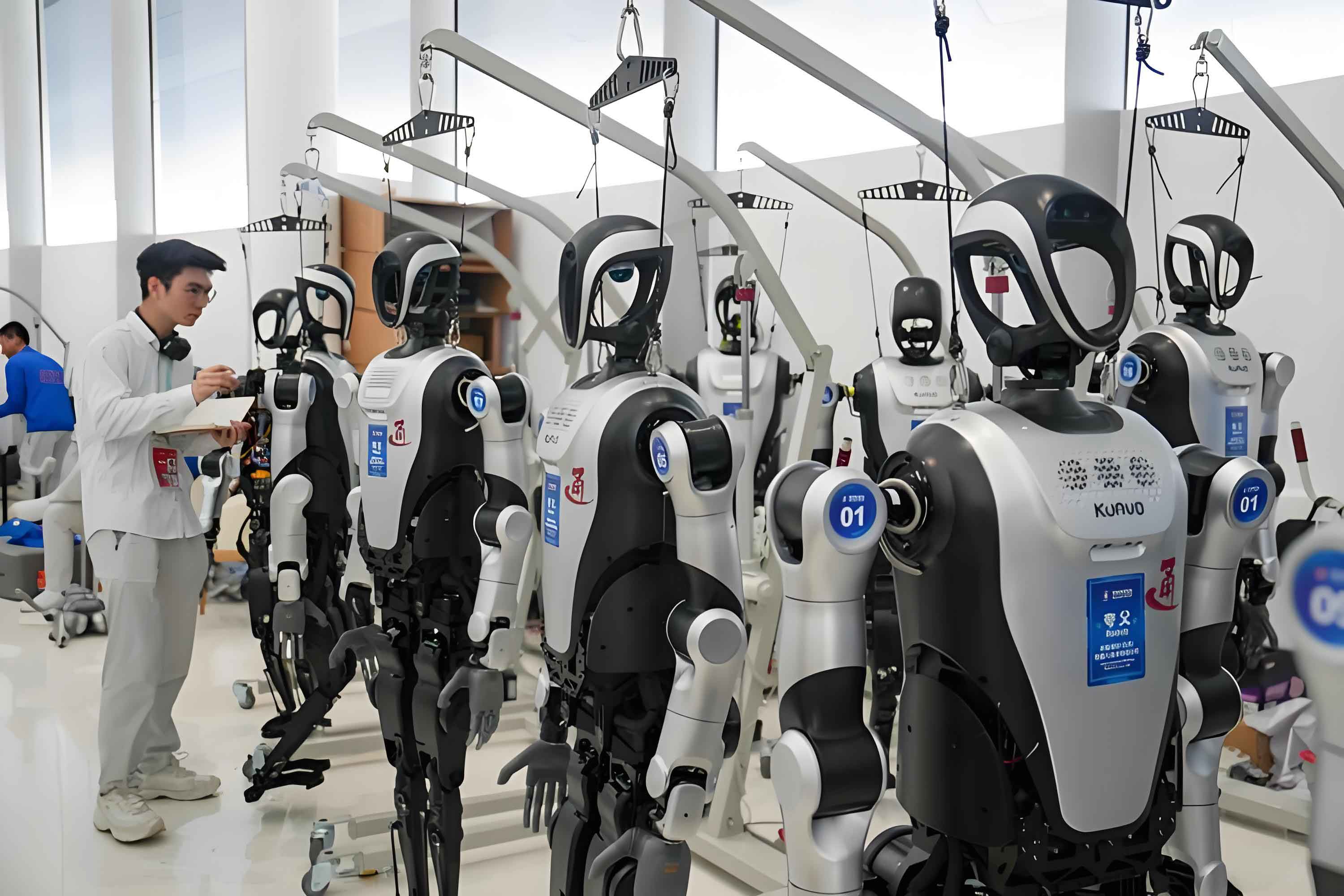
4. Unleashing a New Economic Engine: The humanoid robot industry presents a vast blue-ocean market. Cultivating a complete domestic ecosystem—from core components to integrated systems—can stimulate thousands of upstream and downstream industries, create high-skilled jobs, and establish a powerful new driver for economic growth.
Current Landscape: Market, Investment, and Competition
Market Potential: Projections for the humanoid robot market are highly optimistic, forecasting a multi-hundred-billion-dollar industry within 10-15 years. Manufacturing and domestic service are expected to be the first major adoption waves. A simplified model for market growth can be expressed as:
$$ S(t) = S_0 \cdot (1 + r)^t $$
where \( S(t) \) is the market size at time \( t \), \( S_0 \) is the initial size, and \( r \) is the compound annual growth rate (CAGR). Estimates place \( r \) between 25% and over 98% for unit shipments in the coming decade, indicating explosive growth.
| Market Segment | 2030 Forecast (Global) | 2035 Forecast (Global) | Primary Drivers |
|---|---|---|---|
| Overall Market Size | ~$20 Billion | $154 – $1100 Billion (range) | Tech maturation, cost reduction, AI integration. |
| Manufacturing & Logistics | Early adoption phase | Mass adoption for sorting, assembly, handling | Labor costs, 24/7 operation, flexibility vs. traditional arms. |
| Consumer/Service | Niche high-end applications | Broader adoption in cleaning, companionship, security | Aging populations, rising disposable income, AI sophistication. |
Investment Frenzy: The sector is experiencing intense capital inflow. Tech giants (e.g., Tesla, NVIDIA, Huawei, Xiaomi), top-tier venture capital firms, and government-guided industrial funds are actively investing in startups and R&D. Hundreds of investment deals totaling billions of dollars have been recorded recently, a trend expected to accelerate.
Global Competitive Landscape: The global arena is stratifying into tiers. Pioneers like Boston Dynamics and Tesla hold significant advantages in holistic system integration and cutting-edge AI-motion synergy. Fast followers and specialists, such as Agility Robotics, Figure AI, and several leading Chinese companies (e.g., Ubtech, Fourier), are making rapid progress with viable commercial prototypes, some already entering pilot programs in factories.
Intellectual Property and Talent: China has surpassed Japan in the sheer number of patent filings related to humanoid robots, indicating vigorous R&D activity. However, qualitative depth in fundamental algorithms and novel architectures requires further strengthening. The war for talent—encompassing AI scientists, robotics engineers, and mechatronics specialists—is fierce. Leading universities and corporate research labs are pivotal hubs for cultivating this critical human capital.
Policy Support and Regional Clusters
International Policy Landscape: Nations are deploying substantial funding and strategic plans (e.g., U.S. National Robotics Initiative, Japan’s Robot Strategy, EU’s Horizon Europe) to bolster robotics R&D and adoption. Concurrently, frameworks for safety, ethics, and standardization are being discussed to manage risks associated with advanced humanoid robots.
Domestic Policy and Cluster Development: National industrial policies have progressively identified humanoid robots as a strategic priority. Recent high-level guidelines explicitly aim to break through key technologies (“Brain, Cerebellum, Body”) and build a globally competitive ecosystem by 2027. Regionally, powerful clusters have formed:
- Yangtze River Delta: A comprehensive ecosystem with strengths in component supply, system integration, and commercial application pilots.
- Pearl River Delta: Leverages massive manufacturing scale for application demonstration and has a strong track record in commercial service robots.
- Beijing-Tianjin-Hebei: Benefits from concentrations of top academic institutions and tech talent, focusing on foundational AI research and high-end innovation.
Future Trends and Critical Junctures
1. Embodied AI: Large Models as the “Brain”: The convergence of large language models (LLMs) and vision-language models (VLMs) with robotics is creating “embodied intelligence.” Models like GPT-4V provide humanoid robots with commonsense reasoning, task decomposition, and natural language understanding, moving them closer to general-purpose capability. The learning process for an embodied agent can be framed as optimizing a policy \( \pi_\theta(a | s) \) that maximizes expected cumulative reward \( R \):
$$ J(\theta) = \mathbb{E}_{\tau \sim p_{\pi_\theta}}[R(\tau)] $$
where \( \tau = (s_0, a_0, s_1, a_1, …) \) is a trajectory of states and actions. Large models help in forming richer state representations \( s \) and priors for the policy \( \pi \).
2. The Commercialization Inflection Point (2024-2025): With supportive policies, increased investment, and maturing prototypes, this period is widely regarded as the potential starting point for pre-commercial pilot deployments and the roadmap to scaled manufacturing, especially within industrial settings.
3. Manufacturing as the First Frontier: Structured, repetitive, and measurable environments like factories and warehouses present the most tractable first-use cases for humanoid robots. Their value proposition lies in flexibility—being able to perform multiple different tasks in a space designed for humans, unlike fixed automation.
Confronting Challenges, Seizing Opportunities
Persistent Challenges:
- Technological Immaturity: Core challenges in robust full-body dynamic control, dexterous manipulation, and seamless real-time AI integration remain. Key components like high-performance torque-dense actuators and force-torque sensors still face cost and supply chain hurdles.
- The “Sim2Real” Gap and Data Scarcity: Training sophisticated control policies requires vast amounts of real-world interaction data, which is expensive and time-consuming to acquire. Bridging the gap between simulation and reality is a major research obstacle.
- Cost and Ethical Quandaries: High unit costs (often exceeding $100,000) hinder mass adoption. Furthermore, the increasing autonomy of humanoid robots raises profound questions about safety certification, liability, privacy, job displacement, and long-term societal impact.
Emerging Opportunities:
- Technology-Driven Breakthroughs: Continuous advances in AI (especially multimodal models), new actuator designs (e.g., liquid metal, advanced harmonics), and lighter, stronger materials are constantly pushing the performance envelope and creating new niches.
- Supply Chain红利 (Dividend): Companies specializing in core components—reducers, servos, controllers, sensors—are poised to benefit early from the industry’s growth, even before整机 (complete machine) sales surge, as their technologies are foundational.
- Cross-Industry Synergy (Automotive): Automotive manufacturers possess deeply relevant expertise in perception systems (LiDAR, cameras), real-time control algorithms, and large-scale precision manufacturing. This allows for significant technology reuse, giving them a unique advantage in developing and potentially reducing the cost of humanoid robots.
Strategic Recommendations for Ecosystem Development
1. Strengthen Strategic Planning and International Collaboration:
Formulate detailed roadmaps with clear milestones. Encourage regional specialization based on comparative advantages (R&D hubs vs. manufacturing bases). Foster global partnerships in R&D and standard-setting to integrate into international innovation networks.
2. Focus on Core Technology Breakthroughs:
Launch national-level key R&D programs targeting:
- Perception: 3D vision in dynamic scenes, robust multi-sensor fusion.
- HRI & AI: Affective computing, human intention understanding, and embodied reasoning models.
- Control: Whole-body compliant control, dynamic locomotion over rough terrain. The control objective often involves minimizing a cost function like:
$$ \min_{\mathbf{u}} \int ( \mathbf{x}^T Q \mathbf{x} + \mathbf{u}^T R \mathbf{u} ) dt $$
subject to the system dynamics \( \dot{\mathbf{x}} = f(\mathbf{x}, \mathbf{u}) \), where \( \mathbf{x} \) is the state vector, \( \mathbf{u} \) is the control input, and \( Q, R \) are weighting matrices.
- Actuation: High-power-density motors, efficient compact reducers, and variable impedance actuators.
3. Optimize the Innovation Ecosystem:
Cultivate a mix of leading integrators and specialized “hidden champion” component suppliers. Establish open innovation platforms and shared datasets to lower R&D barriers. Use application pull by creating pilot programs in manufacturing, healthcare, and logistics to drive iterative improvement.
4. Establish Robust Standards and Governance Frameworks:
Accelerate the development of safety, performance, and interoperability standards. Proactively engage in defining ethical guidelines and legal frameworks for accountability, privacy, and safe human-robot coexistence. Implement lifecycle management and certification regimes to ensure responsible development and deployment.