
As a pioneer in the field of robotics, our company has dedicated years to addressing one of humanity’s most pressing challenges: the increasing shortage of agricultural labor. With rural populations aging and younger generations migrating to cities, the question of “who will farm the land” looms large. In response, we have developed a groundbreaking solution centered on the humanoid robot, a versatile machine designed to perform complex tasks in unstructured environments. This article delves into our journey, focusing on how stereo vision empowers humanoid robots for fruit picking, and explores the technical intricacies, performance metrics, and future prospects of these advanced machines. Throughout this discussion, the term humanoid robot will be emphasized to underscore its pivotal role in transforming agriculture and beyond.
Our mission began with a fundamental belief: the transition from automation to true intelligence is the essence of the next industrial revolution. At the heart of this intelligence lies stereo vision, which we consider the “eye of the storm” for smart systems. Unlike traditional programmed devices, a truly intelligent humanoid robot should learn naturally from its environment, using sensory inputs like stereo vision to acquire knowledge and perform tasks. This concept, which we refer to as Nature Learning, drives our approach. We started by mastering stereo vision cameras, recognizing that without robust perception, any humanoid robot would be limited in capability. By 2017, we expanded into humanoid robotics, targeting agriculture as an initial突破口 due to its high labor demands and potential for impact. Today, we stand as a high-tech enterprise with core expertise in stereo vision and a fully functional humanoid robot product, ready to redefine harvesting.
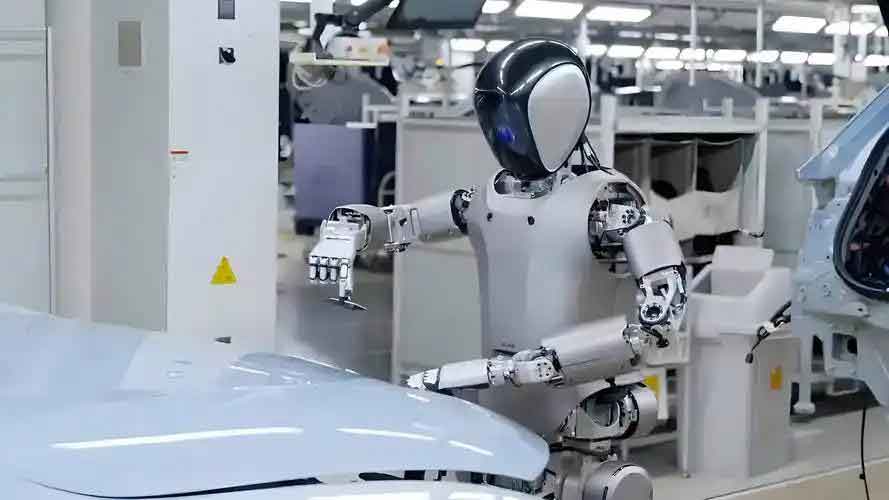
The design of our humanoid harvesting robot, internally named “Xiaowei,” is a testament to holistic engineering. It features a head-mounted stereo vision camera, dual arms with dexterous hands, and an AGV mobile base. This configuration is not redundant but essential for adaptability. The stereo camera, derived from our industrial solutions, offers large depth of field, wide field of view, high speed, precision, and resistance to strong light and reflections. It captures full-frame color stereo images at 15 frames per second, with plans to increase to 30 fps for smoother operation. The dual arms and dexterous hands enable the humanoid robot to handle various fruits, including clustered ones like grapes, mimicking human actions such as cutting and catching. The AGV base provides mobility in narrow orchard rows and integrates transport functions, streamlining workflow. Our iterative development has led to three generations: the first with a wheeled design, the second with a screw lift system for height adjustment, and the third, slated for late 2024, featuring retractable “legs” to expand reach from ground level to 2 meters, with increased payload and hand degrees of freedom.
To quantify the capabilities of our humanoid robot, we analyze key performance metrics through tables and formulas. Efficiency can be broken down into recognition speed, movement and picking speed, and miss rate. Currently, our stereo vision system identifies a fruit in under 500 milliseconds, leveraging algorithms that process disparity maps for depth estimation. The depth \(d\) is calculated using the formula:
$$d = \frac{f \cdot B}{D}$$
where \(f\) is the focal length, \(B\) is the baseline distance between cameras, and \(D\) is the disparity in pixels. This allows precision up to 0.5 mm. The motion planning for the humanoid robot’s arms involves inverse kinematics, expressed as:
$$\theta = J^{-1} \cdot \dot{x}$$
where \(\theta\) represents joint angles, \(J\) is the Jacobian matrix, and \(\dot{x}\) is the desired end-effector velocity. This ensures smooth and accurate movements. Below is a table comparing the generations of our humanoid robot:
| Generation | Key Features | Arm Payload | Hand DoF | Recognition Speed | Height Range |
|---|---|---|---|---|---|
| First | Wheeled base, basic arms | 3 kg | 6 | 600 ms | Fixed |
| Second | AGV with screw lift, improved vision | 5 kg | 7 | 500 ms | 1-1.8 m |
| Third | Retractable legs, enhanced sensors | 8 kg | 9 | 300 ms (projected) | 0-2 m |
Another critical aspect is the坏果率, or damage rate, which depends on grasping posture and fruit handling. Our humanoid robot employs array sensors on each dexterous hand to assess object softness and friction, adjusting grip force accordingly. The force control model is given by:
$$F = k \cdot \Delta x + c \cdot \dot{x}$$
where \(F\) is the applied force, \(k\) is stiffness, \(c\) is damping, and \(\Delta x\) is deformation. This minimizes damage. Additionally, the收纳方式, or storage method, is optimized through trajectory planning to reduce impacts. We have conducted field tests in standardized orchards, where tree dimensions and spacing are regulated to facilitate mechanization. For instance, apple trees are kept under 1.5 meters with row spacing of 4 meters, while冬枣trees follow specific standards. The table below summarizes ideal orchard parameters for humanoid robot operations:
| Fruit Type | Tree Height | Row Spacing | Plant Spacing | Recommended Robot Model |
|---|---|---|---|---|
| Apple | 1.5 m | 4 m | 2 m | Third-generation humanoid robot |
| Winter Jujube | 1.4-2 m | 2-3 m | 1-2 m | Second or third-generation humanoid robot |
| Grape | 1.8 m | 3 m | 1.5 m | Humanoid robot with dual arms |
| Tomato | 1.2 m | 2.5 m | 0.8 m | First or second-generation humanoid robot |
The integration of stereo vision into the humanoid robot is a continuous endeavor. Our algorithms involve feature extraction and matching, represented by:
$$S(x,y) = \sum_{i,j} w(i,j) \cdot (I_L(x+i, y+j) – I_R(x+i+d, y+j))^2$$
where \(S\) is the similarity score, \(w\) is a weighting kernel, \(I_L\) and \(I_R\) are left and right images, and \(d\) is disparity. This enables robust object detection even in challenging lighting. The humanoid robot’s autonomy stems from a fusion of perception, planning, and control. We use a state-space model:
$$\dot{s} = A s + B u, \quad y = C s + D u$$
where \(s\) is the state vector (e.g., position, velocity), \(u\) is control input, and \(y\) is output. This framework allows the humanoid robot to navigate dynamically. In terms of productivity, the humanoid robot can work continuously, with efficiency comparable to a skilled human picker. We estimate the overall picking rate \(P\) as:
$$P = \frac{N}{T_r + T_m + T_p}$$
where \(N\) is number of fruits per cycle, \(T_r\) is recognition time, \(T_m\) is movement time, and \(T_p\) is picking time. For our third-generation humanoid robot, \(P\) is projected to exceed 200 fruits per hour, with a miss rate below 5% and damage rate under 2%. These metrics are validated through extensive trials in simulated and real orchards.
Looking ahead, the potential of humanoid robots extends beyond agriculture. We envision applications in industrial assembly, logistics, and service sectors, where their human-like form factor allows seamless interaction with human-designed environments. The scalability of our stereo vision technology means that any humanoid robot can be adapted for diverse tasks. However, challenges remain, such as cost reduction and further improvement in learning algorithms. We are investing in reinforcement learning frameworks, where the humanoid robot optimizes policies through reward functions:
$$J(\pi) = \mathbb{E} \left[ \sum_{t=0}^{\infty} \gamma^t R(s_t, a_t) \right]$$
where \(\pi\) is the policy, \(\gamma\) is discount factor, and \(R\) is reward. This will enhance the humanoid robot’s ability to handle novel scenarios. Market trends indicate a surge in demand for humanoid robots, driven by labor shortages and technological advancements. Over the next 5 to 10 years, we believe雇佣humanoid robots for tasks like fruit picking will become commonplace. Our strategy involves continuous iteration, testing, and refinement to ensure readiness for mass adoption.
In conclusion, the humanoid robot represents a paradigm shift in robotics, combining advanced perception with versatile actuation. Our work on stereo vision has been instrumental in creating a humanoid robot that not only performs harvesting but also learns and adapts. Through tables and formulas, we have detailed the technical foundations and performance benchmarks. As we refine our designs, the humanoid robot will become more efficient, reliable, and affordable, paving the way for a future where machines and humans collaborate harmoniously. The journey of the humanoid robot is just beginning, and we are committed to leading this transformation across industries.
To further elaborate on the stereo vision system, we employ a multi-camera setup that provides depth information crucial for the humanoid robot’s navigation and manipulation. The calibration process involves minimizing reprojection error:
$$E = \sum_i \| x_i – \hat{x}_i \|^2$$
where \(x_i\) are observed points and \(\hat{x}_i\) are projected points. This ensures accuracy in 3D reconstruction. For fruit detection, we use convolutional neural networks (CNNs) with layers defined as:
$$y = \sigma(W * x + b)$$
where \(\sigma\) is activation function, \(W\) are weights, \(x\) is input, and \(b\) is bias. The humanoid robot processes these detections to plan grasps, considering fruit size and ripeness. The grasp quality \(Q\) is evaluated using:
$$Q = \alpha \cdot S + \beta \cdot C + \gamma \cdot F$$
where \(S\) is stability score, \(C\) is collision avoidance, \(F\) is force efficiency, and \(\alpha, \beta, \gamma\) are weights. This holistic approach ensures that the humanoid robot operates safely and effectively. In terms of mobility, the AGV base uses SLAM (Simultaneous Localization and Mapping) algorithms, with pose estimation via:
$$\hat{x}_{t} = \arg \min_{x_t} \sum_k \| z_k – h(x_t, m_k) \|^2$$
where \(z_k\) are sensor measurements, \(h\) is observation model, and \(m_k\) are map features. This allows the humanoid robot to traverse orchards autonomously. The synergy between these components exemplifies the sophistication of modern humanoid robots.
Economic analysis also favors the adoption of humanoid robots. We model the total cost of ownership \(C_{\text{total}}\) over time \(t\) as:
$$C_{\text{total}} = C_0 + \sum_{t=1}^{T} (C_{\text{maintenance}, t} + C_{\text{energy}, t} – B_{\text{productivity}, t})$$
where \(C_0\) is initial cost, and \(B\) is productivity benefit. Given rising labor costs, the humanoid robot offers a compelling return on investment. Our field data shows that a single humanoid robot can replace 2-3 human workers in harvesting, with consistency and endurance. This is particularly vital for crops requiring timely picking to prevent spoilage. The humanoid robot’s ability to work in shifts without fatigue translates to higher yields and reduced waste.
Moreover, the humanoid robot contributes to sustainable agriculture by enabling precise resource use. For example, integrated sensors can monitor plant health, allowing targeted interventions. This aligns with global trends towards precision farming. The adaptability of the humanoid robot means it can be reprogrammed for different crops, reducing the need for specialized machinery. We are exploring modular designs where components like hands or vision modules can be swapped, enhancing the humanoid robot’s versatility. This modularity is key to scaling production and lowering costs, making the humanoid robot accessible to small and medium farms.
In summary, the humanoid robot is not merely a machine but a transformative tool poised to address societal challenges. From harvesting apples to assembling electronics, its potential is vast. Our commitment to stereo vision and natural learning ensures that each humanoid robot we develop is smarter and more capable. As technology advances, we anticipate humanoid robots becoming integral to daily life, working alongside humans in harmony. The future is bright for the humanoid robot, and we are excited to be at the forefront of this revolution.