
The world is witnessing a profound shift in the nature of production tools. In advanced factories, a new type of worker is emerging—one made of metal, silicon, and advanced algorithms. The humanoid robot, with its familiar bipedal form and dexterous manipulators, is transitioning from science fiction to factory floors and beyond. I observe a new wave of innovation where these machines, boasting steady gaits, precise positioning, and fluid motions, are beginning to tackle complex tasks such as quality inspection, material handling, and sorting on assembly lines. Their deployment signifies more than just automation; it represents a fundamental leap in how we conceptualize and interact with machines in productive environments.
The potential efficiency gains are staggering. Consider automotive manufacturing, where production cycles are relentlessly optimized. Some advanced humanoid robot platforms can now complete a full vehicle quality inspection within 60 to 80 seconds. This capability aligns perfectly with the rhythm of the world’s most advanced automotive plants, which target producing one car per minute. This synergy between machine capability and production demand highlights a critical evolution. The industrial challenge has progressively moved from “can we build cars?” to “can we build excellent cars?” and now to “can we build the excellent equipment that builds excellent cars?” This progression is the very essence of innovation-driven development. As a novel production tool, the humanoid robot is rapidly becoming a new high ground in technological competition, a pivotal new track for future industries, and a powerful new engine for economic growth, holding immense significance for accelerating the development of new, high-quality productive forces.
Beyond the factory, the evolution continues. Service-oriented humanoid robot models, capable of running, climbing stairs, preparing beverages, playing interactive games, and even assisting in delicate procedures, are constantly being refined and upgraded. This versatility stems from their core identity: the humanoid robot is the quintessential product of deep integration between Artificial Intelligence (AI) and robotics. Its anthropomorphic design allows it to navigate human-centric environments with minimal adaptation, accessing spaces and using tools originally designed for people. Equipped with a “thinking brain” powered by advanced AI, it can perceive, reason, and adapt. In essence, the humanoid robot integrates a confluence of advanced technologies—AI, high-end manufacturing, new materials, and sophisticated sensors. It is poised to become the disruptive innovation that follows the computer, the smartphone, and the new energy vehicle, potentially triggering a significant leap in overall productivity.
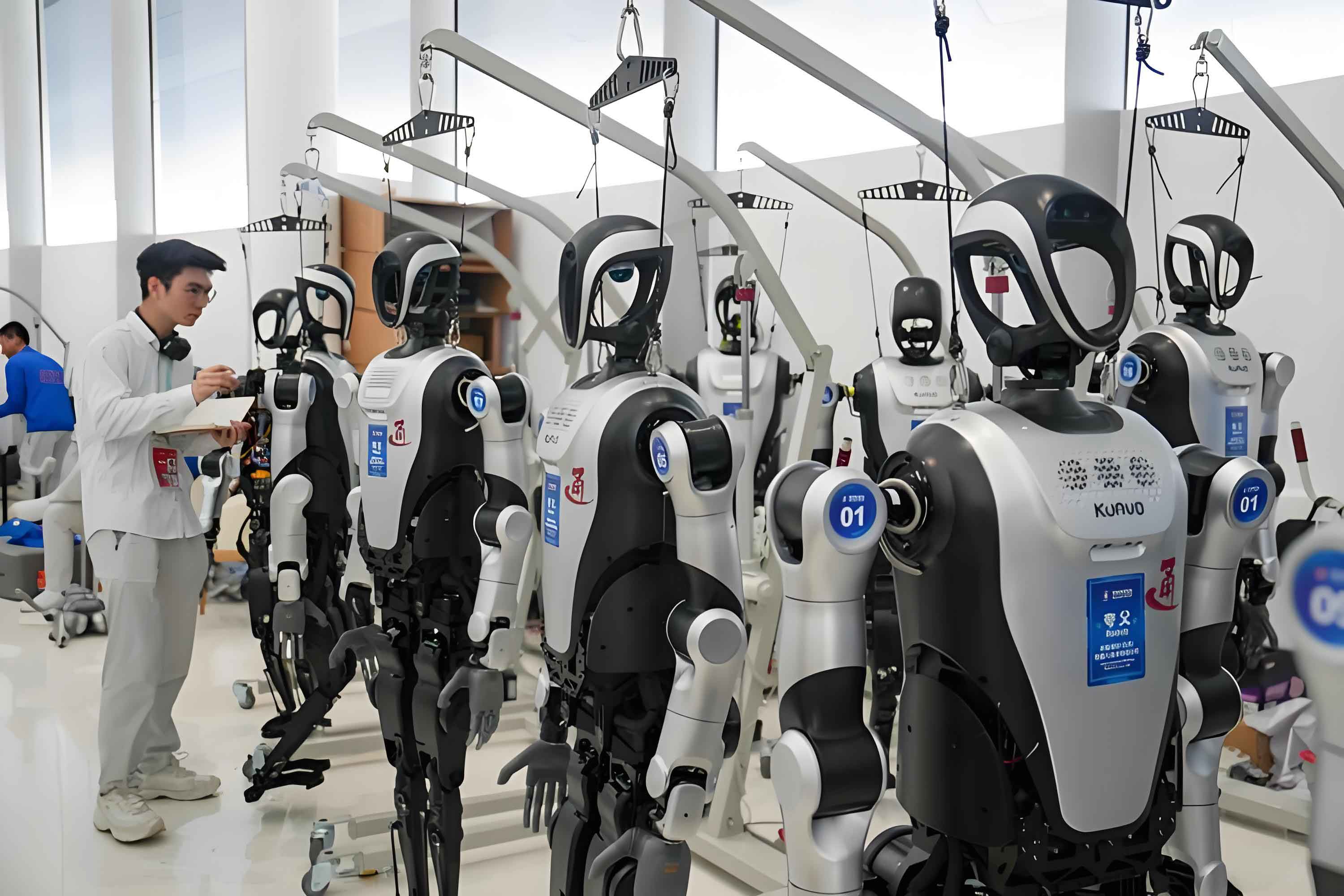
However, replicating the human form and its capabilities is a monumental engineering challenge. The human body is a masterpiece of biological engineering—complex, efficient, and adaptable. Building a functional humanoid robot is therefore an exceptionally difficult task, requiring the convergence of cutting-edge scientific and technological achievements from multiple disciplines. The current industrial landscape reveals several persistent短板 (shortcomings), particularly in core technologies and their integration. To achieve high-quality industrial development, we must steadfastly anchor our efforts in strengthening scientific and technological innovation. This involves accelerating the evolution of key technologies, perfecting application scenarios, and decisively addressing critical issues such as weak integrated design capabilities and insufficient fusion between the industrial chain and the innovation chain.
The Core Technological Pillars and Challenges
The development of a capable humanoid robot rests on several interdependent technological pillars. Each presents unique challenges that must be overcome to achieve stability, efficiency, and intelligence.
| Technological Pillar | Key Components | Primary Challenges |
|---|---|---|
| Bionic Design & Mechanics | Lightweight skeletal structures, joint actuators, tendon-like transmission systems, durable yet flexible materials. | Achieving high strength-to-weight ratio, replicating human range of motion and compliance, ensuring long-term mechanical reliability. |
| AI & Perception | Multi-modal sensors (Vision, LiDAR, IMU, Tactile), AI chips, perception algorithms (SLAM, object recognition), decision-making models. | Real-time environmental understanding, robust operation in unstructured settings, efficient on-board computing with low power consumption. |
| Driving & Control | High-performance servo motors, precision reducers, embedded controllers, real-time operating systems (RTOS). | High torque density, low latency control loops, dynamic balance (bipedal locomotion), precise force/torque control. |
| Energy & Power | High-density batteries, power management systems (PMS), efficient thermal management. | Balancing power demand with operational duration, managing heat dissipation from actuators and computers, fast charging/swapping. |
Mathematically, the control of a humanoid robot involves solving highly complex, non-linear problems in real-time. For instance, the fundamental problem of bipedal locomotion can be framed using concepts like the Linear Inverted Pendulum Model (LIPM) for simplified gait planning, where the dynamics are approximated by:
$$ \ddot{x} = \frac{g}{z_c} (x – p) $$
Here, \( x \) is the center of mass (CoM) position, \( g \) is gravity, \( z_c \) is the constant CoM height, and \( p \) is the center of pressure (CoP). Maintaining dynamic balance requires continuously ensuring the CoP remains within the support polygon defined by the feet. For whole-body control, which coordinates dozens of joints simultaneously, the equation of motion is central:
$$ M(q)\ddot{q} + C(q, \dot{q})\dot{q} + G(q) = \tau + J^T F $$
Where \( M \) is the inertia matrix, \( C \) represents Coriolis and centrifugal forces, \( G \) is the gravity vector, \( q \) represents joint angles, \( \tau \) is the joint torque vector, \( J \) is the Jacobian matrix, and \( F \) is the external force vector. Solving these equations under actuator limits and environmental constraints is the core challenge of real-time control for a humanoid robot.
Enhancing Design Capabilities Through Coordinated Innovation
Advancing the state of the art requires more than isolated breakthroughs; it demands a systematic enhancement of integrated design capabilities. This necessitates strengthened coordination of innovation resources and organized collaboration across the ecosystem. The most dynamic force in this innovation landscape is the enterprise sector. Companies must play the leading role as innovation entities, acting as integrators and orchestrators.
A prime example is the development of dexterous manipulators, or “robot hands.” Progress here is not achieved in isolation. By fostering deep collaborations with domestic and international universities and research institutes—through joint research projects, shared laboratories, and talent exchange programs—enterprises can pool expertise. One collaborative effort led to the development of both anthropomorphic five-fingered dexterous hands and versatile two-fingered grippers for different applications. More importantly, such partnerships can drive vertical integration. For instance, concerted R&D efforts have successfully increased the domestic production rate of critical components like servo drivers from around 40% to over 90%, significantly strengthening supply chain resilience. The key is to organize forces to achieve new breakthroughs in critical technologies, transforming discrete innovations into cohesive system-level design prowess for the humanoid robot.
Deep Integration of Industrial and Innovation Chains: From Lab to Market
The ultimate purpose of R&D is application. For the humanoid robot industry to achieve greater development, it is imperative to master the intricate task of deeply integrating the industrial chain with the innovation chain. This process eliminates “isolation phenomena” in scientific innovation and enhances the overall efficacy of the innovation system. The journey of a component like the dexterous hand to industrialization perfectly illustrates this need for a connected ecosystem.
| Chain Segment | Role & Activities | Dependencies & Outputs |
|---|---|---|
| Upstream (Core Support) | Provides fundamental technologies: high-precision force/tactile sensors, advanced composite/polymer materials, high-torque-density micro-motors, and custom chips. | Depends on basic material science and physics research. Outputs are high-performance components. |
| Midstream (Integration & Development) | Conducts complex system integration, develops core control algorithms (e.g., for grasp planning), designs the mechanical assembly, and creates the software SDK. | Depends on upstream components and advanced R&D in robotics/AI. Outputs are functional subsystems and platforms. |
| Downstream (Application & Market) | Adapts the humanoid robot or its subsystems to specific scenarios (logistics, healthcare, domestic service), validates reliability, and drives commercial adoption. | Depends on mature, stable midstream products. Provides critical feedback and defines performance requirements for upstream/midstream. |
The formula for successful industrialization can be seen as a virtuous cycle:
$$ \text{Innovation Success} = \int (\text{Upstream Tech} \times \text{Midstream Integration} \times \text{Downstream Feedback}) \, dt $$
This emphasizes that progress is the integrated product of all three segments working interactively over time. Only when industry, academia, and research institutions—spanning upstream, midstream, and downstream—mutually reinforce and co-evolve can a complete, robust closed loop from R&D and manufacturing to large-scale application be formed. This synergy is the key to enhancing the quality and efficiency of humanoid robot industry development.
Policy Frameworks and Future Trajectory
A conducive policy environment is crucial for nurturing this complex industry. Forward-looking national strategies and implementation plans provide the necessary guidance and support framework. The sequential rollout of high-level plans focusing on robotics industry development, application promotion, and industrial standards creates a stable and predictable landscape for long-term investment in humanoid robot technology.
| Policy Framework | Strategic Focus | Impact on Humanoid Robots |
|---|---|---|
| High-level Robotics Development Plans | Charting the overall direction for technological breakthroughs, industrial upgrading, and ecosystem cultivation. | Establishes the humanoid robot as a strategic priority, guiding resource allocation for foundational research. |
| “Robotics+” Application Action Plans | Promoting the integration of robots into key sectors like manufacturing, agriculture, and logistics. | Creates and validates early application scenarios for humanoid robot, driving iterative improvement based on real-world use. |
| Industry Standardization & Specifications | Setting benchmarks for safety, reliability, interoperability, and performance metrics. | Promotes healthy market competition, ensures product quality, and builds user trust, accelerating commercial adoption. |
This supportive foundation enables a powerful development strategy: leveraging existing component advantages to propel whole-machine development, and utilizing rich, diverse application scenarios to refine and hone core technologies. By smoothing the fast lane connecting basic applied research and industrialization, the prospects for the large-scale industrial development of humanoid robot technology appear exceptionally bright. The race to capture the opportunities presented by this golden track in humanoid robot technology is underway. Through sustained innovation, strategic collaboration, and ecosystem integration, we are positioned to secure significant advantages in the competitive landscape of the future, fundamentally reshaping the interface between human labor and machine capability.