
The World Robot Conference (WRC) 2025, held at the Beijing Etrong International Exhibition Center, showcased a remarkable evolution in the humanoid robot industry, marking a shift from technological showcases to practical, mass-production applications. With robotic arms performing precise manipulations and humanoid robots engaging in dynamic displays such as combat performances, the event highlighted the sector’s accelerating growth and commercialization efforts. Compared to the previous year, where many humanoid robots were largely static, this year’s exhibitions emphasized operational capabilities in real-world scenarios, from industrial settings to cultural tourism. Industry data revealed that China’s robotics industry revenue grew by 27.8% year-on-year in the first half of 2025, underscoring the expanding footprint of humanoid robots in various domains. As companies reported surging revenues and discussed price trends, the focus remained on overcoming technological barriers and scaling deployments, with insights from industry leaders pointing to a future where humanoid robots become integral to everyday operations.
-
Revenue Growth Highlights Momentum in Humanoid Robot Adoption
The humanoid robot sector is witnessing significant revenue increases, driven by broader adoption across multiple industries. According to reports from the conference, China’s robotics industry achieved a 27.8% year-on-year revenue growth in the first half of 2025, with many companies reporting substantial gains. For instance, Yunmu Zhizao, a company based in Suzhou’s Taicang region, experienced a dramatic rise in revenue, from just over 4 million yuan in 2024 to more than 55 million yuan by mid-2025, with full-year projections exceeding 100 million yuan. This growth is largely attributed to the expansion into cultural tourism, where humanoid robots with lifelike skin textures, such as depictions of historical figures like Emperor Taizong of Tang, Qu Yuan, and Confucius, engage interactively with audiences. These humanoid robots now account for 60% of the company’s revenue, compared to solely industrial applications previously, indicating a strategic diversification into new markets for humanoid robots.
Other prominent firms, including UBTech and Galaxy General, demonstrated advanced humanoid robots capable of handling diverse tasks. UBTech’s Walker S2 humanoid robot features a ±162° flexible waist rotation, enabling operations in a 0–1.8 meter range, with capabilities such as touching the ground, deep squatting, and long-distance grasping. Galaxy General’s wheeled humanoid robot, Galbot, showcased its proficiency in retail environments and industrial settings, including real-time sorting of stacked and misaligned automotive parts using visual recognition systems. UBTech’s recent procurement order worth 90.5115 million yuan from an automotive technology company further exemplifies the growing industrial demand for humanoid robots, highlighting their role in enhancing efficiency and reducing labor costs.
Qinglang Intelligence, under the leadership of CEO Li Tong, has cumulatively deployed over 100,000 robots across various scenarios, focusing on practical applications where humanoid robots can perform simple, repetitive tasks. Li Tong noted that order growth in 2025 has been rapid, particularly in overseas markets, with at least a 50% increase, driven by the cost-effectiveness of humanoid robots compared to human labor in high-wage regions. He emphasized that the key to success lies in identifying tasks that current humanoid robot technology can reliably handle, regardless of the industry, which has facilitated widespread adoption and revenue growth.
Wang Xingxing, founder and CEO of Yujian Technology, projected that the annual shipment volume of humanoid robots could double each year in the foreseeable future, reflecting the industry’s robust momentum. This optimistic outlook is supported by the increasing integration of humanoid robots into commercial operations, moving beyond experimental phases to generate sustainable revenue streams. The overall revenue surge indicates that humanoid robots are no longer mere novelties but are becoming essential tools in sectors ranging from manufacturing to services, with companies leveraging their versatility to capture new market opportunities.
-
Price Reductions and Market Dynamics in the Humanoid Robot Industry
The launch of Yujian Technology’s bipedal humanoid robot R1 at a starting price of 39,900 yuan has sparked discussions about cost trends and potential price wars in the humanoid robot market. This price point contrasts with the company’s earlier G1 model, which was priced from 99,000 yuan and gained attention for its martial arts performances. Wang Xingxing explained that the pricing strategy varies by model size and features, with the aim of making humanoid robots more accessible to encourage broader adoption and usage. He emphasized that offering affordable options could accelerate the integration of humanoid robots into everyday applications, from education to light industrial tasks.
This development follows UBTech’s release of the Tianxingzhe full-size humanoid robot for research and education at 299,000 yuan, marketed as the first such product below 300,000 yuan in the industry. As of July 13, 2025, the Tianxingzhe had received orders for hundreds of units, with over 300 expected to be delivered within the year. These price adjustments reflect a broader trend toward cost reduction in the humanoid robot sector, driven by advancements in供应链管理和规模化生产。
However, industry experts downplay the likelihood of an immediate price war. Zhang Zhengtao, founder and chairman of Lingbao CASBOT, stated that for humanoid robots with full operational capabilities, price is not the primary constraint; instead, technical performance, versatility, and intelligence are the critical factors. He argued that as humanoid robots evolve to handle complex tasks, their value will be determined by functionality rather than cost, and companies should focus on innovation to maintain competitiveness. Similarly, Zhang Yanbai, co-founder of Lingxin Dexterous Hands, noted that while the overall industry is experiencing price普惠化, a severe price battle is unlikely in the short term. He highlighted that engineering challenges, such as developing durable and high-performance components for humanoid robots, require significant investment, which may temper rapid price declines.
Li Tong of Qinglang Intelligence provided a broader perspective on cost dynamics, using a “scissors difference” analogy: as the cost of humanoid robots decreases and labor costs rise in developed countries, a tipping point will be reached, enabling mass adoption. In overseas markets, for example, renting a humanoid robot typically costs one-third to one-half of local labor expenses, making it an economically viable solution. This alignment of costs is expected to drive further demand for humanoid robots, particularly in regions facing labor shortages. Overall, while price reductions may make humanoid robots more accessible, the industry consensus is that technological advancement and market demand will be the primary drivers of growth, rather than price competition alone.
-
Expanding Applications of Humanoid Robots Across Industries
The diversification of humanoid robot applications is a key theme at WRC 2025, with companies showcasing deployments in industrial, cultural tourism, service, and medical sectors. Yunmu Zhizao’s experience illustrates this shift, as the company moved from generating 100% of its revenue from industrial humanoid robots in 2024 to a 40-60 split between industrial and cultural tourism in 2025. Their humanoid robots with realistic skin are used in museums and historical sites to provide immersive interactions, while industrial models handle tasks such as assembly and inspection in manufacturing environments. This expansion highlights the adaptability of humanoid robots to different contexts, enabling companies to tap into new revenue streams.
UBTech and Galaxy General emphasized the multi-scenario capabilities of their humanoid robots. UBTech’s Walker S2 is designed for full-space operations, making it suitable for environments requiring flexible movements, such as warehouses and laboratories. Galaxy General’s Galbot demonstrated its prowess in retail settings, assisting with customer service, and in industrial applications, such as automotive part sorting, where it uses advanced vision systems to identify and handle objects efficiently. These examples underscore the potential of humanoid robots to perform a wide range of tasks, reducing the need for human intervention in repetitive or hazardous jobs.
Qinglang Intelligence adopts a scenario-agnostic approach, focusing on deploying humanoid robots in any field where they can replace simple human tasks. This strategy has led to widespread use in service industries, such as hospitality and healthcare, where humanoid robots can handle greetings, deliveries, and basic monitoring. Li Tong highlighted that the versatility of humanoid robots allows for rapid adaptation to various needs, contributing to their growing deployment numbers and order volumes.
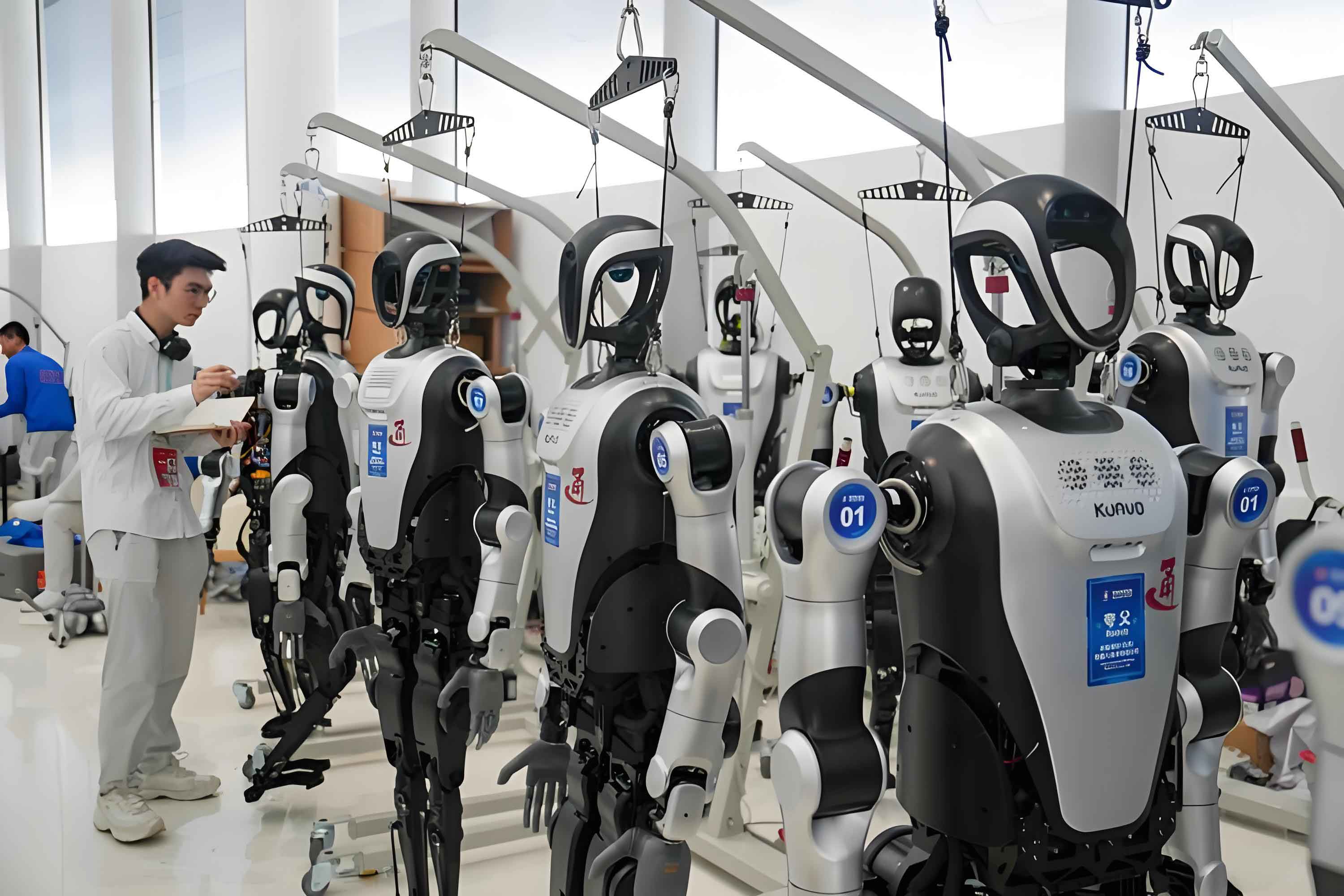
The image above depicts quality inspection processes for humanoid robots, emphasizing the importance of reliability and precision in industrial applications. As humanoid robots become more integrated into production lines and other critical settings, rigorous quality checks are essential to ensure their performance and safety. This focus on durability and accuracy is driving innovations in humanoid robot design, with companies investing in better sensors and control systems to meet the demands of real-world use.
Overall, the expanding applications of humanoid robots demonstrate their potential to transform industries by enhancing efficiency, reducing costs, and enabling new experiences. From entertainment to logistics, humanoid robots are proving to be valuable assets, and their adoption is expected to grow as technology continues to improve.
-
Technological Challenges and the Future of Humanoid Robot Development
Despite the progress in commercialization, the humanoid robot industry faces significant technological hurdles that must be addressed to achieve widespread adoption. Li David, general manager assistant of Yunmu Zhizao, pointed out that the lack of large-scale datasets for industrial operations is a major barrier to developing robust embodied AI brains for humanoid robots. He estimated that breakthroughs in industrial operation foundation models may take one to two years, as current data scarcity limits the ability of humanoid robots to generalize across different tasks and environments. This issue is critical for enhancing the intelligence and autonomy of humanoid robots, enabling them to handle complex scenarios without extensive reprogramming.
Zhang Yanbai of Lingxin Dexterous Hands elaborated on the engineering complexities involved in creating advanced components for humanoid robots, such as dexterous hands. He noted that ideal humanoid robot hands must achieve high torque in small volumes, offer multiple degrees of freedom, integrate various sensors, ensure durability, and remain cost-effective. Solving these challenges requires a long-term perspective and sustained investment in research and development. Zhang Yanbai emphasized that innovation in humanoid robot technology is incremental, and companies must be patient to achieve breakthroughs that enable mass production and reliability.
Paxini, a company specializing in multi-dimensional tactile perception, showcased its TORA-ONE robot’s fine manipulation capabilities, which are crucial for humanoid robots performing delicate tasks. By establishing a data collection factory in June 2025, Paxini aims to build high-quality embodied AI datasets to train models, thereby improving the generalization and adaptability of humanoid robots. This initiative addresses the data scarcity problem and aligns with industry-wide efforts to enhance the cognitive abilities of humanoid robots through better machine learning frameworks.
Wang Xingxing of Yujian Technology echoed the need for technological patience, describing humanoid robots as the “pearl at the top of the manufacturing crown” due to their complexity. The industry’s supply chain is divided into three key areas: the “brain” (AI and cognition), the “body” (hardware and mechanics), and the “cerebellum” (control and coordination). Advances in each area are essential for creating humanoid robots that can operate seamlessly in dynamic environments. As companies continue to innovate, the focus remains on developing more efficient motors, better energy storage systems, and smarter algorithms to overcome current limitations and unlock the full potential of humanoid robots.
-
Insights from Industry Leaders on Long-term Strategies for Humanoid Robots
Executives and founders across the humanoid robot sector emphasize the importance of long-term investment and strategic patience to navigate the challenges and opportunities ahead. Li Tong of Qinglang Intelligence highlighted that while cost reductions are inevitable, the primary focus should be on improving the technological capabilities of humanoid robots to meet evolving market demands. He argued that as humanoid robots become more affordable and capable, they will naturally find applications in a broader range of scenarios, from domestic chores to complex industrial processes. This approach requires continuous innovation and a willingness to iterate based on real-world feedback.
Zhang Zhengtao of Lingbao CASBOT reinforced the view that technical superiority is more important than price for advanced humanoid robots. He believes that as humanoid robots demonstrate greater utility and intelligence, demand will increase, driving further investments in research and development. This, in turn, will lead to cost optimizations through economies of scale, but the initial focus should be on building humanoid robots that can perform reliably in diverse conditions. Zhang Zhengtao cautioned against premature price competitions, which could divert resources from critical technological advancements.
Zhang Yanbai of Lingxin Dexterous Hands added that achieving mass production for humanoid robots depends on solving complex engineering problems and stimulating market demand. He explained that only when humanoid robots are widely adopted can supply-side conditions be optimized for scale, leading to lower costs and higher quality. This virtuous cycle requires collaboration across the industry, including data sharing and standard-setting, to accelerate progress. Zhang Yanbai also stressed that humanoid robot companies must maintain a long-term vision, as breakthroughs in areas like embodied AI and sensor technology may take years to materialize but are essential for sustainable growth.
Wang Xingxing of Yujian Technology summarized the industry’s outlook by predicting that humanoid robot shipments could double annually in the coming years, based on current trends and technological trajectories. He encouraged stakeholders to stay committed to innovation, noting that the humanoid robot market is still in its early stages, with immense potential for expansion. The consensus among leaders is that while commercialization is accelerating, the journey toward fully autonomous and versatile humanoid robots requires persistent effort, collaboration, and a focus on solving real-world problems. As the industry evolves, humanoid robots are poised to become integral partners in various aspects of life, driven by continuous improvements in technology and a deepening understanding of human-robot interaction.
In conclusion, the World Robot Conference 2025 served as a testament to the rapid advancement of the humanoid robot industry, with companies demonstrating tangible progress in revenue growth, price accessibility, and application diversity. The emphasis on moving from demonstration to deployment underscores a maturing market, where humanoid robots are increasingly valued for their practical benefits. However, technological challenges related to AI, data, and engineering remain, necessitating a long-term approach to innovation. As industry leaders advocate for sustained investment and collaboration, the future of humanoid robots appears promising, with the potential to revolutionize sectors worldwide and integrate seamlessly into daily operations. The ongoing evolution of humanoid robots will likely continue to capture attention and drive economic growth, making them a key focus in the global robotics landscape.