
As researchers and industry practitioners, we have witnessed a rapid evolution in humanoid robots, driven by advancements in artificial intelligence, hardware design, and ecosystem development. The focus is shifting from mere biomimetic accuracy to creating intelligent nodes that enhance efficiency in the physical world. In this analysis, we explore the application trends, challenges, and recommendations for humanoid robots, drawing from global developments and our own observations. We emphasize that the success of humanoid robots hinges not on their human-like appearance but on their ability to function as adaptive, intelligent systems in diverse environments. Throughout this discussion, we will incorporate tables and mathematical formulations to summarize key insights, ensuring a comprehensive understanding of the field.
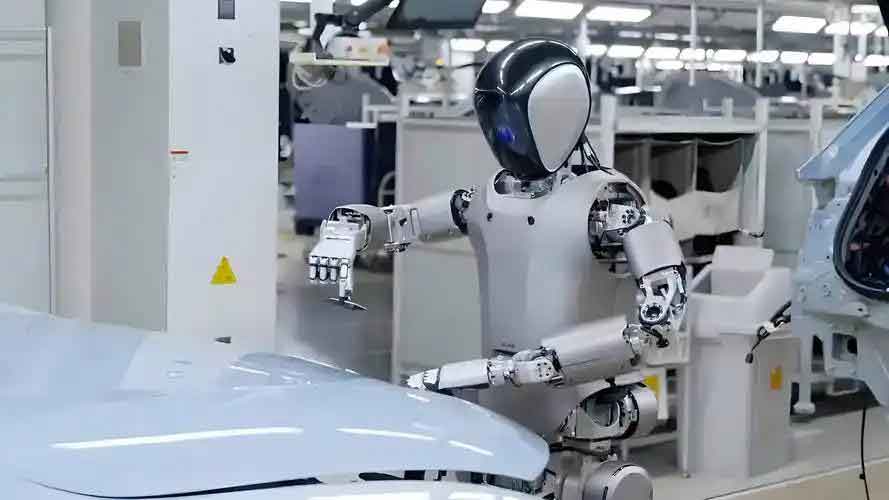
Humanoid robots represent a convergence of multiple disciplines, including robotics, AI, and materials science. Their development is structured around three core components: the “brain” for perception, decision-making, and human-robot interaction; the “cerebellum” for motion control; and the “limbs” for physical execution. We believe that the integration of these elements is critical for achieving general-purpose capabilities. For instance, the brain leverages large-scale AI models to enable complex task planning and environmental understanding, while the cerebellum ensures real-time responsiveness through advanced control algorithms. The limbs, comprising actuators and sensors, provide the physical means for interaction. To quantify progress, we often use performance metrics such as task success rates and energy efficiency. For example, the reward function in reinforcement learning for humanoid robots can be expressed as: $$ R = \sum_{t=0}^{T} \gamma^t r(s_t, a_t) $$ where \( R \) is the cumulative reward, \( \gamma \) is the discount factor, \( r \) is the immediate reward at time \( t \), \( s_t \) is the state, and \( a_t \) is the action taken by the humanoid robot. This formulation helps in optimizing learning processes for humanoid robots in dynamic environments.
The technological landscape for humanoid robots is evolving rapidly, with significant strides in AI-driven systems. In the brain component, large language models (LLMs), vision-language models (VLMs), and multimodal models are enhancing cognitive abilities. We have observed that these models enable humanoid robots to understand natural language, interpret visual scenes, and perform logical reasoning. For instance, the integration of transformer-based architectures allows for end-to-end learning, where a humanoid robot can map sensory inputs directly to actions. The performance of such models can be modeled using a loss function: $$ \mathcal{L} = -\mathbb{E}_{(x,y) \sim \mathcal{D}} \left[ \log p(y | x; \theta) \right] + \lambda \|\theta\|^2 $$ where \( \mathcal{L} \) is the loss, \( \mathcal{D} \) is the dataset, \( x \) represents inputs, \( y \) represents outputs, \( \theta \) are model parameters, and \( \lambda \) is a regularization term. This approach is pivotal for reducing errors in humanoid robot decision-making. In the cerebellum, motion control relies on dynamics equations, such as: $$ \tau = M(q)\ddot{q} + C(q, \dot{q}) + G(q) $$ where \( \tau \) is the torque vector, \( M(q) \) is the inertia matrix, \( C(q, \dot{q}) \) represents Coriolis and centrifugal forces, and \( G(q) \) is the gravitational vector. These equations are essential for stable bipedal locomotion in humanoid robots.
| Component | Key Technologies | Performance Metrics |
|---|---|---|
| Brain (Cognitive Systems) | LLMs, VLMs, Multimodal Models | Task success rate, inference latency, generalization accuracy |
| Cerebellum (Motion Control) | Reinforcement learning, imitation learning | Stability index, energy consumption, response time |
| Limb (Actuation) | High-torque actuators, flexible materials | Power density, durability, weight efficiency |
Globally, the development of humanoid robots is led by tech giants and innovative startups. We have analyzed that companies like Tesla and NVIDIA are pushing the boundaries with proprietary AI platforms and custom hardware. For example, Tesla’s Optimus humanoid robot utilizes an end-to-end AI stack, while NVIDIA’s Project GR00T provides a foundation model for diverse applications. In contrast, domestic efforts are focused on catching up, with companies developing their own AI systems and datasets. The computational demands for humanoid robots are immense, often requiring floating-point operations per second (FLOPS) that scale with model size. A common measure is: $$ \text{FLOPS} = 2 \times \text{model parameters} \times \text{sequence length} $$ which highlights the need for efficient hardware in humanoid robots. Additionally, software platforms like ROS 2 are crucial for integration, but we note a gap in mature open-source ecosystems compared to international standards.
In terms of hardware, the limbs of humanoid robots depend on critical components such as precision reducers, servo motors, and multi-axis force/torque sensors. We have found that international suppliers dominate the market for high-end parts, but domestic manufacturers are making progress in localization. The cost structure of humanoid robots is a significant barrier, with key components contributing to overall expenses. For instance, the torque output of actuators can be modeled as: $$ \tau = k_t \cdot I $$ where \( \tau \) is torque, \( k_t \) is the torque constant, and \( I \) is current. This linear relationship underscores the importance of efficient motor design for humanoid robots. Moreover, energy consumption remains a challenge; the battery life of a humanoid robot can be estimated using: $$ E_{\text{total}} = P_{\text{avg}} \cdot t $$ where \( E_{\text{total}} \) is total energy, \( P_{\text{avg}} \) is average power, and \( t \) is time. Optimizing this is vital for prolonged operation of humanoid robots.
| Component Type | International Leaders | Domestic Progress | Technical Challenges |
|---|---|---|---|
| Precision Reducers | Harmonic Drive Systems, Nabtesco | Growing localization efforts | High accuracy, cost reduction |
| Servo Motors | Kollmorgen, Maxon Motor | Improvements in power density | Thermal management, integration |
| Force/Torque Sensors | ATI Industrial Automation | Emerging domestic solutions | Calibration, durability |
| Electronic Skin | Tekscan, JDI | Early-stage research | Flexibility, scalability |
Application trends for humanoid robots span various sectors, including manufacturing, service industries, and specialized environments. We have observed that in automotive manufacturing, humanoid robots are being deployed for tasks like welding and assembly, where their dexterity offers advantages over traditional robots. The efficiency gain can be quantified using a productivity index: $$ \text{Productivity} = \frac{\text{Output tasks}}{\text{Time}} \times \text{Success rate} $$ which helps in evaluating the impact of humanoid robots. In service scenarios, such as home assistance, humanoid robots are expected to handle chores and provide companionship. However, the complexity of home environments poses challenges for perception and interaction. For example, the probability of successful task completion in a dynamic setting can be modeled as: $$ P(\text{success}) = \int p(s) \cdot p(a|s) \, ds $$ where \( p(s) \) is the state distribution and \( p(a|s) \) is the policy of the humanoid robot. This underscores the need for robust AI in humanoid robots.
Logistics and warehousing represent another promising area for humanoid robots, where they complement automated guided vehicles (AGVs) by handling irregular items. We estimate that the adoption rate of humanoid robots in logistics could follow a logistic growth curve: $$ N(t) = \frac{K}{1 + e^{-r(t-t_0)}} $$ where \( N(t) \) is the number of deployments, \( K \) is the carrying capacity, \( r \) is the growth rate, and \( t_0 \) is the midpoint. This model reflects the gradual integration of humanoid robots into existing systems. In hazardous environments, such as nuclear facilities or disaster response, humanoid robots can reduce human risk. The reliability of a humanoid robot in such settings can be expressed as: $$ R(t) = e^{-\lambda t} $$ where \( R(t) \) is reliability over time and \( \lambda \) is the failure rate. Improving this is crucial for safety-critical applications of humanoid robots.
| Scenario | Key Tasks | Technology Requirements | Market Potential |
|---|---|---|---|
| Manufacturing | Assembly, quality inspection | High precision, real-time control | High, driven by automation needs |
| Home Services | Cleaning, elder care | Natural interaction, safety | Moderate, limited by cost |
| Logistics | Sorting, delivery | Navigation, object manipulation | High, with scalability |
| Hazardous Environments | Inspection, rescue | Durability, autonomy | Moderate, niche applications |
Despite the progress, humanoid robots face several challenges that hinder widespread adoption. From a technical perspective, AI models for humanoid robots suffer from issues like hallucinations and poor generalization. We have analyzed that the generalization error can be bounded using: $$ \epsilon_g \leq \epsilon_e + \sqrt{\frac{\log |\mathcal{H}| + \log(1/\delta)}{2n}} $$ where \( \epsilon_g \) is generalization error, \( \epsilon_e \) is empirical error, \( \mathcal{H} \) is hypothesis class, \( \delta \) is confidence, and \( n \) is sample size. This highlights the data dependency for training humanoid robots. Additionally, sensor fusion in humanoid robots is complex; a common approach is Kalman filtering, represented as: $$ \hat{x}_{k|k} = \hat{x}_{k|k-1} + K_k(z_k – H_k\hat{x}_{k|k-1}) $$ where \( \hat{x} \) is state estimate, \( K \) is Kalman gain, \( z \) is measurement, and \( H \) is observation matrix. Inaccuracies here can lead to failures in humanoid robots.
Industrialization challenges include high costs and inadequate scenario adaptation. We note that the total cost of ownership for humanoid robots can be modeled as: $$ \text{TCO} = C_{\text{acquisition}} + C_{\text{maintenance}} + C_{\text{energy}} $$ which often exceeds practical limits for small enterprises. Moreover, the learning curve for humanoid robots in new environments is steep; the time to proficiency might follow: $$ T_{\text{learn}} = \alpha \cdot \frac{1}{\text{data quality}} + \beta $$ where \( \alpha \) and \( \beta \) are constants. This slows down the deployment of humanoid robots. Ecosystem issues, such as data scarcity and talent shortages, further exacerbate these problems. The data requirement for training humanoid robots can be expressed as: $$ D_{\text{need}} = k \cdot \text{task complexity} $$ where \( k \) is a scaling factor, indicating the need for massive datasets for humanoid robots.
| Challenge Category | Specific Issues | Impact Level |
|---|---|---|
| Technical | AI model errors, sensor limitations | High, affects reliability |
| Industrial | High costs, slow adoption | Medium, limits scalability |
| Ecosystem | Data gaps, skill shortages | High, hinders innovation |
To address these challenges, we propose several recommendations. First, strengthening core technology innovation is essential for humanoid robots. This includes investing in next-generation AI algorithms and hardware components. We suggest fostering collaborations through research consortia, where shared resources can accelerate development. The return on investment for such initiatives can be estimated as: $$ \text{ROI} = \frac{\text{Benefits} – \text{Costs}}{\text{Costs}} \times 100\% $$ which should be positive for sustainable growth of humanoid robots. Second, building a robust industry ecosystem for humanoid robots requires standardizing interfaces and promoting open-source platforms. We advocate for policies that support supply chain resilience, reducing dependencies on foreign components. A risk mitigation model could be: $$ \text{Risk} = \text{Probability} \times \text{Impact} $$ which helps in prioritizing areas for humanoid robots.
Third, accelerating application demonstrations for humanoid robots in select scenarios can drive adoption. We recommend pilot projects in manufacturing and healthcare, where the value proposition is clear. The success probability of such projects can be enhanced by iterative testing, modeled as: $$ P_{\text{success}} = 1 – (1 – p)^n $$ where \( p \) is single-trial success probability and \( n \) is number of trials. Finally, optimizing talent development for humanoid robots involves revising educational curricula and encouraging interdisciplinary programs. The growth in skilled personnel can be described by: $$ N_{\text{talent}}(t) = N_0 e^{rt} $$ where \( N_0 \) is initial number and \( r \) is growth rate. This ensures a pipeline for humanoid robot innovation.
In conclusion, humanoid robots hold immense potential to transform industries and daily life, but realizing this requires concerted efforts in technology, ecosystem, and policy. We emphasize that continuous innovation and collaboration are key to overcoming the current hurdles. By addressing the trends, challenges, and recommendations outlined here, stakeholders can pave the way for humanoid robots to become integral intelligent agents in our society. As we move forward, monitoring progress through metrics and adaptive strategies will be crucial for the sustained advancement of humanoid robots.