
The quest for intelligent materials that can seamlessly interact with their environment, converting ambient stimuli into precise mechanical motion, represents a frontier in modern materials science and robotics. Among the myriad of stimuli-responsive systems, humidity-driven actuators hold particular promise due to the ubiquitous presence of water vapor and the potential for energy-autonomous operation. Our exploration into this domain has led us to the innovative use of graphene oxide (GO) and its photothermal reduction, a process that enables the creation of monolithic, yet functionally graded, smart films. This work details our journey in developing a novel optical fabrication methodology for graphene-based actuators, culminating in the realization of versatile, humidity-driven bionic robot prototypes. The core of our approach lies in manipulating the surface chemistry of GO paper through controlled ultraviolet (UV) irradiation, creating an intrinsic asymmetry that powers motion—a principle inspired by the hygroscopic movements found in plant tendrils and seed pods. The development of such bionic robot components marks a significant step towards soft, programmable machines that operate without conventional electronic or pneumatic systems.
Traditional actuators, often based on bilayer structures of dissimilar materials (e.g., bimetal strips or polymer bilayers), face inherent limitations. Interfacial delamination, fatigue under cyclic loading, and the complexity of integrating disparate materials can compromise performance and longevity. In contrast, our method produces a unified, all-graphene-based film with a gradient in oxygen-containing functional groups across its thickness. This gradient is not a physical laminate but a continuous chemical transition, resulting in exceptional interfacial stability and durability. The resulting material exhibits a pronounced, reversible bending curvature in response to changes in ambient relative humidity (RH), providing the fundamental actuation mechanism for our bionic robot designs. The following sections will elaborate on the material fabrication, the physicochemical mechanism underpinning the humidity response, the quantitative actuation performance, and the embodiment of these principles into functional bionic robot demonstrators.
Material Synthesis and Photoreduction Strategy
The starting material for our intelligent films is free-standing paper-like GO, synthesized via a modified Hummers’ method and vacuum-filtrated to form a flexible, macroscopic sheet. The key innovation is the unilateral, patterned irradiation of this GO paper using a UV light source (e.g., a 365 nm LED). This process, which we term “gradient photoreduction,” selectively reduces the GO on the irradiated side, while the backside remains largely in its highly oxidized state. The reduction process involves the photothermal and photochemical cleavage of labile oxygen functional groups (e.g., epoxides and hydroxyls), increasing the sp2 carbon network’s conjugation on the irradiated surface. The degree of reduction (and thus the property gradient) is precisely tunable by controlling the UV exposure dose (intensity × time).
The table below summarizes the characteristic changes in the material properties before and after controlled unilateral UV irradiation, highlighting the creation of the essential asymmetry.
| Property | Pristine GO Side (Non-Irradiated) | Reduced GO Side (Irradiated) | Measurement Technique |
|---|---|---|---|
| C/O Ratio | ~2.0 | ~5.0 to 10.0 (tunable) | X-ray Photoelectron Spectroscopy (XPS) |
| Water Contact Angle | ~40° (Hydrophilic) | ~80° – 100° (Hydrophobic) | Goniometry |
| Electrical Conductivity | ~10-6 S/m (Insulating) | ~102 S/m (Conductive) | Four-Point Probe |
| Typical Functional Groups | -COOH, -OH, C-O-C (Epoxy) | C=C, Defects, Residual -OH | Fourier-Transform IR Spectroscopy |
This controlled asymmetry is the cornerstone of the actuation behavior. The hydrophilic pristine GO side readily adsorbs water molecules, leading to expansion, while the more hydrophobic reduced graphene oxide (rGO) side exhibits minimal swelling. This differential dimensional change upon humidity variation generates internal stress, causing the film to bend towards the rGO side. The relationship between the induced strain (ε) and the swelling difference can be modeled. If we denote the linear expansion coefficient due to moisture absorption for the GO side as αGO and for the rGO side as αrGO, and the change in moisture content as ΔC, the differential strain Δε driving the bending is approximately:
$$
\Delta \varepsilon = (\alpha_{GO} – \alpha_{rGO}) \cdot \Delta C
$$
For a bilayer beam of total thickness h, the radius of curvature R induced by this mismatch strain is given by the classic Stoney formula adaptation:
$$
\frac{1}{R} = \frac{6 \cdot (1 + m)^2 \cdot \Delta \varepsilon}{h \cdot [3(1+m)^2 + (1+mn)(m^2 + \frac{1}{mn})]}
$$
where m = hGO/hrGO (the thickness ratio of the two effective layers) and n = ErGO/EGO (the Young’s modulus ratio). Since our gradient is continuous, this model provides a simplified but insightful framework. Crucially, this actuation mechanism is entirely intrinsic, reversible, and requires no external power for the bending motion itself, making it ideal for energy-efficient bionic robot applications.
Mechanism of Humidity Response and Actuation Dynamics
The fundamental driving force for our actuator is the differential water adsorption between the two faces of the film. First-principles density functional theory (DFT) calculations support this mechanism. They show that the binding energy of a water molecule to a model oxidized graphene surface (with epoxy and hydroxyl groups) is significantly higher (e.g., -0.5 to -0.7 eV) compared to a partially reduced, mostly sp2 carbon surface (e.g., -0.2 to -0.3 eV). This stronger physisorption on the GO side leads to a greater number of adsorbed water molecules per unit area at a given relative humidity.
The adsorption and subsequent swelling kinetics govern the actuation speed. The process can be described by a diffusion-limited model. The characteristic response time τ for a film of thickness h is related to the diffusion coefficient D of water vapor in the GO/rGO matrix:
$$
\tau \propto \frac{h^2}{D}
$$
Our experiments show that reducing the film thickness or creating micropores via laser processing can dramatically enhance the response speed, enabling actuation cycles on the order of seconds. The actuation performance metrics for a standard film are quantified below:
| Performance Parameter | Value / Range | Test Conditions |
|---|---|---|
| Maximum Bending Curvature | 0.5 – 2.0 cm-1 | RH change: 20% to 90% |
| Response Time (bending) | 3 – 10 seconds | For a 10 μm thick film |
| Recovery Time | 5 – 15 seconds | Upon RH decrease |
| Blocking Force (per width) | 1 – 5 mN/mm | At maximum deflection |
| Cycle Life | > 10,000 cycles | With >90% curvature retention |
The generated force is sufficient to lift objects many times the actuator’s own weight, a critical metric for a functional bionic robot component. The work capacity per unit mass of these graphene actuators rivals or exceeds that of many natural muscular systems and other synthetic hydro-actuators, underscoring their potential in biomimetic applications.
From Intelligent Film to Functional Bionic Robot
The true potential of this technology is realized when the two-dimensional actuation of the film is transformed into controlled, three-dimensional motion for robotic tasks. By patterning the UV irradiation—either through masks or direct laser writing—we can define regions with different responsiveness on a single film. This allows for the design of complex, programmable deformation sequences upon humidity changes.
One of our most compelling demonstrations is a bionic robot gripper inspired by climbing plant tendrils. A rectangular strip of GO paper is unilaterally irradiated with a spiral pattern. When exposed to a moist stimulus (e.g., breath or localized mist), the asymmetrical swelling causes the strip to coil into a tight helix, mimicking the coiling action of a tendril. This helix can then grasp a small object. Subsequent exposure to a dry environment (or a gentle heating from the reduced side’s photothermal effect) causes the helix to uncoil, releasing the object. This represents a fully moisture-triggered, reversible gripping mechanism for a soft bionic robot.
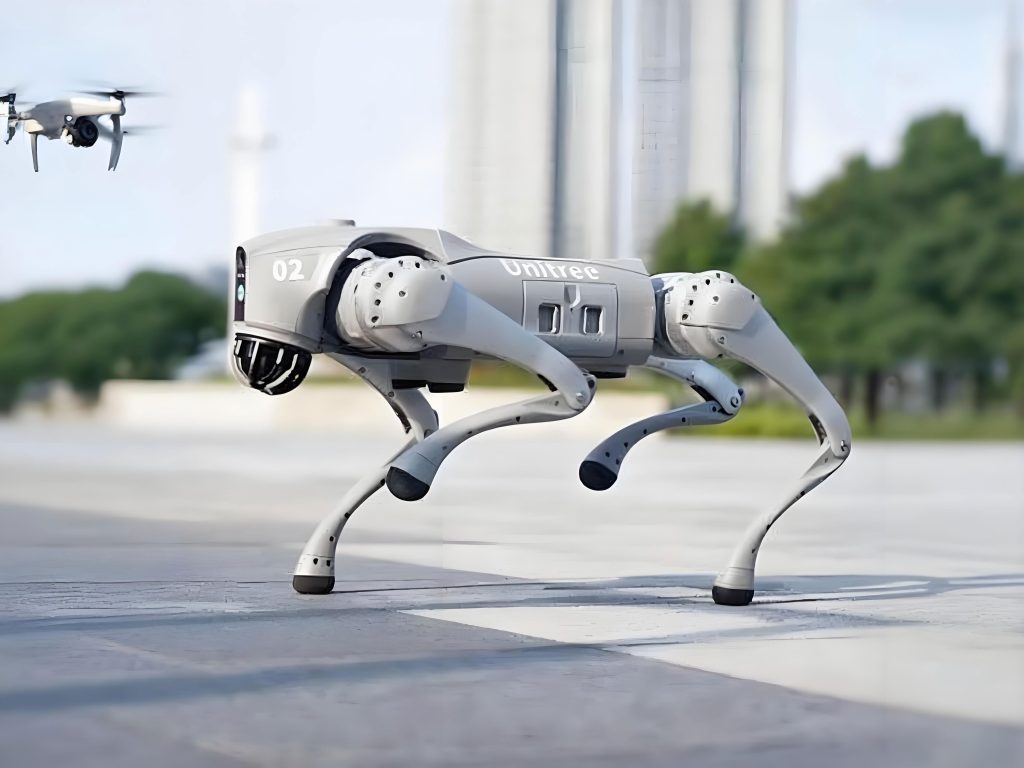
Beyond grippers, we have engineered various bionic robot prototypes:
- Walking Crawlers: Asymmetric leg structures made from our smart film can alternately bend and straighten in a gradient humidity field, enabling inchworm-like locomotion on a moist surface.
- Biomimetic Flowers/Buds: Patterned petals that open in high humidity and close in low humidity, demonstrating potential for environmental sensing and adaptive camouflage.
- Self-Folding Origami Structures: Pre-defined crease lines with differential reduction can guide the autonomous folding of flat sheets into 3D shapes (e.g., boxes, pyramids) under humidity control, a concept valuable for deployable microsystems.
The control of these bionic robots can be achieved through global environmental changes or, more precisely, via localized stimuli. For instance, focusing an IR laser on the conductive rGO side of a specific segment causes localized heating and desorption of water, creating a localized “dry” command that can trigger bending in a selected joint of the bionic robot. This allows for programmable, contactless control of complex motions.
Mathematical Modeling for Robot Design
To transition from demonstrators to engineered bionic robots, predictive design tools are essential. We model the actuator as a Timoshenko beam with moisture-dependent eigenstrain. The governing equation for the deflection w(x,t) along the length x under a transient moisture field C(x,z,t) is:
$$
\frac{\partial^2}{\partial x^2}\left[ D(x) \frac{\partial^2 w}{\partial x^2} \right] = -\frac{\partial^2}{\partial x^2} \left[ \int_{-h/2}^{h/2} E(z) \cdot \alpha(z) \cdot \Delta C(x,z,t) \cdot z \, dz \right]
$$
where D(x) is the flexural rigidity, E(z) is the Young’s modulus gradient through thickness z, and α(z) is the hygroscopic expansion coefficient gradient. For a robot leg performing cyclic motion, the net displacement per cycle can be optimized by solving this equation coupled with the moisture diffusion equation and contact mechanics. The energy conversion efficiency η of the bionic robot actuator, defined as the mechanical work output divided by the chemical potential energy change of the adsorbed water, can be estimated:
$$
\eta = \frac{W_{mech}}{N_{H_2O} \cdot \Delta \mu} \approx \frac{F \cdot \delta}{A \cdot \Gamma \cdot RT \ln(RH)}
$$
where F is force, δ is displacement, A is area, Γ is the differential adsorption density, R is the gas constant, T is temperature, and RH is relative humidity. Our current prototypes achieve η in the range of 0.1% to 1%, highlighting room for material optimization but already demonstrating functional utility.
Future Prospects and Application Horizons
The development of this optically programmable, humidity-responsive graphene film opens broad avenues for next-generation bionic robotics. The material’s combination of high strength, flexibility, biocompatibility, and tailorable responsiveness makes it suitable for several transformative applications:
- Wearable and Epidermal Devices: As an “electronic skin” that responds to human sweat or environmental humidity, enabling adaptive clothing, haptic feedback interfaces, or health monitoring patches.
- Microscale Biomicrorobots: Miniaturized versions could operate in physiological environments, performing tasks like targeted drug delivery or microsurgery, powered by biological humidity gradients.
- Autonomous Environmental Sensors and Harvesters: Bionic robots that change shape to optimize solar exposure, collect atmospheric water, or disperse seeds in response to weather patterns.
- Soft Robotics and Artificial Muscles: As building blocks for multi-degree-of-freedom manipulators and locomotion systems in robots designed for safe interaction with humans or delicate objects.
The optical fabrication pathway is inherently scalable, compatible with roll-to-roll processing, and allows for rapid prototyping of complex actuator designs. Future work will focus on integrating other functionalities, such as embedded sensing (using the rGO’s conductivity) or combining humidity response with photo-thermal actuation for multi-modal control of the bionic robot. Furthermore, hybrid composites incorporating polymers or other 2D materials could enhance force output, response speed, or introduce sensitivity to additional stimuli.
In conclusion, the unilateral photoreduction of graphene oxide presents a powerful and versatile platform for creating intelligent, humidity-driven actuators. By mastering the gradient in surface chemistry, we can dictate the material’s conversation with water vapor, translating it into precise mechanical work. This fundamental advance provides a robust material foundation for a new class of energy-autonomous, soft, and environmentally responsive bionic robots. As we continue to refine the material science and control algorithms, the vision of ubiquitous, small-scale machines that operate in harmony with natural environmental cues moves closer to reality, promising significant impacts across fields from biomedicine to environmental monitoring.