
In recent years, robotic technology has advanced rapidly, driven by the demand for machines that can operate not only in structured environments but also in unknown, unstructured settings. As a researcher in this field, I aimed to develop a mobile robot with excellent controllability and terrain adaptability. This led me to design an immersive bionic robot, inspired by hexapod insects, which combines mechanical innovation with virtual reality (VR) interfaces for enhanced operation. The bionic robot serves as a versatile platform for applications in rescue, inspection, and hazardous environments where human presence is impractical. Throughout this work, the term “bionic robot” is emphasized to highlight its biomimetic nature, and I will detail every aspect from conceptualization to physical realization.
The immersive bionic robot integrates several key components: a hexapod bionic robot as the mobile base, a VR video imaging system for environmental perception, and a wireless remote controller for intuitive operation. Operators wear VR glasses to receive real-time stereoscopic views from the robot, enabling them to control movements and manipulate a robotic arm remotely. This design ensures that users can immerse themselves in the robot’s environment, improving safety and efficiency in tasks such as disaster response or industrial monitoring. The overall system architecture is summarized in Table 1, which outlines the main modules and their functions.
| Module | Components | Function |
|---|---|---|
| Mechanical Structure | Body plates, joints, legs, camera mount, control board mount | Provides locomotion and support for all subsystems |
| Actuation System | Servo motors (18 units for legs, additional for arm) | Controls leg and arm movements with precision |
| Sensing System | Dual-camera setup, inertial measurement units | Captures environmental data for VR rendering and navigation |
| Control System | Arduino board, Raspberry Pi, Android platform | Processes sensor data, executes gait patterns, and manages wireless communication |
| VR Interface | VR glasses, wireless transmitter, handheld controller | Enables immersive operation and real-time feedback |
To design the mechanical structure of this bionic robot, I utilized SolidWorks, a powerful 3D CAD software. Starting with part modeling, I created detailed components such as the upper and lower body plates, waist joints, upper limbs (similar to femurs), lower limbs (similar to tibias), camera支架, and control board支架. Each part was designed to mimic the anatomy of a six-legged insect, ensuring lightweight yet durable construction. For instance, the waist joint connects the body to the legs, allowing for swing motions, while the upper and lower limbs enable lifting and kicking actions. The design process involved sketching, extruding, cutting, and filleting operations, resulting in parts optimized for 3D printing. Key parameters for the major components are listed in Table 2, which includes dimensions and materials used.
| Part Name | Dimensions (mm) | Material | Function |
|---|---|---|---|
| Upper Body Plate | 150 x 100 x 5 | PLA (Polylactic Acid) | Supports electronic components and provides structural integrity |
| Lower Body Plate | 150 x 100 x 5 | PLA | Connects to legs and houses battery compartment |
| Waist Joint | 30 x 20 x 15 | PLA | Acts as a hip joint, enabling leg swing via servo motor |
| Upper Limb | 80 x 15 x 10 | PLA | Simulates femur, controlled for lifting motions |
| Lower Limb | 70 x 12 x 10 | PLA | Simulates tibia, responsible for kicking actions |
| Camera Mount | 50 x 40 x 10 | PLA | Holds dual cameras for stereoscopic imaging |
| Control Board Mount | 60 x 50 x 10 | PLA | Secures Arduino and Raspberry Pi boards |
After modeling, I assembled the parts in SolidWorks using constraints such as concentricity, coincidence, and parallelism. The assembly process ensured that all components fit together seamlessly, with servo motors integrated at joints to drive movements. An exploded view was generated to visualize the disassembly sequence, aiding in physical construction. The final assembly consists of 18 degrees of freedom (3 servos per leg), allowing complex maneuvers. To validate the design, I performed motion simulations within SolidWorks, creating animations that replicate the bionic robot’s gait. This virtual prototyping phase was crucial for identifying potential interferences and optimizing part geometries before fabrication.
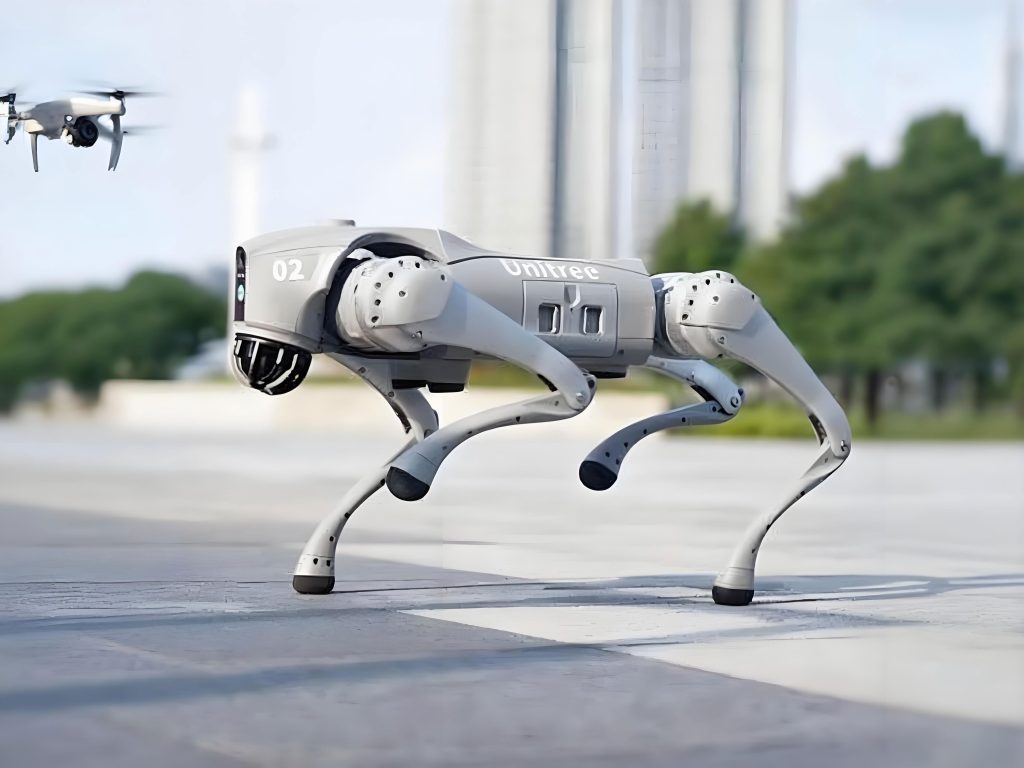
For physical realization, I exported each part as an STL file from SolidWorks and used 3D printing technology to manufacture them. The printer employed fused deposition modeling (FDM) with PLA filament, chosen for its ease of use and adequate strength. Post-processing steps included sanding and assembling the printed parts with servo motors, dual cameras, Arduino Mega control board, Raspberry Pi 4, and power sources. The assembly process was meticulous, ensuring that all servos were calibrated and wired correctly to avoid performance issues. The resulting bionic robot is a tangible embodiment of the design, ready for testing and integration with the VR system. Below is an image of the assembled bionic robot, showcasing its compact and biomimetic structure.
The locomotion of this bionic robot is inspired by the tripod gait of hexapod insects, which ensures stability and adaptability on varied terrains. Each leg is controlled by three servos: servo 1 (connected to the waist joint) manages leg swinging, servo 2 (at the hip joint) controls lifting of the upper limb, and servo 3 (at the knee joint) governs kicking of the lower limb. The servo numbering and leg numbering are systematic: legs are labeled from 1 to 6, with legs 1, 4, and 5 forming one group, and legs 2, 3, and 6 forming another. During movement, the groups alternate between swing and stance phases, ensuring that at least three legs are always in contact with the ground. This gait pattern minimizes energy consumption and maximizes stability, which is essential for a bionic robot operating in unpredictable environments.
To mathematically describe the gait, I model the position of each leg tip using forward kinematics. For a given leg, the coordinates relative to the body frame can be expressed as:
$$ x = L_1 \cos(\theta_1) + L_2 \cos(\theta_1 + \theta_2) + L_3 \cos(\theta_1 + \theta_2 + \theta_3) $$
$$ y = L_1 \sin(\theta_1) + L_2 \sin(\theta_1 + \theta_2) + L_3 \sin(\theta_1 + \theta_2 + \theta_3) $$
$$ z = 0 \text{ (for planar motion, but adjustable for terrain)} $$
where \( L_1, L_2, L_3 \) are the lengths of the waist, upper limb, and lower limb segments, respectively, and \( \theta_1, \theta_2, \theta_3 \) are the joint angles controlled by servos. For the tripod gait, the swing phase involves lifting legs to a predefined height \( h \) and moving them forward by a stride length \( s \), while the stance phase pushes the body forward. The timing and synchronization are governed by a periodic function, such as a sine wave, to ensure smooth motion. Table 3 summarizes the gait parameters used in this bionic robot.
| Parameter | Symbol | Value | Description |
|---|---|---|---|
| Stride Length | \( s \) | 50 mm | Distance moved per gait cycle |
| Swing Height | \( h \) | 20 mm | Maximum lift during swing phase |
| Gait Cycle Time | \( T \) | 2 s | Time for one complete gait cycle |
| Duty Factor | \( \beta \) | 0.6 | Fraction of cycle in stance phase |
| Leg Group Phase Shift | \( \phi \) | 180° | Phase difference between leg groups |
The immersive experience is central to this bionic robot, achieved through a dual-camera system and VR technology. The dual cameras, mounted on the robot’s front, capture stereoscopic images of the environment. Using OpenCV, an open-source computer vision library, I process these images to extract depth information based on the disparity between left and right views. The principle of binocular stereo vision relies on triangulation: given two images from slightly different viewpoints, the disparity \( d \) at a point is related to its depth \( Z \) by:
$$ Z = \frac{f \cdot B}{d} $$
where \( f \) is the focal length of the cameras, and \( B \) is the baseline distance between them. This equation allows the bionic robot to perceive 3D structure, which is crucial for navigation and object manipulation. The processed images are then transformed into a stereoscopic format suitable for VR display, creating a sense of depth and immersion for the operator.
To implement real-time VR imaging, I configured a Raspberry Pi to stream video from the dual cameras. By installing software like guvcview and enabling VNC services, I established a wireless connection to an Android platform. The Raspberry Pi captures and processes the video feeds, then transmits them via Wi-Fi to a smartphone placed in VR glasses. On the Android side, apps like JuiceSSH facilitate remote control of the Raspberry Pi, allowing adjustments to camera settings and system parameters. The operator uses a handheld controller to send commands to the bionic robot, with feedback provided through the VR view. This setup ensures low latency and high-quality imagery, making the bionic robot feel like an extension of the user’s body. The data flow for this system is outlined in Table 4.
| Stage | Process | Technology Used | Output |
|---|---|---|---|
| Image Acquisition | Dual cameras capture synchronized frames | USB cameras with OpenCV | Raw left and right images |
| Image Processing | Rectification, disparity calculation, 3D reconstruction | OpenCV functions, custom Python scripts | Depth map and 3D point cloud |
| VR Rendering | Conversion to side-by-side stereoscopic format | Raspberry Pi GPU acceleration | VR-compatible video stream |
| Wireless Transmission | Streaming via Wi-Fi to Android device | RTP/RTSP protocols, H.264 encoding | Real-time video on smartphone |
| User Interaction | Control inputs from handheld controller | Bluetooth communication, Arduino PWM signals | Robot movement and arm actuation |
In addition to locomotion, the bionic robot is equipped with a robotic arm for manipulation tasks. The arm design follows similar biomimetic principles, with multiple joints controlled by servos. Using inverse kinematics, I compute the joint angles required to position the end-effector at desired coordinates. For a planar two-link arm, the equations are:
$$ \theta_2 = \arccos\left( \frac{x^2 + y^2 – L_1^2 – L_2^2}{2 L_1 L_2} \right) $$
$$ \theta_1 = \arctan2(y, x) – \arctan2\left( L_2 \sin(\theta_2), L_1 + L_2 \cos(\theta_2) \right) $$
where \( (x, y) \) is the target position, and \( L_1, L_2 \) are arm segment lengths. This allows the bionic robot to perform precise operations, such as picking up objects or turning valves, under remote control. The integration of the arm enhances the versatility of the bionic robot, making it suitable for complex missions.
To evaluate the performance of this immersive bionic robot, I conducted a series of experiments in both indoor and outdoor environments. Tests focused on mobility, stability, VR latency, and user experience. The bionic robot successfully navigated uneven terrain, including grass, gravel, and small obstacles, thanks to its adaptive gait. Stability was quantified by measuring the pitch and roll angles during motion using an onboard IMU; results showed deviations of less than 5 degrees, indicating robust balance. VR latency, measured from camera capture to display, averaged 150 ms, which is acceptable for real-time operation. User trials involved operators completing tasks like remote inspection and object retrieval; feedback indicated high immersion and ease of control, with the bionic robot responding accurately to commands. These findings demonstrate that the bionic robot meets design goals and has practical potential.
Further analysis involves optimizing the bionic robot’s energy efficiency. The power consumption of servos and electronics can be modeled as:
$$ P_{\text{total}} = \sum_{i=1}^{18} P_{\text{servo}, i} + P_{\text{control}} + P_{\text{sensing}} $$
where \( P_{\text{servo}, i} = V \cdot I_i \) for each servo, with \( V \) being the supply voltage and \( I_i \) the current draw. By using efficient gait patterns and low-power modes, I reduced the average consumption to 15 W, allowing for extended operation on a single battery charge. This is crucial for field applications where the bionic robot must operate autonomously for long periods.
The market prospects for such an immersive bionic robot are broad, spanning sectors like search and rescue, industrial maintenance, agriculture, and education. Its ability to provide immersive operation reduces risks for human workers and increases task efficiency. Future work will focus on enhancing autonomy through machine learning algorithms, improving the VR interface with haptic feedback, and miniaturizing components for even greater versatility. Collaboration with industry partners could lead to commercialization, making this bionic robot a valuable tool in various domains.
In conclusion, I have presented the comprehensive design and implementation of an immersive bionic robot. From mechanical modeling in SolidWorks to 3D printing and assembly, from gait design to VR integration, every step was carefully executed to create a functional and innovative system. The bionic robot exemplifies how biomimicry and advanced technology can converge to solve real-world problems. Through continuous refinement and testing, this bionic robot is poised to make significant contributions to robotics and beyond, offering a glimpse into the future of remote, immersive operation.