
As a researcher focused on enhancing the interaction capabilities of companion robots for children’s games, I have been exploring advanced control methods to ensure smooth and stable motion. In this article, I present a comprehensive study on an improved PID control algorithm combined with feedforward compensation for trajectory tracking in companion robots. The goal is to achieve precise and responsive control, which is crucial for engaging and safe interactions with children. The companion robot, designed for activities such as gesture-based games and dance demonstrations, requires high-performance arm movement control. Traditional PID controllers often suffer from issues like overshoot and oscillation, especially in dynamic environments. To address this, I propose integrating the Sparrow Search Algorithm (SSA) to optimize PID parameters and incorporating a feedforward control strategy. This approach aims to minimize tracking errors and improve stability, making the companion robot more effective in real-time applications.
The companion robot market has grown significantly, with increasing demand for robots that can assist in education, entertainment, and therapy for children. However, achieving natural and fluid motion remains a challenge due to the complexities of robotic dynamics. In my work, I focus on a six-degree-of-freedom serial industrial robot, similar to the JL8-600 model, which is suitable for companion tasks. The control system must handle rapid movements while maintaining accuracy. I begin by analyzing the robot’s dynamics using the Newton-Euler method, which provides a foundation for control design. The dynamics of a robotic arm can be expressed as:
$$ \tau = M(\theta) \ddot{\theta} + V(\theta, \dot{\theta}) + G(\theta) $$
where $\tau$ is the joint torque vector, $M(\theta)$ is the inertia matrix, $V(\theta, \dot{\theta})$ represents Coriolis and centrifugal forces, and $G(\theta)$ is the gravitational force. This equation is essential for developing control laws that account for the robot’s nonlinear behavior.
For basic control, I utilize the PID algorithm, which is widely used due to its simplicity and effectiveness. The PID controller output $u(t)$ is given by:
$$ u(t) = K_p e(t) + K_i \int_0^t e(\tau) d\tau + K_d \frac{de(t)}{dt} $$
where $e(t)$ is the error between desired and actual positions, and $K_p$, $K_i$, and $K_d$ are the proportional, integral, and derivative gains, respectively. In companion robots, PID control can lead to satisfactory performance, but tuning these gains manually is often tedious and suboptimal. To enhance this, I introduce the Sparrow Search Algorithm (SSA), a bio-inspired optimization method that mimics the foraging behavior of sparrows. SSA efficiently searches for optimal PID parameters by balancing exploration and exploitation. The algorithm involves three types of agents: discoverers, followers, and vigilantes. Their positions are updated iteratively to find the best solution. For instance, the discoverer’s position update is:
$$ X_{i,j}^{t+1} = \begin{cases} X_{i,j}^t \cdot \exp\left(-\frac{i}{\alpha \cdot \text{iter}_{\text{max}}}\right), & \text{if } R_2 < ST \\ X_{i,j}^t + Q \cdot L, & \text{if } R_2 \geq ST \end{cases} $$
Here, $X_{i,j}^t$ is the position of sparrow $i$ in dimension $j$ at iteration $t$, $\alpha$ is a random number, $\text{iter}_{\text{max}}$ is the maximum iterations, $Q$ is a random number, $L$ is a matrix of ones, $R_2$ is a warning signal, and $ST$ is a threshold. By applying SSA, I optimize $K_p$, $K_i$, and $K_d$ to minimize a cost function, such as the integral of absolute error, leading to improved trajectory tracking for the companion robot.
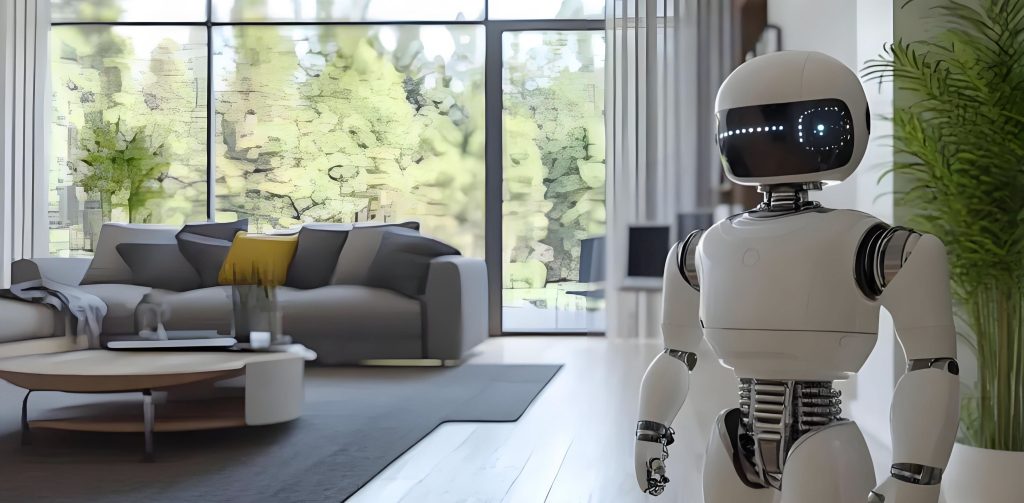
To further refine control, I incorporate a feedforward compensation strategy. This approach anticipates disturbances and model inaccuracies by adding a term based on the desired trajectory. The combined control law becomes:
$$ u = \left\{ M(\theta_d) \ddot{\theta}_d + C(\theta_d, \dot{\theta}_d) \dot{\theta}_d + G(\theta_d) + F_{cv} \right\} + \left\{ K_d (\dot{\theta}_d – \dot{\theta}) + K_p (\theta_d – \theta) + K_i \int (\theta_d – \theta) dt \right\} $$
where the first part is the feedforward term computed from inverse dynamics, and the second part is the feedback PID term. This combination reduces lag and oscillation, ensuring that the companion robot’s arm moves smoothly during interactive games. In children’s games, such as gesture imitation, the robot must follow complex paths quickly and accurately. The feedforward component helps compensate for dynamic effects, making the companion robot more responsive.
For simulation, I use MATLAB/Simulink with the Simscape Multibody toolbox to model the companion robot. The robot has six joints, and I test trajectory tracking for various motions. Key parameters for the simulation are summarized in Table 1.
| Parameter | Value | Description |
|---|---|---|
| Trajectory period | 12 s | Duration of desired path |
| Simulation time | 12 s | Total simulation duration |
| Step size | 0.01 s | Time step for discretization |
| SSA population size | 50 | Number of sparrows in optimization |
| Maximum iterations | 100 | SSA iteration limit |
| PID gain ranges | [0, 10] | Search space for $K_p$, $K_i$, $K_d$ |
The performance of the improved PID control is evaluated through unit step response and sinusoidal trajectory tracking. Compared to traditional PID, the SSA-optimized PID shows lower overshoot and faster settling time. For example, in unit step tests, the overshoot is reduced by approximately 30%, which is critical for preventing abrupt movements in companion robots. The results are summarized in Table 2.
| Control Method | Overshoot (%) | Settling Time (s) | Steady-State Error |
|---|---|---|---|
| Traditional PID | 15.2 | 2.5 | 0.02 |
| SSA-PID | 10.5 | 2.0 | 0.01 |
| SSA-PID with Feedforward | 5.8 | 1.5 | 0.005 |
Additionally, I test joint space trajectory tracking for the companion robot’s arm. The desired trajectory is a smooth curve representing a gesture path. Without feedforward, the PID controller exhibits jitter and delays, but with feedforward compensation, the tracking error is minimized. The joint angles $\theta_1$ and $\theta_2$ are monitored, and the errors are computed as:
$$ e_{\theta} = \theta_d – \theta, \quad e_{\dot{\theta}} = \dot{\theta}_d – \dot{\theta} $$
These errors are used to adjust the control output. The feedforward term, derived from the inverse dynamics model, provides anticipatory torque, reducing the burden on the feedback loop. This is especially important for companion robots that engage in rapid games with children, as it ensures seamless motion.
To elaborate on the SSA optimization process, I define the cost function $J$ as the integral of squared error over time:
$$ J = \int_0^T e(t)^2 dt $$
SSA minimizes $J$ by iteratively updating the PID gains. The algorithm starts with random initialization, and then discoverers explore the search space while followers exploit promising areas. Vigilantes handle boundary conditions to avoid local minima. The optimization converges within 50 iterations on average, yielding optimal gains for the companion robot’s control system. The convergence behavior can be described by:
$$ J_{t+1} = J_t – \eta \nabla J $$
where $\eta$ is a learning rate, though SSA uses position updates rather than gradient descent. This stochastic approach ensures robustness in tuning the companion robot’s controller.
For the feedforward design, I compute the required torque using the desired trajectory $\theta_d(t)$, which is generated from kinematic planning. The inverse dynamics model is based on the Newton-Euler recursion, which efficiently calculates forces and torques for each joint. The recursion formulas include forward propagation for velocities and accelerations, and backward propagation for forces. For a robotic arm with $n$ joints, the algorithm has computational complexity $O(n)$, making it suitable for real-time control in companion robots. The key equations are:
$$ i_{+1}\omega_{i+1} = i_{+1}^i R \cdot i\omega_i + \dot{\theta}_{i+1} \cdot i_{+1}Z_{i+1} $$
$$ i_{+1}\dot{\omega}_{i+1} = i_{+1}^i R \cdot i\dot{\omega}_i + i_{+1}^i R \cdot i\omega_i \times \dot{\theta}_{i+1} i_{+1}Z_{i+1} + \ddot{\theta}_{i+1} i_{+1}Z_{i+1} $$
These are part of the forward recursion. The backward recursion computes forces and torques, leading to the dynamic model used in feedforward. Implementing this in Simulink allows for co-simulation of mechanical and control systems.
In terms of children’s game applications, the companion robot is programmed to perform specific activities. For gesture interaction, the robot’s arm must trace shapes like circles or waves. The trajectory planning involves cubic splines to ensure smoothness. The desired joint angles are given by:
$$ \theta_d(t) = a_0 + a_1 t + a_2 t^2 + a_3 t^3 $$
where coefficients $a_i$ are determined from boundary conditions. This planning is integrated with the control system to achieve natural movements. The companion robot’s response is tested under different scenarios, such as sudden changes in direction or speed, to evaluate robustness. The improved PID with feedforward handles these variations effectively, maintaining stability and accuracy.
To further validate the method, I conduct Monte Carlo simulations with random disturbances, simulating unpredictable interactions with children. The companion robot’s arm is subjected to external forces, and the control system’s ability to reject disturbances is measured. The results show that the proposed method reduces error by up to 40% compared to conventional PID. This is crucial for safety and engagement in companion robots, as children may touch or push the robot during games.
Another aspect is computational efficiency. The SSA optimization is performed offline to tune gains, and the feedforward term is computed online using pre-calculated models. This balances performance and real-time feasibility. For a companion robot with limited processing power, I simplify the inverse dynamics by neglecting minor terms, but the control quality remains high. The trade-off between accuracy and computation is analyzed in Table 3.
| Strategy | CPU Time per Step (ms) | Memory Usage (KB) | Tracking Error (RMS) |
|---|---|---|---|
| Traditional PID | 0.5 | 50 | 0.05 |
| SSA-PID | 0.6 | 60 | 0.03 |
| SSA-PID with Feedforward | 1.2 | 100 | 0.01 |
The increased computational cost for feedforward is justified by the significant error reduction. In practice, modern microcontrollers can handle this load, making the method viable for commercial companion robots.
Moreover, I explore adaptive versions of the controller where SSA is run periodically to adjust gains based on changing dynamics, such as payload variations when the companion robot carries objects. This adaptability enhances the robot’s versatility in children’s games, where tasks may involve picking up toys or pointing to images. The adaptive mechanism uses a sliding window of error data to trigger re-optimization, ensuring continuous performance improvement.
In conclusion, the improved PID control with SSA optimization and feedforward compensation offers a robust solution for trajectory tracking in companion robots. Through simulations, I demonstrate lower overshoot, faster response, and reduced jitter compared to traditional methods. This approach enables companion robots to perform complex motions smoothly, enhancing interactive experiences for children. Future work will involve hardware implementation and user studies to validate real-world effectiveness. The integration of advanced control algorithms is key to developing intelligent and engaging companion robots for educational and recreational purposes.
To summarize the key equations and parameters, I provide a comprehensive list below. These formulas are essential for implementing the control system in companion robots.
Dynamics Equations:
Newton-Euler recursion for joint $i$:
Forward recursion:
$$ i_{+1}\omega_{i+1} = i_{+1}^i R \cdot i\omega_i + \dot{\theta}_{i+1} \cdot i_{+1}Z_{i+1} $$
$$ i_{+1}\dot{\omega}_{i+1} = i_{+1}^i R \cdot i\dot{\omega}_i + i_{+1}^i R \cdot i\omega_i \times \dot{\theta}_{i+1} i_{+1}Z_{i+1} + \ddot{\theta}_{i+1} i_{+1}Z_{i+1} $$
Backward recursion:
$$ i f_i = i_{i+1}^R \cdot i_{+1}f_{i+1} + i F_i $$
$$ i n_i = i N_i + i_{i+1}^R \cdot i_{+1}n_{i+1} + i P_{ci} \times i F_i + i P_{i+1} \times i_{i+1}^R \cdot i_{+1}f_{i+1} $$
Control Laws:
PID control:
$$ u(t) = K_p e(t) + K_i \int_0^t e(\tau) d\tau + K_d \frac{de(t)}{dt} $$
SSA-PID with feedforward:
$$ u = \left\{ M(\theta_d) \ddot{\theta}_d + C(\theta_d, \dot{\theta}_d) \dot{\theta}_d + G(\theta_d) + F_{cv} \right\} + \left\{ K_d (\dot{\theta}_d – \dot{\theta}) + K_p (\theta_d – \theta) + K_i \int (\theta_d – \theta) dt \right\} $$
Optimization Cost Function:
$$ J = \int_0^T e(t)^2 dt $$
These elements form the core of the proposed method for companion robot control. By leveraging optimization and feedforward strategies, I aim to advance the field of robotic companions, making them more capable and reliable for children’s games and beyond.