
From my position inside a secondary vocational school that is rooted in a robotics industrial park, I have watched the industrial robot move from a specialized automation device to a central pillar of intelligent manufacturing. The transition from machine substitution to future factory systems has changed what my students must know, what my colleagues must teach, and what my school must become. The industrial robot is no longer only a programmable arm on a training stand. It is a cyber-physical node that connects mechanical structure, electrical control, sensor feedback, vision, digital twin software, production logistics, and engineering service. When I look at my students, I see future operators, programmers, integrators, maintainers, and process optimizers of the industrial robot. When I look at my school, I see the need for a collaborative education model that is built with government, enterprises, industry parks, and skilled masters. My first-person account here explains how I have helped design and implement a collaborative education practice for the industrial robot major, why the old model struggled, what I changed, and what results I have observed.
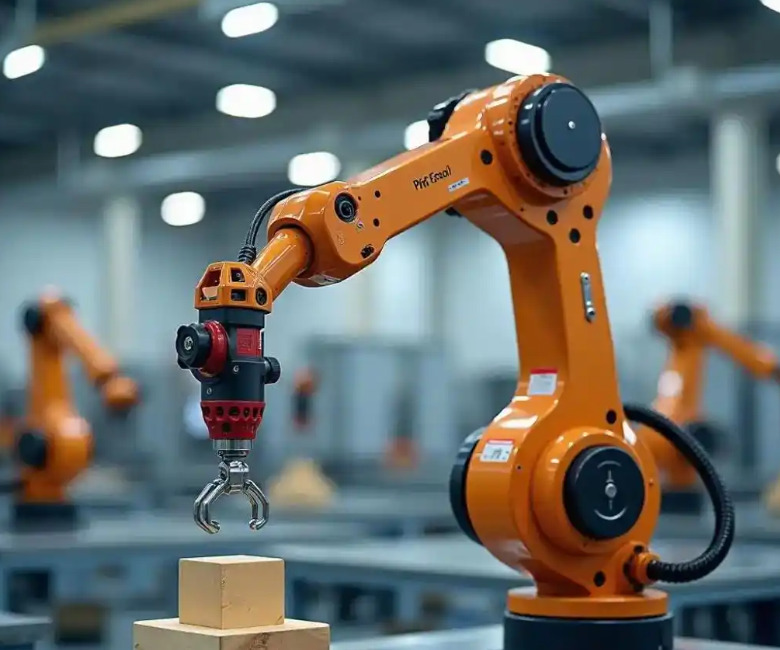
I do not treat the industrial robot as a single teaching object. I treat it as an ecosystem. In my daily work, the industrial robot appears in a production line, in a maintenance task, in a quality inspection station, in a palletizing cell, in a welding booth, in a visual sorting system, and in a digital commissioning environment. The industrial robot is a meeting point for mechanics, electronics, control, programming, data, safety, and teamwork. That is why I cannot separate the industrial robot major from the industrial robot industry chain. I must connect the classroom to the real industrial robot application, the real industrial robot problem, and the real industrial robot project. I must also connect my students to the future industrial robot workplace, not only to the current textbook. This conviction has shaped every step of the collaborative education model I describe below.
The first problem I identified was that my teaching scenario could not synchronize with industrial robot industry upgrades and iterations. The industrial robot major is new, and the corresponding industrial robot industry chain changes rapidly. New industrial robot controllers, collaborative industrial robot arms, mobile industrial robot platforms, machine vision units, force sensors, and digital twin platforms appear faster than my school can purchase and install them. I saw a widening gap between the industrial robot equipment in my workshop and the industrial robot systems in nearby enterprises. My students could operate an older industrial robot teaching cell, but they could not recognize the architecture of a modern industrial robot workstation. I needed to construct a new teaching scenario, not merely buy one new industrial robot. I needed a scenario that could reflect the industrial robot industry chain without requiring my school to own every expensive industrial robot variant. This is why I turned to micro-scale design and virtual-real integration.
The second problem I identified was that curriculum content could not match industrial robot industry development. The industrial robot application scenario is complex. An enterprise may use an industrial robot for welding, another for machine tending, another for inspection, another for assembly, and another for logistics. The production lines are diverse, and the tasks are not standardized in the way that traditional subject matter is standardized. My school lacked teaching resources that reflected these varied industrial robot applications. The curriculum content and the real production tasks had a serious adaptation gap. I could not solve this by writing one more textbook chapter. I had to develop new professional courses that were built from industrial robot work processes, industrial robot typical tasks, and industrial robot professional abilities. I had to make the curriculum follow the industrial robot chain.
The third problem I identified was that learning methods could not adapt to industrial robot job demands. Industrial robot technology is highly integrated and interdisciplinary. It requires mechanical awareness, electrical safety, programming logic, spatial reasoning, troubleshooting discipline, and communication. Many secondary vocational students begin with a learning foundation that is far from the industrial robot job requirement. The traditional lecture-and-demonstration method could not create a precise connection between what students learned and what industrial robot positions demanded. I needed a new learning method that made thinking visible, made progress reviewable, and made problem solving repeatable. I needed flowcharts, digital records, and mentor-guided scaffolds. I needed to turn the industrial robot learning process into a guided journey rather than a fragmented set of exercises.
To summarize the initial diagnosis, I use a skill mismatch index. Let \(C_i^{\text{industry}}\) be the required competence level for industrial robot competence element \(i\), and let \(C_i^{\text{curriculum}}\) be the curriculum-provided competence level. With weights \(w_i\), I estimate the industrial robot skill gap as:
$$G_{\text{skill}} = \frac{1}{n}\sum_{i=1}^{n} w_i \left| C_i^{\text{industry}} – C_i^{\text{curriculum}} \right|$$
When \(G_{\text{skill}}\) is large, my industrial robot teaching is not aligned with industrial robot employment. When \(G_{\text{skill}}\) is small, my students are more likely to transfer school learning into industrial robot workplace performance. I also use an alignment score:
$$S_{\text{align}} = 1 – \frac{1}{n}\sum_{i=1}^{n} \frac{\left| T_i^{\text{job}} – T_i^{\text{school}} \right|}{T_i^{\text{job}}}$$
Here \(T_i^{\text{job}}\) is the time or complexity of an industrial robot job task, and \(T_i^{\text{school}}\) is the time or complexity of the corresponding school task. I want \(S_{\text{align}}\) to approach one. These formulas helped me explain to my partners why the industrial robot major needed collaborative redesign rather than isolated course revision.
| Problem I identified | Observable symptom in my industrial robot major | Collaborative action I helped design | Intended result for industrial robot talent |
|---|---|---|---|
| Teaching scenario lag | Industrial robot training cells were older than enterprise industrial robot workstations | Micro-scale full-chain industrial robot station with real and virtual elements | Higher scenario fidelity and faster industrial robot technology awareness |
| Curriculum mismatch | Industrial robot course tasks did not equal industrial robot job tasks | Course-follows-chain dynamic update mechanism | Real-time alignment between industrial robot teaching and industrial robot jobs |
| Learning method gap | Students struggled with integrated industrial robot programming and debugging | Flowchart scaffolds and digital twin review | Stronger industrial robot problem solving and innovation thinking |
My first major practice was micro-scale design of a full industrial robot industry chain scenario. I focused on core enterprises in the industrial robot chain and worked with the robotics industrial park to develop a digital-intelligent full-real micro-station. I did not want a display room. I wanted a living teaching environment for industrial robot talent. I helped sort the industrial robot chain requirements through joint decision meetings with the park. Based on real equipment, real projects, and real problems, I reconstructed the industrial robot chain scenario under micro-scale design thinking. I retained core technical elements such as the industrial robot control system. I integrated typical tools. I added virtual micro-scenes and teaching micro-resources. Together with my partners, I built a virtual-real symbiotic full-real micro-station with an industry-demand warning and teaching-resource response loop. I also introduced visual intelligent teaching terminals so that the teaching space could become an intelligent scene linking real industrial robot demand with teaching response.
I use a fidelity formula to evaluate whether the micro-station truly represents the industrial robot industry. Let \(r_k\) be the relevance weight of industrial robot scenario element \(k\), and let \(s_k\) be its similarity to the real industrial robot workplace. Then:
$$F_{\text{micro}} = \frac{\sum_{k=1}^{m} r_k s_k}{\sum_{k=1}^{m} r_k}$$
I want \(F_{\text{micro}}\) to be high enough that a student can transfer industrial robot skills from the micro-station to a real industrial robot cell. The micro-station does not need to replicate every square meter of a factory. It needs to preserve the industrial robot control logic, the industrial robot task structure, the industrial robot safety rules, and the industrial robot problem-solving sequence.
| Micro-station element | Design principle I applied | Industrial robot example | Teaching function |
|---|---|---|---|
| Real equipment | Retain core industrial robot control elements | Industrial robot arm, controller, teach pendant, safety interlock | Hands-on industrial robot operation |
| Real project | Desensitize enterprise data but keep task logic | Industrial robot pick-and-place, welding, palletizing, inspection | Task-based industrial robot learning |
| Real problem | Use authentic industrial robot faults and constraints | Cycle time, positioning accuracy, collision risk, communication loss | Inquiry and industrial robot troubleshooting |
| Virtual micro-scene | Simulate expensive or risky industrial robot situations | Digital twin of an industrial robot cell | Safe repetition and industrial robot experimentation |
| Teaching micro-resource | Granular just-in-time support | Industrial robot programming guide, fault library, safety card | Self-directed industrial robot learning |
My second major practice was to re-sort the industrial robot park industry chain and enterprise types. I helped deconstruct the full industrial robot chain into production manufacturing, integration application, and engineering service. I then worked with enterprise engineers to desensitize real projects. We converted typical industrial robot work tasks into progressive learning tasks. We followed a sequence from occupational post group to typical occupational activity to work task to professional ability. This sequence became the backbone of our learning fields. We used loose-leaf work orders to promote real-time connection between teaching content and industrial robot job needs. We also built a course-follows-chain dynamic update mechanism. When the industrial robot industry changed, the curriculum could respond.
I model the curriculum update trigger as:
$$\Delta C(t) = \alpha D(t) + \beta T(t) + \gamma P(t)$$
Here \(D(t)\) represents changes in industrial robot demand, \(T(t)\) represents changes in industrial robot technology, and \(P(t)\) represents changes in industrial robot processes. The coefficients \(\alpha\), \(\beta\), and \(\gamma\) reflect the priority I give to each signal. When \(\Delta C(t) \ge \theta\), where \(\theta\) is my update threshold, I initiate a curriculum revision. This formula helped my team move from sporadic textbook replacement to systematic industrial robot curriculum governance.
| Industrial robot chain segment | Typical activity | Work task | Professional ability | Learning field |
|---|---|---|---|---|
| Production manufacturing | Assembly and calibration | Install an industrial robot joint and verify zero position | Mechanical assembly and measurement | Industrial robot fundamentals |
| Integration application | Cell design and programming | Program an industrial robot path for a workstation | Programming, sensing, and integration | Industrial robot application |
| Engineering service | Maintenance and optimization | Diagnose an industrial robot fault and restore production | Troubleshooting and service | Industrial robot service |
My third major practice was to reconstruct the curriculum system based on core technologies, key processes, and application scenarios. I used national standards as a baseline and developed modular courses in three series: walk-into series, application series, and innovation series. These courses were not isolated. They were designed to strengthen student vocational cognition, develop professional ability, and enhance development capacity and innovative thinking. In the walk-into series, I introduce the industrial robot as a system. In the application series, I teach industrial robot operation, programming, and integration. In the innovation series, I challenge students to optimize, simulate, and redesign industrial robot cells. Each module has clear industrial robot outcomes.
I use a modular curriculum matrix to check coverage. Let \(M_j\) be module \(j\), and let \(A_k\) be industrial robot ability \(k\). The coverage coefficient is:
$$Q_{jk} = \frac{\text{time or weight of } A_k \text{ in } M_j}{\text{total time or weight of } A_k}$$
If \(Q_{jk}\) is too low for a critical industrial robot ability, I revise the module. If \(Q_{jk}\) is high but disconnected from industrial robot tasks, I revise the task design. This quantitative check keeps my modular courses honest.
| Series | Module | Industrial robot focus | Learning outcome |
|---|---|---|---|
| Walk-into | Industrial robot cognition | Industrial robot safety, structure, and coordinate systems | Recognize and describe an industrial robot system |
| Application | Workstation operation | Industrial robot manual and automatic operation | Operate an industrial robot safely |
| Application | Programming | Industrial robot path, logic, and I/O | Program an industrial robot for a given task |
| Innovation | System integration | Industrial robot cell with PLC and sensors | Integrate an industrial robot into a production cell |
| Innovation | Digital twin | Virtual commissioning of an industrial robot cell | Optimize an industrial robot process before deployment |
My fourth major practice was to focus on problem solving and innovative thinking through master-teacher co-guidance and flowcharts. I helped invite skilled masters from the industrial park to serve as part-time mentors. School teachers and park mentors planned learning paths together. We developed flowcharts as learning scaffolds. We integrated learning elements and work elements into the flowcharts. This was important because an industrial robot task is not only a procedure. It is a way of thinking. A student must discover the industrial robot problem, analyze the industrial robot state, and solve the industrial robot fault or optimization challenge. The flowchart gave the student a visible path.
I define a learning trajectory integral for each student:
$$L_i(T) = \int_0^T \left( q_i(t) + p_i(t) + r_i(t) \right) dt$$
Here \(q_i(t)\) is knowledge acquisition, \(p_i(t)\) is practical industrial robot skill growth, and \(r_i(t)\) is reflective industrial robot problem-solving growth. I do not want to measure only the final industrial robot product. I want to measure the trajectory. The trajectory shows whether the student is becoming a flexible industrial robot technician or only memorizing an industrial robot procedure.
| Flowchart type | Role in my industrial robot teaching | Industrial robot application | Learning effect |
|---|---|---|---|
| Workflow chart | Ability navigation system | Discover, analyze, and solve an industrial robot fault | Clear industrial robot problem-solving chain |
| Process flow chart | Technical decoder | Extract key programming experience for an industrial robot path | Stronger procedural industrial robot knowledge |
| Spatial flow chart | Thinking rearview mirror | Reverse the debugging evolution of an industrial robot trajectory | Reflective industrial robot optimization thinking |
My fifth major practice was to highlight the visual review of learning trajectories. I used an intelligent teaching system to build a learning behavior database. The system records each student’s growth trajectory in each industrial robot learning link. Through digital twin technology, I can achieve a mirror restoration of the learning process. I can see when a student hesitated, which industrial robot parameter confused them, how many times they revised an industrial robot program, and how they collaborated with a mentor. This is not surveillance. It is formative evidence. It allows me to provide precise support for industrial robot learning. It also allows students to see their own industrial robot progress.
I use a problem-solving ratio to evaluate growth:
$$P_{\text{solve}} = \frac{N_{\text{solved}}}{N_{\text{attempted}}}$$
Here \(N_{\text{solved}}\) is the number of industrial robot problems solved with acceptable quality, and \(N_{\text{attempted}}\) is the number attempted. I also track revision depth:
$$R_{\text{depth}} = \frac{1}{m}\sum_{j=1}^{m} \log(1 + n_j)$$
where \(n_j\) is the number of meaningful revisions on industrial robot task \(j\). A student who revises an industrial robot program with purpose is developing industrial robot engineering judgment. A student who only copies a final industrial robot program is not.
| Data layer | Captured variable | Industrial robot task example | Feedback I provide |
|---|---|---|---|
| Behavior | Time on task | Operating the industrial robot teach pendant | Pacing and confidence support |
| Error | Fault type | Industrial robot collision alarm or singularity warning | Targeted industrial robot safety and geometry support |
| Revision | Iteration count | Optimizing an industrial robot path | Encouragement of persistent industrial robot optimization |
| Collaboration | Peer and mentor help | Commissioning an industrial robot cell | Teamwork and industrial robot communication coaching |
The collaborative education model has produced practical results that I can see in my school and in my students. The first result is cluster upgrading. The high-end intelligent manufacturing professional group, led by the industrial robot major, has improved its talent training quality. The industrial robot major acts as a nucleus. It pulls mechanical design, electrical automation, intelligent control, and industrial data courses toward higher standards. The industrial robot is not an isolated specialization. It is the connecting thread across the professional group. I have seen students become more confident when they move from one industrial robot module to another because they understand the industrial robot as a system.
The second result is active iteration. My school has taken a leading role in provincial industrial robot curriculum reform for integrated secondary and higher vocational education. It has become a provincial vocational college internship and training base. It is also a council unit in a national industrial robot and industrial digitalization industry-education integration community. These roles are not decorations. They are mechanisms for continuous industrial robot curriculum renewal. They allow me to bring industrial robot enterprise feedback into teaching faster. They allow my students to access industrial robot projects that a single school could not create alone.
The third result is demonstration and radiation. The industrial robot major has influenced professional construction and curriculum construction beyond my own school. We have produced national planned textbooks, national online premium courses, and textbooks with national publishers. These outputs spread the industrial robot collaborative education model. They also raise the standard for industrial robot teaching resources. I have learned that a strong industrial robot program must produce not only skilled students but also reusable knowledge products: industrial robot work orders, industrial robot flowcharts, industrial robot digital twin cases, and industrial robot assessment rubrics.
| Outcome dimension | Indicator | Evidence I observed | Industrial robot connection |
|---|---|---|---|
| Talent quality | Skill certificate pass rate | Improvement across learning cycles | Industrial robot operation and programming |
| Curriculum | National online premium course | One recognized course | Industrial robot application |
| Textbooks | National planned textbooks | Eleven textbooks | Industrial robot fundamentals and integration |
| Radiation | Provincial lead role | Integrated curriculum reform lead | Industrial robot integration curriculum |
| Industry linkage | Community membership | Council unit | Industrial robot and digital manufacturing |
I also use an employability model to explain why the industrial robot collaborative model matters. Let \(K\) be industrial robot knowledge, \(S\) be industrial robot skill, \(I\) be industrial robot innovation, and \(M\) be industrial robot professional mindset. I estimate employability as:
$$E = \sigma(\beta_0 + \beta_1 K + \beta_2 S + \beta_3 I + \beta_4 M)$$
where \(\sigma(z) = \frac{1}{1 + e^{-z}}\). In my experience, \(K\) and \(S\) can be improved by ordinary training, but \(I\) and \(M\) grow through authentic industrial robot projects, mentor guidance, visible reflection, and repeated industrial robot problem solving. That is why the collaborative model is not an add-on. It is the core of industrial robot talent development.
I have learned several design principles from this work. First, the industrial robot teaching scenario must be micro but not artificial. It must preserve real industrial robot logic while reducing scale and cost. Second, the industrial robot curriculum must be dynamic. It cannot wait for a new textbook cycle. It must follow the industrial robot chain through work orders, loose-leaf materials, and modular updates. Third, the industrial robot learning method must make thinking visible. Flowcharts, digital twins, and learning behavior databases are not technology ornaments. They are scaffolds for industrial robot problem solving. Fourth, the industrial robot program must be governed by collaboration. Government, enterprises, industry parks, mentors, teachers, and students must share responsibility for industrial robot talent quality.
I also want to be honest about the difficulties. Building a full-real micro-station for the industrial robot major is expensive. Maintaining industrial robot digital twin models takes time. Training teachers to use industrial robot flowcharts consistently takes professional development. Convincing enterprises to share desensitized industrial robot projects requires trust. Measuring industrial robot learning trajectories requires data ethics and privacy protection. I have not solved every issue. But I have seen that the collaborative direction works. When an enterprise engineer explains an industrial robot cycle-time problem, students listen differently. When a skilled master shows an industrial robot debugging trick, students practice differently. When a digital twin mirrors their industrial robot program, students reflect differently. When a flowchart makes their industrial robot reasoning visible, students improve differently.
I now think of the industrial robot major as a living bridge. On one side is the industrial robot industry chain with its rapid upgrades. On the other side is the student who needs a meaningful future. The bridge is built from real industrial robot equipment, real industrial robot projects, real industrial robot problems, modular industrial robot courses, mentor-guided industrial robot flowcharts, and digital twin industrial robot review. I walk across this bridge every day. My colleagues walk across it with me. My students walk across it toward high-quality employment and further development. The industrial robot is not only a machine in my classroom. It is a promise that education and industry can grow together.
For future improvement, I plan to deepen the industrial robot data model. I want to connect industrial robot learning behavior data with industrial robot enterprise performance data while protecting privacy. I want to test whether specific industrial robot flowchart interventions produce measurable gains in industrial robot troubleshooting speed and accuracy. I want to expand the industrial robot micro-station to include more collaborative industrial robot scenarios, mobile industrial robot scenarios, and vision-guided industrial robot scenarios. I want to build more industrial robot micro-resources that can be updated quickly when the industrial robot industry changes. I want to help more teachers become confident industrial robot curriculum designers, not only industrial robot equipment operators.
I use one more formula to guide my planning. Let \(B\) be the benefit of an industrial robot learning intervention, let \(C\) be its cost, and let \(R\) be its risk. I consider an intervention worthwhile when:
$$B – C – R \ge \delta$$
where \(\delta\) is the minimum acceptable net value for my industrial robot program. This simple inequality reminds me that innovation must be sustainable. An industrial robot digital twin that no teacher can maintain is not a good intervention. An industrial robot project that enterprises cannot share is not scalable. An industrial robot flowchart that students cannot understand is not a scaffold. I want every industrial robot change to be valuable, feasible, and safe.
In conclusion, my first-person experience with the industrial robot major has convinced me that collaborative education is the most realistic path for secondary vocational schools facing rapid industrial robot transformation. The three problems I identified were teaching scenario lag, curriculum mismatch, and learning method gap. The practices I helped build were micro-scale full-chain industrial robot scenarios, course-follows-chain curriculum updates, modular industrial robot courses, master-teacher flowchart scaffolds, and digital twin visual review. The outcomes I observed include stronger industrial robot talent quality, active provincial iteration, and national demonstration radiation. The industrial robot remains at the center of my work because it represents the future of intelligent manufacturing. My students will not only operate the industrial robot. They will understand it, improve it, integrate it, and imagine new uses for it. That is the education I want to provide, and that is why I continue to build the collaborative industrial robot education model every day.