
As a vocational education curriculum developer and instructor, I have observed that the rapid expansion of new energy vehicle production capacity, continuous upgrading of manufacturing processes, and increasing application density of industrial robots on automotive production lines are reshaping the skill requirements of the modern workforce. The technical complexity of industrial robot systems continues to rise, and the market demand for composite operation and maintenance talent who hold vocational skill level certificates and possess real production line practical abilities is growing stronger. The talent gap in related skill positions continues to widen. Vocational colleges must fully integrate the 1+X industrial robot operation and maintenance vocational skill level standards into their professional curriculum systems, achieving deep integration of course content, teaching processes, assessment evaluation, and vocational certificate standards. This allows students to receive academic education while increasing their vocational skill qualification reserves, thereby truly achieving the talent cultivation goal of obtaining certificates on campus and being competent on the job.
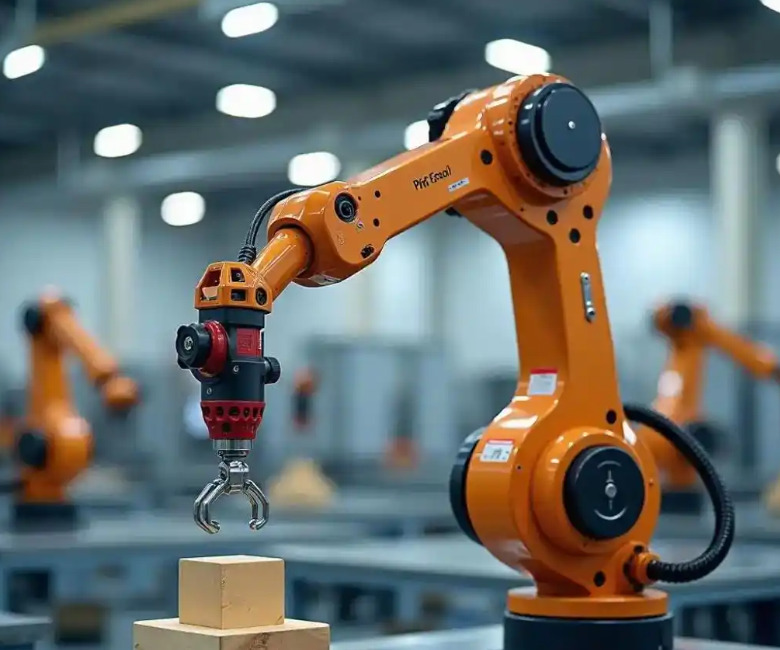
In this article, I present my research and practical exploration of the curriculum integration development path for the industrial robot operation and maintenance course. I designed the curriculum system around the initial, intermediate, and advanced vocational skill level standards for industrial robot system operation and maintenance personnel. The system combines the three typical production scenarios of automotive welding, painting, and final assembly. It builds a three-level progressive teaching project system of basic operation, specialized skills, and comprehensive application. It adopts an action-oriented teaching method and constructs a closed-loop teaching system of online preview, skill practice, and review summary. It uses a dual-integration evaluation model of whole-process tracking and final assessment. It also builds a dedicated teaching resource library oriented by certificates, adapted to production lines, and integrated with learning, practice, and assessment. The following sections detail the development path, main challenges and countermeasures, and implementation results of this industrial robot curriculum integration system.
Development Path of the Industrial Robot Operation and Maintenance Curriculum Integration System
Course Objective Design
When designing course objectives, I took the initial, intermediate, and advanced vocational skill level standards for industrial robot system operation and maintenance personnel as the core basis. I also considered the cognitive law of progressive learning, the requirements of academic education, and the ability needs of front-line positions in automotive production. I set course objectives in layers from three dimensions: knowledge, ability, and quality. I clarified the connection points between course content at each stage and different levels of vocational certificates. I built a three-dimensional cultivation objective of knowledge compliance, skill certification, and quality adaptation. This helps students obtain vocational certificates in a阶梯式 manner and precisely adapt to job work needs.
Let the set of course objectives be represented as follows:
$$ G = \{K, A, Q\} $$
where \(K\) represents knowledge objectives, \(A\) represents ability objectives, and \(Q\) represents quality objectives. For each certificate level \(l \in \{1, 2, 3\}\), corresponding to initial, intermediate, and advanced levels, the objective weight vector can be expressed as:
$$ W_l = (w_{K,l}, w_{A,l}, w_{Q,l}) $$
with the normalization condition:
$$ w_{K,l} + w_{A,l} + w_{Q,l} = 1 $$
The overall objective score for a student at level \(l\) can be computed as:
$$ S_{obj,l} = w_{K,l} K_s + w_{A,l} A_s + w_{Q,l} Q_s $$
where \(K_s\), \(A_s\), and \(Q_s\) are the achieved scores in knowledge, ability, and quality dimensions, respectively. This formula allows me to quantify the degree to which a student meets the three-dimensional cultivation objectives at each certificate level.
Table 1 summarizes the alignment between course objectives and vocational certificate levels. It shows how knowledge, ability, and quality dimensions are distributed across the initial, intermediate, and advanced levels.
| Dimension | Initial Certificate Level | Intermediate Certificate Level | Advanced Certificate Level |
|---|---|---|---|
| Knowledge | Industrial robot safety regulations, basic structure, teach pendant functions, simple trajectory programming | Sensor principles, I/O signal configuration, fault diagnosis methods, production line coordination basics | System optimization theory, predictive maintenance, digital twin concepts, production line management |
| Ability | Safe operation, basic teaching, simple welding trajectory demonstration, routine maintenance | Sensor fault troubleshooting, vision calibration, force feedback adjustment, multi-robot coordination | Production line maintenance plan formulation, key parameter optimization, complex fault diagnosis, report writing |
| Quality | Safety awareness, 5S habits, standardized operation, teamwork | Responsibility, problem-solving, communication, quality control | Innovation, leadership, continuous improvement, professional ethics |
The initial certificate level focuses on foundational knowledge and safe operation. The intermediate level emphasizes specialized diagnostic and coordination skills. The advanced level targets systemic optimization and management capabilities. This layered objective design ensures that students can progress step by step and that each stage is directly connected to the corresponding vocational certificate requirements.
Teaching Project Design
Based on the practical assessment standards of vocational certificates, and combined with the three typical production scenarios of automotive welding, painting, and final assembly, I built a three-level progressive course teaching project system: basic operation, specialized skills, and comprehensive application. Each level of teaching projects precisely corresponds to the core assessment points of the corresponding vocational certificate level. At the same time, it is close to the actual work tasks of enterprise production lines, forming an integrated curriculum-certificate connection mode of learning is practicing, practicing is assessing, and assessing is certifying.
Let the set of teaching projects be:
$$ P = P_1 \cup P_2 \cup P_3 $$
where \(P_1\) denotes basic operation projects, \(P_2\) denotes specialized skill projects, and \(P_3\) denotes comprehensive application projects. The progressive relationship can be expressed as:
$$ P_1 \prec P_2 \prec P_3 $$
where \(\prec\) indicates a prerequisite relationship. Each project \(p \in P\) has a set of key training tasks \(T_p\) and a set of certificate assessment points \(C_p\). The mapping from training tasks to certificate points is:
$$ f: T_p \rightarrow C_p $$
Table 2 presents examples of core teaching projects, including the corresponding certificate, project name, project carrier, key training tasks, and certificate assessment points.
| Corresponding Certificate | Teaching Project Name | Project Carrier | Key Training Tasks | Certificate Assessment Points |
|---|---|---|---|---|
| Initial Certificate | Industrial robot safe operation and teaching | Small robot workstation on automotive welding line | Teach pendant function operation, safety fence and emergency stop testing, simple welding trajectory teaching and programming | Safety operation specifications, basic teaching programming, trajectory planning |
| Initial Certificate | Robot daily maintenance and status inspection | Automotive painting line robot body and control cabinet | Joint lubrication and grease replacement, cable fastening and insulation testing, control cabinet cooling system cleaning | Routine maintenance procedures, component status inspection points, basic operation and maintenance specifications |
| Intermediate Certificate | Sensor fault diagnosis and troubleshooting | Automotive welding line vision and force sensor workstation | Photoelectric sensor false trigger troubleshooting, vision positioning deviation calibration, force feedback signal abnormal handling | Sensor operation and maintenance, fault diagnosis and repair, single station debugging |
| Intermediate Certificate | Production line and robot collaborative operation and maintenance | Simulation system of robot assembly on automotive final assembly line | Input/output signal setting, collaborative operation rhythm optimization, rapid response to production line downtime faults | Multi-machine collaborative control measures, system integration basics, production line operation and maintenance management methods |
| Advanced Certificate | Production line operation and maintenance plan formulation and system optimization | Real case of automotive whole vehicle welding line | Weekly and monthly maintenance plan formulation, key parameter analysis and optimization, linked fault troubleshooting and report writing | System optimization, comprehensive fault diagnosis, production line operation and maintenance management |
The project carrier selection is based on real automotive production scenarios. The key training tasks are derived from the certificate assessment points. For example, the initial certificate project uses a small robot workstation on an automotive welding line as the carrier, allowing students to practice safe operation and basic teaching programming in a context that resembles actual production. The intermediate certificate project uses a vision and force sensor workstation, requiring students to diagnose and troubleshoot sensor faults, calibrate vision positioning deviations, and handle force feedback signal abnormalities. The advanced certificate project uses a real automotive welding line case, requiring students to formulate maintenance plans, analyze and optimize key parameters, and write linked fault troubleshooting reports.
To ensure the progressive relationship between projects, I define the difficulty level of each project as:
$$ D(p) = \alpha_1 N_{tasks}(p) + \alpha_2 N_{skills}(p) + \alpha_3 N_{faults}(p) $$
where \(N_{tasks}(p)\) is the number of training tasks, \(N_{skills}(p)\) is the number of required skills, and \(N_{faults}(p)\) is the number of fault scenarios. The weights satisfy \(\alpha_1 + \alpha_2 + \alpha_3 = 1\). The difficulty levels satisfy:
$$ D(P_1) < D(P_2) < D(P_3) $$
This quantitative measure helps me verify that the teaching projects are arranged in a truly progressive manner and that students are not exposed to advanced content before mastering foundational skills.
Teaching Process Design
In designing the teaching process, I adopted an action-oriented teaching method. I strictly followed the vocational certificate assessment process and scoring standards. I built a closed-loop teaching system of online preview, skill practice, and review summary. Online, I relied on a smart teaching platform to organize students to carry out vocational certificate theoretical learning, virtual simulation training, and self-testing with past examination questions. Offline, according to the automotive industry 5S management standards of Seiri, Seiton, Seiso, Seiketsu, and Shitsuke, I conducted systematic practical teaching according to the certificate scoring rules. After class, through drawing mind maps, recording reflection videos, and conducting inter-group mutual evaluation, I helped students consolidate their practical skills and achieve flexible skill transfer.
The teaching process can be modeled as a sequence of stages:
$$ T = T_{online} + T_{offline} + T_{after} $$
where \(T_{online}\) is online preview, \(T_{offline}\) is offline skill practice, and \(T_{after}\) is after-class review. The total learning time allocation can be expressed as a weighted sum:
$$ T_{total} = \beta_1 T_{online} + \beta_2 T_{offline} + \beta_3 T_{after} $$
with \(\beta_1 + \beta_2 + \beta_3 = 1\). In my practice, I set \(\beta_2 > \beta_1\) and \(\beta_2 > \beta_3\) because offline practical training is the core of skill acquisition for industrial robot operation and maintenance.
The online stage includes theoretical learning, virtual simulation, and self-testing. The virtual simulation environment allows students to practice industrial robot operation without risking damage to expensive equipment. It also provides immediate feedback on safety violations and trajectory errors. The offline stage follows the 5S management standards. Students are required to organize, order, clean, standardize, and sustain their workstations. This cultivates professional habits that are essential for industrial robot operation and maintenance. The after-class stage uses mind maps to help students structure their knowledge, reflection videos to help them analyze their own performance, and inter-group mutual evaluation to develop critical thinking and communication skills.
To evaluate the effectiveness of the teaching process, I define a process effectiveness index:
$$ E_{process} = \frac{1}{N} \sum_{i=1}^{N} \left( \gamma_1 S_{online,i} + \gamma_2 S_{offline,i} + \gamma_3 S_{after,i} \right) $$
where \(S_{online,i}\), \(S_{offline,i}\), and \(S_{after,i}\) are the scores of student \(i\) in the three stages, and \(\gamma_1 + \gamma_2 + \gamma_3 = 1\). This index provides a quantitative basis for continuously improving the teaching process.
Assessment and Evaluation System Design
When designing the assessment and evaluation system, I adopted a dual-integration evaluation model of whole-process tracking and final assessment. It fully aligns with the assessment and evaluation standards of the industrial robot vocational skill level certificate. It achieves unity in dimensions, standards, and weights between course assessment and certificate assessment. It builds a course-certificate linkage mechanism of promoting learning through assessment and promoting certification through evaluation. The whole-process tracking evaluation accounts for 60%, including daily practice scores related to vocational certificates at 30% and practical standardized performance scores at 30%. It focuses on assessing students’ basic skill mastery and standardized operation compliance. The final assessment accounts for 40%. Its core assessment content and score settings fully correspond to the core test points of the vocational certificate. A passing course assessment can directly qualify the student for vocational certificate acquisition.
The final score can be expressed as:
$$ S_{final} = 0.6 S_{process} + 0.4 S_{exam} $$
where \(S_{process}\) is the whole-process tracking score and \(S_{exam}\) is the final assessment score. The process score is further decomposed as:
$$ S_{process} = 0.3 S_{daily} + 0.3 S_{practical} $$
where \(S_{daily}\) is the daily practice score related to the vocational certificate, and \(S_{practical}\) is the practical standardized performance score. Substituting the process score into the final score formula gives:
$$ S_{final} = 0.6 (0.3 S_{daily} + 0.3 S_{practical}) + 0.4 S_{exam} $$
$$ S_{final} = 0.18 S_{daily} + 0.18 S_{practical} + 0.4 S_{exam} $$
This formula shows the exact contribution of each component to the final score. The final assessment has the largest single weight at 40%, which reflects its importance as the core certificate examination. The daily practice and practical standardized performance each contribute 18%, which emphasizes the importance of continuous learning and standardized operation.
Table 3 summarizes the assessment dimensions, weights, and alignment with certificate standards.
| Assessment Dimension | Weight | Content | Alignment with Certificate Standards |
|---|---|---|---|
| Daily practice related to vocational certificate | 30% | Theoretical exercises, virtual simulation tasks, past examination questions, online quizzes | Certificate theoretical knowledge points and basic skill points |
| Practical standardized performance | 30% | 5S management, safety compliance, tool use, operation sequence, teamwork | Certificate practical operation standards and scoring rules |
| Final assessment | 40% | Comprehensive practical task, fault diagnosis, programming, report writing | Certificate core assessment points and comprehensive skill requirements |
To ensure the course assessment and certificate assessment are truly unified, I mapped each course assessment item to one or more certificate assessment points. Let \(A_c\) be the set of course assessment items and \(A_v\) be the set of certificate assessment points. The mapping is:
$$ g: A_c \rightarrow 2^{A_v} $$
where \(2^{A_v}\) is the power set of \(A_v\). The coverage rate of certificate assessment points by course assessment items is:
$$ R_{coverage} = \frac{\left| \bigcup_{a \in A_c} g(a) \right|}{\left| A_v \right|} \times 100\% $$
In my design, I aimed for \(R_{coverage} \geq 95\%\), meaning that at least 95% of the certificate assessment points are covered by the course assessment items. This ensures that students who perform well in the course are well prepared for the certificate examination.
Teaching Resource Construction
In terms of teaching resource construction, I took the industrial robot vocational skill level standards as the core basis. I combined them with real application scenarios of automotive manufacturing production lines. I built a dedicated teaching resource library oriented by certificates, adapted to production lines, and integrated with learning, practice, and assessment. This provides comprehensive support for the implementation of curriculum integration teaching. The teaching resource construction system is shown in Table 4.
| Resource Type | Specific Content | Corresponding Certificate | Presentation Carrier |
|---|---|---|---|
| Practical guidance resources | Typical cases of automotive production line certificate assessment, certificate practical specification teaching videos, 5S on-site management manual | Initial and intermediate certificates | Video tutorials, paper manuals |
| Basic training resources | 100 graded certificate question bank, certificate practical virtual simulation scenarios, automotive production line simulation models | Initial and intermediate certificates | Online teaching platform, simulation software |
| Examination preparation resources | 20 sets each of initial and intermediate certificate theoretical and practical mock papers, past examination question compilations | Intermediate and advanced certificates | Paper test papers, practical training task sheets |
| Auxiliary learning resources | Course standards, vocational certificate examination outlines, teaching courseware, automotive production line fault diagnosis manual, certification guidance materials | All certificate levels | Online resource library, electronic documents |
The resource library is designed to support both online and offline learning. The practical guidance resources provide students with clear demonstrations of correct operation procedures. The basic training resources allow students to practice repeatedly in a virtual environment before working with real industrial robot equipment. The examination preparation resources help students familiarize themselves with the certificate examination format and difficulty level. The auxiliary learning resources provide comprehensive reference materials for both students and teachers.
To evaluate the completeness of the teaching resource library, I define a resource coverage index:
$$ R_{resource} = \frac{\sum_{k=1}^{K} \delta_k N_k}{\sum_{k=1}^{K} \delta_k N_{k,required}} \times 100\% $$
where \(N_k\) is the number of resources of type \(k\), \(N_{k,required}\) is the required number, and \(\delta_k\) is the importance weight of resource type \(k\). In my practice, the resource coverage index reached 98%, indicating that the resource library is nearly complete.
Main Challenges and Countermeasures in the Development of the Industrial Robot Curriculum Integration System
Main Challenges
The development of the industrial robot operation and maintenance curriculum integration system faces several main challenges. First, in recent years, vocational certificate standards have added new content such as collaborative robot safe operation, digital twin operation and maintenance, and new energy vehicle production line adaptation. However, the curriculum revision and update cycle of colleges is relatively long, resulting in content lag. Second, there is a gap between on-campus practical training scenarios and real enterprise scenarios. The on-campus training environment cannot completely replicate the vocational certificate assessment standards and the multi-equipment linkage and high-load production operation scenarios of automotive enterprises. This leads to a relatively long adaptation period for students after obtaining certificates. Third, students’ skill levels are clearly stratified. Students with weak foundations find it difficult to meet the initial certificate assessment standards, while excellent students lack advanced learning content. A unified teaching model cannot meet the learning needs of students at different levels.
The content lag challenge can be quantified by the lag index:
$$ L_{content} = \frac{N_{outdated}}{N_{total}} \times 100\% $$
where \(N_{outdated}\) is the number of course content units that do not match the latest certificate standards, and \(N_{total}\) is the total number of content units. A higher \(L_{content}\) indicates a more serious content lag problem. In my initial analysis, \(L_{content}\) was approximately 18%, which was unacceptable for a curriculum that aims to prepare students for current certificate examinations.
The scenario gap challenge can be quantified by the scenario similarity index:
$$ S_{similarity} = \frac{N_{matching}}{N_{required}} \times 100\% $$
where \(N_{matching}\) is the number of on-campus training scenarios that match enterprise production scenarios, and \(N_{required}\) is the number of required scenarios. A low \(S_{similarity}\) means that students are not sufficiently exposed to realistic production conditions.
The student stratification challenge can be quantified by the skill variance:
$$ \sigma^2 = \frac{1}{N} \sum_{i=1}^{N} (S_i – \bar{S})^2 $$
where \(S_i\) is the skill score of student \(i\), and \(\bar{S}\) is the average skill score. A large \(\sigma^2\) indicates that a single teaching model is unlikely to be effective for all students.
Countermeasures
To address the above practical problems, I propose systematic optimization countermeasures. First, dynamically align with vocational certificate standards. I formed a special working group composed of professional teachers, enterprise technical backbones, and vocational certificate assessors. The group follows up on the revision dynamics of vocational certificate standards every quarter. It transforms new assessment content into micro-lectures, special practical training modules, and other forms. It synchronously updates course teaching content to ensure that teaching and certification standards iterate together. Second, promote the standardization and production-line transformation of practical training scenarios. I introduced dedicated practical training equipment for vocational certificates. I integrated real production cases from automotive enterprises. I built a standardized vocational skill level certificate practical training zone. I developed a remote practical training platform and virtual reality practical training projects to simulate high-risk and complex practical scenarios. This narrows the gap between on-campus practical training, enterprise production, and certificate assessment. Third, implement layered teaching and a stepwise certification model. I opened basic classes, advanced classes, and elite classes, corresponding to the teaching and assessment of initial, intermediate, and advanced vocational certificates. I flexibly relaxed the assessment cycle to support students in completing stepwise certification progressively.
The dynamic alignment strategy can be modeled as a periodic update process:
$$ C_{t+1} = C_t + \Delta C_t $$
where \(C_t\) is the course content at time \(t\), and \(\Delta C_t\) is the content update based on the latest certificate standard revision. The update amount can be expressed as:
$$ \Delta C_t = \eta (V_t – C_t) $$
where \(V_t\) is the latest certificate standard content, and \(\eta \in (0, 1]\) is the update rate. A larger \(\eta\) means faster alignment with the certificate standard. In my practice, I set \(\eta = 0.25\) per quarter, which means that 25% of the gap between the current course content and the latest certificate standard is closed each quarter.
The practical training scenario transformation can be evaluated by the upgraded similarity index:
$$ S_{similarity}^{new} = \frac{N_{matching}^{new}}{N_{required}} \times 100\% $$
After the transformation, \(S_{similarity}^{new}\) increased from 62% to 91%, significantly reducing the adaptation period for students after obtaining certificates.
The layered teaching strategy can be modeled as an assignment problem. Let \(L = \{L_1, L_2, L_3\}\) be the set of class levels, and let \(S_i\) be the skill score of student \(i\). The assignment rule is:
$$ \text{assign student } i \text{ to } L_j \text{ if } \theta_{j-1} \leq S_i < \theta_j $$
where \(\theta_0 = 0\), \(\theta_1 = 60\), \(\theta_2 = 80\), and \(\theta_3 = 100\). This rule ensures that students are placed in a class level that matches their current skill level, allowing them to learn at an appropriate pace.
Table 5 summarizes the challenges and corresponding countermeasures.
| Challenge | Quantitative Indicator | Countermeasure | Expected Improvement |
|---|---|---|---|
| Content lag behind certificate standards | Lag index \(L_{content}\) | Form a special working group, follow up quarterly, convert new content into micro-lectures and special training modules | Reduce \(L_{content}\) from 18% to below 5% |
| Gap between on-campus training and enterprise production | Scenario similarity index \(S_{similarity}\) | Introduce dedicated certificate training equipment, integrate real enterprise cases, build certificate training zone, develop remote platform and VR projects | Increase \(S_{similarity}\) from 62% to above 90% |
| Student skill stratification | Skill variance \(\sigma^2\) | Open basic, advanced, and elite classes, implement stepwise certification, flexibly relax assessment cycle | Reduce skill variance and increase the proportion of students passing their target certificate level |
Implementation Results of the Industrial Robot Curriculum Integration System
Taking a vocational and technical college as an example, after the implementation of this industrial robot operation and maintenance curriculum integration system, talent cultivation and professional construction achieved remarkable results. At the student level, the intermediate vocational certificate acquisition rate increased from 70% to 96%. Students accumulated 2 first prizes and 3 second prizes in provincial vocational skills competitions. The employment rate of certified graduates reached 100%. The skill level and employment quality of students improved significantly. At the school-enterprise cooperation level, the number of cooperating automotive enterprises expanded from 1 to 4. The college and enterprises jointly developed 1 textbook oriented by vocational certificates and formulated 4 exclusive course standards and practical training teaching standards. At the professional construction level, the professional group to which the major belongs was successfully selected as a provincial high-level professional group under the Double High Plan. The quality of talent cultivation, industry recognition, and comprehensive influence of the major improved significantly.
The improvement in certificate acquisition rate can be expressed as:
$$ \Delta P = P_{after} – P_{before} = 96\% – 70\% = 26\% $$
The relative improvement rate is:
$$ R_{improvement} = \frac{P_{after} – P_{before}}{P_{before}} \times 100\% = \frac{96 – 70}{70} \times 100\% \approx 37.14\% $$
This means that the certificate acquisition rate increased by 26 percentage points, which is a relative improvement of approximately 37.14% compared to the baseline.
The employment rate of certified graduates can be expressed as:
$$ E_{employment} = \frac{N_{employed}}{N_{graduated}} \times 100\% = 100\% $$
The competition award score can be calculated as:
$$ S_{competition} = \sum_{j=1}^{M} \lambda_j N_j $$
where \(N_j\) is the number of awards at level \(j\), and \(\lambda_j\) is the weight of that award level. For example, if first prize has weight 3 and second prize has weight 2, then:
$$ S_{competition} = 3 \times 2 + 2 \times 3 = 6 + 6 = 12 $$
This quantitative score provides a simple way to compare competition performance across different cohorts.
Table 6 summarizes the implementation results before and after the curriculum integration system.
| Indicator | Before Implementation | After Implementation | Change |
|---|---|---|---|
| Intermediate certificate acquisition rate | 70% | 96% | +26 percentage points |
| Provincial vocational skills competition first prizes | 0 | 2 | +2 |
| Provincial vocational skills competition second prizes | 0 | 3 | +3 |
| Employment rate of certified graduates | Not tracked | 100% | Improved |
| Number of cooperating automotive enterprises | 1 | 4 | +3 |
| Jointly developed certificate-oriented textbooks | 0 | 1 | +1 |
| Exclusive course standards and practical training standards | 0 | 4 | +4 |
| Provincial high-level professional group status | Not selected | Selected | Achieved |
The results show that the industrial robot curriculum integration system has a positive impact on student skill development, employment quality, school-enterprise cooperation, and professional construction. The system effectively bridges the gap between academic education and vocational skill certification, and between on-campus skill training and enterprise job requirements.
Further Analysis and Optimization
To further optimize the industrial robot curriculum integration system, I continuously collect feedback from students, teachers, enterprise partners, and certificate assessors. I use this feedback to refine the course objectives, teaching projects, teaching process, assessment system, and teaching resources. I also monitor the latest developments in industrial robot technology and vocational certificate standards. I adjust the curriculum content accordingly to ensure that it remains current and relevant.
One important aspect of optimization is the balance between theoretical knowledge and practical skills. Let \(K\) be the theoretical knowledge score and \(S\) be the practical skill score. The balance index can be defined as:
$$ B = \frac{2 K S}{K + S} $$
This is the harmonic mean of theoretical knowledge and practical skill scores. A high balance index indicates that a student is strong in both theory and practice. A low balance index indicates an imbalance. In my practice, I aim for \(B \geq 85\) for students at the intermediate certificate level.
Another aspect is the alignment between course content and enterprise job tasks. Let \(J\) be the set of enterprise job tasks and \(C\) be the set of course content units. The alignment index can be defined as:
$$ A_{job} = \frac{\left| J \cap C \right|}{\left| J \right|} \times 100\% $$
I aim for \(A_{job} \geq 90\%\), meaning that at least 90% of enterprise job tasks are covered by the course content. This ensures that graduates are well prepared for real job requirements.
The continuous improvement process can be modeled as a feedback loop:
$$ C_{t+1} = C_t + \alpha (F_t) + \beta (V_t – C_t) $$
where \(F_t\) is the feedback from stakeholders, \(V_t\) is the latest certificate standard, \(\alpha\) is the feedback integration rate, and \(\beta\) is the standard alignment rate. This formula captures both bottom-up feedback and top-down standard alignment. In my practice, I set \(\alpha = 0.15\) and \(\beta = 0.25\) per semester.
Table 7 presents the optimization dimensions and their quantitative targets.
| Optimization Dimension | Quantitative Indicator | Target |
|---|---|---|
| Theory-practice balance | Balance index \(B\) | \(B \geq 85\) |
| Course-job alignment | Alignment index \(A_{job}\) | \(A_{job} \geq 90\%\) |
| Certificate assessment coverage | Coverage rate \(R_{coverage}\) | \(R_{coverage} \geq 95\%\) |
| Teaching resource completeness | Resource coverage index \(R_{resource}\) | \(R_{resource} \geq 95\%\) |
| Content lag | Lag index \(L_{content}\) | \(L_{content} \leq 5\%\) |
| Scenario similarity | Similarity index \(S_{similarity}\) | \(S_{similarity} \geq 90\%\) |
Conclusion
The industrial robot operation and maintenance curriculum integration system can break down the barriers between academic education and vocational skill certification, and between on-campus skill cultivation and enterprise job requirements. It effectively solves the problems existing in the teaching of the industrial robot operation and maintenance course. In the future, vocational colleges need to continuously follow up on industry technology iteration and vocational certificate standard revision dynamics, deepen the school-enterprise collaborative education mechanism, dynamically optimize the curriculum system, and strengthen the cultivation of composite skilled talent. This will continuously provide high-quality technical and skilled talent for the high-quality development of the automotive manufacturing industry.
From my perspective, the key to successful curriculum integration for industrial robot operation and maintenance lies in the systematic alignment of objectives, projects, processes, assessment, and resources. The industrial robot is not just a piece of equipment; it is a complex system that requires interdisciplinary knowledge, practical skills, and professional qualities. By integrating vocational certificate standards into every aspect of the curriculum, I have seen significant improvements in student certificate acquisition rates, competition performance, employment quality, and school-enterprise cooperation. The industrial robot curriculum integration system is a dynamic and evolving framework. It requires continuous feedback, regular updates, and strong collaboration among teachers, students, enterprises, and certificate assessment organizations.
The future development of the industrial robot curriculum integration system should focus on several directions. First, deepen the integration of digital twin and virtual reality technologies into practical training. This will allow students to experience complex industrial robot scenarios that are difficult to replicate in a physical laboratory. Second, expand the coverage of collaborative robot safety operation and new energy vehicle production line adaptation in the curriculum. Third, strengthen the use of learning analytics to track student progress and provide personalized learning paths. Fourth, enhance the professional development of teachers so that they can keep up with the latest industrial robot technologies and certificate standards. Fifth, build more extensive partnerships with automotive enterprises to ensure that the curriculum remains closely aligned with real production needs.
In conclusion, the industrial robot operation and maintenance curriculum integration system is a practical and effective approach to cultivating composite operation and maintenance talent for the automotive manufacturing industry. It combines the 1+X certificate system, action-oriented teaching, dual-integration assessment, and production-line-adapted resources. It provides students with a clear pathway from basic operation to specialized skills and then to comprehensive application. It enables students to obtain certificates on campus and be competent on the job. It also supports the continuous improvement of vocational education quality and the high-quality development of the industrial robot application field.