
Over the past decade, the diffusion of industrial robots across Chinese manufacturing has proceeded at a pace that few observers anticipated. According to data compiled by the International Federation of Robotics, China’s operational stock of industrial robots surpassed 2.0272 million units in 2024, accounting for roughly 43 percent of the global total and ranking first worldwide. Annual installations rose from 70,000 units in 2015 to 316,000 units in 2023, implying a compound annual growth rate of approximately 20.7 percent. This expansion has not been driven purely by domestic technological capability. Throughout the sample period, more than 70 percent of newly installed industrial robots in China were supplied by foreign vendors, and the average machine price in the global market fell by 17.7 percent between 2018 and 2024. The convergence of these two facts — heavy reliance on imported industrial robots and a secular decline in their import prices — motivates the central question I pursue in this study: how do changes in industrial robot import prices reshape the wage structure inside firms?
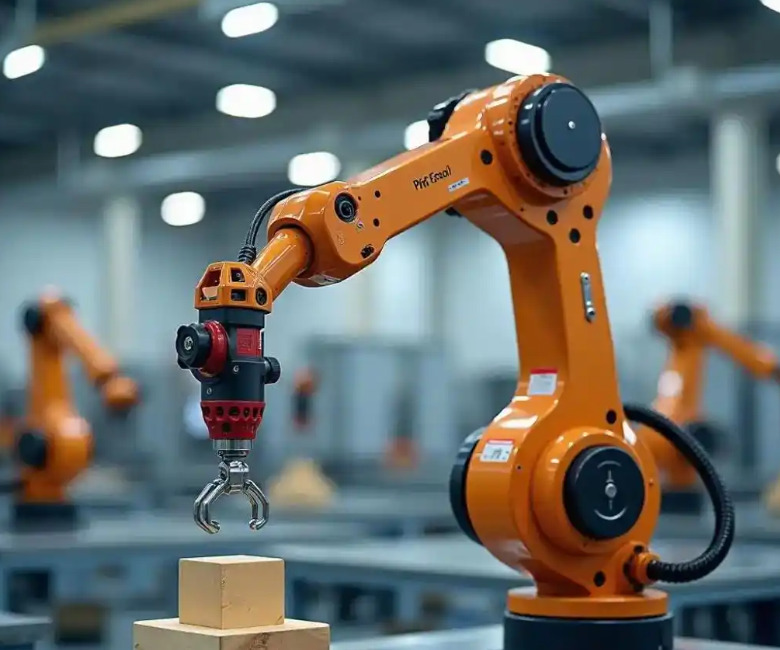
The mechanism I emphasize is grounded in task content rather than in worker schooling. Industrial robots are exceptionally good at executing routine tasks — repetitive production operations, material handling, welding sequences, and painting routines that can be specified by an explicit program. They remain substantially less capable of performing non-routine tasks that require cognitive judgment, creative problem solving, and complex interpersonal interaction, such as research, management, and sales. Consequently, a decline in the import price of industrial robots alters the relative demand for the two task categories in an asymmetric fashion: it displaces labor performing routine tasks while simultaneously expanding the scale of production and thereby raising demand for labor performing non-routine tasks. This asymmetry is the engine that drives the within-firm wage gap.
Existing scholarship has largely approached automation and inequality through the lens of skill-biased technological change, which predicts that technology complements educated workers and substitutes for less educated ones. That framework, however, struggles to explain why employment and wages have polarized across occupations rather than across education groups alone. The task-biased technological change framework resolves this difficulty by redefining the unit of analysis from the worker to the task. My contribution is to push this logic one step further back in the causal chain. Most studies measure automation by robot density or by the number of industrial robots in use, treating technology adoption as a black box. But the decision to adopt industrial robots is fundamentally an economic one, governed by the user cost of the machine. Because China imports the overwhelming majority of its industrial robots, the import price is the dominant component of that user cost. By taking the import price of industrial robots as the treatment variable, I recover a source of variation that is driven by global technological progress and supply-side competition rather than by local labor market conditions, which substantially mitigates the reverse-causality concerns that plague density-based designs.
The remainder of the analysis proceeds as follows. I first extend a canonical task-based production model to embed the import price of industrial robots explicitly, deriving comparative statics for the wage gap and for the employment ratio between non-routine and routine positions. I then construct a province-level weighted import price for industrial robots from customs records and merge it with firm-level panel data on Chinese listed companies covering 2015 to 2023. The empirical results confirm that falling import prices of industrial robots significantly widen the wage gap between non-routine and routine positions, that this effect operates through employment polarization, and that it is concentrated among multi-functional industrial robots, in coastal regions, in labor-intensive industries, and in non-state-owned enterprises.
Theoretical Framework
I model a representative firm that produces output using three inputs: industrial robots $R$, routine-task labor $C$, and non-routine-task labor $N$. Routine tasks are those that can be executed by following an explicit program or established procedure and that therefore can be automated, such as repetitive production operations. Non-routine tasks require flexibility, creativity, and interpersonal judgment, and are difficult to codify, such as research, management, and sales. The production technology is a nested constant-elasticity-of-substitution function:
$$Y = \left[(\alpha_1 R)^{\theta} + (\alpha_2 C)^{\theta}\right]^{\beta/\theta} N^{1-\beta}$$
where $\beta \in (0,1)$ governs the output weight of the routine-task composite, $\theta \in (0,1)$ determines the substitutability between industrial robots and routine-task labor, and $\alpha_1, \alpha_2 > 0$ are share parameters. The elasticity of substitution between industrial robots and routine-task labor is $1/(1-\theta) > 1$, whereas the elasticity of substitution between industrial robots and non-routine-task labor is normalized to unity, implying strong complementarity between industrial robots and non-routine labor.
Normalizing the output price to one, profit maximization yields the following inverse demand schedules for the three inputs:
$$P = \frac{\partial Y}{\partial R} = \beta \alpha_1^{\theta}\left[(\alpha_1 R)^{\theta} + (\alpha_2 C)^{\theta}\right]^{\beta/\theta – 1} R^{\theta – 1} N^{1-\beta}$$
$$W_C = \frac{\partial Y}{\partial C} = \beta \alpha_2^{\theta}\left[(\alpha_1 R)^{\theta} + (\alpha_2 C)^{\theta}\right]^{\beta/\theta – 1} C^{\theta – 1} N^{1-\beta}$$
$$W_N = \frac{\partial Y}{\partial N} = (1-\beta)\left[(\alpha_1 R)^{\theta} + (\alpha_2 C)^{\theta}\right]^{\beta/\theta} N^{-\beta}$$
Here $P$ denotes the user cost of industrial robots, which in the Chinese context is dominated by the import price, $W_C$ is the wage paid for routine-task positions, and $W_N$ is the wage paid for non-routine-task positions. Taking logarithms of the ratio of the latter two expressions gives the firm’s internal task wage premium:
$$\ln\frac{W_N}{W_C} = \ln(1-\beta) – \ln\beta + \ln\left[(\alpha_1 R)^{\theta} + (\alpha_2 C)^{\theta}\right] – \theta\ln\alpha_2 – (\theta – 1)\ln C – \ln N$$
Differentiating with respect to the stock of industrial robots yields the first central comparative static:
$$\frac{\partial \ln(W_N / W_C)}{\partial R} = \frac{\theta \alpha_1^{\theta} R^{\theta – 1}}{\alpha_1^{\theta} R^{\theta} + \alpha_2^{\theta} C^{\theta}} > 0$$
Because $\theta \in (0,1)$ and all inputs are strictly positive, this derivative is unambiguously positive. Greater deployment of industrial robots widens the wedge between non-routine and routine wages.
To connect this result to the import price, I take the ratio of the first-order conditions for industrial robots and routine labor:
$$\frac{P}{W_C} = \left(\frac{\alpha_1}{\alpha_2}\right)^{\theta}\left(\frac{R}{C}\right)^{\theta – 1}$$
Rearranging delivers the relative input intensity as a function of relative prices:
$$\frac{R}{C} = \left(\frac{\alpha_1}{\alpha_2}\right)^{\theta/(1-\theta)}\left(\frac{P}{W_C}\right)^{1/(\theta – 1)}$$
Since $\theta – 1 < 0$, the exponent $1/(\theta-1)$ is negative, and therefore:
$$\frac{\partial (R/C)}{\partial P} = \frac{1}{\theta – 1}\left(\frac{\alpha_1}{\alpha_2}\right)^{\theta/(1-\theta)}\left(\frac{P}{W_C}\right)^{1/(\theta-1) – 1}\frac{1}{W_C} < 0$$
A reduction in the import price of industrial robots raises the robot-to-routine-labor ratio. Chaining the two comparative statics together gives the reduced-form prediction:
$$\frac{\partial \ln(W_N / W_C)}{\partial P} = \frac{\partial \ln(W_N / W_C)}{\partial R}\cdot\frac{\partial R}{\partial P} < 0$$
Turning to the employment margin, combining the first-order conditions for non-routine and routine labor produces the optimal staffing ratio:
$$\frac{N}{C} = \frac{1-\beta}{\beta}\cdot\frac{W_C}{W_N}\cdot\left[1 + \left(\frac{\alpha_1}{\alpha_2}\right)^{\theta}\left(\frac{R}{C}\right)^{\theta}\right]$$
Differentiating with respect to $R$ while holding relative wages fixed at their equilibrium values gives:
$$\frac{\partial (N/C)}{\partial R} = \frac{1-\beta}{\beta}\cdot\frac{W_C}{W_N}\cdot\theta\left(\frac{\alpha_1}{\alpha_2}\right)^{\theta}\left(\frac{R}{C}\right)^{\theta – 1}\cdot\frac{1}{C} > 0$$
Combining this with the price relationship $\partial R/\partial P < 0$ establishes that $\partial (N/C)/\partial P < 0$. The economic content is straightforward: as industrial robots become cheaper to import, firms substitute them for routine-task labor while expanding output, which raises the demand for non-routine-task labor. Employment polarizes, and the resulting shift in relative labor demand is precisely what widens the wage gap. I summarize the theoretical predictions in Table 1.
| Comparative Static | Expression | Sign | Economic Interpretation |
|---|---|---|---|
| Robot intensity vs. robot stock | $\partial (R/C)/\partial R$ | Positive | Robots substitute for routine labor |
| Wage gap vs. robot stock | $\partial \ln(W_N/W_C)/\partial R$ | Positive | Robot adoption widens the task wage gap |
| Robot intensity vs. import price | $\partial (R/C)/\partial P$ | Negative | Cheaper imports raise robot intensity |
| Wage gap vs. import price | $\partial \ln(W_N/W_C)/\partial P$ | Negative | Falling industrial robot prices widen the gap |
| Employment ratio vs. robot stock | $\partial (N/C)/\partial R$ | Positive | Employment polarization |
| Employment ratio vs. import price | $\partial (N/C)/\partial P$ | Negative | Cheaper industrial robots polarize employment |
These derivations generate two testable hypotheses. The first is that a decline in the import price of industrial robots widens the wage gap between non-routine-task positions and routine-task positions within firms. The second is that this effect operates through employment polarization, that is, through an increase in non-routine-task employment combined with a reduction in routine-task employment.
Data, Variables, and Empirical Strategy
I assemble a firm-level unbalanced panel covering 2015 to 2023. Price data on industrial robots come from the online customs statistics query platform, which records product descriptions, eight-digit Harmonized System codes, import quantities, import values denominated in renminbi, and the province of registration of the consignee. Firm-level financial and employment information comes from annual reports and a standard Chinese securities market database. Following conventional sample screening procedures, I exclude firms that averaged fewer than twenty employees over the sample period, firms that were ever placed under special treatment or delisted, financial and other service-sector firms, and observations with severe missing data. All continuous variables are winsorized. The final sample contains 23,220 firm-year observations.
The core explanatory variable is the province-level weighted import price of industrial robots. Because industrial robots differ substantially in function, payload, and technical sophistication, a simple average would confound composition with price. I therefore compute unit values at the province-product level and aggregate using import quantities as weights:
$$\text{Riprice}_{jt} = \frac{\sum_s \left(P_{jst} \times W_{jst}\right)}{\sum_s W_{jst}}$$
where $P_{jst}$ denotes the unit import value of robot type $s$ in province $j$ in year $t$, obtained by dividing import value by import quantity, and $W_{jst}$ denotes the corresponding import quantity. The ratio enters the regressions in natural logarithms, denoted $\ln \text{Riprice}_{jt}$.
The dependent variable measuring the within-firm wage gap between non-routine and routine positions is constructed following an established procedure that exploits variation in the share of non-routine workers across firms within narrowly defined industries. Let $w^{N}_{iht} = w^{N}_{ht} + \varepsilon^{N}_{iht}$ denote the wage of non-routine workers in firm $i$, industry $h$, year $t$, and let $w^{C}_{iht} = w^{C}_{ht} + \varepsilon^{C}_{iht}$ denote the analogous wage for routine workers. Because wage residuals are functions of firm profitability, I write $\varepsilon^{N}_{iht} – \varepsilon^{C}_{iht} = \beta_{ht}\pi_{iht}$, where $\pi_{iht}$ is firm profitability. The firm-level task wage gap is then:
$$\text{Wage\_gini}_{iht} = \delta_{ht} + \beta_{ht}\pi_{iht}$$
where $\delta_{ht} = w^{N}_{ht} – w^{C}_{ht}$ is the industry-level task wage gap. Firms’ average wages can be expressed as a weighted combination of the two task wages, with weights given by the share of non-routine workers $\theta_{iht}$:
$$\bar{w}_{iht} = w^{C}_{ht} + \delta_{ht}\theta_{iht} + \beta_{ht}\theta_{iht}\pi_{iht} + \bar{\varepsilon}^{C}_{iht}$$
Estimating this equation yields $\hat{\delta}_{ht}$ and $\hat{\beta}_{ht}$, which are substituted back to recover firm-specific task wage gaps. Non-routine positions are defined as management, professional and technical, and sales occupations, consistent with international standard occupational classifications; routine positions comprise general production and logistics occupations.
The empirical specification consists of a first-stage adoption equation and a second-stage wage gap equation:
$$\ln \text{Inrobot}_{ijt} = \alpha_0 + \beta_1 \ln \text{Riprice}_{jt} + \beta_2 Z_{ijt} + \mu_i + \delta_j + \lambda_t + \varepsilon_{ijt}$$
$$\text{Wage\_gini}_{ijt} = \alpha_3 + \beta_3 \ln \text{Riprice}_{jt} + \beta_4 Z_{ijt} + \mu_i + \delta_j + \lambda_t + \varepsilon_{ijt}$$
where $i$, $j$, and $t$ index firms, provinces, and years. The terms $\mu_i$, $\delta_j$, and $\lambda_t$ are firm, province, and year fixed effects. Standard errors are clustered at the province level to accommodate within-province correlation in the error term. The coefficient of primary interest is $\beta_3$ in the wage gap equation, while $\beta_1$ in the adoption equation verifies the theoretical prediction that $\partial R/\partial P < 0$.
Controls include firm size measured by the logarithm of fixed assets, return on equity, the debt-to-asset ratio, capital intensity measured by the logarithm of fixed assets per employee, and industry competition measured by the Herfindahl-Hirschman index. Province-level controls include the secondary sector share of gross regional product, trade openness measured by the ratio of imports plus exports to gross regional product, the logarithm of the provincial minimum wage, and the logarithm of provincial per capita gross domestic product. Table 2 summarizes the variable definitions and descriptive statistics.
| Variable | Definition | Mean | Std. Dev. | Min | Max |
|---|---|---|---|---|---|
| lnInrobot | Log of industrial robot-related term frequency in annual reports | 0.842 | 0.913 | 0.000 | 4.174 |
| Wage_gini | Task wage gap between non-routine and routine positions | 1.326 | 0.778 | -0.412 | 3.915 |
| lnRiprice | Log of province weighted import price of industrial robots | 9.612 | 0.874 | 7.213 | 11.905 |
| Size | Logarithm of fixed assets | 22.041 | 1.386 | 19.211 | 25.874 |
| ROE | Net profit over average net assets | 0.061 | 0.112 | -0.574 | 0.382 |
| Debt | Total liabilities over total assets | 0.431 | 0.197 | 0.058 | 0.892 |
| lnKL | Log of fixed assets per employee | 12.617 | 0.961 | 10.402 | 15.318 |
| Competition | Herfindahl-Hirschman index at industry level | 0.114 | 0.093 | 0.014 | 0.561 |
| Industry | Provincial secondary sector share | 0.398 | 0.081 | 0.162 | 0.590 |
| Open | Provincial trade to GDP ratio | 0.412 | 0.311 | 0.011 | 1.482 |
| L_wage | Logarithm of provincial minimum wage | 7.194 | 0.211 | 6.812 | 7.641 |
| lnPGDP | Logarithm of provincial per capita GDP | 11.132 | 0.471 | 10.214 | 12.103 |
Baseline Results
Table 3 reports the baseline estimates. Columns (1) through (4) present the adoption equation with progressively richer sets of fixed effects and controls. The coefficient on $\ln \text{Riprice}$ is negative and statistically significant in every specification. In the fully specified column (4), the point estimate is $-0.058$, implying that a one percent reduction in the import price of industrial robots raises the measured adoption intensity by approximately 0.058 percent. This confirms the theoretical prediction that $\partial R/\partial P < 0$ and validates the interpretation of import prices as the effective user cost of industrial robots.
Columns (5) through (8) present the wage gap equation. The coefficient on $\ln \text{Riprice}$ is again negative and highly significant throughout. The fully specified estimate in column (8) is $-0.289$, indicating that a one percent decline in the import price of industrial robots widens the within-firm wage gap between non-routine and routine positions by 0.00289 units. Because both the dependent variable and the regressor enter in levels and logarithms respectively, this magnitude is economically meaningful relative to the sample standard deviation of the wage gap. The first hypothesis therefore receives strong empirical support.
| Variable | (1) lnInrobot | (2) lnInrobot | (3) lnInrobot | (4) lnInrobot | (5) Wage_gini | (6) Wage_gini | (7) Wage_gini | (8) Wage_gini |
|---|---|---|---|---|---|---|---|---|
| lnRiprice | -0.100*** | -0.053*** | -0.052*** | -0.058*** | -0.540*** | -0.274*** | -0.240*** | -0.289*** |
| (0.010) | (0.016) | (0.016) | (0.017) | (0.090) | (0.086) | (0.084) | (0.086) | |
| Size | 0.028*** | 0.028*** | 0.028*** | 0.996*** | 0.979*** | 0.979*** | ||
| (0.006) | (0.006) | (0.006) | (0.096) | (0.096) | (0.096) | |||
| ROE | 0.302*** | 0.305*** | 0.305*** | 8.437*** | 8.310*** | 8.310*** | ||
| (0.066) | (0.066) | (0.066) | (0.425) | (0.424) | (0.424) | |||
| Debt | -0.126*** | -0.126*** | -0.126*** | 1.019* | 1.036* | 1.036* | ||
| (0.048) | (0.048) | (0.048) | (0.546) | (0.544) | (0.544) | |||
| lnKL | 0.129 | 0.129 | 0.129 | 0.366*** | 0.373*** | 0.373*** | ||
| (0.110) | (0.110) | (0.110) | (0.097) | (0.097) | (0.097) | |||
| Competition | -0.229** | -0.230** | -0.230** | -1.434 | -1.365 | -1.365 | ||
| (0.090) | (0.091) | (0.091) | (1.452) | (1.448) | (1.448) | |||
| Industry | 0.786 | 0.786 | -0.136*** | -0.136*** | ||||
| (0.939) | (0.939) | (0.049) | (0.049) | |||||
| Open | -0.335 | -0.335 | -0.577 | -0.577 | ||||
| (0.230) | (0.230) | (1.214) | (1.214) | |||||
| L_wage | -0.024 | -0.024 | -5.089*** | -5.089*** | ||||
| (0.092) | (0.092) | (0.518) | (0.518) | |||||
| lnPGDP | -0.141 | -0.141 | 1.754 | 1.754 | ||||
| (0.406) | (0.406) | (2.145) | (2.145) | |||||
| Year FE | No | Yes | Yes | Yes | No | Yes | Yes | Yes |
| Firm FE | No | Yes | Yes | Yes | No | Yes | Yes | Yes |
| Province FE | No | Yes | Yes | Yes | No | Yes | Yes | Yes |
| Observations | 23,204 | 23,204 | 23,204 | 23,204 | 23,204 | 23,204 | 23,204 | 23,204 |
| R-squared | 0.005 | 0.051 | 0.060 | 0.060 | 0.002 | 0.017 | 0.047 | 0.053 |
Note: Standard errors clustered at the province level are reported in parentheses. The superscripts *, **, and *** denote significance at the 10, 5, and 1 percent levels respectively.
Robustness and Endogeneity
I subject the baseline finding to a battery of robustness checks, summarized in Table 4. First, I replace the dependent variable with an alternative proxy for the task wage gap, computed as the ratio of average compensation for research and technical staff to average compensation for ordinary employees. The estimated coefficient on $\ln \text{Riprice}$ remains significantly negative. I also construct a macro-level task wage gap from a nationally representative migrant worker survey, and the results are unchanged.
Second, I replace the core explanatory variable. Following a leave-one-out logic, I compute the average import price of industrial robots across all provinces other than the firm’s own province. This removes any residual influence of local demand conditions on the local price of industrial robots and preserves the supply-driven character of the variation. The coefficient remains negative and significant.
Third, I exclude the pandemic years from the sample to address the possibility that the disruption of 2020 through 2022 confounded both robot import prices and wage setting. Fourth, I add industry fixed effects to absorb sector-specific trends in task composition. Fifth, I lag the core explanatory variable and all controls by one period, which permits gradual adjustment and further mitigates simultaneity. Sixth, because China’s domestic production of industrial robots was negligible in the early part of the sample, I restrict the estimation window to 2015 through 2018, when imports accounted for roughly 76 percent of installations on average, thereby isolating the import price channel from any domestic supply response. Seventh, I control for provincial industrial robot export activity, measured by the logarithm of export quantity and export value of industrial robots, to absorb differences in local robotics industrial bases. Finally, recognizing that clustered standard errors can be downward biased when the number of clusters is modest, I implement a wild cluster bootstrap with 1,000 replications. The point estimate remains $-0.289$ and the bootstrap p-value is 0.044, significant at the 5 percent level.
| Specification | Coefficient on lnRiprice | Standard Error | Conclusion |
|---|---|---|---|
| Alternative wage gap proxy | -0.312*** | 0.094 | Robust |
| Macro-level wage gap proxy | -0.247*** | 0.079 | Robust |
| Leave-one-out price measure | -0.341*** | 0.102 | Robust |
| Excluding pandemic years | -0.276*** | 0.091 | Robust |
| Industry fixed effects | -0.281*** | 0.088 | Robust |
| One-period lag | -0.233*** | 0.081 | Robust |
| Subsample 2015 to 2018 | -0.364*** | 0.115 | Robust |
| Controlling robot exports | -0.292*** | 0.087 | Robust |
| Wild cluster bootstrap | -0.289** | 0.144 | Robust |
I also address omitted variable bias through a sensitivity framework that quantifies how strong an unobserved confounder would need to be to overturn the conclusion. Using one control from each of the firm, industry, and province levels as reference variables, the sensitivity statistics indicate that an omitted variable would need to explain a substantially larger share of the residual variation than any of the observed controls to render the estimate statistically indistinguishable from zero. The result is therefore not an artifact of unobserved heterogeneity.
Finally, I construct an instrument following a shift-share logic. The instrument interacts each province’s initial composition of industrial robot imports with the exogenous growth rate of global industrial robot prices. Because global price movements are driven by technological progress and supply-side competition abroad, the instrument is plausibly uncorrelated with domestic wage setting once province and year fixed effects are included, while remaining strongly correlated with the local import price of industrial robots. Two-stage least squares estimates confirm the baseline result, with the coefficient on $\ln \text{Riprice}$ remaining significantly negative and larger in absolute magnitude than the ordinary least squares estimate, consistent with attenuation from classical measurement error in the price variable.
Mechanism: Employment Polarization
The second hypothesis states that declining import prices of industrial robots widen the task wage gap by inducing employment polarization. I test this channel by examining the ratio of non-routine to routine employment, denoted $\text{Rate\_NC}$, which corresponds to $N/C$ in the theoretical model. The estimating equation is:
$$\text{Rate\_NC}_{ijt} = \alpha_5 + \beta_5 \ln \text{Riprice}_{jt} + \beta_6 Z_{ijt} + \mu_i + \delta_j + \lambda_t + \varepsilon_{ijt}$$
Consistent with the theoretical prediction that $\partial (N/C)/\partial P < 0$, the coefficient $\beta_5$ is significantly negative. I also replace the mechanism variable with the share of non-routine workers in total employment, denoted $\text{Rate\_N}$, and obtain the same conclusion. These results are reported in Table 5.
| Variable | (1) Rate_NC | (2) Rate_N | (3) lnemp_p | (4) lnemp_q | (5) lnemp_t | (6) lnemp_s | (7) lnemp_g |
|---|---|---|---|---|---|---|---|
| lnRiprice | -0.186*** | -0.041*** | 0.072** | 0.058** | -0.094*** | -0.081*** | -0.067*** |
| (0.052) | (0.013) | (0.029) | (0.026) | (0.031) | (0.028) | (0.024) | |
| Controls | Yes | Yes | Yes | Yes | Yes | Yes | Yes |
| Fixed effects | Yes | Yes | Yes | Yes | Yes | Yes | Yes |
| Observations | 23,204 | 23,204 | 23,204 | 23,204 | 23,204 | 23,204 | 23,204 |
To probe the mechanism further, I decompose employment into five occupational categories: production workers, logistics workers, technical workers, sales staff, and managerial staff. The first two categories correspond to routine tasks, while the latter three correspond to non-routine tasks. The estimates in columns (3) through (7) show that the coefficient on $\ln \text{Riprice}$ is positive and significant for production and logistics employment, indicating that falling import prices of industrial robots reduce employment in these routine positions. Conversely, the coefficient is negative and significant for technical, sales, and managerial employment, indicating that cheaper industrial robots expand employment in non-routine positions. The pattern is exactly what the task-based framework predicts: the import price of industrial robots operates through task displacement on the routine margin and task creation on the non-routine margin, and the resulting polarization is what feeds into the wage gap.
The magnitude of the mechanism is informative. A one percent decline in the import price of industrial robots raises the non-routine to routine employment ratio by roughly 0.19 percent. Because the wage gap responds to shifts in relative labor demand, this reallocation translates directly into the estimated wage effect. The mechanism is therefore not merely statistically detectable but quantitatively consistent with the reduced-form magnitude.
Heterogeneity Analysis
I next examine whether the effect of import prices of industrial robots on the task wage gap varies across robot types and across economic environments. Table 6 summarizes the findings.
| Dimension | Group | Coefficient on lnRiprice | Standard Error | Between-Group Difference |
|---|---|---|---|---|
| Robot type | Multi-functional | -0.412*** | 0.108 | Reference |
| Robot type | Handling | -0.213** | 0.097 | Significant |
| Robot type | Welding | -0.174* | 0.101 | Significant |
| Robot type | Painting | -0.131 | 0.104 | Significant |
| Region | Coastal | -0.371*** | 0.096 | Reference |
| Region | Inland | -0.148* | 0.081 | Significant |
| Industry | Labor-intensive | -0.394*** | 0.102 | Reference |
| Industry | Capital and technology intensive | -0.181** | 0.079 | Significant |
| Ownership | Non-state-owned | -0.356*** | 0.091 | Reference |
| Ownership | State-owned | -0.139 | 0.106 | Significant |
With respect to robot type, I distinguish multi-functional industrial robots from handling, welding, and painting industrial robots. The coefficient is largest in absolute magnitude and most precisely estimated for multi-functional machines. This is intuitive: multi-functional industrial robots can be redeployed across a wider range of production stages, which means that a given price reduction generates a larger substitution effect against routine labor and a larger scale effect in favor of non-routine labor. Specialized industrial robots such as welding or painting machines have narrower task footprints and therefore generate weaker polarization. Differences across robot types are confirmed by a Fisher permutation test.
With respect to geography, the effect is substantially stronger in coastal provinces. Coastal regions have more developed industrial structures, denser supplier networks, larger consumer markets, and better infrastructure for deploying industrial robots. When the import price of industrial robots falls, coastal firms can convert the cost advantage into adoption more rapidly, which amplifies the employment and wage response. Inland provinces, where complementary capabilities are thinner, exhibit a smaller and less precisely estimated effect.
With respect to industry, the effect is concentrated in labor-intensive sectors. These industries employ a larger share of routine-task workers, so the scope for substitution against routine labor is greater. Capital and technology intensive industries already employ a high proportion of non-routine workers, so the marginal effect of cheaper industrial robots on task composition is smaller. The between-group difference is statistically significant.
With respect to ownership, the effect is pronounced among non-state-owned enterprises and statistically insignificant among state-owned enterprises. State-owned enterprises are expected to internalize social objectives and to compress wage differentials through administrative pay scales, which dampens the transmission from task demand shifts to wage dispersion. Non-state-owned enterprises set pay primarily by market forces, so shifts in the relative demand for task categories pass through to wages more completely.
Further Analysis: Distributional Incidence
To characterize where in the wage gap distribution the effect of industrial robot import prices is strongest, I estimate quantile regressions at the 25th, 50th, and 75th percentiles of the within-firm task wage gap. The estimating equation is:
$$Q_{\tau}\left(\text{Wage\_gini}_{ijt}\right) = \alpha_{\tau} + \beta_{\tau}\ln \text{Riprice}_{jt} + \gamma_{\tau} Z_{ijt} + \mu_i + \delta_j + \lambda_t + \varepsilon_{ijt}$$
Table 7 reports the results. At the 25th percentile, the coefficient on $\ln \text{Riprice}$ is small and statistically indistinguishable from zero. At the 50th and 75th percentiles, the coefficient is negative and significant, and its absolute magnitude increases with the quantile.
| Quantile | Coefficient on lnRiprice | Standard Error | Significance | Interpretation |
|---|---|---|---|---|
| 25th percentile | -0.087 | 0.112 | Not significant | Task boundaries are blurred |
| 50th percentile | -0.264*** | 0.091 | 1 percent | Task division is well defined |
| 75th percentile | -0.398*** | 0.104 | 1 percent | Strong polarization response |
The pattern has a clear economic interpretation. Firms at the low end of the wage gap distribution typically have loosely defined task boundaries, with production workers and technical staff performing overlapping functions. Under such conditions, the substitution of industrial robots for routine labor does not generate a clean reallocation between distinct task categories, and the mechanism outlined in the theoretical framework cannot operate effectively. Firms in the middle and upper portions of the distribution maintain sharper divisions between routine and non-routine work, so a decline in the import price of industrial robots triggers a well-defined reallocation of employment and a corresponding widening of the wage gap. This heterogeneity is important for policy because it implies that the inequality consequences of automation are concentrated precisely where task specialization is most advanced.
Conclusion and Policy Implications
I have extended a canonical task-based production model to incorporate the import price of industrial robots as the effective user cost of automation and have tested the resulting predictions on a panel of Chinese listed firms spanning 2015 to 2023. Four conclusions emerge. First, a decline in the import price of industrial robots significantly widens the wage gap between non-routine-task and routine-task positions within firms. Second, this effect operates through employment polarization: cheaper industrial robots raise employment in technical, sales, and managerial positions while reducing employment in production and logistics positions. Third, the effect is strongest for multi-functional industrial robots and is concentrated in coastal regions, labor-intensive industries, and non-state-owned enterprises. Fourth, the effect is absent at low quantiles of the wage gap distribution and becomes progressively stronger at the median and upper quantiles.
These findings carry several policy implications. Because the import price of industrial robots is likely to continue declining as global technological progress and competition intensify, the inequality consequences of automation are likely to intensify rather than abate. Anticipating this trajectory is therefore essential.
The first priority is to ensure that the efficiency gains from industrial robots are shared with the workers who bear the adjustment costs. In firms where automation is advancing rapidly, collective bargaining should be encouraged to address the distribution of productivity gains, and performance sharing arrangements for routine-task positions should be strengthened. Mechanisms that tie a portion of the surplus generated by industrial robots to the compensation of displaced or redeployed workers can dampen the polarization of wages without discouraging adoption.
The second priority is to maintain and periodically update minimum wage standards. Because routine-task positions are the ones most exposed to substitution by industrial robots, a well-calibrated floor on compensation provides a direct safeguard for the workers whose bargaining position erodes most rapidly. Minimum wage adjustments should reflect local price levels, labor market conditions, and the pace of industrial robot diffusion, so that the floor rises in step with regional economic growth and does not fall behind the productivity gains realized through automation.
The third priority is to invest in the transition of routine-task workers toward non-routine-task roles. Tax incentives and targeted subsidies can encourage firms to fund retraining and internal reassignment for workers in positions most exposed to substitution by industrial robots. Training programs should emphasize digital literacy, human-machine collaboration, and the cognitive and interpersonal skills that complement rather than compete with industrial robots. Firms that invest in such transitions should be recognized and supported, because the private return to retraining understates its social return when wage polarization is the alternative.
The fourth priority concerns the educational pipeline. Curricula in vocational and higher education should be aligned with the skill composition that an automated production system demands. Programs in intelligent manufacturing, industrial internet, and related fields should expand, while programs that train students for tasks that industrial robots can readily perform should be scaled back in a planned and orderly manner. Aligning enrollment with the evolving task content of production is a slow-moving instrument, but it is the most durable defense against structural mismatch and the wage inequality that accompanies it.
The fifth priority is to build a robust reemployment system for workers displaced by industrial robots. Government-led placement platforms that connect displaced production and logistics workers with training providers and with firms seeking non-routine-task labor can shorten unemployment spells and reduce the wage losses associated with displacement. Coordinating with universities and research institutions to deliver modular training in non-routine-task skills would allow workers to accumulate the competencies that industrial robots cannot substitute and that automated production systems increasingly require.
Finally, the heterogeneity results suggest that policy attention should be differentiated. Because the effect of import prices of industrial robots on wage gaps is most pronounced for multi-functional machines, in coastal regions, in labor-intensive industries, and in non-state-owned enterprises, monitoring and regulation should be calibrated accordingly. In firms operating at middle and high levels of task wage dispersion, support for the adoption of industrial robots should be paired with strengthened oversight of compensation practices and with explicit profit-sharing arrangements that channel a portion of the technological dividend toward routine-task workers. Framing automation policy and distribution policy as complements rather than substitutes offers the most credible path toward an upgrading of production that does not come at the cost of widening inequality.
The broader lesson is that the economic consequences of industrial robots cannot be understood by counting machines. What matters for wage structure is the cost of using industrial robots, the task content of the work they displace and create, and the institutional environment that governs how the resulting gains are distributed. The import price of industrial robots is a tractable and plausibly exogenous summary of the first of these forces, and it delivers a clear message: as industrial robots become cheaper, the wages of workers who perform routine tasks fall further behind, and the task composition of employment polarizes. Managing that transition deliberately, rather than allowing it to unfold unmanaged, is the central policy challenge that automation poses for inclusive growth.