
I have been investigating how to develop a course-certificate integration curriculum system for industrial robots operation and maintenance. My starting point is the rapid expansion of domestic new energy vehicle production capacity, the continuous upgrading of manufacturing processes, and the increasing application density of industrial robots on automotive production lines. As the technical complexity of industrial robots continues to rise, the market demand for composite maintenance talent who hold vocational skill level certificates and possess production-line practical operation ability is becoming stronger. The talent gap in related skill positions continues to widen. Vocational colleges therefore need to fully integrate the 1+X vocational skill level standard for industrial robots operation and maintenance into the professional curriculum system, achieve deep integration of course content, teaching process, and assessment evaluation with vocational certificate standards, and allow students to receive academic education while increasing their vocational skill qualification reserves. In this way, I aim to truly realize the talent training goal of obtaining certificates while at school and being competent after taking up a post.
In my research, I treat industrial robots not as isolated pieces of equipment but as core production assets embedded in welding, painting, and final assembly scenarios. The operation and maintenance of industrial robots requires a combination of safety awareness, mechanical and electrical knowledge, sensor diagnosis, system optimization, and production-line coordination. When industrial robots are deployed at higher density, the failure modes become more complex, the cost of downtime becomes higher, and the skill requirements for maintenance personnel become more demanding. This is why I focus on a course-certificate integration system that connects academic learning with certificate assessment and enterprise岗位 needs. The ultimate goal is to enable students to master the operation and maintenance of industrial robots in a progressive, standardized, and industry-adapted way.
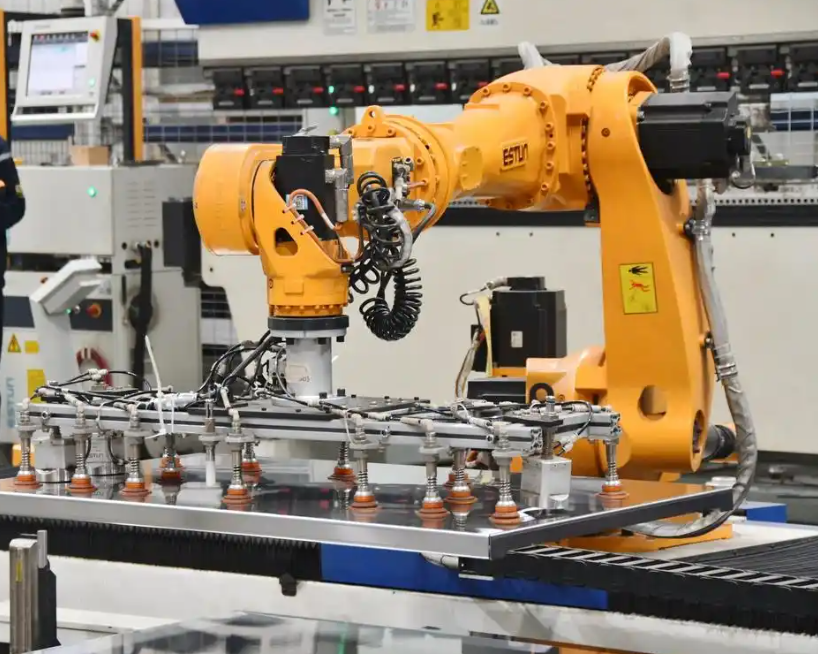
I designed the development path of the course-certificate integration curriculum system around five major components: course objective design, teaching project design, teaching process design, assessment evaluation system design, and teaching resource construction. Each component is oriented toward the vocational skill level standard for industrial robots operation and maintenance. I also pay attention to the progressive cognitive law of learning, the requirements of academic education, and the actual ability needs of frontline automotive production positions. My curriculum system is therefore not a simple addition of certificate training to an existing course. It is a structural reconstruction that maps knowledge, ability, and quality objectives to different certificate levels and to real production tasks involving industrial robots.
Course Objective Design
When I design course objectives, I use the vocational skill level standards for industrial robots system operators at the junior, intermediate, and senior levels as the core basis. I align these standards with the progressive cognitive law of learning and balance the requirements of academic education with the ability needs of automotive production frontline positions. I set course objectives in a layered manner from three dimensions: knowledge, ability, and quality. I then clarify the connection points between course content at each stage and vocational certificates at different levels. This creates a three-dimensional training objective system characterized by knowledge compliance, skill certification, and quality adaptation. It helps students obtain vocational certificates in a step-by-step manner and accurately adapt to job requirements.
| Objective Dimension | Junior Certificate Focus | Intermediate Certificate Focus | Senior Certificate Focus |
|---|---|---|---|
| Knowledge | Safety rules, basic structure of industrial robots, teach pendant functions, maintenance documentation | Sensor principles, I/O signals, fault diagnosis flow, production-line coordination logic | System optimization methods, reliability analysis, maintenance planning, report writing |
| Ability | Safe operation, simple teaching programming, routine inspection, lubrication, cable fastening | Sensor fault diagnosis, vision and force calibration, single-station debugging, rapid response | Production-line maintenance plan formulation, key parameter optimization, linked fault troubleshooting |
| Quality | 5S awareness, safety responsibility, standardized operation habits | Team collaboration, problem-solving, data-based decision-making | System thinking, continuous improvement, technical documentation and communication |
I express the layered objective design as a multidimensional function. Let \(K\) represent knowledge, \(A\) represent ability, and \(Q\) represent quality. The overall course objective \(G\) can be described as:
$$ G = f(K, A, Q) = \sum_{d=1}^{3} w_d g_d $$
Here, \(w_d\) represents the weight of each dimension, and \(g_d\) represents the achievement level in that dimension. In my design, the weights are not fixed across all certificate levels. For the junior certificate, I place greater weight on safety knowledge and standardized operation quality. For the intermediate certificate, I increase the weight of diagnostic ability and collaborative quality. For the senior certificate, I emphasize system optimization ability and comprehensive quality. This dynamic weighting allows the course objectives to remain aligned with the vocational skill level standard for industrial robots operation and maintenance.
I also define the mapping between course objectives and certificate levels through a compatibility condition. Let \(C_j\) be the competency requirement of a certificate level, and let \(O_c\) be the course objective outcome. The course-certificate alignment degree \(M\) can be expressed as:
$$ M = \frac{\sum_{i=1}^{n} \min(O_{c,i}, C_{j,i})}{\sum_{i=1}^{n} C_{j,i}} $$
When \(M\) approaches 1, the course objective is highly aligned with the certificate standard. When \(M\) is low, I need to revise the objective design, add missing knowledge points, strengthen weak ability training, or adjust quality cultivation activities. This formula helps me quantify whether the course objectives are truly certificate-oriented rather than superficially connected. It also supports continuous improvement of the curriculum for industrial robots operation and maintenance.
Teaching Project Design
I base the teaching project design on the practical assessment standards of vocational certificates and combine them with three typical automotive production scenarios: welding, painting, and final assembly. I build a three-level progressive course teaching project system: basic operation, specialized skills, and comprehensive application. Each level corresponds precisely to the core assessment points of the corresponding certificate level. At the same time, each project is close to the actual work tasks of an enterprise production line. This forms an integrated course-certificate connection model in which learning is practicing, practicing is assessing, and assessing is certifying.
| Corresponding Certificate | Teaching Project Name | Project Carrier | Key Training Tasks | Certificate Assessment Points |
|---|---|---|---|---|
| Junior certificate | Safe operation and teaching of industrial robots | Small industrial robot workstation on an automotive welding line | Teach pendant function operation, safety fence and emergency stop testing, simple welding trajectory teaching and programming | Safety operation specifications, basic teaching programming, trajectory planning |
| Junior certificate | Daily maintenance and status inspection of industrial robots | Robot body and control cabinet on an automotive painting line | Joint lubrication and grease replacement, cable fastening and insulation testing, control cabinet cooling system cleaning | Routine maintenance process, component status inspection points, basic maintenance specifications |
| Intermediate certificate | Sensor fault diagnosis and troubleshooting | Vision and force sensor workstation on an automotive welding line | Photoelectric sensor false trigger troubleshooting, vision positioning deviation calibration, force feedback signal abnormality handling | Sensor maintenance, fault diagnosis and repair, single-station debugging |
| Intermediate certificate | Collaborative maintenance of production line and industrial robots | Simulation system for robot assembly on an automotive final assembly line | Input/output signal setting, collaborative operation rhythm optimization, rapid response to production line downtime | Multi-machine collaborative control measures, system integration basics, production line maintenance management methods |
| Senior certificate | Production line maintenance plan formulation and system optimization | Real case of an automotive whole-vehicle welding line | Weekly and monthly maintenance plan formulation, key parameter analysis and optimization, linked fault troubleshooting and report writing | System optimization, comprehensive fault diagnosis, production line maintenance management extension |
I use this project system to ensure that students encounter industrial robots in contexts that resemble real automotive manufacturing. The junior projects build safety and basic maintenance habits. The intermediate projects introduce sensor diagnosis and collaborative operation. The senior projects require students to analyze the whole production line, optimize parameters, and write maintenance reports. In my experience, this progression prevents students from learning fragmented skills. Instead, they accumulate a coherent ability structure around industrial robots operation and maintenance.
I also define a project difficulty coefficient \(D_p\) to describe the progressive challenge of each teaching project. Let \(c_1\) be the number of basic operation tasks, \(c_2\) be the number of diagnostic tasks, and \(c_3\) be the number of system optimization tasks. The difficulty coefficient can be written as:
$$ D_p = \alpha_1 c_1 + \alpha_2 c_2 + \alpha_3 c_3 $$
where \(\alpha_1 < \alpha_2 < \alpha_3\). This formula helps me arrange projects in a sequence that matches the cognitive development of students and the certificate level requirements. It also allows me to adjust project content when the vocational skill level standard for industrial robots changes.
Teaching Process Design
When I design the teaching process, I adopt an action-oriented teaching method. I strictly follow the assessment process and scoring standards of the vocational certificate. I construct a closed-loop teaching system of online preview, skill practical training, and review summary. Online, I rely on a smart teaching platform to organize students to carry out vocational certificate theory learning, virtual simulation training, and self-testing with past exam questions. Offline, I follow the 5S management standards of the automotive industry, which include Seiri, Seiton, Seiso, Seiketsu, and Shitsuke. According to the certificate scoring rules, I carry out systematic practical training. After class, I use methods such as drawing mind maps, recording reflection videos, and conducting group mutual evaluation to consolidate students’ practical skills and help them achieve flexible skill transfer.
| Teaching Stage | Main Activities | Platform or Tool | Output | Certificate Connection |
|---|---|---|---|---|
| Online preview | Theory learning, virtual simulation, past exam self-test | Smart teaching platform, simulation software | Pre-study notes, self-test scores, simulation operation records | Theory points and safety specifications of industrial robots certificates |
| Offline practical training | 5S standardized operation, task-based training, scoring rule practice | Training workstation, certificate-specific equipment | Operation records, inspection sheets, fault diagnosis reports | Practical assessment points of industrial robots operation and maintenance |
| After-class review | Mind mapping, reflection video, group mutual evaluation | Online platform, video recording tools, evaluation rubrics | Mind maps, reflection videos, peer evaluation forms | Skill consolidation and transfer for industrial robots maintenance |
I model the closed-loop learning effect as a weighted sum. Let \(P\) be online preview performance, \(T\) be offline practical training performance, and \(R\) be after-class review performance. The learning effect \(L\) can be expressed as:
$$ L = \alpha P + \beta T + \gamma R $$
where \(\alpha + \beta + \gamma = 1\). In my implementation, I adjust these weights according to the certificate level. For junior students, I increase \(\beta\) to emphasize standardized operation. For intermediate students, I balance \(\beta\) and \(\gamma\) to strengthen diagnosis and reflection. For senior students, I increase \(\gamma\) to encourage system thinking and knowledge transfer. This formula provides a simple but useful way to monitor whether the teaching process is producing the desired learning effect for industrial robots operation and maintenance.
I also use a skill transfer coefficient to evaluate whether students can apply what they learned in one scenario to another. Let \(S_0\) be the initial skill level, \(S_1\) be the skill level after training, and \(S_2\) be the skill level in a new task. The transfer coefficient \(T_s\) is:
$$ T_s = \frac{S_2 – S_0}{S_1 – S_0} $$
When \(T_s\) is close to 1, students can transfer their skills from one industrial robots task to another. When \(T_s\) is low, I need to add more varied cases, more reflection activities, or more cross-scenario training. This is particularly important because industrial robots are used in welding, painting, and final assembly, and each scenario has different requirements.
Assessment Evaluation System Design
When I design the assessment evaluation system, I adopt a dual-integration evaluation model of whole-process tracking and final assessment. I fully align it with the assessment evaluation standards of the industrial robots vocational skill level certificate. I achieve unity between course assessment and certificate assessment in dimensions, standards, and weights. I build a course-certificate linkage mechanism that promotes learning through assessment and promotes certification through evaluation. The whole-process tracking evaluation accounts for 60%, including daily practice scores related to the vocational certificate at 30% and practical standardized performance scores at 30%. This part focuses on assessing students’ basic skill mastery and standardized operation compliance. The final assessment accounts for 40%, and its core assessment content and score settings fully correspond to the core test points of the vocational certificate. If a student passes the course assessment, they can directly obtain the qualification to take the vocational certificate examination.
| Evaluation Module | Weight | Content | Certificate Alignment |
|---|---|---|---|
| Daily practice related to vocational certificate | 30% | Online exercises, theoretical tests, simulation task completion | Theory and basic operation points of industrial robots certificates |
| Practical standardized performance | 30% | 5S compliance, safety operation, tool use, maintenance records | Practical assessment standards and standardized operation requirements |
| Final assessment | 40% | Comprehensive practical tasks, fault diagnosis, system optimization report | Core test points of intermediate and senior certificates |
I express the total course score \(S_{total}\) as:
$$ S_{total} = 0.6 \times S_{process} + 0.4 \times S_{final} $$
where \(S_{process}\) is the whole-process tracking score and \(S_{final}\) is the final assessment score. The whole-process tracking score itself is:
$$ S_{process} = 0.5 \times S_{daily} + 0.5 \times S_{practical} $$
Here, \(S_{daily}\) is the daily practice score related to the vocational certificate, and \(S_{practical}\) is the practical standardized performance score. In my design, the final assessment score directly corresponds to the certificate core test points. If \(S_{total} \geq 60\) and the practical standardized performance score is above the certificate threshold, the student obtains the qualification to take the certificate examination. This creates a clear and measurable link between course learning and certificate acquisition.
I also define a course-certificate consistency index \(CCI\). Let \(W_c\) be the course assessment weights and \(W_v\) be the vocational certificate assessment weights. The consistency index is:
$$ CCI = 1 – \frac{1}{2} \sum_{i=1}^{n} |W_{c,i} – W_{v,i}| $$
When \(CCI\) is close to 1, the course assessment and certificate assessment are highly consistent. When \(CCI\) is low, I adjust the assessment dimensions, weights, or scoring rubrics. This index helps me maintain the course-certificate integration over time, especially when the vocational skill level standard for industrial robots is revised.
Teaching Resource Construction
In terms of teaching resource construction, I use the industrial robots vocational skill level standard as the core basis and combine it with real application scenarios of automotive manufacturing production lines. I build a dedicated teaching resource library characterized by certificate orientation, production line adaptation, and integration of learning, practice, and assessment. This library provides comprehensive support for the implementation of course-certificate integration teaching. The teaching resource construction system is shown in the following table.
| Resource Type | Specific Content | Corresponding Certificate | Presentation Carrier |
|---|---|---|---|
| Practical guidance resources | Typical cases of automotive production line certificate assessment, standardized teaching videos for certificate practical operation, 5S site management manual | Junior and intermediate certificates | Video tutorials, paper manuals |
| Basic training resources | 100 graded certificate question bank, virtual simulation scenes for certificate practical operation, automotive production line simulation models | Junior and intermediate certificates | Online teaching platform, simulation software |
| Exam preparation resources | 20 sets each of theory and practical simulation papers for junior and intermediate certificates, compilation of past exam questions | Intermediate and senior certificates | Paper test papers, practical training task sheets |
| Auxiliary learning resources | Course standards, vocational certificate syllabus, teaching courseware, automotive production line fault diagnosis manual, certification guidance materials | All certificate levels | Online resource library, electronic documents |
I ensure that each resource type is connected to at least one certificate level and one real task involving industrial robots. The practical guidance resources help students understand the scoring rules and safety standards. The basic training resources provide repeated practice opportunities through virtual simulation. The exam preparation resources reduce the gap between course assessment and certificate assessment. The auxiliary learning resources support self-directed learning and teacher lesson preparation. Together, these resources form an integrated support system for industrial robots operation and maintenance education.
I also use a resource coverage index \(RCI\) to evaluate whether the teaching resources cover the certificate assessment points. Let \(N_c\) be the number of certificate assessment points covered by resources and \(N_t\) be the total number of certificate assessment points. Then:
$$ RCI = \frac{N_c}{N_t} $$
I aim to keep \(RCI\) above a target value, for example 0.95, before each teaching cycle. If \(RCI\) is lower, I update the resource library by adding micro-lectures, simulation tasks, case studies, or assessment rubrics. This is especially important because the vocational certificate standard for industrial robots continues to add new content such as collaborative robot safety operation, digital twin maintenance, and new energy vehicle production line adaptation.
Main Challenges and Countermeasures
The development of the course-certificate integration curriculum system for industrial robots operation and maintenance faces several main challenges. First, in recent years, vocational certificate standards have added entirely new content, including collaborative robot safety operation, digital twin maintenance, and new energy vehicle production line adaptation. However, the curriculum revision and update cycle of colleges is relatively long, resulting in content lag. Second, there is a gap between on-campus training scenarios and real enterprise scenarios. The on-campus training environment cannot completely replicate the vocational certificate assessment standards and the multi-device linkage and high-load production operation scenarios of automobile enterprises. As a result, students still need a long adaptation period after obtaining the certificate. Third, students’ skill levels are clearly stratified. Students with weak foundations find it difficult to meet the junior certificate assessment standards, while excellent students lack advanced learning content. A unified teaching model cannot meet the learning needs of different levels.
| Challenge | Manifestation | Impact on Industrial Robots Training | Countermeasure | Expected Indicator |
|---|---|---|---|---|
| Certificate standard update lag | New content such as collaborative robots, digital twins, and new energy vehicle lines is not quickly integrated | Students learn outdated content and cannot meet new certificate requirements | Form a special working group of professional teachers, enterprise technical backbones, and certificate assessors; follow standard revisions quarterly; convert new content into micro-lectures and special training modules | Reduce standard lag degree \(\Delta S\) toward 0 |
| Gap between campus training and enterprise reality | Campus training cannot fully replicate multi-device linkage and high-load production | Students need a long adaptation period after certification | Promote standardized and production-line transformation of training scenarios; introduce certificate-specific training equipment; integrate real enterprise cases; build a standardized certificate training zone; develop remote training platform and VR training projects | Increase scenario similarity index \(G\) |
| Student skill stratification | Weak students cannot reach junior certificate standards; excellent students lack advanced content | Unified teaching cannot satisfy different learning needs | Implement layered teaching and step-by-step certification; open basic, advanced, and elite classes corresponding to junior, intermediate, and senior certificate teaching and assessment; flexibly relax assessment cycles | Increase layered teaching satisfaction \(M\) |
To address these challenges, I propose systematic optimization countermeasures. First, I dynamically connect with the vocational certificate standard. I form a special working group composed of professional teachers, enterprise technical backbones, and vocational certificate assessors. The group follows the revision dynamics of the vocational certificate standard every quarter. It converts newly added assessment content into micro-lectures, special practical training, and other modules. It synchronously updates course teaching content to ensure that teaching and certification standards iterate together. Second, I promote the standardization and production-line transformation of practical training scenarios. I introduce certificate-specific practical training equipment, integrate real production cases from automobile enterprises, and build a standardized vocational skill level certificate training zone. I develop a remote practical training platform and virtual reality training projects to simulate high-risk and complex practical operation scenarios, thereby narrowing the gap between on-campus training, enterprise production, and certificate assessment. Third, I implement layered teaching and step-by-step certification. I open basic classes, advanced classes, and elite classes, corresponding respectively to junior, intermediate, and senior certificate teaching and assessment. I flexibly relax the assessment cycle and support students in completing step-by-step certification progressively.
I use a standard lag degree \(\Delta S\) to measure the gap between the certificate standard and the curriculum content:
$$ \Delta S = S_{cert} – S_{curriculum} $$
where \(S_{cert}\) represents the certificate standard content and \(S_{curriculum}\) represents the curriculum content. My goal is to keep \(\Delta S\) as close to zero as possible. I also define a scenario similarity index \(G\) to evaluate how closely the training environment resembles the enterprise production environment:
$$ G = 1 – \frac{1}{n} \sum_{i=1}^{n} \left| \frac{C_{campus,i}}{C_{enterprise,i}} – 1 \right| $$
When \(G\) is close to 1, the campus training scenario is highly similar to the enterprise scenario. When \(G\) is low, I need to improve the training equipment, virtual simulation, or real case integration. For layered teaching, I define a satisfaction index \(M\):
$$ M = \frac{\sum_{i=1}^{m} n_i s_i}{\sum_{i=1}^{m} n_i} $$
where \(n_i\) is the number of students in layer \(i\) and \(s_i\) is the satisfaction or achievement score of that layer. These formulas help me monitor whether the countermeasures are effective for industrial robots operation and maintenance training.
Implementation Results
I applied this course-certificate integration curriculum system for industrial robots operation and maintenance in a vocational and technical college. After implementation, talent training and professional construction achieved remarkable results. At the student level, the intermediate vocational certificate acquisition rate of the major increased from 70% to 96%. Students of the major cumulatively won 2 first prizes and 3 second prizes in provincial vocational skill competitions. The employment rate of certificate-holding graduates reached 100%. The skill level and employment quality of students improved significantly. At the school-enterprise cooperation level, the number of cooperating automobile enterprises expanded from 1 to 4. The school and enterprises jointly developed 1 certificate-oriented textbook and formulated 4 exclusive course standards and practical training teaching standards. At the professional construction level, the professional group to which the major belongs was successfully selected as a provincial high-level professional group under the Double High Plan. The quality of professional talent training, industry recognition, and comprehensive influence improved significantly.
| Indicator | Before Implementation | After Implementation | Change | Formula |
|---|---|---|---|---|
| Intermediate certificate acquisition rate | 70% | 96% | +26 percentage points | \(\Delta R = 96\% – 70\% = 26\%\) |
| Provincial vocational skill competition first prize | 0 | 2 | +2 | \(N_1 = 2\) |
| Provincial vocational skill competition second prize | 0 | 3 | +3 | \(N_2 = 3\) |
| Employment rate of certificate-holding graduates | Not available | 100% | Full employment | \(E = 1.00\) |
| Cooperating automobile enterprises | 1 | 4 | +3 | \(\Delta C = 4 – 1 = 3\) |
| Jointly developed certificate-oriented textbook | 0 | 1 | +1 | \(T_b = 1\) |
| Exclusive course standards and practical training teaching standards | 0 | 4 | +4 | \(S_t = 4\) |
I also calculate the relative improvement rate of the intermediate certificate acquisition rate:
$$ R_{improve} = \frac{96\% – 70\%}{70\%} \times 100\% \approx 37.14\% $$
This means that after implementing the course-certificate integration system, the intermediate certificate acquisition rate increased by approximately 37.14% relative to the original level. The employment rate of certificate-holding graduates reached 100%, indicating that the integration of industrial robots operation and maintenance training with certificate standards improved both student competence and employer recognition. The expansion of cooperating automobile enterprises from 1 to 4 also shows that the curriculum system is better aligned with industry needs. The joint development of a certificate-oriented textbook and the formulation of four course standards and practical training teaching standards provide a sustainable foundation for future improvement.
At the professional construction level, the selection of the professional group as a provincial high-level professional group under the Double High Plan reflects the broader impact of the curriculum reform. The reform is not limited to a single course. It strengthens the connection between industrial robots operation and maintenance, automotive manufacturing, and vocational certificate assessment. It also improves the professional group’s ability to serve the regional automotive industry. In my view, the implementation results demonstrate that course-certificate integration can effectively address the mismatch between academic education and vocational skill certification.
Further Analysis of Industrial Robots Talent Development
I believe that the course-certificate integration system must continue to evolve as industrial robots become more intelligent, more collaborative, and more deeply integrated with digital twins and new energy vehicle production lines. The operation and maintenance of industrial robots is no longer limited to manual teaching and basic fault repair. It increasingly involves data analysis, remote monitoring, predictive maintenance, and system-level optimization. Therefore, I design the curriculum to include not only basic operation and maintenance skills but also higher-order abilities such as fault prediction, parameter optimization, and production line coordination. This is why the senior certificate projects require students to formulate maintenance plans, analyze key parameters, and write reports. These tasks push students beyond procedural knowledge and toward system thinking.
I also pay attention to the safety and ethical dimensions of industrial robots. Collaborative robots work alongside human operators, so safety operation is not only a technical requirement but also a professional quality. In my teaching process, I integrate safety fence testing, emergency stop operation, and 5S management into every practical training task. I assess these aspects through the practical standardized performance score. This ensures that students develop safe habits before they enter the workplace. When they operate industrial robots in real production lines, they can avoid accidents and reduce downtime.
I further consider the role of virtual reality and remote training platforms in narrowing the gap between campus and enterprise. Industrial robots are expensive, and many colleges cannot replicate a full automotive production line on campus. Virtual reality can simulate high-risk, high-cost, and complex scenarios. Remote training platforms can connect students to enterprise equipment and real production data. In my curriculum, I use these tools as supplements rather than replacements for hands-on training. The combination of virtual simulation and physical operation helps students understand the logic of industrial robots while developing practical skills. It also supports repeated practice without consuming materials or risking equipment damage.
I also recognize that teacher capacity is a critical factor in course-certificate integration. Teachers need to understand both the academic curriculum and the vocational certificate assessment standards. They also need experience with real industrial robots in enterprise settings. In my countermeasures, I include the formation of a special working group composed of professional teachers, enterprise technical backbones, and certificate assessors. This group follows certificate standard revisions and updates teaching content. It also provides a mechanism for teachers to learn from enterprise experts and certificate assessors. Over time, this collaboration can improve the quality of teaching resources, assessment rubrics, and practical training projects.
I use a teacher-capacity index \(TCI\) to describe the readiness of teachers for course-certificate integration:
$$ TCI = w_1 E_t + w_2 E_c + w_3 E_i $$
where \(E_t\) is teaching experience, \(E_c\) is certificate assessment experience, and \(E_i\) is enterprise practice experience. The weights \(w_1, w_2, w_3\) sum to 1. When \(TCI\) is low, I can arrange teacher training, enterprise internships, or certificate assessor workshops. This index helps me ensure that the curriculum system is not only well designed but also well implemented. For industrial robots operation and maintenance, teacher capacity directly affects how well students understand complex concepts such as sensor diagnosis, system integration, and production line optimization.
I also monitor student engagement and learning behavior. Let \(E\) be the engagement score, \(A\) be attendance, \(P\) be participation, and \(S\) be self-study time. I can define an engagement index as:
$$ EI = \beta_1 A + \beta_2 P + \beta_3 S $$
where \(\beta_1 + \beta_2 + \beta_3 = 1\). If \(EI\) is low, I adjust the teaching process by adding more interactive activities, virtual simulation challenges, or group competitions. For industrial robots training, engagement is particularly important because many tasks require repeated practice and careful observation. A low engagement level can lead to safety violations, poor maintenance habits, and weak diagnostic ability.
Curriculum Optimization Cycle
I treat curriculum development as a continuous optimization cycle rather than a one-time project. The cycle includes standard tracking, content updating, teaching implementation, assessment analysis, and feedback improvement. Every quarter, the special working group reviews the vocational certificate standard for industrial robots operation and maintenance. It identifies new assessment points, new technologies, and new enterprise requirements. It then converts these into micro-lectures, practical training modules, simulation scenarios, or assessment tasks. After each teaching cycle, I analyze student performance data, certificate acquisition rates, competition results, and employment feedback. I use this data to adjust course objectives, project difficulty, teaching methods, and assessment weights.
| Optimization Stage | Main Actions | Data Sources | Output | Frequency |
|---|---|---|---|---|
| Standard tracking | Review certificate standard revisions, enterprise technical updates, and new industrial robots applications | Certificate standards, enterprise reports, industry conferences | Updated assessment point list | Quarterly |
| Content updating | Develop micro-lectures, practical modules, simulation tasks, and assessment rubrics | Updated assessment point list, teacher feedback, enterprise cases | Revised teaching resources | Quarterly or semester-based |
| Teaching implementation | Deliver online preview, offline practical training, and after-class review | Teaching platform data, classroom observation, student records | Student performance data | Continuous |
| Assessment analysis | Analyze course scores, certificate acquisition rates, competition results, and employment data | Assessment system, certificate results, employer feedback | Gap analysis report | Semester-based |
| Feedback improvement | Adjust objectives, projects, process, assessment, and resources | Gap analysis report, teacher reflection, student feedback | Updated curriculum system | Annual or semester-based |
I define the curriculum optimization cycle as a feedback control system. Let \(C(t)\) be the curriculum state at time \(t\), \(S(t)\) be the certificate standard state, and \(U(t)\) be the update action. The change in curriculum state can be described as:
$$ \frac{dC}{dt} = k(S – C) + U $$
where \(k\) is the response rate. When \(k\) is large, the curriculum responds quickly to standard changes. When \(k\) is small, the curriculum lags behind. In my design, I aim to increase \(k\) by establishing quarterly standard tracking and a special working group. The update action \(U\) represents the development of new micro-lectures, practical modules, and assessment tasks. This control model helps me think about course-certificate integration as a dynamic process rather than a static document.
I also consider the balance between standardization and flexibility. Standardization is necessary for certificate alignment, safety, and quality assurance. Flexibility is necessary for different student levels, local industry needs, and emerging technologies. In my course-certificate integration system, I standardize the core assessment points, safety rules, and 5S requirements. I provide flexibility through layered teaching, optional advanced projects, and enterprise-specific case studies. This balance allows the curriculum to remain comparable to the certificate standard while adapting to diverse learning needs and regional industrial contexts.
Conclusion
The course-certificate integration curriculum system for industrial robots operation and maintenance can break down the barriers between academic education and vocational skill certification, and between on-campus skill training and enterprise job requirements. It effectively solves problems existing in the teaching of industrial robots operation and maintenance. In my research and implementation, I found that course objective design, teaching project design, teaching process design, assessment evaluation system design, and teaching resource construction must all be aligned with the vocational skill level standard. The use of tables and formulas helps make the alignment measurable, analyzable, and improvable. The three-level progressive project system, the closed-loop teaching process, the dual-integration assessment model, and the certificate-oriented resource library together create a coherent learning experience for students.
In the future, vocational colleges need to continue following industry technology iteration and vocational certificate standard revision dynamics. They need to deepen school-enterprise collaborative education mechanisms, dynamically optimize the curriculum system, and strengthen the training of composite skilled talent. For industrial robots operation and maintenance, this means continuously updating content related to collaborative robots, digital twin maintenance, new energy vehicle production line adaptation, and intelligent manufacturing. It also means strengthening teacher capacity, improving virtual and remote training platforms, and expanding enterprise partnerships. By doing so, colleges can continuously deliver high-quality technical and skilled talent for the high-quality development of the automobile manufacturing industry.
I conclude that the course-certificate integration approach is not merely a reform of teaching content. It is a systematic reconstruction of objectives, projects, processes, assessment, and resources around the real needs of industrial robots operation and maintenance. When implemented with clear standards, measurable indicators, and continuous feedback, it can significantly improve student skill levels, certificate acquisition rates, employment quality, and industry recognition. The experience I have gathered shows that industrial robots education benefits most when academic learning, certificate assessment, and enterprise practice are tightly connected. This connection is the core of my course-certificate integration curriculum system, and it is also the direction I will continue to develop in future research and practice.