
In the field of precision motion control, harmonic drive gears are pivotal components due to their high reduction ratios, compactness, and minimal backlash. However, the performance and longevity of these devices are critically dependent on precise assembly. Even minor deviations during the assembly process can induce significant stress concentrations, alter meshing characteristics, and ultimately lead to premature failure. In this comprehensive investigation, I explore the profound impact of specific assembly errors on the stress distribution within a harmonic drive gear, focusing on a non-tangent double circular arc tooth profile. The core objective is to quantify how errors in the relative positioning of the circular spline, flexspline, and wave generator affect the structural integrity of the flexspline, which is the most critical and fatigue-prone element.
The harmonic drive gear operates on the principle of elastic deformation. A wave generator, typically an elliptical cam assembly, deforms a thin-walled flexspline, causing its external teeth to mesh progressively with the internal teeth of a rigid circular spline. This unique mechanism, while efficient, makes the system highly sensitive to geometrical imperfections. Errors introduced during the mounting of these three primary components—termed assembly errors—can distort the intended deformation pattern, leading to uneven load distribution, increased stress, and potentially catastrophic interference between teeth. Therefore, a deep understanding of these error influences is not merely academic but essential for reliable design, assembly tolerancing, and field maintenance. This study employs a combined approach of advanced tooth profile design, parameterized error modeling, and nonlinear finite element analysis to systematically dissect these effects.
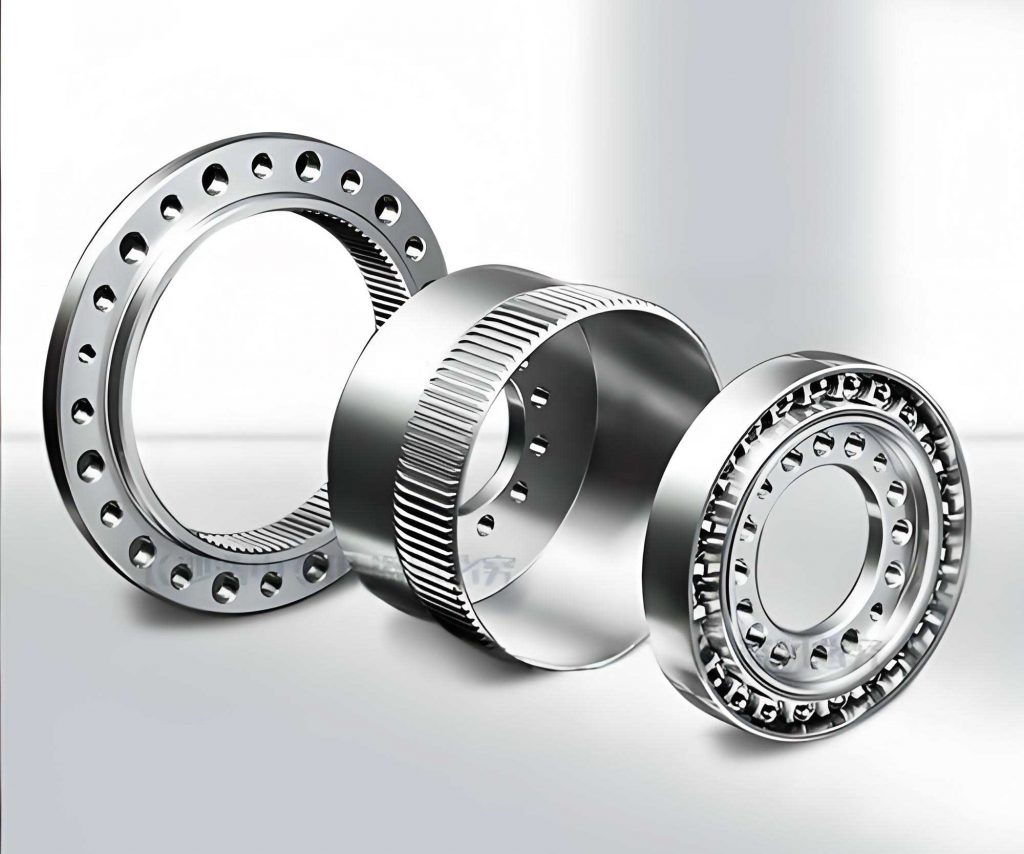
The foundation of any stress analysis in a harmonic drive gear begins with an accurate geometrical model of the teeth. For this research, I selected a non-tangent double circular arc profile for the flexspline. This profile, comprising convex and concave circular arcs, offers a longer path of contact and simpler manufacturing compared to its tangent counterpart, making it a compelling subject for study. The design process is rooted in the improved kinematics method. First, the flexspline tooth profile is defined in a local coordinate system. Let the profile be parameterized by the arc length \( u \). The profile consists of three segments: the convex arc \( AB \), the concave arc \( BC \), and the root fillet \( CD \). For the convex arc segment (\(0 \le u \le l_1\)), the position vector \( \mathbf{r_1} \) and the unit normal vector \( \mathbf{n_1} \) are given by:
$$
\mathbf{r_1}(u) = \begin{bmatrix}
\rho_a \cos(\theta – u/\rho_a) + x_{oa} \\
\rho_a \sin(\theta – u/\rho_a) + y_{oa}
\end{bmatrix}, \quad \mathbf{n_1}(u) = \begin{bmatrix}
\cos(\theta – u/\rho_a) \\
\sin(\theta – u/\rho_a)
\end{bmatrix}
$$
where \( \rho_a \) is the radius of the convex arc, \( \theta = \arcsin[(h_a + X_a)/\rho_a] \), \( l_1 = \rho_a (\theta – \gamma) \), \( x_{oa} = -l \), and \( y_{oa} = h_f + t – X_a \). Here, \( h_a \) is the addendum, \( h_f \) is the dedendum, \( t \) is the root wall thickness, \( X_a \) and \( Y_a \) are translation offsets for the convex arc center, and \( \gamma \) is the angle defining the transition point.
For the concave arc segment (\( l_1 \le u \le l_2 \)), the corresponding vectors are:
$$
\mathbf{r_2}(u) = \begin{bmatrix}
x_{of} – \rho_f \cos\left(\gamma + \frac{u – l_1}{\rho_f}\right) \\
y_{of} – \rho_f \sin\left(\gamma + \frac{u – l_1}{\rho_f}\right)
\end{bmatrix}, \quad \mathbf{n_2}(u) = \begin{bmatrix}
\cos\left(\gamma + \frac{u – l_1}{\rho_f}\right) \\
\sin\left(\gamma + \frac{u – l_1}{\rho_f}\right)
\end{bmatrix}
$$
where \( \rho_f \) is the radius of the concave arc, \( x_{of} = (\rho_a + \rho_f)\cos\gamma + h_l \tan\gamma – l_a \), \( y_{of} = h_f + t + X_f \), and \( l_2 = l_1 + \rho_f \left( \arcsin[(X_f + h_f)/\rho_f] – \gamma \right) \). The root fillet is typically a circular arc tangent to the concave arc and the root cylinder. The conjugate tooth profile for the circular spline is then derived numerically using the meshing equation based on the theory of gearing. For a given point on the flexspline profile defined by \( \mathbf{r}^{(1)} \) and \( \mathbf{n}^{(1)} \), the corresponding meshing rotation angle \( \phi \) for the circular spline must satisfy:
$$
\mathbf{n}^{(1)} \cdot \left( \mathbf{v}^{(12)} \right) = 0
$$
where \( \mathbf{v}^{(12)} \) is the relative velocity vector between the flexspline and circular spline, considering the wave generator’s motion. Solving this equation for discrete points along the flexspline profile yields the theoretical conjugate profile for the circular spline. The key parameters defining the double circular arc profile are summarized in the table below, based on a CSF-25-120 harmonic drive gear with module \( m = 0.263 \) mm.
| Symbol | Meaning | Value / Expression |
|---|---|---|
| \( h_a^* \) | Addendum coefficient | 0.7 |
| \( h_f^* \) | Dedendum coefficient | 0.9 |
| \( h \) | Whole depth | \( (h_a^* + h_f^*)m \) |
| \( \rho_a \) | Convex arc radius | \( 0.48m \) |
| \( \rho_f \) | Concave arc radius | \( 0.52m \) |
| \( X_a, Y_a \) | Convex arc center offsets | Calculated from design |
| \( X_f, Y_f \) | Concave arc center offsets | Calculated from design |
| \( \gamma \) | Transition angle | 10° |
| \( k_t \) | Tooth thickness ratio | 1.7 |
| \( t_1 \) | Root wall thickness | 0.6633 mm |
With the tooth geometry established, the focus shifts to the assembly errors. In a practical harmonic drive gear assembly, perfect alignment is unattainable. The errors most susceptible to control during assembly and most impactful on performance are classified into three main categories. The first is the center distance error between the circular spline and the flexspline, denoted \( \delta_{CF} \). Ideally, their rotational axes should coincide. However, a radial offset \( e_{CF} \) often exists, and its deviation from the nominal zero value is \( \delta_{CF} \). This error can be decomposed into components along the major (\( \delta_{CFY} \)) and minor (\( \delta_{CFX} \)) axes of the wave generator’s ellipse. The second error is the axial installation error of the cam (wave generator) relative to the flexspline, \( \delta_{WFZ} \), defined as the deviation in the distance \( d_{WF} \) from the cam’s installation cross-section to the flexspline cup bottom. The third is the radial installation error of the cam, \( \delta_{WFJ} \), which is the deviation of the radial distance \( e_{WF} \) between the cam’s axis and the flexspline’s axis in the installation plane. This radial error is also decomposed into major (\( \delta_{WFY} \)) and minor (\( \delta_{WFX} \)) axis components. A schematic representation clarifies these parameters, showing how misalignments can distort the intended engagement.
To systematically study the isolated and combined effects of these errors, I designed a parameterized experiment using a control variable approach. The baseline model assumes perfect assembly: \( \delta_{CFX}=\delta_{CFY}=0 \), \( \delta_{WFZ}=0 \) (with nominal \( d_{WF}=24 \) mm), and \( \delta_{WFX}=\delta_{WFY}=0 \). A series of 25 finite element analysis (FEA) simulations were planned, where each error factor was varied within a realistic range while keeping others at zero. The experiment matrix is shown below. This structured approach allows for clear attribution of stress variations to specific error sources.
| Experiment Set | Varied Parameter | Range (mm) | Fixed Parameters |
|---|---|---|---|
| 1 | \( \delta_{CFX} \) (Minor axis) | 0.01 to 0.05 | \( \delta_{CFY}=\delta_{WFZ}=\delta_{WFX}=\delta_{WFY}=0 \) |
| 2 | \( \delta_{CFY} \) (Major axis) | 0.01 to 0.05 | \( \delta_{CFX}=\delta_{WFZ}=\delta_{WFX}=\delta_{WFY}=0 \) |
| 3 | \( \delta_{WFZ} \) (Axial) | -1.00 to 1.00 | \( \delta_{CFX}=\delta_{CFY}=\delta_{WFX}=\delta_{WFY}=0 \) |
| 4 | \( \delta_{WFX} \) (Cam, minor axis) | 0.01 to 0.05 | \( \delta_{CFX}=\delta_{CFY}=\delta_{WFZ}=\delta_{WFY}=0 \) |
| 5 | \( \delta_{WFY} \) (Cam, major axis) | 0.01 to 0.05 | \( \delta_{CFX}=\delta_{CFY}=\delta_{WFZ}=\delta_{WFX}=0 \) |
The computational heart of this study lies in the nonlinear finite element analysis. I constructed a detailed 3D model of the harmonic drive gear, comprising the circular spline, flexspline, and wave generator (split into two halves for assembly). The model was simplified by removing small chamfers and fillets not critical for global stress patterns. A high-quality hexahedral mesh was generated using C3D8R elements, with a convergence study ensuring mesh-independent results for stress. The material properties were assigned as follows: 30CrMnSiA for the flexspline (Young’s modulus \( E = 196 \) GPa, Poisson’s ratio \( \nu = 0.30 \), density \( \rho = 7750 \) kg/m³) and 45 steel for the circular spline and wave generator (\( E = 210 \) GPa, \( \nu = 0.269 \), \( \rho = 7850 \) kg/m³). The boundary conditions simulated a common configuration: the circular spline fixed, the wave generator input prevented from rotating but allowed to deform the flexspline, and the flexspline cup bottom coupled to a reference point with all degrees of freedom constrained to represent the output. The interaction between the wave generator and the flexspline’s inner wall was modeled as a surface-to-surface contact with finite sliding and a friction coefficient of 0.15. The contact between the flexspline teeth and circular spline teeth was also defined, capturing the complex multi-tooth meshing behavior. For each of the 25 error configurations in the experiment matrix, the assembly positions were adjusted accordingly, and a static analysis was performed to solve for the stress and deformation fields under the imposed deformation from the wave generator.
The post-processing phase involved extracting key stress metrics from each simulation. To capture the nuanced effects, I established multiple observation nodes on the flexspline: nodes on the tooth surface and root near the major axis positive side (Points 1 & 2), minor axis positive side (Points 3 & 4), major axis negative side (Points 5 & 6), and minor axis negative side (Points 7 & 8). Additionally, the maximum von Mises stress on the entire flexspline tooth region and the maximum stress at the cup bottom were recorded. The results are presented through a combination of stress contour plots, parametric curves, and summarized tables.
The impact of the circular spline-flexspline center distance error along the major axis (\( \delta_{CFY} \)) is dramatic and highly nonlinear. As \( \delta_{CFY} \) increases from 0 to 0.05 mm, the maximum stress on the flexspline teeth escalates from approximately 410 MPa to a staggering 11,000 MPa—an increase by a factor of nearly 27. This explosive growth is primarily concentrated on the teeth located on the negative side of the major axis (Points 5 & 6), where the stress follows an exponential trend. Conversely, the stress at observation points on the positive major axis (Points 1 & 2) shows a slight decrease. The stress at the minor axis points remains relatively unchanged. This asymmetric response indicates that a positive \( \delta_{CFY} \) (circular spline offset in the positive Y-direction) drastically reduces the clearance and increases interference on the negative Y-side teeth, while slightly relieving the engagement on the opposite side. In stark contrast, the maximum stress at the flexspline cup bottom remains virtually constant, insensitive to this particular error. The relationship for tooth stress can be approximated by a high-order polynomial:
$$
\sigma_{\text{max, tooth}} (\delta_{CFY}) \approx 410 + 2.1 \times 10^5 \delta_{CFY} + 1.8 \times 10^7 \delta_{CFY}^2 \quad \text{(MPa)}
$$
The influence of the minor-axis center distance error (\( \delta_{CFX} \)) is significant but more linear and less severe than its major-axis counterpart. Both the maximum tooth stress and the maximum cup bottom stress increase monotonically with \( \delta_{CFX} \). For a change from 0 to 0.05 mm, the tooth stress increases by about 200%, and the cup bottom stress rises by approximately 61%. The stress redistribution is different: stresses at the major axis points decrease slightly, while stresses at the minor axis negative side points (7 & 8) increase. This indicates a shift in the primary load-bearing region. The linear fits for these trends are:
$$
\sigma_{\text{max, tooth}} (\delta_{CFX}) \approx 410 + 14800 \cdot \delta_{CFX} \quad \text{(MPa)}
$$
$$
\sigma_{\text{cup bottom}} (\delta_{CFX}) \approx 322 + 3900 \cdot \delta_{CFX} \quad \text{(MPa)}
$$
Analyzing the wave generator installation errors reveals distinct behaviors. The axial error \( \delta_{WFZ} \) has the least pronounced effect on overall stress levels within the studied range (-1 to +1 mm). The maximum tooth stress exhibits a complex, shallow curve with a minimum near \( \delta_{WFZ} = 0.5 \) mm, varying by only about 12.5% from the nominal case. The cup bottom stress is again nearly invariant. However, \( \delta_{WFZ} \) influences the axial location of the maximum stress on the tooth, causing it to migrate from the front to the rear of the tooth as the cam position shifts. The stress at specific observation points on the major axis shows a mild quadratic trend, peaking near the nominal axial position.
The radial installation error of the cam along the major axis (\( \delta_{WFY} \)) proves to be another critical factor, rivaling \( \delta_{CFY} \) in its severity. This error directly alters the effective radial deformation (\( w_0 \)) imposed on the flexspline by the wave generator. An increase in \( \delta_{WFY} \) leads to a catastrophic, exponential rise in the maximum tooth stress, similar to the \( \delta_{CFY} \) case. The stress on the major axis negative side teeth skyrockets, while the cup bottom stress experiences a moderate but noticeable linear increase—a key difference from the \( \delta_{CFY} \) effect. This highlights that \( \delta_{WFY }\) not only worsens tooth engagement but also modifies the global bending moment on the flexspline cup. The relationship can be modeled as:
$$
\sigma_{\text{max, tooth}} (\delta_{WFY}) \approx 410 + 1.5 \times 10^5 \delta_{WFY} + 1.5 \times 10^7 \delta_{WFY}^2 \quad \text{(MPa)}
$$
$$
\sigma_{\text{cup bottom}} (\delta_{WFY}) \approx 322 + 4200 \cdot \delta_{WFY} \quad \text{(MPa)}
$$
Finally, the cam radial error along the minor axis (\( \delta_{WFX} \)) induces a stress redistribution without causing the extreme peaks seen with major-axis errors. As \( \delta_{WFX} \) increases, stresses decrease on the major axis side and increase on the minor axis side, effectively rotating the high-stress region around the flexspline circumference. The overall maximum tooth stress increases linearly but modestly, and the cup bottom stress remains largely unaffected. This suggests that \( \delta_{WFX} \) primarily alters the load distribution among teeth rather than creating severe local overloading.
To consolidate the findings, the sensitivity of the harmonic drive gear’s stress state to the five primary error components is ranked in the table below. The ranking considers both the magnitude of impact on tooth stress and the effect on cup bottom stress.
| Rank | Assembly Error | Impact on Max Tooth Stress | Impact on Cup Bottom Stress | Primary Effect |
|---|---|---|---|---|
| 1 | \( \delta_{CFY} \) (Major axis center distance) | Extremely High (Exponential) | Negligible | Severe overloading on one side teeth |
| 2 | \( \delta_{WFY} \) (Major axis cam radial) | Extremely High (Exponential) | Moderate (Linear increase) | Increased deformation & bending moment |
| 3 | \( \delta_{CFX} \) (Minor axis center distance) | High (Linear) | Significant (Linear increase) | Load shift & increased global load |
| 4 | \( \delta_{WFX} \) (Minor axis cam radial) | Moderate (Linear) | Negligible | Load redistribution around circumference |
| 5 | \( \delta_{WFZ} \) (Cam axial) | Low (Quadratic/Minimal change) | Negligible | Axial shift of stress concentration |
The meshing characteristics, specifically the backlash or clearance between mating teeth, are equally important for the precision and smooth operation of a harmonic drive gear. Using a parametric script in MATLAB linked to the geometrical model, I calculated the effective tooth clearance for various error settings. The general trend is that errors causing increased stress (like \( \delta_{CFY} \) and \( \delta_{WFY} \)) simultaneously result in a drastic reduction or even elimination of clearance on one flank, leading to destructive interference. This directly correlates with the observed stress explosion. Errors like \( \delta_{CFX} \) cause an asymmetric change in clearance around the gear, reducing it on one minor axis side and increasing it on the other, which aligns with the stress redistribution observed. Maintaining a small, positive clearance is vital for preventing binding and ensuring smooth motion; these results provide quantitative limits for assembly tolerances to achieve that.
In conclusion, this detailed investigation underscores the critical importance of controlling specific assembly errors in harmonic drive gears. The performance and stress state of a harmonic drive gear are exquisitely sensitive to misalignments, particularly those along the major axis of the wave generator. The major-axis center distance error (\( \delta_{CFY} \)) and the major-axis cam radial error (\( \delta_{WFY} \)) are the most detrimental, capable of increasing tooth stress by orders of magnitude through a mechanism of severe geometric interference. The minor-axis errors (\( \delta_{CFX}, \delta_{WFX} \)) have a substantial but more linear and manageable impact, often redistributing stress rather than concentrating it catastrophically. The axial cam error (\( \delta_{WFZ} \)) has a relatively minor influence within typical ranges. For the harmonic drive gear cup, the minor-axis center distance error and the major-axis cam radial error are the primary contributors to increased bending stress. Therefore, the assembly process for any harmonic drive gear must prioritize the precise coaxial alignment of the circular spline and flexspline, especially along the wave generator’s major axis, followed by the precise radial positioning of the cam itself. The insights and quantitative relationships derived from this finite element-based parametric study provide a valuable framework for establishing realistic assembly tolerances, guiding quality control procedures, and informing error compensation strategies in the design and manufacturing of high-reliability harmonic drive gear systems. Future work could explore the interaction effects between multiple simultaneous errors and their impact on dynamic performance and fatigue life.