
In modern precision engineering, strain wave gears, also known as harmonic drives, are widely used in robotics, aerospace, and industrial automation due to their high torque capacity, compact size, and excellent positional accuracy. However, the dynamic performance of strain wave gear systems can be significantly affected by material defects or operational fatigue, leading to cracks in key components. As an engineer specializing in mechanical dynamics, I have often encountered scenarios where unexpected vibrations or reduced stiffness in strain wave gear transmissions trace back to microscopic cracks in the wave generator, flexspline, or output shaft. In this paper, I aim to explore how these cracks influence the torsional stiffness of strain wave gear systems, leveraging principles from fracture mechanics, material mechanics, and system dynamics. By deriving analytical formulas for flexibility and stiffness coefficients—incorporating crack effects—and providing a computational methodology, I hope to offer a practical framework for engineers to assess and enhance the reliability of strain wave gear designs. The strain wave gear’s unique operating principle, which relies on elastic deformation of the flexspline, makes it particularly sensitive to structural integrity; thus, understanding crack-induced stiffness variations is crucial for optimizing performance and longevity.
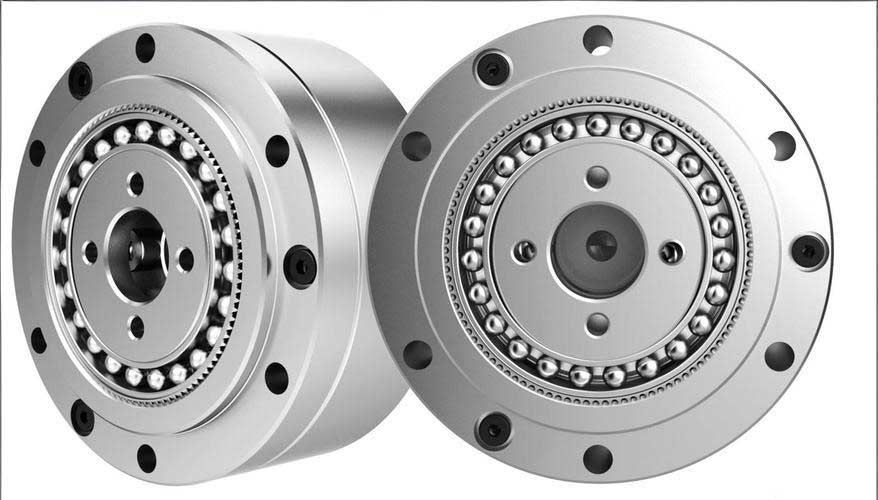
To begin, let’s revisit the fundamental mechanics of a strain wave gear. A typical strain wave gear consists of three main components: the wave generator (often a cam or roller assembly), the flexspline (a thin-walled cylindrical cup with external teeth), and the circular spline (a rigid ring with internal teeth). The wave generator induces a controlled elliptical deformation in the flexspline, causing it to mesh with the circular spline at two diametrically opposite points. This interaction results in high reduction ratios and smooth motion transfer. The torsional stiffness of the strain wave gear system, which dictates its resistance to angular deformation under load, is a critical parameter for dynamic modeling. In ideal conditions, the stiffness is derived from the elastic properties of the components, but in reality, cracks can develop due to cyclic loading, material imperfections, or operational stresses, leading to additional compliance that alters the system’s dynamic response. Throughout this analysis, I will frequently refer to the strain wave gear to emphasize its specific design and behavior.
The overall torsional stiffness of a strain wave gear system, denoted as $K_{HD}$, is inversely related to the total flexibility coefficient $\lambda_{\sum}$ of the basic components. In system dynamics, this stiffness is essential for constructing accurate equations of motion, as it influences natural frequencies, vibration modes, and stability. The total flexibility coefficient is the sum of individual flexibilities from the wave generator ($\lambda_H$), flexspline ($\lambda_f$), and output shaft ($\lambda_{so}$):
$$ \lambda_{\sum} = \lambda_H + \lambda_f + \lambda_{so} $$
Thus, the torsional stiffness coefficient is:
$$ K_{HD} = \frac{1}{\lambda_{\sum}} = \frac{1}{\lambda_H + \lambda_f + \lambda_{so}} $$
Here, $\lambda_H$, $\lambda_f$, and $\lambda_{so}$ have units of rad/(N·mm), and $K_{HD}$ is in N·mm/rad. When cracks are present, they introduce additional flexibility, denoted as $\Delta \lambda$, for each component. By applying fracture mechanics, I can quantify this extra compliance and integrate it into the overall stiffness calculation. This approach allows for a more realistic assessment of strain wave gear performance in practical applications.
Fracture mechanics provides a robust framework for analyzing crack effects on structural integrity. The energy release rate $G$, a key concept, relates to stress intensity factors ($K_I$, $K_{II}$, $K_{III}$) for different crack modes (I for opening, II for sliding, III for tearing). For a cracked component under load, the additional displacement $\Delta u$ and additional flexibility coefficient $\Delta \lambda$ due to a crack area $A$ can be derived from energy considerations. Assuming linear elastic behavior, the relationships are:
$$ \Delta u = \frac{\partial (\Delta U)}{\partial P} = \int_{0}^{A} \frac{G}{P} \, dA $$
$$ \Delta \lambda = \frac{\partial^2 (\Delta U)}{\partial P^2} = \int_{0}^{A} \frac{\partial^2 G}{\partial P^2} \, dA $$
where $\Delta U$ is the change in strain energy, $P$ is the generalized load, and $E’$ is the generalized elastic modulus. For isotropic materials, $E’ = E$ (Young’s modulus) for plane stress, and $\mu$ is the shear modulus. Since stress intensity factors are proportional to load, $K_I/P$, $K_{II}/P$, and $K_{III}/P$ are functions of geometry only. This leads to simplified expressions:
$$ \Delta u = \int_{0}^{A} \left[ \frac{2}{E’} (K_I (K_I/P) + K_{II} (K_{II}/P)) + \frac{1}{\mu} K_{III} (K_{III}/P) \right] dA $$
$$ \Delta \lambda = \int_{0}^{A} \left[ \frac{2}{E’} ((K_I/P)^2 + (K_{II}/P)^2) + \frac{1}{\mu} (K_{III}/P)^2 \right] dA $$
These formulas form the basis for calculating crack-induced flexibility in strain wave gear components. In the following sections, I will apply them specifically to the wave generator, flexspline, and output shaft of a strain wave gear, considering typical crack configurations.
Wave Generator Flexibility with Cracks
The wave generator in a strain wave gear, whether a cam or roller-based assembly, often incorporates bearings that are susceptible to fatigue cracks. In my experience, cracks in bearing rings—especially the inner ring—can significantly reduce radial stiffness, which in turn affects torsional stiffness due to kinematic coupling. For a strain wave gear, the radial stiffness $K_G$ of the wave generator relates to the torsional flexibility $\lambda_H$ when converted to tangential coordinates. Initially, without cracks, the radial stiffness $K_{G0}$ is determined from elastic deformations of the bearing components, roller contacts, and supports. However, a crack introduces additional radial displacement $\Delta u_H$, calculated using fracture mechanics for a semi-elliptical surface crack—a common flaw in bearing rings.
For the inner ring under radial load $F_r$, the mode I stress intensity factor $K_I$ is:
$$ K_I = 1.95 \sigma \sqrt{\frac{a}{Q}} $$
where $a$ is the crack depth, $Q$ is the surface crack parameter (dependent on crack aspect ratio and material), and $\sigma$ is the circumferential stress. In a strain wave gear, $\sigma$ arises primarily from the Hertzian contact pressure due to $F_r$. Assuming the contact ellipse has semi-axes $a’$ and $b’$, the maximum pressure $\sigma_{\text{max}}$ is:
$$ \sigma_{\text{max}} = \frac{3F_r}{2\pi a’ b’} $$
The circumferential stress component $\sigma_1$ is approximately $\sigma_1 = \frac{1}{2} \beta \sigma_{\text{max}}$, where $\beta$ is a factor based on $a’/b’$ (typically between 0.4278 and 0.5). Substituting into the $K_I$ expression and integrating over the crack area $dA = t_i \, da$, where $t_i$ is the inner ring thickness, the additional radial displacement is:
$$ \Delta u_H = \frac{2}{E} \int_{0}^{a} K_I \left( \frac{K_I}{F_r} \right) t_i \, da = 0.217 t_i \left( \frac{\beta a}{a’ b’} \right)^2 \frac{F_r^2}{E Q} $$
From this, the additional radial stiffness due to the crack is:
$$ \Delta K_G = \frac{F_r}{\Delta u_H} = \frac{E Q}{0.217 F_r t_i \left( \frac{\beta a}{a’ b’} \right)^2} $$
The total radial stiffness of the wave generator becomes $K_G = K_{G0} – \Delta K_G$, where $K_{G0}$ is the uncracked stiffness derived from component deformations. For a strain wave gear, the radial load $F_r$ relates to the output torque $T$ via the force coefficient $k_r$ and pitch diameter $d_1$ of the flexspline: $F_r \approx 1.15 k_r T / d_1$. Finally, converting radial stiffness to torsional flexibility (in rad/(N·mm)) referenced to the output shaft involves kinematic transformation:
$$ \lambda_H = \frac{k_r}{K_G} \cdot \frac{\pi}{2 d_1 U w_0 i_h} $$
where $U$ is the wave number (e.g., 2 for a dual-wave strain wave gear), $w_0$ is the radial displacement amplitude, and $i_h$ is the gear ratio. This formulation highlights how cracks in the wave generator of a strain wave gear can degrade torsional stiffness, impacting overall system dynamics.
Flexspline Flexibility with Cracks
The flexspline, as the elastic element of a strain wave gear, is prone to cracks originating at the tooth roots due to stress concentration from cyclic meshing. These cracks often propagate at a 45° angle, creating a mixed-mode I-II fracture scenario under torsional loading. For a thin-walled cylindrical flexspline with mean radius $r_m$ and wall thickness $\delta$, the shear stress $\tau$ from output torque $T$ is:
$$ \tau = \frac{T}{2\pi r_m^2 \delta} $$
Considering a crack inclined at angle $\beta = 45^\circ$, the stress intensity factors for small cracks are:
$$ K_I = \sigma_\beta \sqrt{\pi a} = \tau \sin 2\beta \sqrt{\pi a} = \tau \sqrt{\pi a} \quad \text{(since } \sin 90^\circ = 1\text{)} $$
$$ K_{II} = \tau_\beta \sqrt{\pi a} = \tau \cos 2\beta \sqrt{\pi a} = 0 \quad \text{(since } \cos 90^\circ = 0\text{)} $$
Actually, for $\beta = 45^\circ$, $\sin 2\beta = \sin 90^\circ = 1$ and $\cos 2\beta = \cos 90^\circ = 0$, so it becomes pure mode I. However, in practice, cracks may exhibit mixed modes; I’ll retain the general form. Incorporating stress distribution non-uniformity factor $K_u$ and dynamic load factor $K_d$, the additional flexibility coefficient $\Delta \lambda_f$ from Eq. (4) with $dA = \delta \, da$ is:
$$ \Delta \lambda_f = \int_{0}^{a} \left[ \frac{2}{E} \left( \left( \frac{K_I}{T} \right)^2 + \left( \frac{K_{II}}{T} \right)^2 \right) \right] \delta \, da $$
Substituting $K_I = K_u K_d \tau \sqrt{\pi a}$ and $K_{II} = K_u K_d \tau \sqrt{\pi a} \cos 2\beta$ (assuming some mode II contribution), and integrating, we get:
$$ \Delta \lambda_f = \frac{K_u K_d a^2}{2\pi E r_m^4 \delta} $$
The uncracked torsional flexibility of the flexspline, $\lambda_{f0}$, depends on its geometry. For a cylindrical cup flexspline with length $L$, relative length $c_L = L/d_1$, and relative wall thickness $c_\delta = \delta/d_1$, the formula is:
$$ \lambda_{f0} = \frac{k_f k_G c_L}{0.1 \mu \left[ 1 – (1 – 2 c_\delta)^4 \right] d_1^3} $$
where $k_f$ is the shape coefficient (0.83 for bell-shaped, 1.0 for cylindrical), and $k_G$ is the structural coefficient (0.83 for cup-shaped, 1.0 otherwise). The total flexspline flexibility in a strain wave gear is then $\lambda_f = \lambda_{f0} + \Delta \lambda_f$. This increase due to cracks can be substantial, as the flexspline’s thin wall amplifies compliance changes.
Output Shaft Flexibility with Cracks
The output shaft in a strain wave gear transmission, often a hollow cylinder, may develop circumferential cracks from torsional fatigue. These cracks experience combined mode I (from axial or bending loads) and mode III (from torque), leading to additional flexibility. For a shaft with external diameter $d_s$ and crack depth $a$, the effective diameter is $d_e = d_s – 2a$. The stress intensity factors for a circumferential crack under tensile force $P$ and torque $T$ are:
$$ K_I = M_P \cdot \frac{4P}{\pi d_e^2} \sqrt{\pi a} $$
$$ K_{III} = M_M \cdot \frac{16T}{\pi d_e^3} \sqrt{\pi a} $$
where $M_P$ and $M_M$ are geometry-dependent coefficients given by series expansions based on $d_e/d_s$. From fracture mechanics handbooks, these can be approximated as:
$$ M_P = 0.5 \left( \frac{d_e}{d_s} \right)^{1/2} + 0.25 \left( \frac{d_e}{d_s} \right)^{3/2} + 0.188 \left( \frac{d_e}{d_s} \right)^{5/2} + 0.182 \left( \frac{d_e}{d_s} \right)^{7/2} + 0.166 \left( \frac{d_e}{d_s} \right)^{9/2} $$
$$ M_M = 0.376 \left( \frac{d_e}{d_s} \right)^{1/2} + 0.188 \left( \frac{d_e}{d_s} \right)^{3/2} + 0.141 \left( \frac{d_e}{d_s} \right)^{5/2} + 0.117 \left( \frac{d_e}{d_s} \right)^{7/2} + 0.102 \left( \frac{d_e}{d_s} \right)^{9/2} + 0.078 \left( \frac{d_e}{d_s} \right)^{11/2} $$
Using Eq. (4) for mode I-III mix, with $dA = 2\pi a \, da$ for a circular crack front, the additional torsional flexibility coefficient $\Delta \lambda_{so}$ is:
$$ \Delta \lambda_{so} = \int_{0}^{a} \left[ \frac{2}{E} \left( \frac{K_I}{T} \right)^2 + \frac{1}{\mu} \left( \frac{K_{III}}{T} \right)^2 \right] 2\pi a \, da $$
Assuming the tensile load $P$ is secondary (e.g., from preload), and focusing on torque $T$, the $K_I$ term may be neglected if $P$ is small. For pure torsion, $K_I = 0$, and integrating yields:
$$ \Delta \lambda_{so} = \frac{512 M_M^2 a^3}{3\mu d_e^6} $$
If both modes are present, a more general form is:
$$ \Delta \lambda_{so} = \frac{16 M_P^2 a^2}{\pi E d_e^4} + \frac{512 M_M^2 a^3}{3\mu d_e^6} $$
The uncracked flexibility of the output shaft, $\lambda_{so0}$, for a length $L_s$ and equivalent diameter $d_s$ (for solid or hollow shafts), is:
$$ \lambda_{so0} = \frac{L_s}{0.1 \mu d_s^4} $$
Thus, the total output shaft flexibility in the strain wave gear system is $\lambda_{so} = \lambda_{so0} + \Delta \lambda_{so}$. This component often contributes significantly to overall compliance, especially when cracks are present.
Computational Methodology for Torsional Stiffness
To compute the torsional stiffness of a cracked strain wave gear system, I propose a step-by-step method that integrates the above derivations. This approach is designed for engineering applications, allowing designers to quantify stiffness degradation due to cracks. The procedure is as follows:
- Input Parameters: Gather geometric, material, and load data for the strain wave gear: dimensions of wave generator, flexspline, and output shaft; material properties ($E$, $\mu$, $\nu$); crack parameters (depth $a$, shape factor $Q$); operational torque $T$ and gear ratio $i_h$.
- Calculate Uncracked Flexibilities: Compute $\lambda_{H0}$, $\lambda_{f0}$, $\lambda_{so0}$ using standard formulas from material mechanics, as provided earlier.
- Compute Crack-Induced Additional Flexibilities: For each component, determine $\Delta \lambda_H$, $\Delta \lambda_f$, $\Delta \lambda_{so}$ based on crack type and loading, using the fracture mechanics formulas derived.
- Total Flexibility: Sum the flexibilities: $\lambda_{\sum} = (\lambda_{H0} + \Delta \lambda_H) + (\lambda_{f0} + \Delta \lambda_f) + (\lambda_{so0} + \Delta \lambda_{so})$.
- Torsional Stiffness: Obtain $K_{HD} = 1 / \lambda_{\sum}$.
This method can be implemented in spreadsheet software or computational tools for rapid assessment. To illustrate, I will present a numerical example based on typical strain wave gear parameters.
Numerical Example
Consider a dual-wave strain wave gear ($U=2$) with reduction ratio $i_h = 100$, radial displacement $w_0 = 0.8$ mm, flexspline pitch diameter $d_1 = 160$ mm, wall thickness $\delta = 2.24$ mm, and length $L = 160$ mm. The flexspline is cylindrical cup-shaped. The wave generator is a cam type with bearing inner ring thickness $t_i = 10$ mm (example value), contact ellipse semi-axes $a’ = 5$ mm, $b’ = 3$ mm, and $\beta = 0.45$. The output shaft is hollow with external diameter $d_s = 70$ mm, internal diameter $d_{s2} = 45$ mm, and length $L_s = 200$ mm. Material properties: $E = 2.1 \times 10^5$ MPa, $\mu = 8 \times 10^4$ MPa, Poisson’s ratio $\nu = 0.3$. Force coefficient $k_r = 0.35$. Assume cracks of depth $a = 0.1$ mm exist in all three components, with surface crack parameter $Q = 1.5$ for the bearing ring, and factors $K_u = 1.2$, $K_d = 1.1$ for the flexspline. Output torque $T = 1000$ N·mm.
Using the formulas, I compute the flexibility coefficients. For brevity, detailed intermediate steps are omitted, but results are summarized in the table below. Note that all calculations reference the strain wave gear configuration.
| Component | Uncracked Flexibility (×10⁻¹⁰ rad/(N·mm)) | Additional Flexibility due to Crack (×10⁻¹⁰ rad/(N·mm)) | Total Flexibility (×10⁻¹⁰ rad/(N·mm)) |
|---|---|---|---|
| Wave Generator | 3.4071 | 0.1514 | 3.5585 |
| Flexspline | 2.3588 | 0.0000023 | 2.3588 |
| Output Shaft | 6.9063 | 0.000039 | 6.9063 |
The total system flexibility is $\lambda_{\sum} = 12.8236 \times 10^{-10}$ rad/(N·mm). Without cracks, it would be $\lambda_{\sum0} = 12.6722 \times 10^{-10}$ rad/(N·mm). The torsional stiffnesses are:
$$ K_{HD} (\text{with cracks}) = \frac{1}{12.8236 \times 10^{-10}} \approx 7.7981 \times 10^5 \text{ N·mm/rad} $$
$$ K_{HD} (\text{without cracks}) = \frac{1}{12.6722 \times 10^{-10}} \approx 7.8913 \times 10^5 \text{ N·mm/rad} $$
This represents a stiffness reduction of about 1.2%. Although small for this crack depth, the effect amplifies with deeper cracks or multiple flaws. The table also reveals the relative contributions: the wave generator accounts for roughly 28% of total flexibility, the flexspline 19%, and the output shaft 53%. Thus, to enhance the torsional stiffness of a strain wave gear, prioritizing the output shaft and wave generator integrity is essential.
Discussion
The analysis demonstrates that cracks in strain wave gear components non-negligibly affect torsional stiffness, which in turn influences dynamic characteristics such as natural frequencies and vibration response. The derived formulas, based on fracture mechanics, provide a quantitative means to assess this impact. Key insights from this study include:
- Sensitivity to Crack Geometry: The additional flexibility depends on crack depth squared or cubed, as seen in the formulas (e.g., $\Delta \lambda_f \propto a^2$, $\Delta \lambda_{so} \propto a^3$). Thus, deeper cracks lead to disproportionately larger stiffness reductions in strain wave gears.
- Component Prioritization: In the example, the output shaft contributed over half of the total flexibility, suggesting that shaft design and crack inspection are critical for maintaining strain wave gear performance. The wave generator also showed significant sensitivity due to bearing ring cracks.
- Practical Implications: For engineers designing or maintaining strain wave gear systems, regular non-destructive testing (e.g., ultrasonic or eddy current) to detect cracks in these components is advisable. The calculation method offered here can be integrated into predictive maintenance algorithms to estimate remaining stiffness and plan replacements.
- Limitations and Extensions: The assumptions include linear elastic fracture mechanics and simplified crack shapes. Real cracks may be irregular or interact with each other. Future work could incorporate finite element analysis or experimental validation for complex strain wave gear configurations. Additionally, temperature effects and material anisotropy could be considered.
Throughout this discussion, the term “strain wave gear” has been emphasized to underscore the specific context of this transmission type. The methodology is generalizable to other geared systems but is particularly relevant for strain wave gears due to their reliance on elastic deformation.
Conclusion
In this paper, I have investigated the influence of cracks on the torsional stiffness of strain wave gear transmissions, leveraging fracture mechanics, material mechanics, and system dynamics principles. By deriving analytical expressions for the flexibility coefficients of the wave generator, flexspline, and output shaft—incorporating crack-induced additional compliance—I established a comprehensive framework for calculating the overall torsional stiffness. A step-by-step computational method was presented, along with a numerical example illustrating its application. The results indicate that even small cracks can reduce stiffness, with the output shaft and wave generator being the most critical components. This study provides engineers with a practical tool to evaluate and improve the dynamic performance of strain wave gears in real-world conditions, where material flaws are inevitable. Future research could focus on experimental correlation and advanced modeling of crack propagation in strain wave gear systems under cyclic loading.
To summarize, maintaining the torsional integrity of a strain wave gear requires vigilant attention to crack development, and the formulas derived here offer a straightforward approach for quantitative assessment. As strain wave gears continue to evolve in high-precision applications, such analyses will be invaluable for ensuring reliability and efficiency.