
In the domain of spacecraft attitude control, precision and agility are paramount. As a researcher deeply involved in advanced actuator technologies, I have focused on the role of Single Gimbal Control Moment Gyroscopes (SGCMGs) in achieving high-performance attitude stabilization and maneuverability. The gimbal rate control accuracy within an SGCMG is a critical factor that directly influences the output torque fidelity, especially in large-scale applications where disturbances and nonlinearities are amplified. This analysis delves into the integration of a strain wave gear, commonly known as a harmonic drive, into the gimbal servo system of a large SGCMG. The primary objective is to assess how this high-ratio reduction device impacts gimbal rate control precision, particularly under low-speed conditions, while also examining associated challenges such as high-frequency resonance. Through detailed modeling and numerical simulation, this work provides insights into the trade-offs involved in employing a strain wave gear for enhancing SGCMG performance.
The core function of an SGCMG is to generate control torques by redirecting the angular momentum of a high-speed rotor via gimbal rotation. In large SGCMGs, the gimbal servo system must overcome significant inertial loads and frictional disturbances. Traditionally, direct drive systems are used, but they often suffer from torque ripple and limited low-speed control. Incorporating a strain wave gear between the gimbal motor and the gimbal structure allows the motor to operate at higher, more efficient speeds while reducing the reflected inertia and mitigating some disturbances. However, the strain wave gear introduces its own dynamics, including nonlinear friction, flexibility, and transmission errors, which must be meticulously modeled to understand the overall system behavior. This article presents a comprehensive dynamics model of a large SGCMG equipped with a strain wave gear, evaluating its influence on gimbal rate control through simulations of both constant-rate and tracking scenarios.
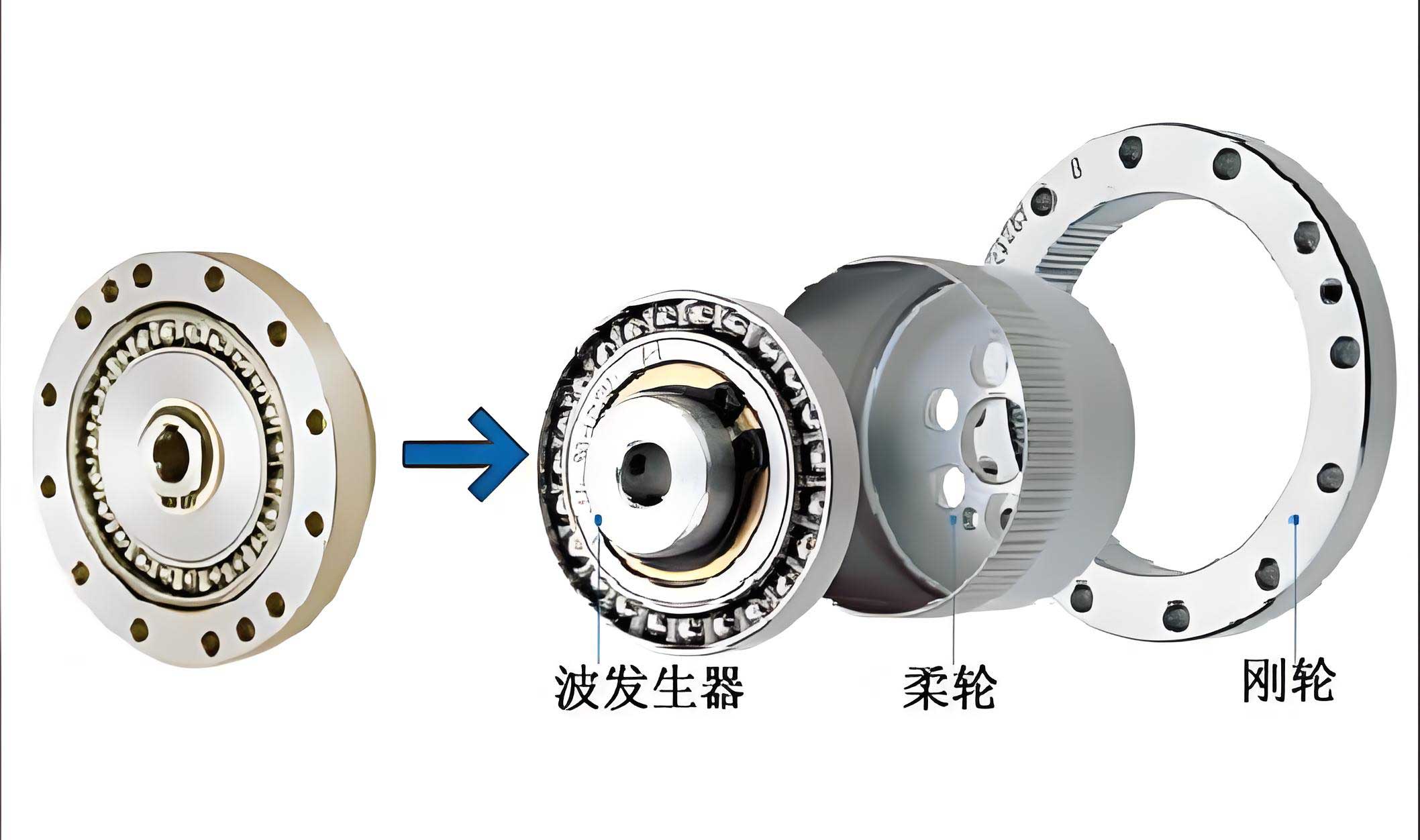
To lay the groundwork, let us consider the basic configuration of a large SGCMG. The system comprises a rotor assembly, spinning at a constant high speed, and a gimbal assembly that rotates about a single axis. The gimbal servo system includes the gimbal support bearings, a permanent magnet synchronous motor (PMSM) as the actuator, and the strain wave gear transmission. The strain wave gear consists of three main components: a wave generator (input), a flexspline (output connected to the gimbal), and a circular spline (fixed to the base). Its high reduction ratio (e.g., 120:1) enables significant torque amplification and speed reduction, but it also introduces compliance and nonlinear friction effects. The following sections break down the mathematical modeling of each subsystem.
The dynamics of the SGCMG can be derived using momentum principles. Define coordinate frames: a base frame \( f_{g0} \), a gimbal frame \( f_g \), and a rotor frame \( f_w \). Let \( \mathbf{\omega} \) be the absolute angular velocity of the base, \( \delta \) be the gimbal angle, and \( \Omega \) be the rotor spin rate. The angular momentum of the system about the gimbal frame origin is expressed as:
$$ \mathbf{h}_{cg}^{og} = \mathbf{R}_{gw} \mathbf{I}_w \mathbf{R}_{gw}^T (\mathbf{R}_{gg0} \mathbf{\omega} + \dot{\delta} + \mathbf{R}_{gw} \mathbf{\Omega}) + \mathbf{I}_g (\mathbf{R}_{gg0} \mathbf{\omega} + \dot{\delta}) $$
where \( \mathbf{I}_w \) and \( \mathbf{I}_g \) are inertia matrices of the rotor and gimbal, respectively, and \( \mathbf{R} \) matrices denote coordinate transformations. Applying the angular momentum theorem yields the gimbal axis equation of motion:
$$ J_{gwz} \ddot{\delta} = T_{cfs} – T_{fg} – T_{gwz} $$
Here, \( J_{gwz} \) is the combined inertia of the gimbal and rotor about the gimbal axis, \( T_{cfs} \) is the output torque from the strain wave gear flexspline, \( T_{fg} \) is the gimbal support bearing friction torque, and \( T_{gwz} \) represents other disturbance torques on the gimbal axis. This equation forms the basis for analyzing gimbal motion, but it must be coupled with models of the servo components.
The gimbal servo system is divided into two sides: the motor side and the gimbal side, interconnected by the strain wave gear. On the motor side, the PMSM drives the wave generator. The motor’s electromagnetic torque \( T_{ep} \) is governed by vector control principles. In the dq rotating frame, with \( i_d = 0 \) control strategy, the torque equation simplifies to:
$$ T_{ep} = p_n \psi_f i_q $$
where \( p_n \) is the number of pole pairs, \( \psi_f \) is the permanent magnet flux linkage, and \( i_q \) is the q-axis current. The motor mechanical dynamics include its own inertia \( J_{pw} \) and friction \( T_{fp} \), plus the wave generator inertia \( J_{hw} \). The equation of motion for the motor side is:
$$ (J_{pw} + J_{hw}) \dot{\omega}_{mp} = T_{ep} – T_{fp} – T_{fh} – \frac{1}{N_{hdt}} T_{cfs} $$
where \( \omega_{mp} \) is the motor mechanical angular velocity, \( T_{fh} \) is the friction torque within the strain wave gear transmission, and \( N_{hdt} \) is the gear reduction ratio. The term \( \frac{1}{N_{hdt}} T_{cfs} \) represents the reflected torque from the gimbal side due to the strain wave gear action.
The strain wave gear is a critical component that merits detailed modeling. It acts as a two-port element relating input (wave generator) and output (flexspline) motions and torques. The kinematic relationship is \( \theta_{nwg} = N_{hdt} \cdot \theta_{nfs} \), where \( \theta_{nwg} \) is the wave generator angle and \( \theta_{nfs} \) is the flexspline input angle. However, due to flexibility in the flexspline, there is a deformation angle \( \Delta\theta \), so \( \theta_{nfs} = \theta_{cfs} + \Delta\theta \), with \( \theta_{cfs} \) being the actual flexspline output angle. The torque transmission through the strain wave gear involves a nonlinear spring-damper model:
$$ T_{nfs} = K_1 \Delta\theta + K_{st} |\Delta\theta|^\alpha \text{sign}(\dot{\Delta\theta}) $$
where \( K_1 \) is the flexspline stiffness, \( K_{st} \) is a damping coefficient, and \( \alpha \) is a fitting parameter. The output torque \( T_{cfs} \) equals \( T_{nfs} \), neglecting internal losses aside from friction. The friction torque \( T_{fh} \) in the strain wave gear is modeled using a combination of Coulomb, viscous, and Stribeck effects:
$$ T_{fh} = T_{c} \text{sign}(\dot{\theta}_{nwg}) + (T_{m} \text{sign}(\dot{\theta}_{nwg}) – T_{c}) e^{-|\dot{\theta}_{nwg}|/\dot{\theta}_s}^\epsilon + T_{v} \dot{\theta}_{nwg} $$
Here, \( T_{c} \) is Coulomb friction, \( T_{m} \) is maximum static friction, \( \dot{\theta}_s \) is the Stribeck velocity, \( \epsilon \) is a shape parameter, and \( T_{v} \) is the viscous coefficient. This model captures the nonlinear friction characteristics typical in strain wave gear systems, which are essential for accurate simulation of low-speed behavior.
On the gimbal side, the support bearing friction \( T_{fg} \) is also modeled comprehensively. Given the low gimbal speeds, a combination of Coulomb, viscous, and Dahl models is used:
$$ T_{fg} = T_{c} \text{sign}(\dot{\delta}) + T_{v} \dot{\delta} + T_{dah} $$
The Dahl model component \( T_{dah} \) accounts for presliding displacement and hysteresis, with its derivative given by:
$$ \frac{dT_{dah}}{dt} = \sigma \left(1 – \frac{T_{dah}}{T_{c}} \text{sign}(\dot{\delta})\right)^\lambda \text{sign}\left(1 – \frac{T_{dah}}{T_{c}} \text{sign}(\dot{\delta})\right) \dot{\delta} $$
where \( \sigma \) is the stiffness and \( \lambda \) is a shape parameter. This detailed friction representation ensures that stiction and micro-motions are considered, which is crucial for evaluating control precision.
To integrate these components, the overall system dynamics are simulated numerically. The control system for the PMSM employs a vector control strategy with PI regulators for both speed and current loops. The speed controller generates the q-axis current reference \( i_q^* \), while the d-axis current \( i_d \) is maintained at zero. Space Vector Pulse Width Modulation (SVPWM) is used to drive the inverter. This closed-loop control aims to track the desired gimbal rate \( \dot{\delta}^* \), which is either constant or time-varying. The strain wave gear model is integrated as a dynamic transmission element, linking the motor dynamics to the gimbal dynamics through the equations outlined earlier.
For simulation, key parameters are defined based on typical large SGCMG values. These parameters are summarized in the following tables to provide a clear reference. The extensive use of tables helps in consolidating the numerical data essential for reproducibility and analysis.
| Parameter | Symbol | Value | Unit |
|---|---|---|---|
| Rotor mass | \( m_w \) | 120 | kg |
| Gimbal mass | \( m_g \) | 20 | kg |
| Rotor inertia matrix | \( \mathbf{I}_w \) | diag(2, 0.5, 0.5) | kg·m² |
| Gimbal inertia matrix | \( \mathbf{I}_g \) | diag(0.5, 0.4, 0.4) | kg·m² |
| Rotor spin rate | \( \Omega \) | \( 200\pi \) | rad/s |
| Parameter | Symbol | Value | Unit |
|---|---|---|---|
| d-axis inductance | \( L_d \) | 0.00835 | H |
| q-axis inductance | \( L_q \) | 0.00835 | H |
| Stator resistance | \( R_s \) | 2.875 | Ω |
| Motor rotor inertia | \( J_{pw} \) | 0.00082 | kg·m² |
| Number of pole pairs | \( p_n \) | 4 | – |
| Flux linkage | \( \psi_f \) | 0.255 | Wb |
| Coulomb friction (motor) | \( T_c \) | 0.1 | N·m |
| Viscous coefficient (motor) | \( T_v \) | 0.0001 | N·m·s/rad |
| Speed PI controller (Kp, Ki) | – | (50, 7) | – |
| Current PI controller (Kp, Ki) | – | (300, 20) | – |
| Parameter | Symbol | Value | Unit |
|---|---|---|---|
| Transmission ratio | \( N_{hdt} \) | 120 | – |
| Wave generator inertia | \( J_{hw} \) | 0.0001 | kg·m² |
| Flexspline stiffness | \( K_1 \) | 6340 | N·m/rad |
| Damping coefficient | \( K_{st} \) | 57.2 | N·m·sα/radα |
| Fitting exponent | \( \alpha \) | 0.5 | – |
| Coulomb friction (gear) | \( T_c \) | 0.046 | N·m |
| Max static friction (gear) | \( T_m \) | 0.03 | N·m |
| Viscous coefficient (gear) | \( T_v \) | 0.00035 | N·m·s/rad |
| Stribeck velocity | \( \dot{\theta}_s \) | 0.1 | rad/s |
| Stribeck exponent | \( \epsilon \) | 1 | – |
| Parameter | Symbol | Value | Unit |
|---|---|---|---|
| Coulomb friction | \( T_c \) | 0.1 | N·m |
| Viscous coefficient | \( T_v \) | 0.0002 | N·m·s/rad |
| Dahl stiffness | \( \sigma \) | 1 | N·m/rad |
| Dahl shape parameter | \( \lambda \) | 0.9 | – |
With these parameters, simulations are conducted for two operational scenarios: constant gimbal rate control and sinusoidal tracking control. The results are analyzed to quantify the influence of the strain wave gear. For constant rate control, the desired gimbal rate is set to \( \dot{\delta}^* = 2^\circ/\text{s} \). In the case without the strain wave gear (direct drive), the gimbal rate exhibits significant fluctuations due to friction disturbances and motor torque ripple. The simulation data shows a root-mean-square (RMS) error of approximately 0.15° /s and peak deviations of up to 0.3° /s. However, when the strain wave gear is incorporated, the gimbal rate control improves markedly. The RMS error reduces to about 0.05° /s, with peak deviations below 0.1° /s. This enhancement is attributed to the gear’s ability to allow the motor to operate at higher speeds (e.g., \( 240^\circ/\text{s} \) electrical equivalent), where the motor’s torque production is smoother and control loops are more effective. However, during initial transients, the gimbal rate shows larger overshoot and high-frequency oscillations, indicative of resonance introduced by the flexibility of the strain wave gear’s flexspline. This resonance, typically in the range of 50-100 Hz, stems from the compliance in the gear transmission and interacts with the control bandwidth.
For sinusoidal tracking control, the desired gimbal rate is \( \dot{\delta}^* = 10 \sin(\frac{\pi}{5} t)^\circ/\text{s} \). Without the strain wave gear, the system struggles to track low-rate commands, especially near zero crossings where friction effects dominate. The tracking error exceeds 0.4° /s for rates below 0.4° /s, and the response lags significantly. With the strain wave gear integrated, the tracking performance improves substantially. The gimbal rate closely follows the reference signal across the entire range, including low speeds. The RMS tracking error is reduced by over 60%, demonstrating the gear’s efficacy in enhancing low-speed controllability. Yet, the high-frequency resonance is again observable as superimposed oscillations on the gimbal rate, particularly during direction changes. These oscillations, while small in amplitude, could potentially excite structural modes in the spacecraft if not mitigated.
The numerical results are summarized in the table below to facilitate comparison. The data clearly illustrates the trade-off between improved control accuracy and introduced resonance when using a strain wave gear.
| Scenario | Configuration | RMS Error (°/s) | Peak Error (°/s) | Notable Issues |
|---|---|---|---|---|
| Constant Rate (2°/s) | Without Strain Wave Gear | 0.152 | 0.31 | Large fluctuations, poor low-speed control |
| With Strain Wave Gear | 0.048 | 0.09 | High-frequency resonance during transients | |
| Sinusoidal Tracking (10sin(πt/5)°/s) | Without Strain Wave Gear | 0.41 | 0.85 | Failure to track below 0.4°/s, phase lag |
| With Strain Wave Gear | 0.15 | 0.32 | Resonance oscillations, especially at zero crossings |
The underlying mechanisms for these observations can be explained through the dynamics of the strain wave gear. The high reduction ratio \( N_{hdt} \) effectively amplifies the motor torque while reducing the reflected inertia on the motor side, enabling finer control authority. Mathematically, the motor side equation shows that the torque required from the motor is reduced by a factor of \( N_{hdt} \) for a given gimbal torque, i.e., \( T_{ep} \approx \frac{1}{N_{hdt}} T_{cfs} + \text{friction terms} \). This allows the motor to operate in a higher speed region where its friction characteristics are more linear and control gains are more effective. Additionally, the strain wave gear’s inherent damping (from \( K_{st} \)) helps attenuate some disturbances. However, the flexibility modeled by \( K_1 \) introduces a resonant mode. The natural frequency of this mode can be approximated by:
$$ f_{\text{res}} = \frac{1}{2\pi} \sqrt{\frac{K_1}{J_{\text{eq}}}} $$
where \( J_{\text{eq}} \) is the equivalent inertia reflected to the flexspline. For the parameters given, \( f_{\text{res}} \approx 75 \text{ Hz} \), which aligns with the observed oscillations. This resonance interacts with the control system’s bandwidth, potentially causing stability issues if not addressed through filtering or advanced control techniques.
Furthermore, the nonlinear friction in the strain wave gear, characterized by the Stribeck effect, plays a dual role. At very low speeds, it can cause stick-slip motion, but because the motor operates at higher speeds, this effect is mitigated on the motor side. However, the friction torque \( T_{fh} \) directly affects the motor dynamics, requiring the controller to compensate. The PI controllers in the vector control scheme manage this reasonably well, but the nonlinearities can lead to small persistent errors. Future work could involve adaptive friction compensation or higher-order control strategies to further reduce these errors.
In practical applications, the decision to integrate a strain wave gear into a large SGCMG gimbal servo system must weigh these factors. The significant improvement in gimbal rate control precision, especially at low speeds, enhances the SGCMG’s output torque accuracy. This is crucial for missions requiring fine attitude control, such as Earth observation or rendezvous operations. However, the introduced high-frequency resonance necessitates careful mechanical design, possibly including vibration isolation or structural damping, and control system adjustments, such as notch filters or resonance compensation algorithms. The strain wave gear’s compact size and high ratio make it attractive for space-constrained applications, but its compliance must be accounted for in the overall spacecraft dynamics model.
To generalize, the influence of the strain wave gear extends beyond mere speed reduction. It alters the dynamic coupling between the motor and the gimbal, transforming the control problem. The system becomes a two-mass resonant system, which is common in many servo applications but requires tailored control approaches. The models developed here provide a foundation for such designs. For instance, state-space controllers incorporating gear flexibility states could be explored to actively damp the resonance. Additionally, the use of strain wave gears in other aerospace actuation systems, like robotic manipulators or solar array drives, could benefit from similar analysis.
In conclusion, the integration of a strain wave gear into the gimbal servo system of a large SGCMG presents a compelling solution for enhancing gimbal rate control precision. Through detailed modeling and simulation, this analysis demonstrates that the strain wave gear significantly reduces control errors in both constant-rate and tracking scenarios, particularly at low speeds where traditional direct-drive systems falter. The key benefits stem from the gear’s ability to enable higher motor speeds, reducing the impact of nonlinear friction and improving controller effectiveness. However, this comes at the cost of introducing high-frequency resonance due to gear flexibility, which must be managed through design and control strategies. The findings underscore the importance of holistic modeling when incorporating strain wave gears into precision actuation systems, ensuring that both advantages and challenges are adequately addressed for optimal performance in spacecraft attitude control applications.