
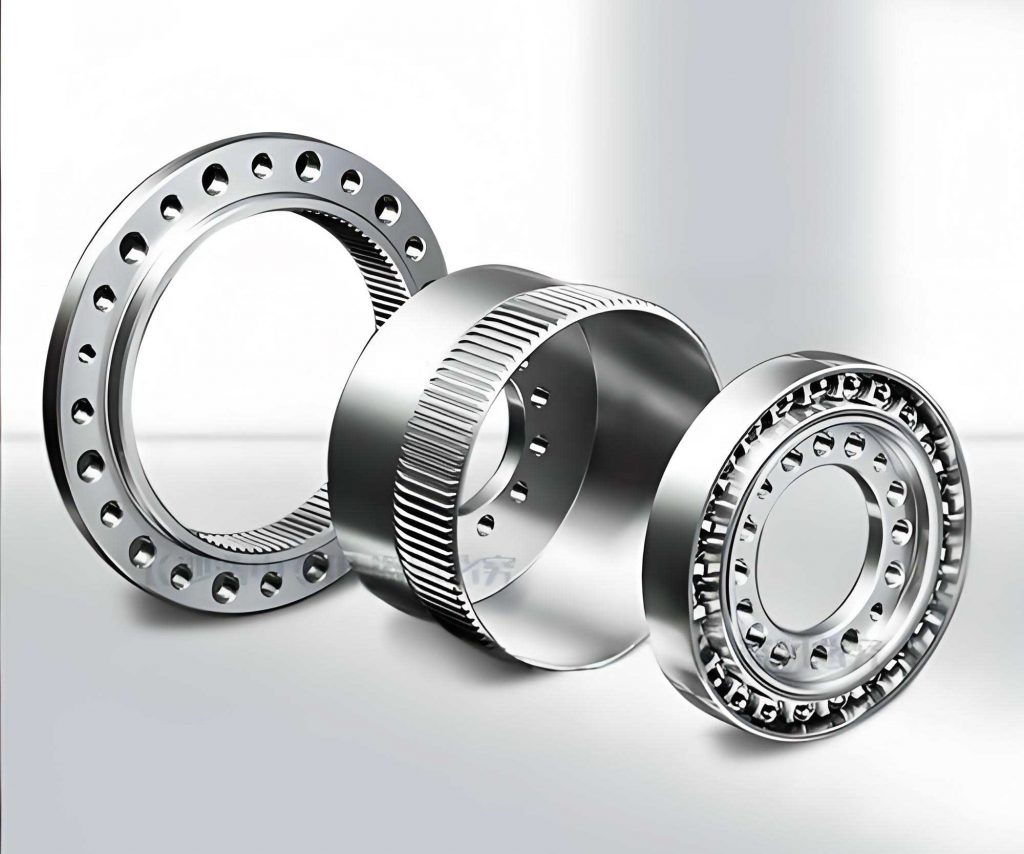
In the field of precision mechanical transmission, harmonic drive gears have garnered significant attention due to their compact size, high transmission accuracy, and large overlap ratio. These advantages make harmonic drive gear systems indispensable in applications such as metal machine tools, semiconductor manufacturing equipment, and communication devices. As a researcher focused on mechanical design theory, I have undertaken a detailed investigation into a critical aspect of harmonic drive gear performance: the influence of the wave generator on the transmission characteristics. Specifically, this study addresses the conical angle effect induced when an elliptical wave generator is inserted into the flexspline, which prevents complete contact between the flexspline inner wall and the wave generator. This phenomenon leads to non-uniform deformation along the axial direction of the flexspline, potentially causing meshing interference between the flexspline and circular spline gears, thereby affecting the overall efficiency and durability of the harmonic drive gear system. Through finite element analysis using Abaqus software, I simulate the flexspline under various conditions—initial deformation, no-load, and load—to quantify these effects. The findings reveal that the axial conical angle increases deformation beyond theoretical values, induces high-stress zones at specific locations, and highlights the superiority of double-circular-arc tooth profiles over involute profiles in mitigating issues like point engagement. This article presents a thorough exploration, incorporating mathematical formulations, tabular summaries, and visual aids to elucidate the complex interactions within harmonic drive gear assemblies.
The fundamental operation of a harmonic drive gear relies on the wave generator inducing controlled elastic deformation in the flexspline, enabling meshing with the circular spline. Traditionally, designs assume ideal contact between the flexspline and wave generator, as depicted in early models. However, in practical harmonic drive gear setups, the wave generator possesses a finite width. Upon insertion, the flexspline exhibits a conical angle at the long-axis end, flaring outward from the cup bottom to the open end, and an inverse conical angle at the short-axis end. This axial asymmetry means that the deformation function varies across different cross-sections of the flexspline tooth ring. Most existing research concentrates on single-cross-section meshing, neglecting this conical angle effect. In my analysis, I consider three key cross-sections: the front section (near the open end), the middle section, and the rear section (near the cup bottom). The rear section is often designated as the main design截面 due to its contact with the wave generator at the long axis. However, the front and middle sections experience different deformation magnitudes, leading to tooth interference when meshing with the circular spline. This interference forces abnormal contact, particularly in involute tooth profiles, resulting in point engagement—a condition where stress concentrates at the tooth tip, accelerating wear and compromising the harmonic drive gear’s lifespan.
To mathematically describe the deformation, I base my analysis on harmonic drive gear theory. The radial deformation of the flexspline, induced by the wave generator, is typically expressed as a function of the angular position and axial coordinate. Let \( w_0 \) represent the theoretical radial deformation at the rear cross-section, and \( \theta \) denote the conical angle at the long axis. The actual radial deformation \( w(z, \phi) \) at an axial position \( z \) (measured from the rear section) and angular position \( \phi \) can be approximated as:
$$ w(z, \phi) = w_0 \left(1 + \frac{z \cdot \tan(\theta)}{R}\right) \cdot \cos(2\phi) \quad \text{for the long-axis region} $$
where \( R \) is the nominal radius of the flexspline, and \( \phi = 0 \) corresponds to the long axis. Similarly, for the short-axis region, the deformation is reduced. This equation highlights how the conical angle \( \theta \) amplifies deformation toward the front section, exceeding the theoretical value \( w_0 \). In standard harmonic drive gear design, parameters like the radial deformation coefficient \( w^* \) are used, where \( w_0 = w^* \cdot m \), with \( m \) as the module. For instance, in my study, I adopt \( m = 1 \, \text{mm} \), flexspline tooth number \( z = 100 \), circular spline tooth number \( z_g = 102 \), addendum coefficient \( h_a^* = 0.8 \), dedendum coefficient \( h_f^* = 1.05 \), radial deformation coefficient \( w^* = 0.9 \), and modification coefficient \( x = 1.95 \). The theoretical deformation is \( w_0 = 0.9 \, \text{mm} \), but due to the conical angle, the actual deformation at the front section becomes larger, as confirmed by finite element analysis.
The meshing condition between the flexspline and circular spline gears is further complicated by this deformation disparity. For involute tooth profiles, the standard meshing equation assumes uniform deformation. However, with axial variation, the contact path deviates, leading to point engagement at the front section. To quantify this, I define the contact stress \( \sigma_c \) based on Hertzian contact theory, modified for elastic deformation:
$$ \sigma_c = \sqrt{\frac{F_n \cdot E^*}{\pi \cdot \rho}} $$
where \( F_n \) is the normal force per tooth, \( E^* \) is the equivalent elastic modulus, and \( \rho \) is the relative curvature radius at the contact point. In harmonic drive gear systems, \( F_n \) varies along the axial direction due to the conical angle effect, increasing at the front section and causing higher stress concentrations. Additionally, the bending stress \( \sigma_b \) in the flexspline, particularly at the rear section where it connects to the cup body, can be expressed as:
$$ \sigma_b = \frac{M \cdot c}{I} $$
with \( M \) as the bending moment induced by forced meshing, \( c \) as the distance from the neutral axis, and \( I \) as the area moment of inertia. This bending stress contributes to fatigue cracks, a common failure mode in harmonic drive gear assemblies. To compare tooth profiles, I evaluate both involute and double-circular-arc profiles. The double-circular-arc profile, characterized by two circular arcs forming the tooth flank, offers better conformity and stress distribution. Its geometry can be described by parameters such as arc radii \( R_1 \) and \( R_2 \), and pressure angles. Table 1 summarizes the key geometric parameters used in this study for both tooth profiles, emphasizing their application in harmonic drive gear systems.
| Parameter | Involute Profile | Double-Circular-Arc Profile |
|---|---|---|
| Module (m) | 1 mm | 1 mm |
| Tooth Numbers (z / z_g) | 100 / 102 | 100 / 102 |
| Addendum Coefficient (h_a^*) | 0.8 | 0.8 |
| Dedendum Coefficient (h_f^*) | 1.05 | 1.05 |
| Radial Deformation Coefficient (w^*) | 0.9 | 0.9 |
| Modification Coefficient (x) | 1.95 | 1.95 |
| Tooth Profile Equation | $$ r(\phi) = \frac{m z}{2} \cos(\alpha) + m x $$ | Arc segments with radii R1=2.5mm, R2=1.8mm |
| Pressure Angle | 20° | Variable along arc |
In my finite element analysis using Abaqus, I model the harmonic drive gear assembly to simulate real-world conditions. The model includes the flexspline, wave generator (simplified as an elliptical rigid body), and circular spline. Materials are assigned linear elastic properties: for the flexspline, typically alloy steel with Young’s modulus \( E = 210 \, \text{GPa} \) and Poisson’s ratio \( \nu = 0.3 \). The wave generator is constrained to simulate rotation, while the circular spline is fixed. Meshing is performed with quadratic tetrahedral elements, ensuring convergence through mesh sensitivity studies. I analyze three scenarios: initial deformation (wave generator insertion without circular spline), no-load (circular spline engaged but no torque), and load (applied torque of \( T = 150 \, \text{N·m} \)). The contact interactions use penalty friction with a coefficient of 0.1. To capture stress concentrations, I refine the mesh at tooth roots and contact zones. The simulations output deformation contours, stress distributions, and contact pressures, providing insights into the harmonic drive gear behavior under the influence of the wave generator’s conical angle.
The initial deformation analysis reveals that the conical angle significantly alters the flexspline’s shape. As shown in the deformation cloud diagram from Abaqus, the maximum radial deformation at the long-axis front section reaches 1.142 mm, which is 26.9% higher than the theoretical value of 0.9 mm. This excess deformation confirms that the front section teeth will interfere with the circular spline during meshing. The deformation disparity can be quantified using the following formula derived from simulation data:
$$ \Delta w = w_{\text{max}} – w_0 = 1.142 – 0.9 = 0.242 \, \text{mm} $$
This \( \Delta w \) correlates with the conical angle \( \theta \), which can be estimated from geometry: \( \theta = \arctan(\Delta w / L) \), where \( L \) is the axial length from rear to front section (approximately 20 mm in this model). Thus, \( \theta \approx \arctan(0.242 / 20) \approx 0.693^\circ \). Although small, this angle induces notable effects in harmonic drive gear meshing. Table 2 summarizes the deformation results across cross-sections, highlighting the axial non-uniformity.
| Cross-Section | Theoretical Deformation (mm) | Simulated Deformation (mm) | Deviation (%) |
|---|---|---|---|
| Rear (Section 3) | 0.900 | 0.900 | 0.0 |
| Middle (Section 2) | 0.900 | 1.021 | 13.4 |
| Front (Section 1) | 0.900 | 1.142 | 26.9 |
Under no-load conditions, the circular spline constrains the flexspline, forcing the conical angle to diminish or vanish at the long axis. This constraint generates bending deformation in the flexspline tooth ring, particularly at the rear section near the cup connection. The stress distribution from Abaqus shows high stress concentrations at two locations: the teeth in the front section and the rear section where bending occurs. The maximum von Mises stress in the no-load case is approximately 280 MPa for involute teeth, primarily at the tooth tips of the front section. This aligns with the point engagement phenomenon, where contact occurs at a single point rather than along a line, elevating stress. The bending stress at the rear section can be estimated using the formula:
$$ \sigma_b \approx \frac{E \cdot \delta}{L^2} \cdot t $$
where \( \delta \) is the deflection due to forced meshing (simulated as 0.05 mm), \( t \) is the flexspline thickness (2 mm), yielding \( \sigma_b \approx 105 \, \text{MPa} \). This cyclic bending during operation predisposes the harmonic drive gear to fatigue failure, underscoring the need for design improvements.
In the load condition with \( T = 150 \, \text{N·m} \), the flexspline experiences combined loads from tooth meshing and wave generator tension. The stress analysis compares involute and double-circular-arc tooth profiles. For involute teeth, the maximum stress reaches 532.2 MPa, located at the tooth tip of the front section—clear evidence of point engagement. In contrast, the double-circular-arc profile shows a maximum stress of 350.7 MPa, a reduction of 34.1%, and the stress concentration shifts to the tooth flank arc region, indicating improved contact distribution. This demonstrates the efficacy of double-circular-arc profiles in harmonic drive gear systems. The contact pressure \( p \) can be related to the normal force \( F_n \) and contact area \( A \): \( p = F_n / A \). For double-circular-arc teeth, the larger effective contact area due to arc conformity reduces \( p \), thereby lowering stress. Table 3 compares the stress results for both profiles under load, emphasizing the benefits of double-circular-arc design in harmonic drive gear applications.
| Tooth Profile | Max von Mises Stress (MPa) | Stress Location | Reduction vs. Involute (%) |
|---|---|---|---|
| Involute | 532.2 | Tooth tip, front section | — |
| Double-Circular-Arc | 350.7 | Tooth flank arc, front section | 34.1 |
To further analyze the meshing performance, I derive the transmission error \( \Delta \phi \) caused by the conical angle. In an ideal harmonic drive gear, the rotation is perfectly smooth, but deformation variations introduce error. The error can be expressed as a function of the conical angle and axial position:
$$ \Delta \phi(z) = \frac{\partial w(z, \phi)}{\partial \phi} \cdot \frac{1}{R} $$
Integrating over the axial length, the cumulative error affects the harmonic drive gear’s precision. For involute teeth, this error exacerbates point engagement, while double-circular-arc teeth, with their forgiving geometry, tolerate higher errors without stress spikes. Additionally, the fatigue life \( N_f \) of the flexspline can be estimated using the stress-life approach:
$$ N_f = C \cdot \sigma^{-m} $$
where \( C \) and \( m \) are material constants. Given the stress reduction with double-circular-arc teeth, \( N_f \) increases significantly, enhancing the harmonic drive gear’s durability. My simulations also consider the effect of torque variation on stress. As torque increases, the stress rises nonlinearly due to contact and bending interactions. For harmonic drive gear design, optimizing the wave generator profile to minimize the conical angle is crucial. One approach is to taper the wave generator or adjust its ellipticity, but this requires balancing with other constraints like manufacturing feasibility.
The double-circular-arc tooth profile’s superiority stems from its geometric properties. The arcs provide continuous curvature, ensuring smoother contact transition and reducing edge stresses. In contrast, involute teeth have a constant pressure angle, making them prone to tip contact under deformation mismatches. For harmonic drive gear systems operating under high precision demands, such as in robotics or aerospace, adopting double-circular-arc profiles can mitigate the wave generator’s adverse effects. Moreover, the axial stress distribution can be optimized by varying tooth profile parameters along the axis, though this adds complexity. My analysis suggests that for standard harmonic drive gear modules, double-circular-arc teeth offer a practical solution without major redesigns.
In conclusion, this study comprehensively analyzes the influence of the wave generator on harmonic drive gear transmission, focusing on the conical angle effect. Through theoretical formulations and finite element simulations in Abaqus, I demonstrate that the conical angle causes axial non-uniform deformation, exceeding theoretical values and leading to high-stress zones at the flexspline’s front tooth section and rear cup connection. The involute tooth profile suffers from point engagement, elevating stress and wear, while the double-circular-arc profile effectively reduces stress by 34.1% and shifts concentration to more robust areas. These insights underscore the importance of considering wave generator-induced deformations in harmonic drive gear design. Future work could explore advanced wave generator shapes or adaptive tooth profiles to further enhance performance. As harmonic drive gears continue to evolve, addressing such nuances will be key to unlocking their full potential in precision mechanical systems.