
The rapid evolution of the global healthcare sector, propelled by technological advancements and strategic national policies, has positioned the medical equipment industry as a critical pillar. Within this landscape, the medical robot segment stands out as the epitome of high-end, intelligent medical devices, characterized by significant technical barriers, stringent market entry requirements, and high value-added potential. Driven by supportive policies like the “Healthy China 2030” initiative and various national industrial development plans, China’s medical robot industry is transitioning from a cultivation phase to a growth and maturation phase. Despite this promising outlook, the industry’s sustainable expansion faces a formidable constraint: a severe shortage of high-quality, frontline technical talent capable of navigating its interdisciplinary complexities.
This talent gap manifests in several critical challenges within traditional educational frameworks: a pronounced deficiency in cross-disciplinary knowledge bridging mechanics, electronics, medicine, and informatics; scarce opportunities for hands-on, authentic practice with advanced medical robot systems; a persistent mismatch between evolving industry demands and static educational curricula; and an underdevelopment of the comprehensive professional素养 required for high-stakes medical environments. To address these systemic issues and fuel the industry’s growth, a transformative approach to talent development is essential. This article elucidates an innovative training model, conceptualized and implemented through a deep industry-education partnership, termed the “Five-Dimensional Integration, Parallel Education-Training, Dual-Environment Three-Mode” model for cultivating medical robot Field Engineers.
The core philosophy of this model is to achieve deep integration between vocational education and industrial practice. It establishes a collaborative ecosystem—a dedicated Medical Robot Field Engineer Academy—co-founded and operated by the vocational institute and leading industry enterprises. Guided by a dual-leadership philosophy intertwining “technical competency” and the “mission of safeguarding healthcare and life,” the model systematically dismantles the barriers between campus and factory. Its objective is to cultivate a new breed of field engineers who are not only proficient in operation but also understand process design, possess management and collaboration skills, and harbor an innovative,工匠 spirit capable of solving complex on-site problems for medical robot systems.
Theoretical Framework: Deconstructing the Holistic Model
The proposed model is a structured, systemic framework designed to synchronize every aspect of the educational process with the realities of the medical robot industry. It can be formally represented as an integrated function aimed at optimizing Field Engineer competency ($C_{FE}$):
$$
C_{FE} = f(\text{Integration}_{5D}, \text{Parallel}_{E\&T}, \text{Environment}_{Dual}, \text{Mode}_{Three})
$$
Where each component is meticulously defined and interconnected. The following table summarizes the foundational pillars of this model:
| Model Pillar | Core Principle | Key Components & Actions |
|---|---|---|
| Five-Dimensional Integration (5D) | Synchronization of educational and industrial systems. |
|
| Parallel Education & Training | Dual-track development for students and employees. |
|
| Dual-Environment Three-Mode | Contextual learning across simulated and real settings. |
|
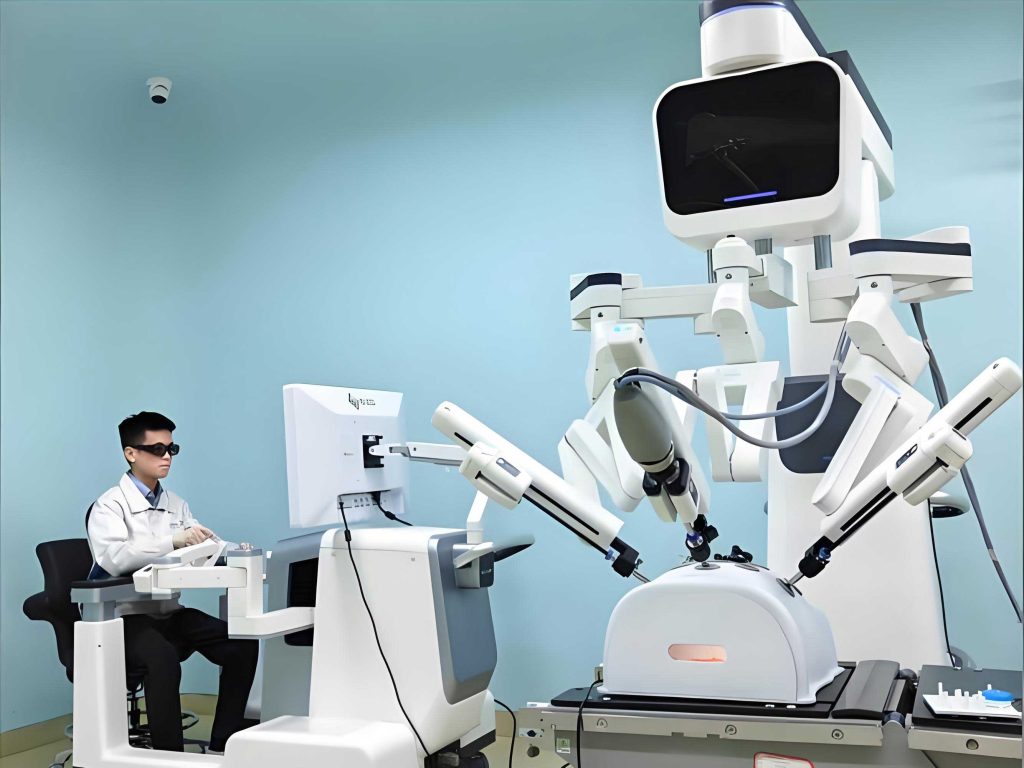
The operationalization of this framework creates a closed-loop, progressive talent pipeline: Enrollment → Cultivation → Shadowing → Adaptation → Employment. This ensures a seamless transition for the learner from the role of a student to that of a proficient field engineer.
Practical Implementation: Building the Ecosystem
The translation of this model from theory to practice involves multi-layered collaboration and resource integration, which can be expressed as a synergistic equation:
$$
\text{Ecosystem}_{MR-FE} = G + I + E + As + H + \text{Platforms}_{R\&D}
$$
Where $G$ represents Government policy guidance, $I$ the Institute’s educational resources, $E$ the Enterprise’s technical and operational assets, $As$ relevant industry Associations, $H$ partner Hospitals (for clinical context), and $\text{Platforms}_{R\&D}$ signifies shared research and development platforms.
1. Co-Designing the Talent Blueprint and Curriculum System
A joint Professional Construction Steering Committee, comprising experts from both academia and industry, conducts granular task analysis for target positions such as Medical Robot Assembly & Debugging Technician, System O&M Engineer, and Quality Validation Specialist. This analysis yields a detailed “position competency map,” which directly informs the curriculum. The resulting system is a “Post-Course Integration, Certification-Competition Guided, Ability-Progression” architecture.
The curriculum is modular and能力递进, structured around four core competency areas derived from the medical robot lifecycle: Production & Assembly, Quality Inspection, Installation & Debugging, and Operation & Maintenance. Crucially, it integrates standards from national vocational teaching guidelines, enterprise skill certification systems (e.g., Medical Device Assembler), and the knowledge domains of national skill competitions (e.g., Medical Electrical Instrument Repair). This “岗课赛证” fusion ensures relevance and rigor. The思政 education, themed “Guardian of Medical Safety,” is woven throughout all modules.
$$
\text{Curriculum}_{MR} = \bigcup_{\text{module } i} (\text{Theory}_i \cap \text{Practice}_i \cap \text{Standard}_{\text{industry}} \cap \text{Ethic}_{\text{medical}})
$$
| Academic Stage | Core Module Focus | Sample Courses / Activities | Primary Learning Environment |
|---|---|---|---|
| Foundation (Year 1-2) | Basic Disciplinary Knowledge & Cognitive Familiarization | Mechanical Fundamentals, Electronics, Medical Basics, Introduction to Medical Robots, Industrial Control, Cognitive Internship. | On-Campus Labs, Virtual Simulations. |
| Core Competency (Year 2-3) | Specialized Technical Skills & Project-Based Inquiry | Medical Robot Application Programming, Servo Control Systems, Mechanical/Electrical Assembly Practicum, System Debugging Training, Innovation Workshops. | On-Campus “Factory-in-School,” Project Labs. |
| Synthesis & Adaptation (Year 3) | Integrated Practice & Enterprise Immersion | Capstone Project (e.g., master-slave手 assembly optimization), On-site O&M Rotation, Quality Management, Graduation Design co-supervised by enterprise mentor. | Enterprise “School-in-Factory,” Partner Hospitals. |
2. Developing Immersive Resources and Shared Platforms
Joint teams of enterprise engineers and institute faculty co-develop dynamic pedagogical resources. These include:
- Modular Handbooks & Living-leaf Textbooks: Focused on拆解 tasks like master-slave手 remote control assembly, 3D imaging integration, and system troubleshooting for medical robot platforms.
- Digital Resource库: A repository of granular learning materials, virtual仿真 modules, and training videos accessible for both education and corporate training.
- National Exemplar Practice Center: An upgraded, smart实训基地 featuring digital management systems. It combines physical training stations for medical robot assembly with VR/AR-based simulations of surgical suites or maintenance wards, creating the essential “Dual Environment.”
3. Innovating Pedagogical Organization and Instructor Development
The教学组织形式 is “Training-Education Interactive, Work-Study Alternating.” It employs a CDIO (Conceive-Design-Implement-Operate) approach, using the full lifecycle of a medical robot subsystem as a teaching carrier. Students experience “dual-identity” (student/apprentice), guided by “dual-mentors” (college teacher + enterprise master), across “dual-sites.”
A “1+1+2” apprenticeship model is implemented: one enterprise expert and one college teacher jointly mentor two students. A robust bidirectional flow mechanism for instructors is established:
- College Teachers to Industry: Mandatory periodic secondments to enterprise posts (assembly, debugging, service) to gain and update hands-on medical robot expertise.
- Enterprise Masters to Campus: Trained in pedagogical methods to effectively deliver training and supervise projects, while also leading technical workshops.
This creates a true “dual-qualified” teaching innovation team.
4. Implementing a Synergistic Evaluation System
Moving beyond traditional academic grading, a “Tripartite Multi-dimensional” evaluation system is adopted:
$$
\text{Final Grade} = \alpha \cdot \text{School Evaluation} + \beta \cdot \text{Enterprise Evaluation} + \gamma \cdot \text{Third-party (Industry) Evaluation}
$$
Where $\alpha + \beta + \gamma = 1$, and typically $\beta \geq \alpha$, reflecting the strong weight of practical performance. Assessment criteria are directly mapped from enterprise KPIs for quality, efficiency, safety, and innovation in medical robot related tasks.
Model Efficacy and Outcomes
The implementation of this holistic model has yielded significant, measurable outcomes that validate its design principles and address the initial talent gap challenges.
1. Enhanced Student Competency and Employability: The immersive, progressive pipeline has dramatically improved graduate readiness. Key metrics include:
- Skill Competition Performance: Students have won over 100 awards in provincial, national, and industry-specific技能 competitions related to医疗 equipment and robotics.
- Employment Metrics: Graduate employment rates have consistently exceeded 98%, with job satisfaction from employers reaching 100%. Graduates are recognized for their shortened adaptation period and ability to handle complex medical robot O&M tasks.
- Innovation Capacity: Student participation in “Internet+” innovation competitions and patenting related to医疗 device improvements has surged.
2. Upgraded Institutional and Faculty Capacity: The collaboration has transformed the educational infrastructure.
- The co-built practice center has been recognized as a National-Level Productive Public Training Base.
- The joint teaching team was awarded provincial-level “Teaching Innovation Team” status.
- Faculty have achieved top honors in National Teaching Ability Competitions, and their applied research output, often co-conducted with enterprise partners on medical robot challenges, has increased substantially.
3. Stronger Industry-Education Synergy and Ecosystem Impact: The model has fostered a genuine共生 mechanism.
- The academy serves as a talent reserve for the partner enterprise, ensuring a pipeline of job-ready medical robot field engineers.
- Enterprises benefit from direct input into curriculum design, access to faculty for joint R&D, and a platform for employee upskilling.
- The model has been disseminated as a replicable case study, contributing to regional cluster development in high-end medical equipment.
| Outcome Category | Specific Achievements | Impact Indicator |
|---|---|---|
| Talent Cultivation Quality | High competition success rates; Exceptional graduate employment & satisfaction. | >100 awards; >98% employment; 100% employer satisfaction. |
| Educational Platform Development | Establishment of national-level training base; Creation of provincial innovation teams. | National accreditation; Team awards and teaching competition prizes. |
| Industry-Academy Integration Depth | Co-development of resources; Joint R&D projects; Stable talent pipeline. | Multiple co-authored textbooks/handbooks; Patents and process improvements for medical robots. |
Conclusion and Future Implications
The “Five-Dimensional Integration, Parallel Education-Training, Dual-Environment Three-Mode” model represents a systemic and effective response to the acute talent challenges in the high-tech medical robot industry. By fundamentally aligning educational processes with industrial realities through deep, structured collaboration, it successfully cultivates field engineers who are both technically proficient and holistically prepared for the demands of modern healthcare technology environments. The model’s success is rooted in its integrated approach—viewing goals, content, process, evaluation, and culture as interconnected dimensions for fusion, rather than pursuing isolated reforms.
The implications of this practice are significant for the broader landscape of vocational and professional education, particularly in high-stakes, interdisciplinary fields like medical technology. It provides a transferable framework that can be adapted by other institutions and enterprises globally facing similar skill gaps. The model underscores the necessity of moving beyond superficial partnerships to build deeply integrated, resource-sharing ecosystems where the boundaries between learning and working are strategically blurred. As the medical robot industry continues to evolve, such innovative training paradigms will be indispensable in building a sustainable talent pipeline, ensuring technological adoption, and ultimately, contributing to the advancement of global healthcare.