
The global manufacturing landscape is undergoing a profound transformation, shifting from rigid, dedicated production lines towards flexible, reconfigurable systems. This transition is particularly accelerated by the dual trends of electrification and digitalization within the automotive industry. Traditional automotive manufacturing relies on highly specialized equipment with fixed layouts and long product introduction cycles, struggling to meet market demands for product diversification and rapid iteration. In contrast, Flexible Manufacturing Systems (FMS), through modular design, reconfigurable processes, and intelligent control, enable the dynamic allocation of production resources and swift responsiveness.
In this transformative era, the embodied AI robot emerges as a core enabling technology. By integrating advanced capabilities in environmental perception, autonomous decision-making, and precise execution—powered by computer vision, force feedback, and adaptive control—the embodied AI robot can autonomously adapt to the processing requirements of different product variants, significantly enhancing the flexibility and efficiency of production systems. Furthermore, when combined with Digital Twin and Industrial Internet technologies, the embodied AI robot facilitates real-time process optimization and remote collaboration, endowing manufacturing systems with greater scalability and fault tolerance.
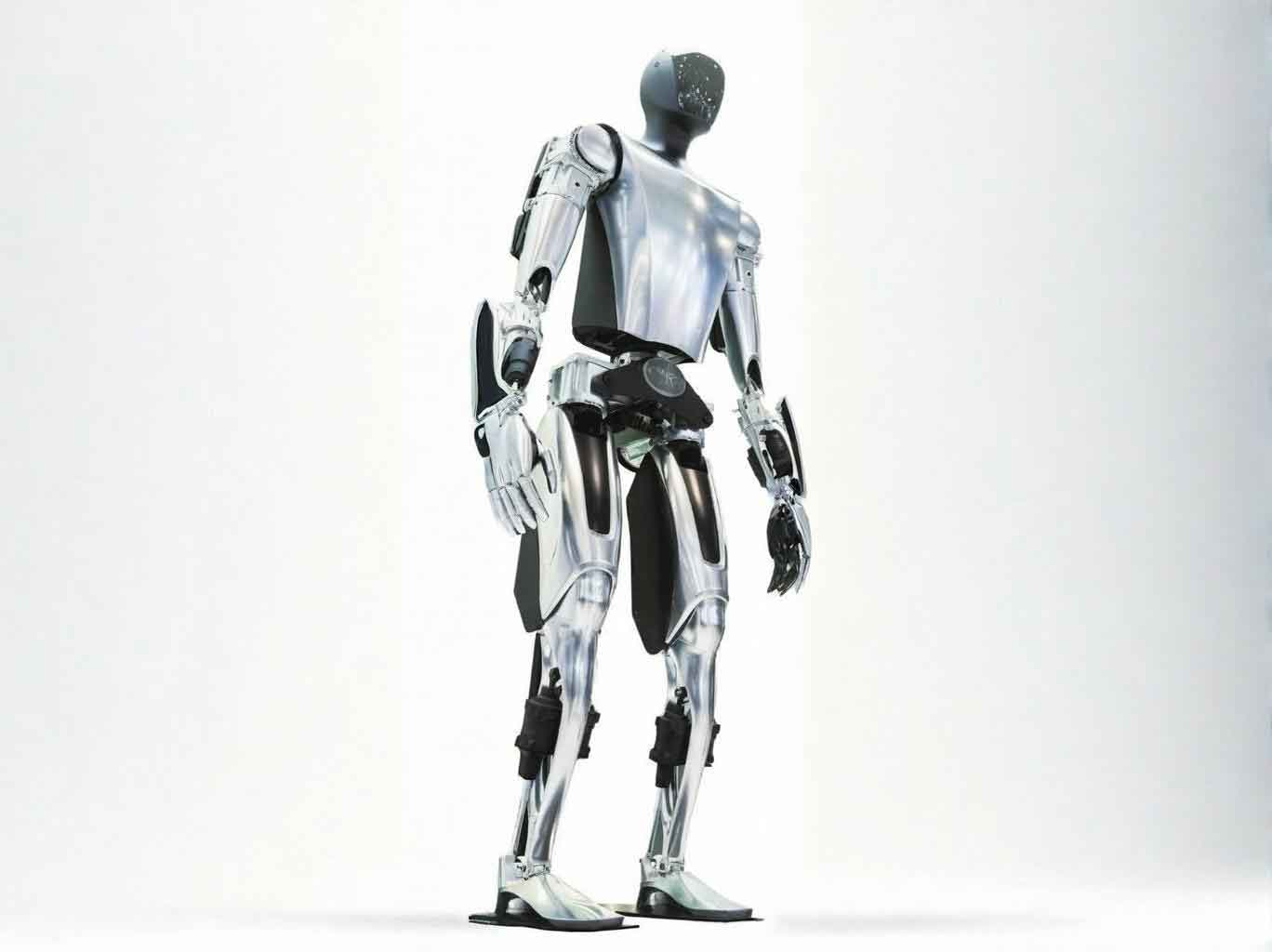
Therefore, the embodied AI robot is not merely a key enabler of flexible manufacturing but a vital driver propelling the industry towards intelligent, personalized, and sustainable production. As artificial intelligence and robotics technologies converge more deeply, FMS will achieve unprecedented levels of autonomy and adaptability, providing robust technological support for the global manufacturing upgrade.
The Core Driver of Intelligent Manufacturing: Embodied Intelligence
Embodied Intelligence serves as the foundational theoretical framework for intelligent manufacturing. Its primary advantage lies in the seamless integration of perception, cognition, planning, and execution within the robot itself. This integration allows a production line to perceive environmental changes in real-time, make rapid decisions, optimize processes, and execute various operational tasks. This unified perception-decision-action capability enables production systems to swiftly adapt to diverse and fluctuating production demands.
This article explores the application and effectiveness of Embodied Intelligence through a practical lens, analyzing its implementation within an automotive engine assembly line. This analysis aims to provide both a theoretical basis and a practical pathway for the future of manufacturing transformation.
Challenges in Flexible Manufacturing and the Technical Architecture of Embodied AI Robots
Core Demands of Flexible Manufacturing
The shift towards flexible manufacturing is driven by three fundamental demands that traditional rigid systems fail to address adequately:
1. Shortened Product Introduction Cycle: The rapid iteration of new energy vehicle models necessitates drastically reduced time-to-market. Traditional lines, designed for stable, long-lifecycle products like internal combustion engines, are ill-suited for this pace. Flexible systems, utilizing reconfigurable equipment and automation, can reduce introduction cycles to 12-18 months for new models.
2. Process Flexibility: To handle multi-variant, low-volume production, a line must possess the inherent ability to process a wide array of different parts and components. Rigid manufacturing offers little room for adjustment or recombination of processes.
3. Dynamic Decision-Making: In the face of order volatility and supply chain uncertainty, production systems must move beyond static planning. Dynamic decision-making capability is essential for real-time production scheduling, anomaly response, and rapid plan adjustment based on live data streams.
The Embodied Intelligence-Driven Technical Architecture for Robots
Embodied Intelligence emphasizes a full closed-loop of “Perception-Cognition-Planning-Action.” Its technical architecture for an embodied AI robot comprises three key layers, as summarized in the table below:
| Architecture Layer | Core Function & Technologies | Output/Contribution to Flexibility |
|---|---|---|
| Perception Layer | Multi-modal sensor fusion (3D vision, force control, audio). Real-time monitoring of processes, equipment, and parts. Dynamic environment modeling. | Rich, contextual data representing the current state of the production cell and workpiece. |
| Cognition Layer | AI algorithms for task decomposition, path planning, and decision-making. Analyzes perception data to formulate and optimize execution strategies. | Adaptive plans and decisions that allow the robot to self-adjust to different operational scenarios. |
| Execution Layer | High-precision mechanical design and motion control. Translates cognitive decisions into concrete physical actions (e.g., assembly, fastening, dispensing). | Accurate and reliable physical manipulation across variable production tasks. |
The synergistic operation of these three layers enables true flexibility. The perception layer’s data can be modeled as a multi-dimensional state vector \( S_t \):
$$ S_t = \{ V_t, F_t, A_t, P_t \} $$
where \( V_t \) represents visual features, \( F_t \) represents force/torque readings, \( A_t \) represents auditory signals, and \( P_t \) represents positional data at time \( t \). The cognition layer processes this state to generate an optimal action policy \( \pi^* \), often derived from maximizing an expected reward function \( R \):
$$ \pi^* = \arg\max_{\pi} \mathbb{E} \left[ \sum_{t} R(S_t, A_t) | \pi \right] $$
where \( A_t \) is the action taken by the embodied AI robot under policy \( \pi \). The execution layer then implements the chosen action \( A_t \) with high fidelity.
Multi-Level Application of Embodied AI Robots in Flexible Manufacturing
Logistics Layer: Island-Based Production and AGV Synergy
Island-based assembly involves dividing the main production flow into independent functional or process “islands.” Each island specializes in a particular stage (e.g., cylinder head sub-assembly, piston-rod sub-assembly) and can be flexibly combined and sequenced according to product requirements.
The embodied AI robot synergizes with Automated Guided Vehicles (AGVs) in this layout. AGVs handle macro-material transport between islands. The embodied AI robot, often as part of a compound mobile manipulator system, performs the “last-meter” precise pick-and-place operations for loading/unloading at each station. This collaboration decouples material flow from fixed conveyors, creating a dynamic and re-routable logistics network.
Equipment Layer: Modular Intelligent Robotic Platforms
Complex assembly processes are decomposed into independent, interchangeable modules (e.g., assembly unit, fastening unit, dispensing unit, leak test unit). Each module, often built around an embodied AI robot, is optimized for a specific step.
The key innovation here is the use of low-code control platforms. Traditional reconfiguration for a new product (e.g., changing screw type or tightening sequence) could take 3-4 hours of manual reprogramming and debugging. A modular embodied AI robot platform with a low-code interface allows engineers to visually drag, drop, and parameterize pre-defined process blocks (like “Pick Screw,” “Torque to Yield”). This reduces changeover time dramatically, for instance, to under 15 minutes, as shown in the functional relationship:
$$ T_{changeover} = f(C_{complexity}, I_{interface}) $$
$$ \text{With Low-Code: } \frac{dT_{changeover}}{dC_{complexity}} \ll \text{With Traditional Programming} $$
where \( T_{changeover} \) is the reconfiguration time, \( C_{complexity} \) is the process complexity, and \( I_{interface} \) represents the usability of the programming interface.
Information Layer: Upgraded Production Line MES System
The Manufacturing Execution System (MES) acts as the central nervous system. Traditional MES focuses on rigid work order management and basic tracking. An upgraded MES for flexible manufacturing, interacting closely with embodied AI robot data, expands its scope significantly. Key enhanced functions include:
- Dynamic Factory Modeling: Creating a software twin of the physical layout that can be updated when islands or stations are added, enabling plug-and-play integration.
- Flexible Process Route Management: Defining and managing multiple, variable assembly sequences for different product variants within the same system.
- Advanced Quality & Traceability: Configuring per-station quality gates and error-proofing rules linked to the product model, and managing complex rework flows.
- Integrated Performance Analytics: Calculating Overall Equipment Effectiveness (OEE) and other KPIs by aggregating data from robots, AGVs, and stations.
The system ensures that the cognitive layer of each embodied AI robot is informed by the latest global production goals and constraints.
Case Study: Engine Assembly Line Project
Project Background and Solution
A major automotive manufacturer required a high-mix engine production line capable of assembling multiple engine models efficiently. The traditional dedicated line was incompatible with this need for flexibility. The implemented solution centered on creating a smart, flexible engine assembly line using AGVs for material handling and embodied AI robot workstations for all critical assembly tasks. The line was structured into distinct zones: a cylinder head sub-assembly area and a main assembly area. This design separated sub-assembly flows from the final assembly line, managed by a synchronized fleet of AGVs.
Implementation Across Layers
1. Logistics Layer Configuration: The island-based layout was implemented with a specialized AGV fleet, as detailed below:
| AGV Type | Quantity | Primary Function |
|---|---|---|
| Cylinder Head AGV | 4 | Transport cylinder head sub-assemblies to main line. |
| Kitting AGV | 5 | Deliver piston-rod kits and other components to main line stations. |
| Engine Pallet AGV | 28 | Carry the engine block pallet through all main assembly stations and to final test. |
AGVs would drop pallets at station buffers and proceed to other tasks, maximizing utilization and creating a non-synchronous, flexible flow.
2. Equipment Layer – The Smart Fastening Station: A prime example was the smart fastening station powered by an embodied AI robot. Using the low-code platform, the complete fastening sequence was configured from modular blocks. The force and position data during tightening were monitored in real-time, adhering to a quality curve defined by parameters like target torque \( \tau_{target} \) and angle \( \theta_{max} \). The system validated each fastener against a quality window:
$$ Q_{screw} = \begin{cases}
Pass, & \text{if } \tau_{final} \in [\tau_{min}, \tau_{max}] \text{ and } \theta_{final} \in [\theta_{min}, \theta_{max}] \\
Fail, & \text{otherwise}
\end{cases} $$
This allowed for rapid changeover between different engine models requiring different fastener specifications.
3. Information Layer – MES Integration: The upgraded MES provided the digital backbone. It managed the dynamic routing of different engine models, ensured the correct assembly program was dispatched to each embodied AI robot based on the engine ID on the AGV pallet, tracked complete build history, and managed any necessary rework orders. The OEE dashboard aggregated downtime reasons from all robotic stations, enabling continuous improvement.
Results and Impact
The implementation yielded significant benefits directly attributable to the embodied AI robot and its integrated systems:
- Enhanced Line Flexibility: Changing assembly sequences no longer required physical relocation of stations, only updates to AGV paths and robot programs.
- Improved Quality: In-process vision inspection by robots and real-time force control minimized defects. Any non-conforming product could be immediately rerouted by an AGV to a rework island.
- Digital Traceability & Support: The MES provided full component traceability and delivered digital work instructions (animations, diagrams) to human operators at relevant stations, ensuring process consistency.
The project validated the multi-level collaborative model, demonstrating that the intelligence of the embodied AI robot, from precise execution to data generation, is fundamental to modern flexible manufacturing.
Future Trends and Challenges
Future Trends
The multi-level collaborative application of embodied AI robot technology represents a cornerstone for the future of manufacturing. The deep integration of Embodied Intelligence will drive FMS towards continuous self-evolution. We anticipate trends such as:
- Increased Autonomy: Embodied AI robot systems will perform more complex self-diagnosis, self-reconfiguration, and collaborative problem-solving without human intervention.
- Hyper-Adaptive Learning: Robots will learn from every interaction, using simulation-to-real (Sim2Real) and reinforcement learning to continuously refine their policies \( \pi \), optimizing for broader objectives like energy efficiency and tool wear alongside quality and speed.
- Deep Human-Robot Collaboration (HRC): The embodied AI robot will become a more intuitive partner, understanding human intent and adapting its actions for safe and efficient shared tasks.
Challenges and Strategic Recommendations
Despite the promise, significant challenges remain:
1. Data Governance and Standardization: The proliferation of IIoT devices and embodied AI robot generates vast, heterogeneous data streams (e.g., time-series sensor data, event logs, image streams). The lack of unified semantics and communication protocols creates data silos. Recommendation: Industry-wide efforts to adopt data models like Asset Administration Shell (AAS) and communication standards like OPC UA are crucial.
2. Integration Complexity and Investment: Retrofitting existing brownfield facilities with flexible, intelligent systems is complex and costly. Recommendation: A phased implementation strategy, starting with pilot islands, and increased R&D into scalable, modular solutions can mitigate risk and demonstrate ROI.
3. Talent Gap: There is a severe shortage of multi-disciplinary talent skilled in robotics, AI, data science, and traditional manufacturing engineering. Recommendation: Establishing long-term industry-academia partnerships, creating tailored apprenticeship programs, and developing continuous upskilling pathways for the current workforce are essential strategies.
Conclusion
This article has presented and analyzed a multi-level collaborative solution for flexible manufacturing grounded in Embodied Intelligence. Through the detailed examination of the embodied AI robot‘s role across logistics, equipment, and information layers, supported by a practical case study, we have demonstrated a viable and effective path for manufacturing digital transformation.
On a theoretical level, the primary contribution is the articulation of a comprehensive technical framework for the embodied AI robot within industrial settings. This framework unifies perception, cognition, and execution, enabling manufacturing systems to gain contextual awareness and autonomous adjustment capabilities. The proposed modular architecture and intelligent production organization models provide a blueprint for systems that are both rapidly reconfigurable and dynamically optimizable.
In practical terms, the evidence confirms the tangible advantages conferred by the embodied AI robot. At the equipment layer, these platforms deliver unmatched adaptability and precision. Within the logistics layer, their synergy with AGVs creates material flows that are both efficient and fluid. At the information layer, the data generated by each embodied AI robot feeds into intelligent decision-support systems, enhancing the overall predictability and responsiveness of production. The convergence of these capabilities results in a holistic elevation of manufacturing system performance. The embodied AI robot, therefore, stands as a fundamental component in the development of new, high-quality productive forces essential for the next era of global industrial advancement.