
In recent years, the field of robotics has witnessed a paradigm shift with the emergence of embodied intelligence, where robots are designed to perceive, reason, and act within their environments autonomously. As a researcher focused on industrial automation, I have been deeply involved in developing advanced systems that leverage this technology. In this context, we propose a novel dual-arm industrial robot system based on embodied AI, aiming to address the limitations of traditional robotic setups in manufacturing. This embodied AI robot integrates multimodal large models, sensory perception, and autonomous decision-making, enabling it to tackle complex tasks in unstructured scenarios. The system represents a significant step forward in making robots more adaptable, intelligent, and efficient in real-world applications.
The concept of an embodied AI robot revolves around creating machines that not only execute pre-programmed commands but also understand and interact with their surroundings through sensory inputs. Traditional dual-arm robots, such as ABB’s YuMi or humanoid systems like Honda’s Asimo, have shown promise but often suffer from limited payload, rigidity, and programming complexity. Our work builds upon these foundations by incorporating standard industrial robotic arms with enhanced AI capabilities, resulting in an embodied AI robot that excels in load capacity, speed, and adaptability. This approach allows for seamless deployment in diverse industrial settings, from assembly lines to custom welding tasks.
Our embodied AI robot system is composed of several key components that work in harmony to achieve intelligent operation. These include a high-performance computing unit, dual industrial robotic arms, a vision perception system, a voice interaction module, a mobile base, and an experimental platform. The computing unit serves as the brain, processing data from sensors and executing AI algorithms. The vision system, equipped with global cameras, captures environmental details like object shape, position, and color, while the voice module enables natural language commands via large language models. The robotic arms, as the physical executors, perform tasks such as grasping, welding, and palletizing. This integration transforms the system into a true embodied AI robot, capable of learning and adapting on the fly.
The operational workspace of our embodied AI robot is a critical aspect of its design. It is determined by the kinematic parameters of each arm and the layout of the worktable. For a single industrial robotic arm, the workspace can be defined using standard kinematic equations. Let the position of the end-effector be represented by a homogeneous transformation matrix derived from Denavit-Hartenberg parameters. For an arm with $n$ joints, the forward kinematics can be expressed as:
$$ T_{0}^{n} = \prod_{i=1}^{n} A_{i} $$
where $A_{i}$ is the transformation matrix for joint $i$. In our dual-arm setup, the workspace is divided into two regions: a collaborative space where both arms can operate together for tasks like assembly, and an independent space for non-cooperative tasks. This division maximizes efficiency and flexibility, allowing the embodied AI robot to handle multiple operations simultaneously. The collaborative space $C$ can be modeled as the intersection of the individual workspaces $W_1$ and $W_2$:
$$ C = W_1 \cap W_2 $$
while the independent space $I$ is the complement:
$$ I = (W_1 \cup W_2) \setminus C $$
This mathematical formulation ensures optimal task allocation and collision avoidance, key features for an embodied AI robot operating in dynamic environments.
To illustrate the system configuration, consider the following visual representation that highlights the integration of components in our embodied AI robot. The image below showcases the physical setup, emphasizing the dual-arm structure and sensory modules.
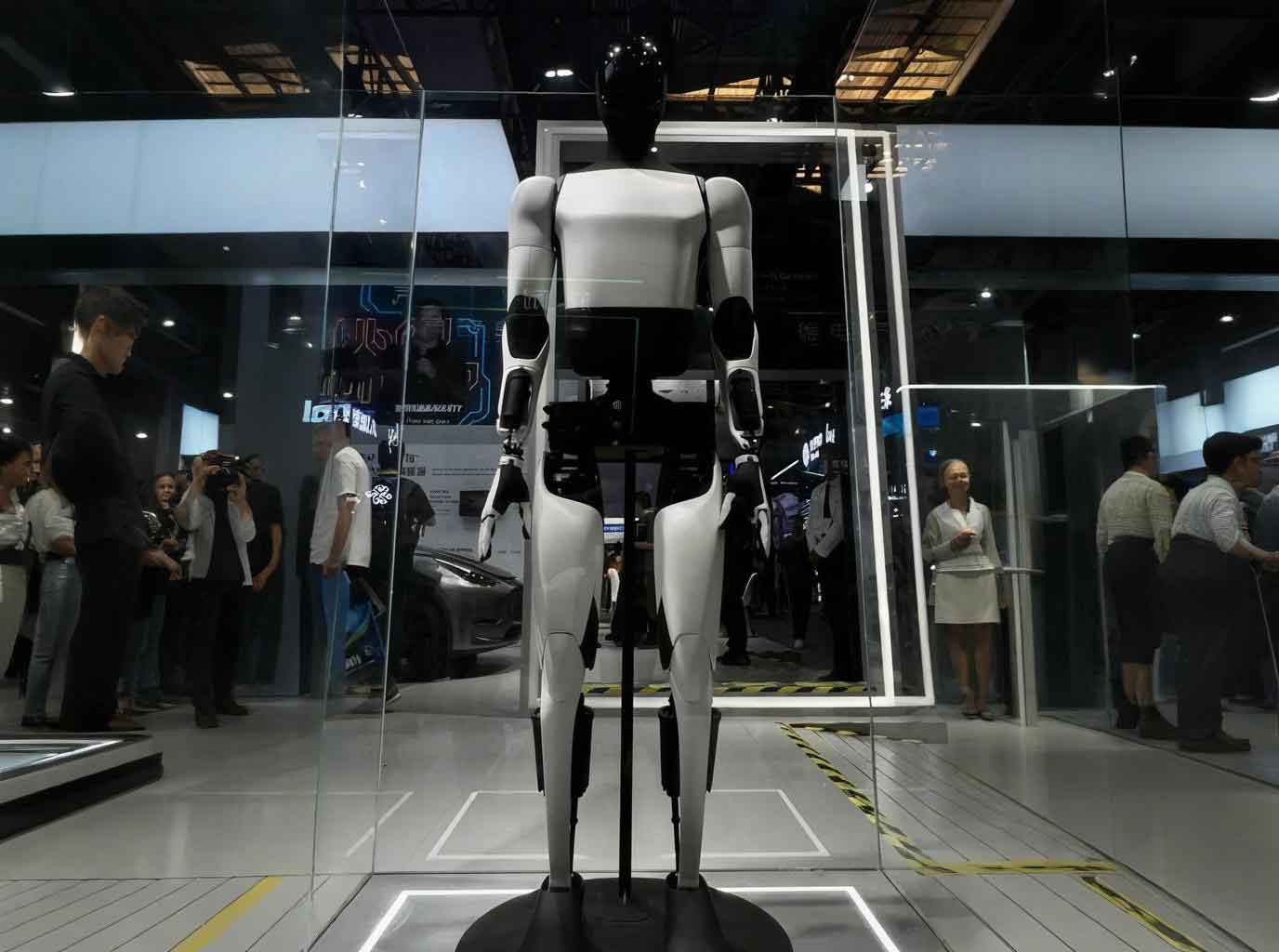
The core of our embodied AI robot lies in its AI-driven decision-making system, which leverages visual-language models (VLMs) to interpret and plan tasks. Unlike conventional robots that rely on rigid programming, this embodied AI robot processes multimodal inputs—such as visual data and voice commands—to decompose complex instructions into actionable steps. For instance, when given a command like “Prepare eight candies,” the system uses VLM-based reasoning to identify objects, plan trajectories, and execute motions autonomously. This capability is enhanced by real-time perception, where the vision system continuously updates environmental data, allowing the embodied AI robot to adapt to changes. The decision pipeline can be summarized as:
$$ \text{Input} \rightarrow \text{VLM Processing} \rightarrow \text{Task Decomposition} \rightarrow \text{Motion Planning} \rightarrow \text{Execution} $$
This process enables the embodied AI robot to perform with a level of intelligence comparable to human-like understanding, making it suitable for non-structured industrial scenarios.
A critical technical challenge in implementing an embodied AI robot is accurate spatial coordination between perception and action. We address this through coordinate transformations and system calibration. The vision system captures object coordinates in the camera frame, which must be converted to the robot’s base frame for precise manipulation. Using homogeneous transformations, the conversion formula is:
$$ P_r = T_{12}^{-1} \cdot P_c $$
where $P_r$ is the coordinate in the robot frame, $T_{12}^{-1}$ is the inverse transformation matrix from camera to robot, and $P_c$ is the coordinate in the camera frame. For calibration, we employ an eye-to-hand method, where the camera is fixed externally. This involves solving for intrinsic and extrinsic parameters by correlating 3D points with 2D image pixels. The calibration matrix $K$ for the camera is derived through optimization techniques, ensuring minimal error in localization. This precision is vital for the embodied AI robot to perform delicate tasks like welding or assembly with high accuracy.
To evaluate the performance of our embodied AI robot, we conducted extensive experiments, including a “candy grasping” test that demonstrated its autonomous capabilities. In this scenario, the system successfully interpreted voice commands, perceived the environment via vision, and coordinated both arms to pick and place candies into a bowl. The process involved real-time feedback loops, where the AI model adjusted plans based on sensory inputs. Results showed that the embodied AI robot achieved a task completion rate of over 95% with minimal human intervention, highlighting its robustness. Additionally, we tested the system in industrial applications like welding, where it autonomously identified seams and performed welds after task planning. These experiments validate the practicality of our embodied AI robot in real-world settings.
The advantages of our embodied AI robot become evident when compared to traditional dual-arm systems. Below is a comprehensive table summarizing key performance metrics across different robotic platforms. This comparison underscores the superiority of our embodied AI robot in terms of stiffness, speed, load capacity, and adaptability.
| System Type | Stiffness Rating | Speed & Acceleration | Payload Capacity (kg) | Adaptability (Embodied AI) |
|---|---|---|---|---|
| Embodied AI Robot (Our System) | High (★★★) | High (★★★) | Up to 10 | Yes, with VLM integration |
| Collaborative Dual-Arm System | Medium (★★) | Medium (★★) | 0.5-5 | Limited, pre-programmed |
| Humanoid Dual-Arm Robot | Low (★) | Low (★) | 0.5-2 | Minimal, requires explicit coding |
| Traditional Industrial Robot | High (★★★) | High (★★★) | 10-50 | No, lacks AI perception |
As shown, our embodied AI robot combines the strength of industrial arms with the intelligence of AI, making it a versatile solution. The stiffness rating is derived from structural rigidity, which affects precision in tasks like welding. Speed and acceleration are crucial for productivity, and our system outperforms others due to optimized control algorithms. Payload capacity is enhanced by using industrial-grade components, allowing the embodied AI robot to handle heavier objects. Most importantly, the embodied AI capability enables autonomous task planning, reducing the need for manual reprogramming.
In industrial applications, our embodied AI robot demonstrates remarkable versatility. For welding tasks, it uses visual perception to detect weld seams and plan paths dynamically, as illustrated in earlier tests. The system can be extended to grinding, assembly, and palletizing by swapping end-effectors or adding auxiliary tools. This flexibility stems from the embodied AI foundation, which allows the robot to understand context and adjust strategies accordingly. For example, in a grinding scenario, the embodied AI robot can analyze surface contours and apply force control based on real-time feedback. The general workflow for such tasks involves:
- Perception: Capturing environmental data via sensors.
- Reasoning: Using AI models to interpret tasks and constraints.
- Planning: Generating motion trajectories and force profiles.
- Execution: Performing the operation with closed-loop control.
This workflow ensures that the embodied AI robot can handle variability in workpieces and environments, a key requirement in modern manufacturing.
Beyond basic operations, the embodied AI robot incorporates advanced control theories to enhance performance. For instance, dynamics modeling helps in managing loads and speeds. The equations of motion for a robotic arm can be expressed using the Lagrangian formulation:
$$ \tau = M(q)\ddot{q} + C(q, \dot{q})\dot{q} + G(q) $$
where $\tau$ is the torque vector, $M(q)$ is the inertia matrix, $C(q, \dot{q})$ represents Coriolis and centrifugal forces, and $G(q)$ is the gravitational vector. By integrating these dynamics into the AI planner, our embodied AI robot optimizes energy efficiency and reduces wear. Additionally, we implement impedance control for force-sensitive tasks, allowing the robot to interact safely with objects. The impedance model is given by:
$$ F = M_d \ddot{x} + B_d \dot{x} + K_d x $$
where $F$ is the interaction force, $x$ is the position error, and $M_d$, $B_d$, $K_d$ are desired inertia, damping, and stiffness matrices. This control strategy enables the embodied AI robot to perform delicate operations like inserting parts or polishing surfaces without damage.
The development of this embodied AI robot also involves addressing scalability and deployment challenges. In large-scale industrial settings, multiple robots may need to collaborate. Our system supports swarm intelligence principles, where embodied AI robots share data and coordinate via a central AI hub. This can be modeled using multi-agent systems theory, where each robot $i$ has a state $s_i$ and follows a policy $\pi_i$ derived from reinforcement learning. The overall objective is to maximize collective reward $R$:
$$ R = \sum_{t=0}^{T} \gamma^t r_t(s_t, a_t) $$
where $\gamma$ is a discount factor and $r_t$ is the immediate reward. By training embodied AI robots in simulation and transferring policies to real-world setups, we achieve robust performance across diverse factories. This approach reduces deployment time and costs, making the embodied AI robot an economical choice for smart manufacturing.
Looking ahead, the future of embodied AI robots in industry is bright, but challenges remain. One area for improvement is real-time perception latency, which can affect responsiveness in fast-paced environments. We are exploring edge computing solutions to process sensor data locally, reducing reliance on cloud-based AI. Another direction is enhancing the VLM’s understanding of complex instructions, perhaps by incorporating domain-specific knowledge graphs. Despite these hurdles, our embodied AI robot has shown promising results in pilot deployments, with companies reporting increased productivity and flexibility. As AI technology evolves, we anticipate that embodied AI robots will become standard in sectors like automotive, electronics, and logistics.
In conclusion, our work on the embodied AI robot system represents a significant advancement in industrial robotics. By fusing embodied intelligence with robust mechanical design, we have created a platform that is both powerful and smart. The system’s ability to autonomously perceive, decide, and act makes it a valuable asset for tackling non-structured tasks, from candy sorting to precision welding. While further refinements are needed, especially in real-time adaptation, the foundation is solid. We believe that embodied AI robots like ours will drive the next wave of automation, transforming factories into agile, intelligent ecosystems. Through continuous research and collaboration, we aim to push the boundaries of what robots can achieve, ultimately making embodied AI a cornerstone of modern industry.