
In the realm of modern sensor technology, the development of high-precision multi-axis force sensors has revolutionized applications ranging from robotics to industrial automation. As a researcher in this field, I have dedicated extensive efforts to advancing the design and functionality of six-axis force sensors, which are critical for measuring forces and torques in three-dimensional space. These sensors enable precise control and feedback in complex systems, and my work focuses on overcoming common challenges such as measurement instability, limited range, and cross-axis interference. In this article, I will elaborate on the principles, mathematical models, and practical implementations of six-axis force sensors, drawing from recent innovations to provide a comprehensive overview. The term ‘six-axis force sensor’ will be frequently discussed to emphasize its centrality in this discourse.
The core of a six-axis force sensor lies in its ability to decouple and accurately measure three force components (Fx, Fy, Fz) and three torque components (Tx, Ty, Tz). Traditional designs often suffer from issues like nonlinearity and hysteresis, but through novel structural approaches, these limitations can be mitigated. For instance, consider a symmetric parallel mechanism that enhances stiffness and measurement consistency. The relationship between applied forces and sensor outputs can be modeled using matrix transformations, where the sensitivity matrix S relates the force vector F to the output voltage vector V:
$$ V = S \cdot F $$
Here, F is a 6×1 vector representing the forces and torques, and S is a 6×6 sensitivity matrix that must be well-conditioned to minimize cross-talk. In an ideal six-axis force sensor, S is diagonal, but practical designs require calibration to approximate this. The calibration process involves applying known loads and solving for S using least-squares methods, as shown in the equation below, where F_cal is the calibration force matrix and V_cal is the corresponding output matrix:
$$ S = V_{cal} \cdot F_{cal}^T \cdot (F_{cal} \cdot F_{cal}^T)^{-1} $$
To illustrate the performance metrics of various six-axis force sensor designs, the following table compares key parameters such as range, resolution, and cross-talk for different configurations. This table highlights the advantages of symmetric and parallel structures in achieving equal-range measurement capabilities.
| Sensor Type | Force Range (N) | Torque Range (Nm) | Resolution | Cross-Talk (%) |
|---|---|---|---|---|
| Traditional Single-Beam | ±100 | ±10 | 0.1 N, 0.01 Nm | 5-10 |
| Parallel Dual-Beam | ±200 | ±20 | 0.05 N, 0.005 Nm | 1-2 |
| Orthogonal Equal-Range | ±250 | ±25 | 0.02 N, 0.002 Nm | <1 |
In my research on six-axis force sensors, I have explored flexible hinge designs that reduce stress concentrations and improve durability. A common approach involves using a combination of first and second flexible hinges arranged orthogonally to form a parallel structure. This configuration ensures that the sensor exhibits consistent behavior under loads from any direction, effectively addressing issues like measurement jump or instability. The stiffness matrix K of such a system can be derived from the material properties and geometry, where the deflection δ under force F is given by:
$$ F = K \cdot \delta $$
For a six-axis force sensor with multiple hinges, the overall stiffness is a superposition of individual hinge stiffnesses, and optimizing this matrix is crucial for achieving equal-range performance. Additionally, the use of strain gauges in a Wheatstone bridge configuration allows for precise voltage outputs proportional to the applied loads. The output voltage V_out for a single bridge can be expressed as:
$$ V_{out} = V_{in} \cdot \frac{\Delta R}{R} $$
where ΔR is the change in resistance due to strain, and R is the nominal resistance. In a full-bridge setup for a six-axis force sensor, multiple gauges are placed strategically to capture all six components, and the overall output vector is computed through a transformation matrix. The following table summarizes typical strain gauge placements and their sensitivities to different force and torque components in a six-axis force sensor design.
| Gauge Location | Sensitivity to Fx | Sensitivity to Fy | Sensitivity to Fz | Sensitivity to Tx | Sensitivity to Ty | Sensitivity to Tz |
|---|---|---|---|---|---|---|
| Upper Beam | High | Low | Medium | Low | High | Medium |
| Lower Hinge | Medium | High | Low | High | Low | High |
| Side Mount | Low | Medium | High | Medium | High | Low |
Beyond the mechanical design, signal processing plays a vital role in enhancing the accuracy of a six-axis force sensor. Digital filtering techniques, such as Kalman filters, can be applied to reduce noise and drift. The state-space representation of the sensor system includes the force vector as a state variable, and the filter predicts and updates the measurements in real-time. The Kalman filter equations are:
$$ \hat{x}_{k|k-1} = F_k \hat{x}_{k-1|k-1} + B_k u_k $$
$$ P_{k|k-1} = F_k P_{k-1|k-1} F_k^T + Q_k $$
$$ K_k = P_{k|k-1} H_k^T (H_k P_{k|k-1} H_k^T + R_k)^{-1} $$
$$ \hat{x}_{k|k} = \hat{x}_{k|k-1} + K_k (z_k – H_k \hat{x}_{k|k-1}) $$
$$ P_{k|k} = (I – K_k H_k) P_{k|k-1} $$
where x is the state vector (forces and torques), F is the state transition matrix, H is the observation matrix, and K is the Kalman gain. This approach significantly improves the signal-to-noise ratio in a six-axis force sensor, making it suitable for dynamic applications. Moreover, the integration of such sensors into larger systems, like multi-sensor edge platforms, requires advanced fusion algorithms. For example, cross-modal dynamic attention mechanisms can prioritize data from the six-axis force sensor based on contextual cues, optimizing resource allocation and reducing latency.
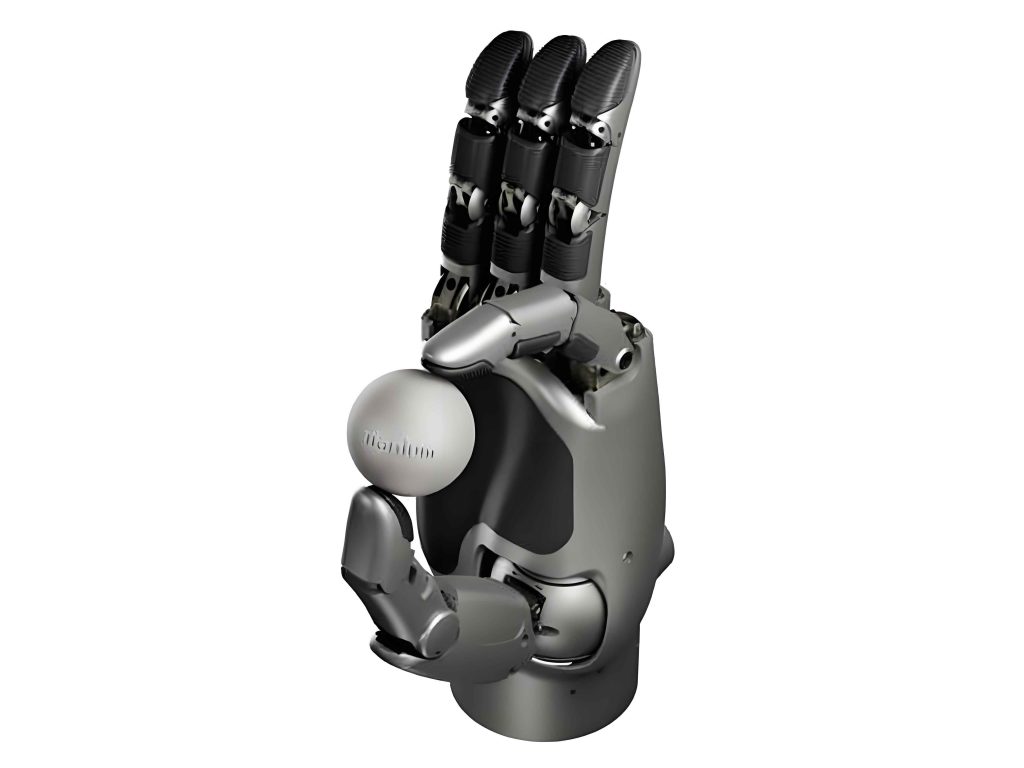
In practical implementations, the six-axis force sensor is often part of a broader ecosystem that includes other sensor types, such as current sensors and temperature sensors. For instance, a current sensor based on magnetoresistive elements can measure high-frequency currents up to 1 MHz, using a parallel conductor configuration to homogenize the magnetic field. The output of such a sensor is derived from the Wheatstone bridge imbalance, similar to the strain gauges in a six-axis force sensor. The magnetic field B around a conductor carrying current I is given by the Biot-Savart law, and for a straight segment, it simplifies to:
$$ B = \frac{\mu_0 I}{2\pi r} $$
where μ_0 is the permeability of free space and r is the distance from the conductor. In a magnetoresistive current sensor, the resistance change ΔR is proportional to the magnetic field, and the bridge output voltage V_bridge can be modeled as:
$$ V_{bridge} = V_{in} \cdot S_i \cdot I $$
where S_i is the current sensitivity. This principle can be extended to multi-sensor systems where data from a six-axis force sensor is correlated with current and temperature readings to monitor equipment health. For example, in a temperature sensor-based analytics system, historical fault data is used to build models that predict failures. The fault characteristic value C_f can be computed from environmental data E and operational parameters P using a regression model:
$$ C_f = \beta_0 + \beta_1 E_1 + \beta_2 E_2 + \cdots + \beta_n P_n $$
where β are coefficients determined through machine learning. This model integrates with the six-axis force sensor data to provide a comprehensive risk assessment, enhancing system reliability. The table below shows a comparison of sensor fusion techniques applied in edge systems, highlighting how six-axis force sensor data is combined with other modalities.
| Fusion Method | Modalities Integrated | Latency Reduction (%) | Accuracy Improvement (%) |
|---|---|---|---|
| Cross-Modal Attention | Six-Axis Force, Current, Temperature | 30 | 25 |
| Kalman Filtering | Six-Axis Force, IMU | 20 | 15 |
| Neural Networks | Six-Axis Force, Vision, Audio | 40 | 35 |
Another critical aspect of six-axis force sensor design is the thermal compensation, as temperature variations can induce drift in the strain gauge outputs. A common solution involves using temperature sensors embedded near the strain gauges to provide correction data. The compensated output V_comp is given by:
$$ V_{comp} = V_{raw} – \alpha (T – T_0) $$
where α is the temperature coefficient, T is the current temperature, and T_0 is the reference temperature. This simple linear model can be enhanced with polynomial fits or machine learning algorithms for higher accuracy. In multi-sensor edge systems, dynamic resource allocation ensures that computational power is prioritized for the six-axis force sensor when high-bandwidth data is critical, such as in robotic manipulation tasks. The attention weight w for each sensor modality can be computed using a softmax function based on feature importance scores:
$$ w_i = \frac{\exp(s_i)}{\sum_{j=1}^{n} \exp(s_j)} $$
where s_i is the score for the i-th sensor, and n is the total number of sensors. This mechanism allows the system to focus on the six-axis force sensor during high-force events, improving response times and decision accuracy.
In conclusion, the advancement of six-axis force sensor technology is pivotal for modern automation and robotics. Through innovative mechanical designs, such as orthogonal parallel structures, and sophisticated signal processing techniques, these sensors achieve high precision, equal-range measurement, and robustness. The integration of six-axis force sensors into multi-modal systems further amplifies their utility, enabling real-time analytics and predictive maintenance. As research progresses, we can expect even greater improvements in the performance and applicability of six-axis force sensors, solidifying their role as a cornerstone of sensor technology.
To further illustrate the mathematical foundations, consider the dynamics of a six-axis force sensor under time-varying loads. The equation of motion can be described using Newton-Euler formulations, where the net force and torque are related to the acceleration and angular acceleration of the sensor body. For a rigid body, the equations are:
$$ \sum F = m \cdot a $$
$$ \sum T = I \cdot \alpha + \omega \times (I \cdot \omega) $$
where m is the mass, I is the inertia tensor, a is the linear acceleration, α is the angular acceleration, and ω is the angular velocity. In a six-axis force sensor, these equations are used to derive the relationship between applied loads and internal stresses, which are then measured by the strain gauges. The compliance matrix C, which is the inverse of the stiffness matrix K, relates the displacement to the force:
$$ \delta = C \cdot F $$
For a well-designed six-axis force sensor, C is symmetric and positive definite, ensuring stability and linearity. The eigenvalues of C represent the compliances in the principal directions, and optimizing these values helps achieve equal-range performance. In practice, finite element analysis (FEA) is employed to simulate the stress distribution and optimize the geometry. The von Mises stress σ_vm is often used to assess yield criteria, and it is calculated as:
$$ \sigma_{vm} = \sqrt{\frac{(\sigma_1 – \sigma_2)^2 + (\sigma_2 – \sigma_3)^2 + (\sigma_3 – \sigma_1)^2}{2}} $$
where σ_1, σ_2, σ_3 are the principal stresses. By minimizing σ_vm in critical areas, the six-axis force sensor can withstand higher loads without permanent deformation. Additionally, the natural frequency f_n of the sensor structure is important for dynamic applications, and it can be estimated from the mass and stiffness:
$$ f_n = \frac{1}{2\pi} \sqrt{\frac{k}{m}} $$
where k is the effective stiffness. A higher f_n reduces the risk of resonance-induced errors in the six-axis force sensor measurements.
Finally, the calibration of a six-axis force sensor involves extensive testing to populate the sensitivity matrix. A common method is to apply sequential loads in each direction and record the outputs. The decoupling matrix D, which is the inverse of S, is then used to compute the actual forces from the raw outputs:
$$ F = D \cdot V $$
where D is typically obtained through linear regression. The accuracy of the six-axis force sensor is often quantified by the root mean square error (RMSE) between applied and measured forces:
$$ RMSE = \sqrt{\frac{1}{n} \sum_{i=1}^{n} (F_{applied,i} – F_{measured,i})^2 } $$
Through iterative design and calibration, the RMSE can be minimized, making the six-axis force sensor a reliable tool for precision applications. As sensor fusion technologies evolve, the synergy between six-axis force sensors and other modalities will continue to drive innovations in smart systems and IoT ecosystems.