
In the field of precision motion control and power transmission, strain wave gear drives, commonly known as harmonic drives, represent a paradigm of compact, high-ratio, and high-precision gearing technology. The unique principle of operation, relying on the controlled elastic deformation of a flexible spline, enables exceptional performance characteristics. A critical component that enables this function is the wave generator. This article delves into the design and research of a novel fluidic wave generator, a conceptual fusion of fluid power technology and strain wave gear principles, which aims to overcome certain inherent limitations of traditional mechanical wave generators.
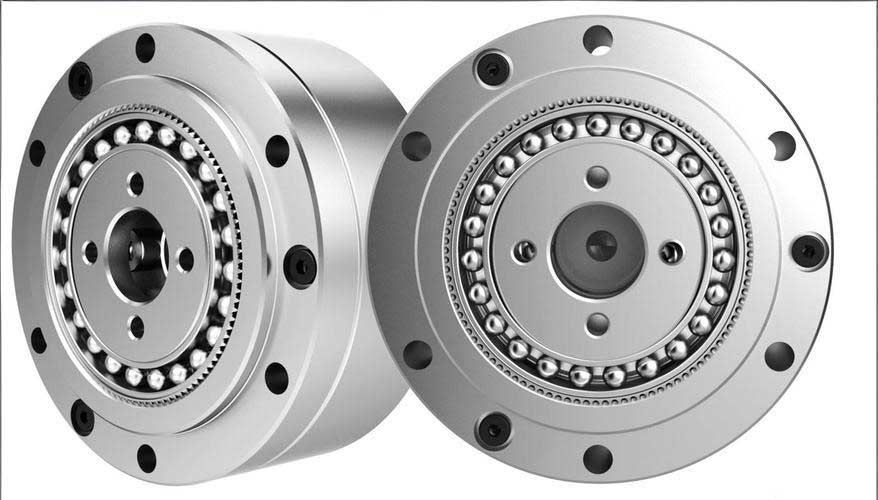
The fundamental principle of a strain wave gear involves three primary components: a rigid circular spline, a flexible spline (or “flexspline”), and the wave generator. The wave generator, typically an elliptical cam or a set of bearings, is inserted into the flexspline, deforming it from its natural circular shape into an elliptical one. This deformation forces the teeth of the flexspline to engage with the teeth of the circular spline at two opposing regions along the major axis. As the wave generator rotates, the points of engagement travel around the circumference of the gear. Because the flexspline has slightly fewer teeth (typically two fewer) than the circular spline, each full revolution of the wave generator results in a small relative rotation between the two splines in the opposite direction, producing a very high reduction ratio, governed by the formula:
$$
i = \frac{N_f}{N_f – N_c}
$$
where \( i \) is the reduction ratio, \( N_f \) is the number of teeth on the flexspline, and \( N_c \) is the number of teeth on the circular spline. For a standard configuration where the wave generator is the input, the circular spline is fixed, and the flexspline is the output, the ratio simplifies to \( i = -\frac{N_f}{2} \) for a two-teeth difference.
Traditional wave generators, while effective, possess certain constraints. They are predominantly rigid mechanical elements (conical cam, disk cam, or bearing-based). Their major axis dimension is fixed, and any adjustment to the preload or mesh condition between the flexspline and circular spline typically requires disassembly. This rigidity can also translate into sensitivity to alignment errors and a lack of inherent compliance to absorb shock loads or accommodate minor misalignments dynamically during operation.
The core innovation discussed here is the replacement of this rigid mechanical element with a dynamically controllable, compliant system—the fluidic wave generator. This system utilizes an array of fluidic actuators (pneumatic or hydraulic cylinders) arranged radially to impart the necessary elliptical deformation on the flexspline. This approach transitions the strain wave gear from a purely mechanical device to a mechatronic or fluidic-mechanical hybrid system.
Conceptual Design and Working Principle of the Fluidic Wave Generator
The primary objective is to generate a precise, rotating elliptical deformation profile. This can be achieved by orchestrating the synchronized, periodic extension and retraction of multiple linear actuators. A fundamental model for this concept employs four groups of actuators, labeled A, B, C, and D. These actuator groups are mounted on a rigid baseplate, with their piston rods oriented radially inward towards a common center. They are spaced at 45-degree angular intervals around the full circle.
The operational sequence is designed to mimic a standard elliptical wave generator profile. Rather than a physical ellipse rotating, the “ellipse” is defined by the locus of the tips of the extended piston rods. The sequence for generating a counter-clockwise rotating wave is as follows:
- Step 1: Actuator Group A extends.
- Step 2: Actuator Group A retracts.
- Step 3: Actuator Group B extends.
- Step 4: Actuator Group B retracts.
- Step 5: Actuator Group C extends.
- Step 6: Actuator Group C retracts.
- Step 7: Actuator Group D extends.
- Step 8: Actuator Group D retracts.
This cycle (A+ → A- → B+ → B- → C+ → C- → D+ → D-) repeats continuously. At any given moment, typically only one or two opposing groups might be fully extended, creating the major axis of the effective ellipse. The sequential activation causes the “high point” or major axis orientation to step around the circle. By reversing the activation sequence, the direction of the effective wave rotation can be reversed. The radial displacement \( r(\theta, t) \) of the generated wave profile can be approximated as a function of angular position \( \theta \) and time \( t \):
$$
r(\theta, t) \approx R_0 + \Delta R \cdot \cos(2(\theta – \omega t))
$$
where \( R_0 \) is the nominal radius of the retracted state, \( \Delta R \) is the amplitude of radial deformation (half the difference between major and minor axis), and \( \omega \) is the angular speed of the wave. The factor of 2 indicates a two-lobe (elliptical) wave, consistent with most strain wave gear applications.
The following table compares key characteristics of traditional wave generators with the proposed fluidic wave generator:
| Feature | Traditional Mechanical Wave Generator | Fluidic Wave Generator |
|---|---|---|
| Actuation Principle | Mechanical rotation of cam/roller. | Sequential fluid pressure actuation of pistons. |
| Compliance/Stiffness | Essentially rigid, fixed preload. | Inherently compliant; preload adjustable via fluid pressure. |
| Wave Profile Adjustment | Fixed by hardware geometry; requires physical change. | Potentially adjustable in real-time via control of actuator stroke/pressure. |
| Fault Tolerance | Single point of failure (bearing/cam). | Potential for redundancy in multi-actuator arrays. |
| Backlash Control | Set by initial assembly. | Can be dynamically adjusted to compensate for wear. |
| Complexity | Mechanically simple, high-precision machining required. | Electro-fluidic system complexity, but actuator manufacturing can be simpler. |
| Application Environment | Sensitive to extreme temps, radiation unless specially designed. | Fluid selection (e.g., inert gas) allows use in harsh/clean environments. |
Detailed System Design and Control
For a practical implementation, especially in a pneumatic embodiment, the choice of actuators is crucial. Large-bore, short-stroke, spring-return single-acting cylinders are suitable. They provide the necessary radial force during the extension (pressure) stroke, while retraction is handled by an internal spring. This simplifies the fluidic control circuitry as only a pressurized supply line to extend the cylinders is needed.
The control system’s primary function is to execute the precise sequence outlined above. For a purely pneumatic, non-electronic implementation (suitable for explosive or high-interference environments), a cascade control circuit based on pilot-operated valves and travel sensors can be designed. The state of each actuator group (extended or retracted) is detected using mechanical limit valves (3/2-way roller lever valves) actuated by the piston rod. The signal from one valve triggers the next step in the sequence.
A pneumatic control circuit for the counter-clockwise sequence would consist of the following core elements:
- Four groups of single-acting cylinders (A, B, C, D).
- Four 5/2- or 3/2-way double pilot valves acting as the main memory elements for each group.
- Limit valves (a0, b0, c0, d0) to detect the retracted “home” position of each group.
- A network of shuttle (OR) valves to route pilot signals appropriately.
- A manual start valve to initiate the cycle.
The step-displacement diagram, a standard tool in pneumatic sequencing design, formally defines the cycle:
| Step | Actuator A | Actuator B | Actuator C | Actuator D | Trigger Signal |
|---|---|---|---|---|---|
| 0 (Initial) | Retracted | Retracted | Retracted | Retracted | Start Signal (S) |
| 1 | Extend | Retracted | Retracted | Retracted | S via valve network |
| 2 | Retracted | Retracted | Retracted | Retracted | Signal from A extended |
| 3 | Retracted | Extend | Retracted | Retracted | Signal from A retracted (a0) |
| 4 | Retracted | Retracted | Retracted | Retracted | Signal from B extended |
| 5 | Retracted | Retracted | Extend | Retracted | Signal from B retracted (b0) |
| 6 | Retracted | Retracted | Retracted | Retracted | Signal from C extended |
| 7 | Retracted | Retracted | Retracted | Extend | Signal from C retracted (c0) |
| 8 | Retracted | Retracted | Retracted | Retracted | Signal from D extended -> Resets to Step 1 |
Mathematically, the force \( F_i \) exerted by an actuator on the flexspline is a direct function of the supplied fluid pressure \( P \) and the piston bore area \( A_b \), minus any frictional losses \( F_f \):
$$
F_i = P \cdot A_b – F_f
$$
This force is responsible for maintaining the meshing contact between the flexspline and circular spline teeth. The dynamic control of \( P \) offers a direct mechanism to modulate the transmission torque capacity and backlash of the strain wave gear in real-time, a feature impossible with rigid generators.
Advantages, Challenges, and Potential Applications
The fluidic wave generator concept introduces several transformative advantages for strain wave gear technology:
1. Dynamic Compliance and Shock Absorption: The fluid medium (air or oil) provides inherent damping. Sudden load spikes can cause the actuators to momentarily compress, allowing the flexspline to deflect slightly without damage, protecting the gear teeth from impact failure.
2. Adjustable Preload and Backlash Elimination: By controlling the system pressure, the radial force deforming the flexspline can be adjusted. This allows for optimal preload setting during operation and can even be used to actively compensate for tooth wear, maintaining near-zero backlash throughout the system’s life. The contact force \( F_c \) at the major axis is roughly proportional to the sum of forces from opposing actuators:
$$
F_c \propto 2 \cdot (P \cdot A_b)
$$
3. Tolerance to Misalignment: The array of independent actuators can adapt to minor misalignments between the wave generator assembly and the flexspline, as each piston can stroke independently to some degree to maintain contact.
4. Functionality as a Fluidic Stepping Motor: The entire assembly—fluidic sequencer driving the wave generator which drives the strain wave gear—effectively constitutes a novel type of fluidic motor with very high inherent step-down ratio and precise positioning capability, suitable for low-speed, high-torque direct drive applications in hazardous areas.
5. Simplified High-Precision Components: The manufacturing challenge shifts from producing a perfect, high-precision elliptical cam to producing standard cylinders and a sophisticated control system. The precision is derived from the control logic and software rather than ultra-tight mechanical tolerances.
However, significant challenges must be addressed:
- Control Complexity & Speed: Achieving high rotational speeds requires extremely fast valve switching and cylinder response, which may be limited by pneumatic system compressibility and valve shift times. A hybrid electro-pneumatic/hydraulic system with servo valves would offer higher performance but at greater cost and complexity.
- Power Density & Efficiency: The need for a continuous supply of pressurized fluid and the energy losses associated with compressing air or pumping oil may result in lower overall system efficiency compared to a purely mechanical strain wave gear.
- Sealing and Maintenance: The system involves numerous dynamic seals on the actuators, which are potential points of leakage and wear.
- Stiffness under Load: While compliant for shocks, the static stiffness of the system is determined by the fluid’s bulk modulus (hydraulic is much stiffer than pneumatic) and the control system’s ability to maintain pressure. For high-precision positioning under varying loads, a hydraulic implementation would be necessary.
The potential applications for a strain wave gear equipped with a fluidic wave generator are found in niches where its unique advantages are critical:
- Robotics (Collaborative & Hydraulic): In cobots, inherent compliance is a safety requirement. In heavy-duty hydraulic robots, it can be directly integrated into the hydraulic power system.
- Harsh Environments: All-pneumatic systems for explosive atmospheres (mining, chemical plants) or cleanrooms where sparks from electric motors are undesirable.
- High-Precision, Adjustable Systems: Applications like telescope mirror positioning or semiconductor manufacturing equipment where active backlash compensation and vibration damping are valuable.
- Research Platforms: As a testbed for studying meshing dynamics, load distribution, and wear in strain wave gears under dynamically adjustable preload conditions.
Conclusion and Future Perspectives
The fluidic wave generator presents a radical re-imagining of a core component in strain wave gear transmission. By transitioning from a rigid mechanical element to a software-controlled, compliant fluidic system, it addresses longstanding limitations related to static preload, shock sensitivity, and dynamic adjustability. This innovation effectively bridges fluid power and precision gearing, opening up new functional possibilities such as active torque control, adaptive backlash elimination, and inherent safety through compliance.
While practical challenges in speed, efficiency, and system complexity remain as barriers to widespread adoption, the concept holds significant promise for specialized applications. Future research directions would logically focus on optimizing the actuator array geometry (e.g., using more than four groups for a smoother wave profile), implementing advanced closed-loop electro-fluidic servo control for precise stroke and pressure regulation, and developing compact, integrated hydraulic actuator packages specifically for this purpose. The fusion of this fluidic actuation principle with the elegant kinematics of the strain wave gear underscores a continued evolution in transmission technology, where adaptability and control become as important as mechanical advantage and precision.