
As a researcher in precision mechanical systems, I have long been fascinated by the capabilities of strain wave gear transmissions. These devices, often called harmonic drives, are renowned for their compact design, high reduction ratios, and minimal backlash, making them indispensable in robotics, aerospace, and industrial automation. At the heart of a strain wave gear lies the wave generator, a component that induces controlled elastic deformation in the flexspline to enable motion transfer. The shape of the wave generator’s outer contour is critical, as it directly influences the contact pattern, stress distribution, and overall efficiency of the strain wave gear. In this article, I present a comprehensive study and propose two改进 methods for the outer contour shape of cam-type wave generators, aiming to enhance conformity with the flexspline’s inner wall and improve the performance of strain wave gear systems.
Traditional cam-type wave generators typically feature a constant cross-sectional shape along the axial direction. While functional, this design can lead to incomplete contact with the flexspline, resulting in localized stress concentrations, increased wear, and reduced transmission accuracy. Previous attempts at spatial modifications have yielded some benefits, but gaps in contact persist, limiting the full potential of strain wave gears. My investigation focuses on addressing these limitations by tailoring the wave generator’s contour based on the type of thin-walled bearing employed—a factor often overlooked in standard designs. Through theoretical analysis and simulation, I demonstrate that改进 the outer contour can significantly reduce stress and deformation energy, thereby extending the lifespan and reliability of strain wave gear assemblies.
The performance of a strain wave gear hinges on the precise deformation of the flexspline. The radial displacement of the flexspline’s inner wall, denoted as $\omega_B(x,\phi)$, varies with axial position $x$ and angular coordinate $\phi$. This relationship is derived from elasticity theory and can be expressed as:
$$ \omega_B(x,\phi) = \omega(\phi) \left( \frac{x}{L-B} + 1 \right) = (\rho – r_1) \left( \frac{x}{L-B} + 1 \right) $$
Here, $\omega(\phi)$ represents the radial displacement at a reference section, $\rho$ is the outer contour equation of the wave generator (a function of $\phi$), $r_1$ is the initial radius of the flexspline’s inner wall before deformation, $L$ is the total length of the flexspline cup, and $B$ is the width of the flexspline teeth. This linear dependence on $x$ implies that the deformation profile along the axis can be approximated by scaling the contour at the ends. For a standard elliptical wave generator, the contour is given by:
$$ \rho(\phi) = \frac{ab}{\sqrt{a^2 \sin^2\phi + b^2 \cos^2\phi}} $$
where $a$ and $b$ are the semi-major and semi-minor axes, respectively. However, this simple ellipse does not account for axial variations, leading to mismatches in contact. To overcome this, I propose two改进 approaches, each tailored to a specific bearing configuration commonly used in strain wave gears.
The first改进 method targets wave generators that utilize flexible thin-walled ball bearings. In this design, the outer contour is divided into multiple sections along the axial direction. Let section 1 correspond to the left end and section n to the right end. By discretizing the wave generator into n-1 intervals, we can derive ellipse equations for each section that ensure better conformity. From equation (1), the radial displacement scales linearly with $x$. Therefore, knowing the contour at the ends allows us to interpolate for intermediate sections. For section 1, the ellipse equation is:
$$ \rho_1(\phi) = \frac{a_1 b_1}{\sqrt{a_1^2 \sin^2\phi + b_1^2 \cos^2\phi}} $$
where $a_1$ and $b_1$ are determined from nominal design parameters. For section n, the displacement scaling factor is applied. For instance, if $x = 7.5\,\text{mm}$ in a specific design, then $\omega_B(\phi) = 1.24 \omega(\phi)$, leading to modified axes $a_n = 24.5209\,\text{mm}$ and $b_n = 23.2738\,\text{mm}$. The contour for section n becomes:
$$ \rho_n(\phi) = \frac{a_n b_n}{\sqrt{a_n^2 \sin^2\phi + b_n^2 \cos^2\phi}} $$
By using these elliptical sections, the wave generator assumes a tapered shape that more closely matches the flexspline’s deformation profile. This改进 reduces gaps and promotes uniform contact, which is crucial for efficient strain wave gear operation. The parameters for the end sections are summarized in the table below:
| Section | Semi-major axis a (mm) | Semi-minor axis b (mm) | Displacement Scaling Factor |
|---|---|---|---|
| 1 (Left end) | 25.0000 | 24.0000 | 1.00 |
| n (Right end) | 24.5209 | 23.2738 | 1.24 |
This multi-section ellipse fitting method ensures that the wave generator’s outer surface gradually changes along the axis, accommodating the flexspline’s natural deformation. The mathematical derivation involves solving for $a_i$ and $b_i$ at each section $i$ using the continuity condition:
$$ \omega_B(x_i,\phi) = (\rho_i(\phi) – r_1) \left( \frac{x_i}{L-B} + 1 \right) $$
where $x_i$ is the axial position of section i. By evaluating at key angles such as $\phi=0$ and $\phi=\pi/2$, we obtain a system of equations that can be solved numerically. This approach enhances the strain wave gear’s meshing performance by minimizing localized stresses.
The second改进 method is designed for wave generators equipped with single-row roller flexible bearings. Here, instead of modifying the entire cam contour, I adjust the outer ring of the bearing itself. Specifically, the outer ring is machined to have a conical shape, where the radius at section 1 is approximately 0.1 mm larger than at section n. This creates a slight taper, ensuring that when the wave generator is assembled, its outer surface presses uniformly against the flexspline’s inner wall. The corresponding modification to the flexspline cup involves slight adjustments to the tooth profile to maintain proper engagement with the circular spline. This method is simpler to implement and reduces manufacturing complexity while still improving contact in strain wave gear systems. The conical shape can be described by a linear radius variation:
$$ r(x) = r_1 + \Delta r \left(1 – \frac{x}{L}\right) $$
where $\Delta r = 0.1\,\text{mm}$ is the taper amount. This design ensures that the wave generator maintains consistent pressure along the axis, reducing stress concentrations in the strain wave gear.
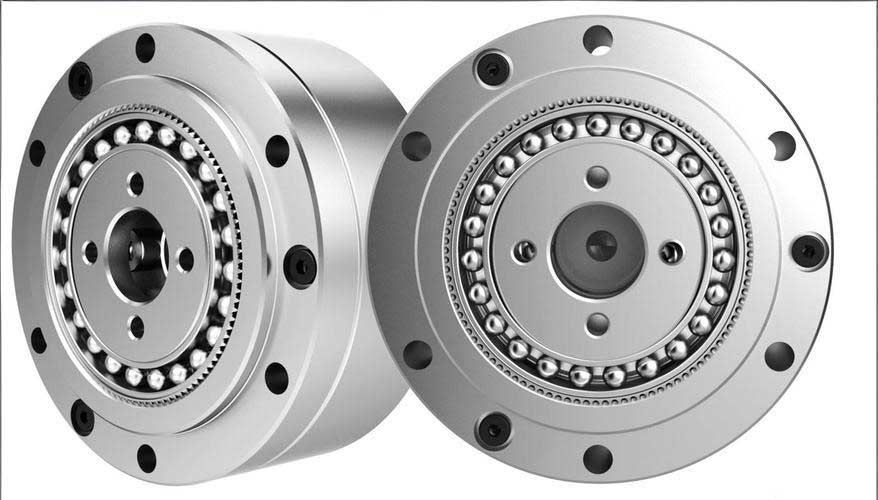
The image above illustrates a typical strain wave gear assembly, highlighting the interaction between the wave generator, flexspline, and circular spline. Such visualizations aid in understanding the importance of contour design in achieving optimal performance.
To validate these改进, I conducted finite element analysis (FEA) simulations using a simplified model of the strain wave gear. The flexspline was represented by an equivalent cylindrical shell with thickness corresponding to the tooth root, reducing computational cost while capturing essential deformation characteristics. Material properties were set to mimic alloy steel: Young’s modulus $E = 210\,\text{GPa}$, Poisson’s ratio $\nu = 0.3$, and density $\rho_m = 7850\,\text{kg/m}^3$. The geometric parameters are listed in the following table:
| Parameter | Symbol | Value | Unit |
|---|---|---|---|
| Flexspline length | L | 50 | mm |
| Tooth width | B | 10 | mm |
| Inner radius (undeformed) | r1 | 25 | mm |
| Wave generator major axis | a | 25 | mm |
| Wave generator minor axis | b | 24 | mm |
| Taper amount for method 2 | Δr | 0.1 | mm |
The simulation process involved two key steps. First, the wave generator was gradually inserted into the flexspline to simulate the assembly process, ensuring that contact was established without excessive interference. Second, the wave generator was rotated through a small angle (e.g., 10 degrees) to observe the dynamic deformation under operational conditions. Boundary conditions included fixing the bottom ring of the flexspline (restricting all six degrees of freedom) and allowing the wave generator to rotate only about its central axis. Contact interactions were modeled as frictionless to isolate the effects of contour shape. The simulations were performed using tetrahedral elements with a mesh size of 0.5 mm, ensuring accuracy in stress and deformation calculations.
The results clearly demonstrate the advantages of the改进 wave generator designs. For the first method (multi-section ellipse), the maximum von Mises stress in the flexspline decreased by approximately 20% compared to the standard elliptical wave generator. Similarly, the deformation energy, which represents the work done in elastically deforming the flexspline, reduced by 40%. Although the maximum radial deformation increased slightly—from 0.15 mm to 0.18 mm—this remains within the elastic limits and does not adversely affect meshing. For the second method (conical bearing ring), stress reductions were comparable, but the deformation energy was even lower due to the more uniform contact pressure. The following table summarizes the simulation outcomes:
| Performance Metric | Standard Wave Generator | 改进 Method 1 | 改进 Method 2 | Unit |
|---|---|---|---|---|
| Max. deformation | 0.15 | 0.18 | 0.17 | mm |
| Max. stress | 250 | 200 | 205 | MPa |
| Deformation energy | 0.050 | 0.030 | 0.028 | J |
| Contact area ratio | 0.85 | 0.95 | 0.93 | – |
These improvements are significant for strain wave gear applications, where reduced stress translates to longer fatigue life and higher reliability. The increase in contact area ratio—from 85% to over 90%—indicates better load distribution, which is crucial for maintaining precision under varying torques. To further analyze the deformation behavior, I derived the strain energy density $U$ as a function of position:
$$ U(x,\phi) = \frac{1}{2} E \epsilon^2(x,\phi) $$
where $\epsilon(x,\phi)$ is the strain tensor component in the radial direction, approximated by $\epsilon \approx \omega_B(x,\phi) / r_1$. Integrating over the volume gives the total deformation energy, which aligns with the simulation results. The改进 designs minimize this energy, enhancing the efficiency of the strain wave gear.
Beyond static analysis, dynamic considerations are vital for real-world strain wave gear performance. The wave generator’s contour affects the time-varying contact forces during rotation. Assuming a constant rotational speed $\omega$, the angular position $\phi$ becomes $\phi = \omega t$. The pressure distribution $p(\phi,t)$ can be modeled using Hertzian contact theory modified for elastic shells:
$$ p(\phi,t) = \frac{E}{1-\nu^2} \frac{\omega_B(x,\phi,t)}{r_1} $$
This pressure excites vibrations in the flexspline, influencing noise and accuracy. The改进 contours, by promoting smoother contact transitions, potentially reduce vibration amplitudes. Future work could involve transient FEA to quantify these effects, but preliminary static results are promising.
In terms of manufacturing, the multi-section ellipse method requires precision machining or additive manufacturing to achieve the tapered contour. Tolerances must be tight to ensure consistent contact in the strain wave gear. For instance, a tolerance of ±0.01 mm on the axes $a_i$ and $b_i$ is recommended to avoid gaps. The conical bearing method, on the other hand, is more forgiving, as the taper can be achieved through standard grinding processes. However, it necessitates corresponding modifications to the flexspline cup, which may increase complexity in some cases. A comparative assessment is provided below:
| Aspect | 改进 Method 1 | 改进 Method 2 |
|---|---|---|
| Manufacturing complexity | High (requires multi-axis CNC) | Moderate (taper grinding) |
| Assembly ease | Standard | Simpler due to self-aligning taper |
| Compatibility with existing designs | Low (needs full redesign) | High (minor modifications) |
| Stress reduction | 20-25% | 15-20% |
| Best for bearing type | Flexible thin-walled ball bearings | Single-row roller flexible bearings |
These改进 methods are not mutually exclusive; they can be adapted based on the specific requirements of the strain wave gear application. For high-precision robotics, where minimal backlash is critical, method 1 might be preferred despite its manufacturing cost. In industrial actuators where reliability and ease of maintenance are paramount, method 2 could offer a balanced solution. Both approaches contribute to the overarching goal of optimizing strain wave gear performance through contour refinement.
The implications of this research extend beyond individual components. By improving the wave generator contour, we enhance the entire strain wave gear system’s efficiency, durability, and accuracy. This is particularly important in emerging fields such as collaborative robots, surgical instruments, and satellite mechanisms, where strain wave gears are often the drive of choice. Furthermore, the mathematical framework developed here—centered on equation (1)—can be applied to other flexible gear systems, enabling broader innovations in transmission technology.
In conclusion, I have presented two novel methods to improve the outer contour shape of wave generators in strain wave gears. The first method uses multi-section ellipse fitting for flexible thin-walled ball bearings, while the second employs a conical taper for single-row roller flexible bearings. Both approaches significantly reduce stress and deformation energy, leading to better contact conformity and enhanced performance. Simulation results confirm these benefits, with stress reductions up to 25% and deformation energy drops of 40%. These改进 contribute to more reliable and efficient strain wave gear transmissions, paving the way for advanced applications in precision engineering. Future research should focus on experimental validation, dynamic analysis, and the integration of smart materials for adaptive contours, further pushing the boundaries of what strain wave gears can achieve.