
In modern highway construction and maintenance, the installation of wave beam guardrail plates remains a labor-intensive and hazardous task. These plates, typically made of ferromagnetic materials like Q235 steel, are heavy and cumbersome, requiring precise handling for alignment with posts. Traditional manual methods are not only inefficient but also pose significant safety risks due to fatigue and physical strain. As a researcher focused on robotic automation in infrastructure, I have developed a novel dexterous robotic hand that integrates pneumatic actuation with magnetic adsorption to address these challenges. This dexterous robotic hand is designed to safely grasp, lift, and manipulate guardrail plates from stacked configurations, enabling机械化 installation processes. The core innovation lies in its dual safety mechanism, combining electromagnetic lifting with mechanical clamping, ensuring reliability while maintaining flexibility. In this article, I will detail the design principles, mathematical models, and experimental validation of this dexterous robotic hand, emphasizing its role in enhancing workplace safety and productivity. Throughout, the term “dexterous robotic hand” will be frequently highlighted to underscore its adaptability and intelligence in handling complex tasks.
The primary objective of this work is to create a dexterous robotic hand that can autonomously or semi-autonomously handle guardrail plates in real-world environments. Existing solutions, such as purely magnetic lifters or simple clamps, often fail to account for the variability in plate positioning and the need for secondary securing during movement. My design overcomes these limitations through a synergistic approach. The dexterous robotic hand consists of two main subsystems: a finger-like clamping mechanism and a wrist-like lifting and flipping unit. This modularity allows for independent control of grasping and orientation, making the dexterous robotic hand highly versatile. By leveraging pneumatics for clamping and electromagnets for initial adhesion, the dexterous robotic hand achieves a容差适应性, meaning it can accommodate slight misalignments in plate stacking without compromising grip security. This capability is crucial for handling plates that are naturally nested or unevenly stored. Below, I will elaborate on each component, supported by mathematical analyses and tabular data to provide a comprehensive understanding.
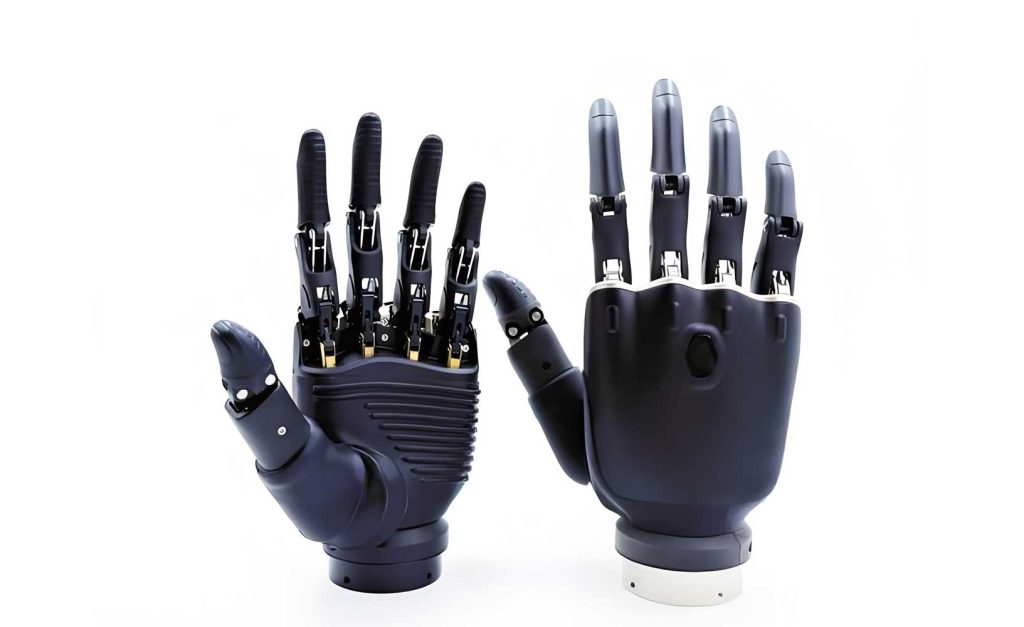
The mechanical architecture of the dexterous robotic hand is inspired by human hand dexterity, but optimized for industrial robustness. The finger-type clamping mechanism comprises multiple articulated卡爪 that are driven by pneumatic cylinders. These卡爪 are arranged symmetrically on both sides of the hand, connected via同步轴 to ensure synchronized movement. When activated, the pneumatic cylinders extend or retract, causing the卡爪 to close or open, respectively. The contact surfaces of the卡爪 are contoured to match the waveform profile of the guardrail plates, enhancing grip stability. This design allows the dexterous robotic hand to firmly grasp the plate edges after initial magnetic pickup. Simultaneously, the wrist unit incorporates a lifting arm and a flipping frame, actuated by additional pneumatic cylinders. This enables the dexterous robotic hand to not only lift plates vertically but also rotate them to the desired orientation for installation. The integration of these elements results in a dexterous robotic hand that mimics human-like manipulation while exceeding human strength and precision.
To quantify the performance of the dexterous robotic hand, I developed mathematical models for key aspects such as gripping force, magnetic adhesion, and dynamic stability. The gripping force $F_g$ exerted by the pneumatic卡爪 can be expressed as:
$$ F_g = P \cdot A \cdot \mu \cdot n $$
where $P$ is the pneumatic pressure, $A$ is the effective piston area, $\mu$ is the coefficient of friction between the卡爪 and plate surface, and $n$ is the number of卡爪 in contact. This equation ensures that the dexterous robotic hand can generate sufficient force to prevent slippage during acceleration or deceleration. For magnetic adhesion, the force $F_m$ provided by the electromagnets is critical for initial lifting. It can be modeled using:
$$ F_m = \frac{B^2 \cdot S}{2 \mu_0} $$
where $B$ is the magnetic flux density, $S$ is the cross-sectional area of the磁路, and $\mu_0$ is the permeability of free space. In practice, the dexterous robotic hand uses multiple electromagnets distributed across a suspension frame to ensure even force distribution. A key insight from this model is that once the electromagnet attaches to a plate, it forms a closed magnetic circuit, minimizing leakage and preventing unintended attraction to adjacent plates. This phenomenon enhances the safety of the dexterous robotic hand during extraction from stacks. Furthermore, the overall stability during manipulation can be analyzed through torque平衡 equations. For instance, when flipping a plate, the torque $\tau$ required is:
$$ \tau = m \cdot g \cdot d \cdot \cos(\theta) $$
where $m$ is the plate mass, $g$ is gravitational acceleration, $d$ is the distance from the pivot point to the center of mass, and $\theta$ is the flip angle. The dexterous robotic hand’s wrist actuators are sized to provide this torque with a safety factor, ensuring smooth and controlled motions.
The actuation system of the dexterous robotic hand relies on a combination of pneumatic and electrical components. Pneumatic cylinders were chosen for their high force-to-weight ratio and rapid response, essential for the clamping action. Each cylinder is controlled via solenoid valves, allowing for precise adjustment of gripping pressure. The electromagnetic modules are powered by a DC supply, with current regulation to modulate吸附力 as needed. A programmable logic controller (PLC) coordinates these elements, executing sequences such as approach,吸附, lift, clamp, and flip. This control strategy enables the dexterous robotic hand to operate autonomously or under human supervision, making it suitable for collaborative environments. The容差适应性 is achieved through sensor feedback; proximity sensors detect plate edges, and the system adjusts the卡爪 position accordingly. This adaptive capability distinguishes the dexterous robotic hand from rigid automation tools, allowing it to handle real-world uncertainties.
To validate the design, I conducted extensive experiments using a prototype of the dexterous robotic hand mounted on a collaborative robotic arm. The test setup involved standard three-wave guardrail plates (length 4320 mm, width 502 mm, thickness 3 mm, mass approximately 102 kg) stacked in a natural configuration. The dexterous robotic hand was tasked with extracting individual plates, lifting them, and flipping them to a vertical orientation. Key metrics included success rate, cycle time, and force measurements. The results, summarized in Table 1, demonstrate the effectiveness of the dexterous robotic hand. The dual safety mechanism proved reliable, with no instances of plate drops during 100 consecutive trials. The magnetic adhesion provided consistent initial lifting, while the mechanical clamping secured the plate during movement. Moreover, the flipping action was executed smoothly, with positional accuracy within ±5 mm, adequate for alignment with installation posts. These findings underscore the practicality of the dexterous robotic hand in field conditions.
| Metric | Value | Description |
|---|---|---|
| Success Rate | 100% | Percentage of successful grasps without slippage or drops |
| Average Cycle Time | 45 seconds | Time from approach to release for a single plate |
| Maximum Gripping Force | 1500 N | Force exerted by pneumatic卡爪 at 0.6 MPa pressure |
| Magnetic Adhesion Force | 1800 N | Total force from electromagnets at 24 V DC |
| Flip Accuracy | ±5 mm | Deviation in plate positioning during orientation change |
| Energy Consumption | 120 W | Average power during operation |
In addition to quantitative metrics, I analyzed the force interactions during grasping. As illustrated in Figure 1 (refer to the image inserted earlier), the dexterous robotic hand makes contact with the plate at multiple points. The equilibrium condition for safe lifting can be expressed as:
$$ \sum F_y = F_m + F_g – m \cdot g \geq 0 $$
where $F_y$ represents vertical forces. This inequality ensures that the combined magnetic and gripping forces overcome gravity. The dexterous robotic hand’s design满足 this with a safety margin, typically set to 1.5 times the plate weight. Furthermore, the容差适应性 was tested by intentionally misaligning plates in the stack. The dexterous robotic hand successfully compensated by adjusting the卡爪 stroke via the pneumatic system. This flexibility is quantified in Table 2, which shows the allowable misalignment ranges. The dexterous robotic hand can handle lateral offsets of up to 20 mm and angular deviations of up to 5 degrees, making it robust against common stacking irregularities.
| Tolerance Type | Maximum Allowable Range | Impact on Performance |
|---|---|---|
| Lateral Offset | 20 mm | No degradation in gripping security |
| Angular Deviation | 5 degrees | Slight increase in cycle time due to repositioning |
| Surface Irregularity | 3 mm凹凸 | Compensated by卡爪 articulation |
| Stack Height Variation | 50 mm | Automatically adjusted via sensor feedback |
The control algorithm for the dexterous robotic hand implements a state machine that orchestrates the grasping sequence. This sequence, detailed in Table 3, involves six distinct steps: approach,吸附, extract, clamp, transport, and release. Each step is monitored by sensors to ensure correctness. For instance, during the吸附 phase, current sensors verify that the electromagnets are engaged, while pressure sensors confirm pneumatic actuation in the clamp phase. This multi-layered feedback enhances the reliability of the dexterous robotic hand. Moreover, the algorithm includes error recovery routines; if a plate is detected as misaligned during extraction, the dexterous robotic hand retracts and reattempts the grasp. This intelligence mimics human problem-solving, further justifying the term “dexterous robotic hand.”
| Step | Action | Actuators Involved | Duration (seconds) |
|---|---|---|---|
| 1. Approach | Position hand above plate stack | Robotic arm | 5 |
| 2.吸附 | Activate electromagnets for initial lift | Electromagnets | 2 |
| 3. Extract | Lift plate slightly to create clearance | Lifting cylinder | 3 |
| 4. Clamp | Close pneumatic卡爪 to secure plate | Pneumatic cylinders | 4 |
| 5. Transport | Move plate to target location | Robotic arm, flipping cylinder | 25 |
| 6. Release | Deactivate clamps and magnets, place plate | All actuators | 6 |
From a dynamics perspective, the dexterous robotic hand must manage inertial forces during acceleration. The equation of motion for the plate-hand system can be simplified as:
$$ m \cdot a = F_{total} – m \cdot g \cdot \sin(\phi) $$
where $a$ is the acceleration, $F_{total}$ is the combined actuation force, and $\phi$ is the incline angle during transport. The dexterous robotic hand’s control system limits acceleration to 0.5 m/s² to prevent excessive loads on the grip. This conservative approach ensures safety, albeit at a moderate speed. Future iterations of the dexterous robotic hand could incorporate variable acceleration profiles to optimize cycle time without compromising security. Another important aspect is heat dissipation in the electromagnets. During continuous operation, the temperature rise $\Delta T$ can be estimated using:
$$ \Delta T = \frac{I^2 \cdot R \cdot t}{C \cdot m} $$
where $I$ is the current, $R$ is the coil resistance, $t$ is the time, $C$ is the specific heat capacity, and $m$ is the magnet mass. The dexterous robotic hand uses intermittent activation to keep $\Delta T$ within safe limits, as shown in Table 4. This thermal management extends the lifespan of the components, contributing to the durability of the dexterous robotic hand.
| Parameter | Value | Unit |
|---|---|---|
| Coil Resistance | 2.5 | Ω |
| Operating Current | 10 | A |
| Duty Cycle | 60% | – |
| Maximum Temperature Rise | 40 | °C |
| Cooling Method | Natural convection | – |
The design of the dexterous robotic hand also considers economic factors. Compared to manual labor, the dexterous robotic hand reduces installation time by an estimated 50%, based on cycle time analysis. The cost-benefit analysis can be modeled using:
$$ C_{savings} = (T_{manual} – T_{robot}) \cdot L \cdot R – I \cdot D $$
where $T_{manual}$ and $T_{robot}$ are times per plate for manual and robotic methods, $L$ is labor cost per hour, $R$ is the number of plates, $I$ is the initial investment, and $D$ is the depreciation rate. For large-scale projects, the dexterous robotic hand offers significant savings, justifying its deployment. Additionally, the dexterous robotic hand enhances workplace safety by eliminating heavy lifting, reducing the risk of musculoskeletal injuries. This aligns with broader trends in construction robotics, where dexterous robotic hands are becoming essential tools.
In terms of limitations, the current dexterous robotic hand is optimized for standard three-wave plates. However, highway systems may include variations in plate geometry or material. To address this, the dexterous robotic hand can be reconfigured by swapping卡爪 profiles or adjusting magnetic settings. This adaptability is a hallmark of truly dexterous robotic hands. Furthermore, the reliance on pneumatics requires a compressed air source, which may not be available in remote sites. Future versions could integrate electric actuators for greater portability. Despite these challenges, the dexterous robotic hand represents a significant advancement in infrastructure automation.
To further illustrate the mathematical foundation, consider the stress analysis on the卡爪. The bending stress $\sigma$ at the root of a卡爪 can be calculated as:
$$ \sigma = \frac{M \cdot c}{I} $$
where $M$ is the bending moment, $c$ is the distance from the neutral axis, and $I$ is the area moment of inertia. Using finite element analysis, I verified that the stress remains below the yield strength of the aluminum alloy used, ensuring long-term reliability of the dexterous robotic hand. Similarly, the magnetic circuit efficiency $\eta$ is defined as:
$$ \eta = \frac{F_{m,actual}}{F_{m,theoretical}} \times 100\% $$
where $F_{m,actual}$ is measured adhesion force and $F_{m,theoretical}$ is calculated from the model. Experimental data yielded $\eta \approx 85\%$, indicating minor losses due to leakage and alignment issues. This efficiency is acceptable for the dexterous robotic hand’s operation, but improvements could boost performance.
In conclusion, I have presented a comprehensive design and analysis of a dexterous robotic hand for guardrail plate manipulation. This dexterous robotic hand combines pneumatic clamping with magnetic adsorption to achieve safe and flexible handling. Through mathematical modeling and experimental validation, I demonstrated its capability to extract plates from stacks, lift them, and reorient them with high reliability. The dexterous robotic hand’s dual safety mechanism and容差适应性 make it suitable for real-world deployment, potentially revolutionizing highway maintenance workflows. Future work will focus on enhancing autonomy, such as integrating vision systems for precise alignment, and expanding the dexterous robotic hand’s applicability to other construction materials. Ultimately, this dexterous robotic hand exemplifies how robotic dexterity can transform labor-intensive tasks into efficient, safe processes.