
In the realm of assistive robotics, the development of intuitive control systems and adaptive end effectors is paramount for enhancing the quality of life for individuals with disabilities. This work presents a comprehensive design and analysis of a novel end effector system for clamping flexible objects, such as fruits or delicate items, controlled entirely through brain-computer interface (BCI) technology. The core innovation lies in the fusion of a non-invasive BCI control scheme with a mechanically simple yet highly effective end effector that utilizes a liquid plastic-based clamping mechanism. The entire system is designed to be operated via mental commands, enabling users to grasp and manipulate compliant objects with minimal physical effort and maximal stability. Throughout this discussion, the term “end effector” will be emphasized repeatedly, as it is the critical physical interface between the robotic system and the environment, responsible for the final actuation and interaction.
The motivation for this research stems from the observed limitations in existing robotic grippers and prosthetic devices. Conventional end effectors, often rigid and force-controlled, struggle with deformable targets, potentially causing damage or unreliable grips. Meanwhile, BCI systems have advanced significantly, offering a direct communication pathway from the brain to external devices. However, most BCI-controlled manipulators focus on the control algorithm rather than the physical design of the end effector itself. This project bridges that gap by proposing a specialized end effector whose design is intrinsically suited for safe, stable flexible object manipulation, all under the command of brainwave signals.
The overall system architecture is composed of four primary modules: the electroencephalogram (EEG) acquisition module, the wireless Bluetooth communication module, the central processing and control module, and the pneumatic end effector. The user wears a dry-electrode EEG sensor, which captures raw brainwave signals. These signals are processed onboard to extract meaningful cognitive state metrics, such as attention and relaxation levels. The processed data is then transmitted wirelessly to a microcontroller unit (MCU). The MCU interprets this data, applies threshold-based decision logic, and generates control signals for the pneumatic actuator that drives the end effector. This creates a closed-loop system where the user’s mental state directly translates into physical clamping actions, with visual feedback completing the loop.
The heart of the system is the uniquely designed end effector. Its primary function is to apply a combination of gentle downward pressure and circumferential clamping force on a target object. The design philosophy prioritizes simplicity, reliability, and gentleness. The end effector consists of a standard pneumatic cylinder mounted onto the robotic arm’s wrist and a custom-designed clamping assembly. The clamping assembly is the true novelty. It features an elastic, cylindrical clamping sleeve made from Acrylonitrile Butadiene Styrene (ABS). This sleeve houses a sealed, spherical cavity filled with a substance known as liquid plastic. The pneumatic cylinder drives a piston rod connected to a plunger that interfaces with this liquid plastic cavity.
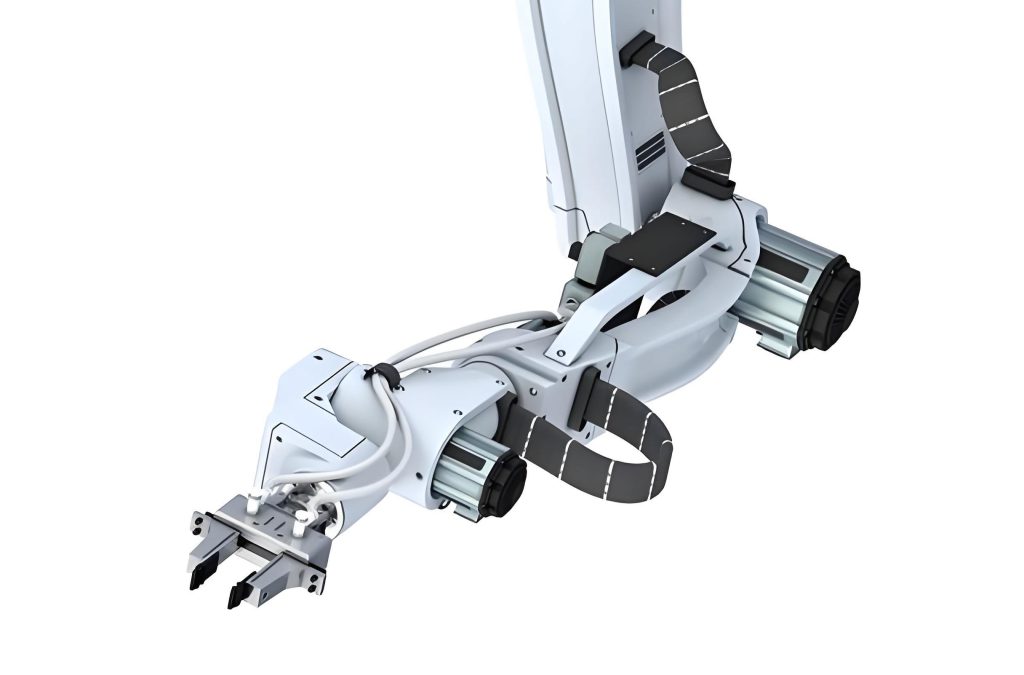
The working principle of this end effector is elegantly simple and based on fluid mechanics. When the control system sends a “clamp” command, the pneumatic cylinder extends, pushing the piston rod and its attached plunger downward. This downward motion increases the pressure within the incompressible liquid plastic medium, as described by Pascal’s principle. The pressure increase is uniform throughout the fluid. This pressurized fluid then acts on the inner walls of the elastic ABS clamping sleeve. The sleeve, constrained in the upward direction but free to expand radially and deform at its lower rim, undergoes a dual-mode deformation. First, the overall sleeve is pushed slightly downward, applying a vertical preload force \(F_v\) onto the target object. Second, and more crucially, the hydrostatic pressure causes the lower, open end of the cylindrical sleeve to bulge inward, creating a circumferential clamping force \(F_c\). The simultaneous application of \(F_v\) and \(F_c\) creates a secure, enveloping grip on the object. The grip force is inherently self-limiting and gentle due to the material properties of the ABS and the liquid plastic. The relationship between the input pneumatic force and the resulting clamping forces can be modeled. Let \(A_p\) be the cross-sectional area of the pneumatic piston, \(P_{air}\) the air pressure supplied to the cylinder, and \(A_f\) the effective area of the plunger acting on the liquid plastic. The force transmitted to the liquid is approximately \(F_{in} = P_{air} \cdot A_p\). The resulting hydrostatic pressure in the liquid plastic is \(P_{fluid} = F_{in} / A_f\). Assuming the sleeve deforms elastically and the object is compliant, the normal pressure exerted by the sleeve on the object is related to \(P_{fluid}\). A simplified model for the circumferential clamping stress \(\sigma_c\) at the contact interface can be derived from thick-walled cylinder theory under internal pressure:
$$ \sigma_c \approx \frac{P_{fluid} \cdot r_i}{t} $$
where \(r_i\) is the inner radius of the sleeve’s deformation zone and \(t\) is the effective wall thickness of the elastic sleeve during deformation. The total clamping force is then the integral of this stress over the contact area. The vertical force is simpler: \(F_v \approx P_{fluid} \cdot A_{plunge}\). The elastic modulus of the sleeve material (ABS, \(E_{ABS} \approx 2 \times 10^8 \, Pa\)) and the bulk modulus of the liquid plastic (\(K_{LP}\)) ensure that deformations are controlled and reversible. When the command to release is given, the pneumatic cylinder retracts, relieving the pressure in the liquid plastic. The elastic energy stored in the deformed ABS sleeve restores it to its original shape, releasing the object without any sticking or residual strain.
To quantify the design parameters and material choices, the following table summarizes key properties:
| Component | Material/Type | Key Property | Value/Description |
|---|---|---|---|
| Clamping Sleeve | ABS (Acrylonitrile Butadiene Styrene) | Elastic Modulus (\(E_1\)) | \(2 \times 10^8 \, Pa\) |
| Fill Medium | Liquid Plastic | Bulk Modulus (\(K\), approximate) | \(2.94 \times 10^7 \, Pa\) |
| Actuator | Pneumatic Cylinder | Bore Diameter | 16 mm (example) |
| Pressure Source | Compressed Air | Operating Pressure (\(P_{air}\)) | 0.2 – 0.6 MPa |
| Control MCU | ATmega328P (AVR) | Clock Speed | 16 MHz |
| EEG Sensor | NeuroSky TGAM Module | Sampling Rate | 512 Hz |
The control system is what makes this end effector accessible. The BCI paradigm used here relies on the analysis of specific brainwave frequency bands. The raw EEG signal \(s(t)\) is a superposition of various oscillations. The TGAM sensor performs onboard filtering and feature extraction. The power spectral density (PSD) is computed over short time windows. The key bands for control are the Alpha (8-13 Hz) and Beta (14-30 Hz) waves. The sensor’s proprietary algorithm computes two eSense™ metrics: Attention (\(A_t\)) and Meditation (\(M_t\)), each scaled from 0 to 100. These are derived from the relative power in specific bands. For instance, Meditation is often correlated with increased Alpha power. The algorithm can be conceptually represented as:
$$ A_t = f_A \left( \frac{P_{\beta}}{P_{\alpha} + P_{\theta} + P_{\delta} + \epsilon} \right) $$
$$ M_t = f_M \left( \frac{P_{\alpha}}{P_{\beta} + P_{\theta} + P_{\delta} + \epsilon} \right) $$
where \(P_{\alpha}, P_{\beta}, P_{\theta}, P_{\delta}\) represent the power in the Alpha, Beta, Theta, and Delta bands respectively, \(\epsilon\) is a small constant to avoid division by zero, and \(f_A, f_M\) are non-linear scaling and normalization functions. The processed \(A_t\) and \(M_t\) values are sent via Bluetooth to the MCU. The control logic on the MCU is a state machine. Two thresholds, \(T_{high}\) for attention and \(T_{low}\) for meditation, are set based on user calibration. The decision rule for activating the end effector’s clamp cycle is:
IF \(A_t > T_{high}\) AND \(M_t < T_{low}\) THEN
Set actuator output to HIGH (clamp)
ELSE IF \(A_t < T_{low}\) AND \(M_t > T_{high}\) THEN
Set actuator output to LOW (release)
ELSE
Maintain current state
END IF
This simple rule allows the user to initiate a grasp by concentrating intensely (high attention, low meditation) and to release by relaxing (low attention, high meditation). The Bluetooth module (HC-05) establishes a serial communication link. The data packet structure must be parsed correctly by the MCU. A typical packet might include a sync byte, payload length, the \(A_t\) and \(M_t\) values, and a checksum. The MCU program continuously polls the serial buffer, validates packets, extracts the metrics, and applies the control rule, generating a PWM signal to drive a solenoid valve controlling the pneumatic cylinder. The flow of the control software is critical for the reliable operation of the end effector.
To evaluate the performance of this end effector system, a theoretical analysis of its grasping capabilities is essential. The primary metric for a clamping end effector is the maximum holding force against gravity and the pressure distribution on the object. For a spherical object of radius \(R\) being grasped, the contact geometry is complex. However, we can approximate the sleeve’s deformed profile as a segment of a torus. The total normal force \(F_n\) exerted by the sleeve can be related to the fluid pressure \(P_{fluid}\) and the design geometry. Let the contact arc length be \(L_c\). A force balance in the vertical direction for holding the object against gravity yields:
$$ 2 \cdot F_n \cdot \mu \cdot \sin(\theta) \geq m g $$
where \(\mu\) is the coefficient of friction between the sleeve and the object, \(\theta\) is the effective wrap angle, \(m\) is the object mass, and \(g\) is gravity. \(F_n\) itself is proportional to \(P_{fluid}\) and the contact area \(A_c\). \(A_c \approx L_c \cdot w\), where \(w\) is the width of the clamping sleeve’s contact rim. Therefore, \(F_n \approx P_{fluid} \cdot C \cdot A_c\), where \(C\) is a geometric factor accounting for the curvature. Combining these, we get a minimum required pneumatic pressure for a successful grip:
$$ P_{air, min} \geq \frac{m g}{2 \mu \sin(\theta) C A_c} \cdot \frac{A_f}{A_p} $$
This equation highlights the parameters that influence the end effector’s performance. By adjusting the pneumatic pressure, the system can adapt to objects of different weights. The gentle nature of the grip is ensured because the pressure is distributed over a relatively large area \(A_c\), reducing stress on the object’s surface. The following table illustrates the theoretical gripping capability for different object sizes and weights, assuming typical parameter values (\(\mu=0.5\), \(\theta=45^\circ\), \(C=0.7\), \(A_f/A_p = 0.8\), \(w=20mm\), \(L_c\) proportional to object diameter).
| Object Type (approx.) | Diameter (mm) | Mass (g) | Required \(P_{air, min}\) (MPa) | Calculated Contact Stress (kPa) |
|---|---|---|---|---|
| Small Apple | 70 | 150 | 0.18 | 25 |
| Orange | 80 | 200 | 0.22 | 28 |
| Peach | 60 | 120 | 0.16 | 30 |
| Tomato | 65 | 100 | 0.14 | 22 |
The calculated contact stresses are well below the crushing threshold for most fruits, demonstrating the end effector’s suitability for flexible objects. Another advantage of this liquid plastic-based end effector is its passive adaptability. As the sleeve conforms to the object, the liquid plastic redistributes, ensuring a more uniform pressure distribution compared to rigid, multi-fingered grippers. This characteristic minimizes point loads and bruises.
The design of the end effector also considers practical assembly and maintenance. The clamping sleeve is a single, monolithic piece, eliminating complex joints or moving parts that could fail. The liquid plastic is sealed for life, requiring no user maintenance. The pneumatic interface is standard. This robustness is vital for an assistive device. Furthermore, the BCI control paradigm offers a hands-free operation mode that is crucial for users with severe motor impairments. The learning curve for operating the end effector is tied to the user’s ability to modulate their attention and relaxation levels consciously. With practice, users can achieve reliable control, making the end effector an extension of their will.
In terms of signal processing fidelity, the performance of the overall system depends heavily on the quality of the EEG signal. The TGAM sensor incorporates digital filtering to isolate the relevant brainwave bands. The transfer function of its bandpass filter for the Alpha band, for example, can be approximated. If we consider a simple IIR filter design, the filtered signal \(y_{\alpha}[n]\) for the Alpha band is obtained from the raw sampled signal \(x[n]\) via a difference equation:
$$ y_{\alpha}[n] = \sum_{k=0}^{M} b_k x[n-k] – \sum_{k=1}^{N} a_k y_{\alpha}[n-k] $$
where the coefficients \(a_k\) and \(b_k\) define the 8-13 Hz passband. The power \(P_{\alpha}\) in a window of \(W\) samples is then estimated as:
$$ P_{\alpha} = \frac{1}{W} \sum_{n=0}^{W-1} (y_{\alpha}[n])^2 $$
This processed metric must be transmitted and acted upon with minimal latency to ensure the end effector responds in a timely manner, creating a natural feeling of control. The total system latency, from thought to mechanical action of the end effector, should ideally be under 300-500 ms for a seamless experience.
Potential improvements and extensions to this end effector system are numerous. The current design uses a binary clamp/release based on dual thresholds. A more advanced scheme could proportional control the pneumatic pressure based on the amplitude of the attention signal, allowing for variable grip strength. This would require a proportional pressure regulator and a more complex control law, such as:
$$ P_{air, command} = K_p \cdot (A_t – T_{high}) \quad \text{for} \quad A_t > T_{high} $$
where \(K_p\) is a gain constant. Additionally, the end effector could be equipped with simple tactile sensors to provide haptic feedback to the user, perhaps through a separate sensory modality in the BCI system. The material of the clamping sleeve could also be optimized further; silicone rubber, for instance, might offer a higher coefficient of friction and even gentler compliance than ABS for certain applications.
In conclusion, the integration of brain-computer interface technology with a mechanically innovative end effector presents a compelling solution for assistive manipulation of flexible objects. This work has detailed the design, operating principle, control system, and theoretical performance of such an end effector. The core concept—using a pressurized liquid plastic within an elastic sleeve to generate a gentle, conforming grip—provides a significant advantage over traditional rigid grippers for compliant targets. When combined with a non-invasive BCI that translates cognitive states into commands, the system offers a high degree of accessibility and intuitive operation. The end effector is not just a tool; it becomes a seamlessly controlled extension of the user’s intent. Future work will involve building physical prototypes, conducting user studies to refine the BCI control parameters, and testing the end effector’s performance with a wide variety of real-world objects. The journey towards truly dexterous and mind-controlled robotic manipulation continues, with the humble yet crucial end effector playing the starring role in the final act of physical interaction.