
In the pursuit of advancing transportation technology, particularly for heavy-duty commercial vehicles, the integration of electromechanical braking (EMB) systems has emerged as a critical frontier. Traditional EMB systems often rely on gear trains combined with ball screws, which, while functional, present significant limitations such as low transmission efficiency, excessive heat generation, short lifespan, and inadequate stiffness under high loads. These issues are exacerbated in demanding applications like parking brakes for trucks, where reliability and durability are paramount. To address these challenges, our research team embarked on developing a novel high-power planetary roller screw assembly. This innovative design leverages multi-point spiral surface meshing transmission to replace conventional point and line contacts, thereby enhancing load capacity, longevity, and efficiency. Throughout this project, we focused on optimizing the structural design, material selection, and heat treatment processes to create a planetary roller screw that not only meets but exceeds the rigorous demands of modern EMB systems. The following article details our comprehensive approach, from conceptualization to validation, emphasizing the transformative potential of this technology in improving safety and performance in commercial vehicle braking.
The core innovation lies in the planetary roller screw mechanism, which utilizes multiple rollers distributed around a central screw to transmit motion and force. Unlike ball screws that rely on point contacts, the planetary roller screw employs line contacts that evolve into multi-point engagements under load, significantly reducing stress concentrations. This fundamental shift in contact mechanics allows for higher load ratings and improved stiffness. Our design process began with a thorough analysis of existing planetary roller screw types, including standard, reverse, recirculating, bearing ring, and differential configurations. After evaluating their suitability for heavy-load environments, we selected the standard planetary roller screw due to its robustness, adaptability to large linear travels, and performance in harsh conditions. To further enhance its capabilities, we incorporated a concave arc tooth profile on the screw and nut, paired with convex arc rollers, creating a harmonious凹凸接触 that promotes even load distribution. This design was refined using finite element analysis (FEA) to model stress patterns and optimize parameters such as thread pitch, number of starts, and tooth angle. The initial FEA results revealed uneven load distribution across the threads, with the first engaged thread experiencing the highest stress. To mitigate this, we implemented several optimizations: adjusting the number of thread starts and the tooth angle, staggering the planetary roller cavities axially by 0.5 mm for easier assembly, using 0.5 mm thick spacers on the left side of the rollers, incorporating thrust bearings on the right side to reduce wear, and replacing initial slotted shaft holes with round holes for better precision control, secured with shaft collars. These modifications ensured a more uniform stress distribution, as confirmed by subsequent simulations.
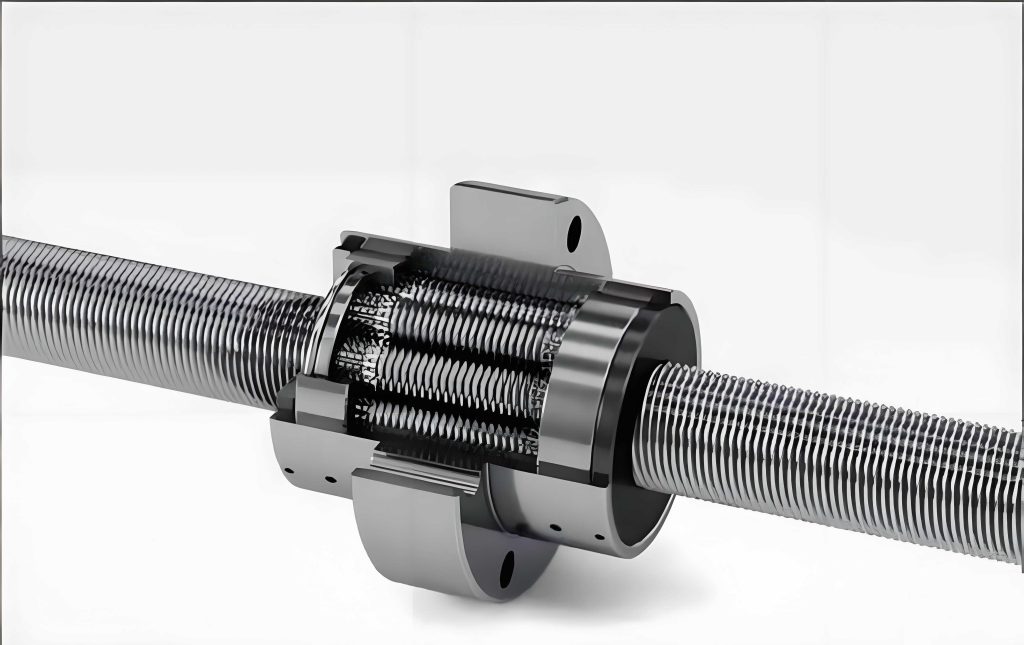
Beyond structural refinements, we addressed specific failure modes common in heavy-duty applications, such as wear from prolonged braking and contamination from dust or quartz sand particles. Traditional planetary roller screws rely on cages to position the rollers, but under high loads, maintaining precise gaps becomes challenging. To overcome this, we developed a self-adjusting gap spring collar. This component utilizes internal tension to automatically compensate for wear-induced clearance changes, thereby preserving transmission accuracy over time. Additionally, to prevent abrasive wear and contamination, we integrated a felt ring structure within the collar. The felt ring, with an inner diameter slightly smaller than the cover plate, sweeps along the screw during operation, sealing out external debris and retaining lubricating oil. This dual-function design enhances both cleanliness and lubrication, critical for longevity in dusty environments. The assembly of our planetary roller screw, as illustrated in the figure, showcases these innovative features, culminating in a robust and reliable configuration ready for rigorous testing.
Material selection played a pivotal role in ensuring the planetary roller screw could withstand extreme loads and operating conditions. The screw, rollers, and nut must exhibit high strength, hardness, wear resistance, and thermal stability. We conducted comparative trials between high-carbon chromium bearing steel GCr15 and premium nitriding steel 38CrMoAlA. While GCr15 is commonly used for rollers due to its high hardness (exceeding HRC 70 after heat treatment), we found it prone to chipping at thread tips under high loads, reducing lifespan. In contrast, 38CrMoAlA, when subjected to quenching and tempering to HRC 35-38 followed by soft nitriding, achieved a hard surface with a tough core, minimal thermal distortion, and an outer circular runout below 0.01 mm. This combination offered superior transmission efficiency and durability, making it our material of choice. The heat treatment process was equally critical; we experimented with various methods, including QPQ (quench-polish-quench), hard nitriding, and high-frequency quenching, before settling on soft nitriding (low-temperature nitrocarburizing). Soft nitriding involves diffusing nitrogen and carbon atoms into the surface at relatively low temperatures (around 420°C), resulting in a thin, hard layer (approximately 0.25 mm thick) with a hardness of about 800 HV. This process minimizes dimensional changes (errors below 0.01 mm) and provides excellent wear resistance without compromising the core toughness. To optimize the parameters, we employed an orthogonal experimental design, varying factors such as salt bath temperature, treatment time, and atmosphere composition. The results, summarized in Table 1, guided our final selection: a temperature of 420°C, a time of 4 hours, and a nitrogen-rich atmosphere, which yielded the best balance of surface hardness and case depth.
| Factor | Level 1 | Level 2 | Level 3 | Level 4 | Level 5 |
|---|---|---|---|---|---|
| Salt Bath Temperature (°C) | 400 | 450 | 500 | 550 | 600 |
| Holding Time (hours) | 4 | 2 | 4 | 2 | 4 |
| Atmosphere Composition | Nitrogen-rich | Balanced C/N | Nitrogen-rich | Balanced C/N | Carbon-rich |
| Surface Hardness (HV0.2) | 766 | 570 | 658 | 392 | 623 |
| Case Depth (mm) | 0.25 | 0.30 | 0.30 | 0.32 | 0.45 |
The mechanical performance of the planetary roller screw can be modeled using principles of contact mechanics and tribology. For instance, the contact stress between the roller and screw threads can be approximated by Hertzian theory. For two cylindrical surfaces in line contact, the maximum contact pressure \( p_{\text{max}} \) is given by:
$$ p_{\text{max}} = \sqrt{\frac{F E^*}{\pi R L}} $$
where \( F \) is the normal load per unit length, \( E^* \) is the equivalent Young’s modulus, \( R \) is the effective radius of curvature, and \( L \) is the contact length. In our multi-point engagement design, the load is distributed across multiple rollers, reducing \( F \) and thus \( p_{\text{max}} \), which enhances fatigue life. The transmission efficiency \( \eta \) of the planetary roller screw can be expressed as:
$$ \eta = \frac{P_{\text{out}}}{P_{\text{in}}} = \frac{F v}{T \omega} $$
where \( P_{\text{out}} \) is the output power (product of axial force \( F \) and linear velocity \( v \)), \( P_{\text{in}} \) is the input power (product of torque \( T \) and angular velocity \( \omega \)). Under ideal conditions, neglecting friction, the lead \( l \) of the screw relates linear and angular motion: \( v = \frac{l \omega}{2\pi} \). However, in practice, efficiency is affected by friction coefficients, lubrication, and alignment. Our design aims to minimize losses through optimized geometry and surface treatments.
To validate the planetary roller screw’s capabilities, we conducted a series of rigorous tests, including static load capacity, dynamic efficiency, thread precision, hardness measurements, and fatigue endurance. The static load test involved applying axial forces via a hydraulic cylinder until failure. All prototypes exceeded the design requirement of 9,800 N, with maximum thrusts surpassing 10,000 N without significant deformation or travel error. This demonstrates the structural integrity of our planetary roller screw under extreme conditions. Dynamic efficiency was evaluated by measuring input torque and output force during both tension and compression cycles. The results, as shown in Table 2, indicate high efficiency values, with tension cycles ranging from 0.809 to 0.846 and compression cycles from 0.728 to 0.796. These efficiencies are superior to traditional ball screws, attributable to the reduced sliding friction in the multi-point meshing of the planetary roller screw.
| Test Condition | Efficiency Range | Average Efficiency | Notes |
|---|---|---|---|
| Tension (Pulling) | 0.809 – 0.846 | 0.828 | Measured at 5,000 N load |
| Compression (Pushing) | 0.728 – 0.796 | 0.762 | Measured at 5,000 N load |
| High-Speed Cycle | 0.750 – 0.820 | 0.785 | At 100 mm/s linear speed |
Thread precision and wear were assessed using a universal toolmaker’s microscope. After testing, the thread profiles showed no plastic deformation, with single-thread errors not exceeding 0.005 mm, well below the 0.002 mm design target. This high precision ensures consistent performance and minimal backlash. Hardness testing confirmed the effectiveness of our soft nitriding process, with surface hardness averaging 800 HV and case depth around 0.25 mm. The microstructure examination revealed a uniform compound layer and diffusion zone, as depicted in the earlier figure, contributing to the enhanced wear resistance.
Fatigue testing was performed on an EMB system test bench to simulate real-world braking conditions. The planetary roller screw was subjected to cyclic loading with a maximum thrust of 13,720 N over 5,000 cycles. Post-test analysis showed negligible wear, especially at the thread tips, which remained intact without chipping or deformation. This outcome validates the durability of our soft-nitrided 38CrMoAlA material and the optimized design. The wear rate \( W \) can be modeled using Archard’s equation:
$$ W = k \frac{F s}{H} $$
where \( k \) is a wear coefficient, \( F \) is the normal load, \( s \) is the sliding distance, and \( H \) is the material hardness. By increasing \( H \) through soft nitriding and reducing \( F \) via load distribution, we minimized \( W \), extending the service life of the planetary roller screw. Additionally, the self-adjusting gap mechanism maintained proper clearances throughout the test, preventing performance degradation.
Beyond laboratory tests, we analyzed the planetary roller screw’s performance in terms of thermal management. Heat generation in EMB systems is a critical concern, as excessive temperatures can degrade lubrication and material properties. The power loss \( P_{\text{loss}} \) due to friction in the screw mechanism can be estimated as:
$$ P_{\text{loss}} = T_{\text{friction}} \omega = \mu F \frac{l}{2\pi} \omega $$
where \( \mu \) is the friction coefficient, and other terms are as defined earlier. Our design reduces \( \mu \) through improved surface finish and lubrication retention, thereby lowering \( P_{\text{loss}} \) and heat buildup. Comparative thermal imaging tests between traditional ball screws and our planetary roller screw showed a temperature reduction of up to 15°C under identical loads, enhancing safety and reliability during prolonged braking.
The development of this high-load planetary roller screw also involved considerations of lightweight design. By using advanced materials and optimizing geometry, we achieved a weight reduction of approximately 20% compared to conventional counterparts, without compromising strength. This is crucial for vehicle applications where unsprung mass affects handling and fuel efficiency. The stiffness \( k_{\text{axial}} \) of the screw assembly in the axial direction can be expressed as:
$$ k_{\text{axial}} = \frac{A E}{L} + \frac{1}{\sum_{i} \frac{1}{k_{\text{contact}, i}}} $$
where \( A \) is the cross-sectional area, \( E \) is Young’s modulus, \( L \) is the length, and \( k_{\text{contact}, i} \) are the contact stiffnesses at roller interfaces. Our multi-point engagement increases the overall \( k_{\text{axial}} \), leading to better response and precision in braking actuation.
In summary, our innovative planetary roller screw assembly represents a significant advancement in electromechanical braking technology. By leveraging multi-point spiral surface meshing, optimized materials, and advanced heat treatment, we have created a solution that addresses the key limitations of existing systems. The planetary roller screw offers exceptional load capacity, high efficiency, long lifespan, and robustness against冲击和疲劳测试. Its self-adjusting gap and sealing features further enhance reliability in demanding environments. This technology not only improves the performance of commercial vehicle parking brakes but also has potential applications in aerospace, industrial automation, and robotics, where high-precision linear motion under heavy loads is required. Future work will focus on scaling the design for different vehicle sizes, integrating smart sensors for condition monitoring, and exploring additive manufacturing for further customization. Through continuous iteration and testing, we aim to set new standards in motion control and safety systems, driven by the relentless pursuit of engineering excellence.
The success of this project underscores the importance of holistic design approaches that combine mechanical analysis, material science, and empirical validation. From stress simulations to fatigue tests, every step was guided by data-driven decisions, resulting in a planetary roller screw that exceeds industry benchmarks. As transportation evolves towards electrification and automation, such innovations will play a pivotal role in ensuring safety and efficiency. We are confident that our planetary roller screw will contribute to the next generation of EMB systems, offering a reliable and high-performance solution for the challenges of modern mobility. The journey from concept to realization has been marked by challenges, but the outcomes demonstrate the transformative power of targeted engineering innovation.