
In our gas turbine power plant, we face significant challenges in maintaining equipment efficiency and management levels. The plant is a complex, multi-system, and multi-device coupled engineering project, requiring regular on-site inspections to minimize equipment failure rates and ensure effective operation. However, current operational difficulties include a shortage of personnel, extensive inspection areas, and prolonged inspection times. Our traditional inspection methods primarily involve routine and special inspections, with routine inspections conducted at least twice daily and special inspections performed during high-temperature weather, peak power generation periods, before new equipment operation, and after abnormal weather conditions. Maintenance personnel rely on handheld temperature and vibration measurement devices to inspect equipment, manually recording monitoring data. This approach leads to long inspection durations, high labor intensity, and stringent requirements for personnel expertise.
The existing manual inspection methods suffer from several drawbacks: excessive reliance on the responsibility of safety officers, leading to arbitrary execution; a crude inspection model that is difficult to supervise and evaluate; delayed information feedback based on paper records, hindering sharing with relevant managers; difficulty in comprehensively analyzing inspection results, offering little value for predictive maintenance; and software management systems that cannot adapt to the variable and complex on-site conditions. With advancements in science and technology, the use of deep learning, image recognition, and robotics has become increasingly frequent. The establishment of an unmanned inspection platform must meet the following requirements: unmanned operation with timely warnings; visibility, measurability, and controllability; autonomous inspection and remote control; comprehensive inspection with accurate data and automated analysis to identify hazards; and clear fault localization with intelligent judgment of causes and potential risks.
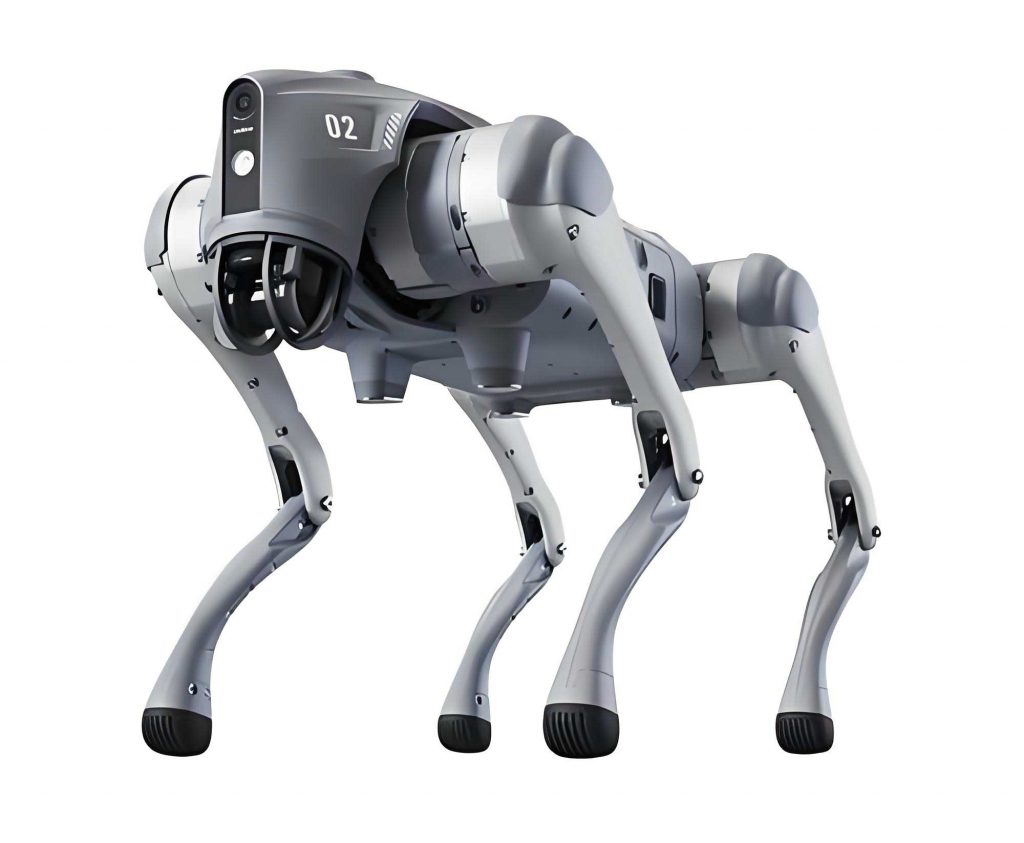
Therefore, the development of a domestically produced quadruped robot dog intelligent inspection algorithm and device leverages the integrated innovation of advanced robotics, deep learning algorithms, and machine vision technology. This robot dog perfectly replaces traditional manual inspections, fundamentally addressing issues such as insufficient operational personnel, high work intensity, and human errors like missed or incorrect inspections in gas turbine power plants. It effectively ensures the stable and safe operation of the plant. Our project focuses on the inspection needs of equipment and instruments in gas turbine power plants, researching key technologies and systems for quadruped inspection robot dogs, developing high-precision inspection algorithm models based on deep learning, and assembling them with innovative hardware and software architectures to achieve intelligent unmanned inspection.
Research and Development of Bionic Quadruped Robot Dog Carrier and Supporting Devices
Given the complex working environment of gas turbine power plants, we analyzed the required functions for inspection robot dogs by combining relevant standards and existing inspection robots in the market. We studied the motion control system of bionic quadruped robot dogs, and through research on the本体 and supporting devices, formulated a hardware design方案 that meets inspection requirements. This design aims to create a bionic quadruped robot dog with high-performance execution,极强的 terrain adaptability, and environmental perception capabilities. The robot dog must navigate uneven surfaces, climb stairs, and avoid obstacles autonomously, ensuring reliable operation in confined spaces. To quantify its mobility, we consider the stability margin $S$ defined by the support polygon: $$S = \min_{i} (d_i)$$ where $d_i$ is the distance from the center of mass to the edge of the support polygon for leg $i$. A larger $S$ indicates better stability during locomotion.
| Aspect | Manual Inspection | Robot Dog Inspection |
|---|---|---|
| Inspection Time | Long (hours per round) | Short (autonomous, continuous) |
| Labor Intensity | High | Low (unmanned) |
| Data Accuracy | Prone to human error | High (sensor-based) |
| Adaptability | Limited by human fatigue | High (all-weather operation) |
| Cost Efficiency | High operational cost | Reduced long-term cost |
Development of Domestic Positioning and Navigation System for Bionic Quadruped Robot Dog
The positioning and navigation system for the bionic quadruped robot dog is a critical component of our project, serving as the foundation for efficient and accurate inspection in gas turbine power plants. Addressing environmental challenges, we researched 2D lidar positioning, depth vision, infrared sensing, and other technologies to achieve high-precision map construction and real-time localization. This enables the robot dog to avoid and绕障 obstacles,识别 and track routes, and guide it along preset paths to destinations. The navigation algorithm integrates simultaneous localization and mapping (SLAM) using lidar data. The robot dog’s position $\mathbf{x}_t$ at time $t$ is estimated through an extended Kalman filter: $$\mathbf{x}_t = f(\mathbf{x}_{t-1}, \mathbf{u}_t) + \mathbf{w}_t$$ where $f$ is the motion model, $\mathbf{u}_t$ is control input, and $\mathbf{w}_t$ is process noise. Observation $\mathbf{z}_t$ from sensors updates the estimate: $$\mathbf{z}_t = h(\mathbf{x}_t) + \mathbf{v}_t$$ with $h$ as the observation model and $\mathbf{v}_t$ as measurement noise. This ensures重复 positioning accuracy within 5 cm.
Research on Domestic Multi-Sensor Perception Equipment Detection System
Inspection work primarily involves temperature measurement, sound identification, photography, and meter reading for numerous devices. Based on requirements, we formulated hardware and software solutions, selecting infrared thermal imagers, sound pickups, and other equipment. Through deep learning based on mechanical equipment vibration recognition, infrared temperature detection, and sensor perception, we analyzed parameters of various devices and designed a perception system tailored to the intelligent inspection scheme for gas turbine power plants. This system drives the platform to conduct real-time inspections and record environmental conditions, equipment temperatures, and vibration states. For temperature detection, the infrared sensor measures radiant energy, and temperature $T$ is derived from Stefan-Boltzmann law: $$P = \epsilon \sigma A T^4$$ where $P$ is power, $\epsilon$ is emissivity, $\sigma$ is Stefan-Boltzmann constant, and $A$ is area. Vibration analysis uses Fast Fourier Transform (FFT) to convert time-domain signals to frequency domain: $$X(f) = \int_{-\infty}^{\infty} x(t) e^{-j2\pi ft} dt$$ enabling fault diagnosis from spectral patterns.
| Parameter | Specification |
|---|---|
| Weight | ≤ 50 kg |
| Payload Capacity | ≥ 10 kg |
| Maximum Speed | ≥ 1 m/s |
| Operating Time | ≥ 60 minutes |
| Environment Temperature | -20°C to 45°C |
| Protection Rating | IP54 |
Study of 360-Degree Panoramic Monitoring System
Gas turbine power plants require 24/7 full-scenario monitoring, and 360-degree video panoramic coverage is a core aspect of our project. We researched parameters of hardware such as multi-degree-of-freedom gimbals and visible-light high-definition cameras. Based on optical lens zoom and low-light night vision感知 technology, we achieved real-time detection of plant environments and meter reading, ensuring全覆盖 without blind spots, with playback capability. The image vision cognitive system reads and compares data from various meters, accurately assessing the health and safety status of equipment through data analysis. The visual processing employs convolutional neural networks (CNNs) for object detection: $$y = \sigma(W * x + b)$$ where $x$ is input image, $W$ is weight matrix, $b$ is bias, $*$ denotes convolution, and $\sigma$ is activation function. This enables defect recognition accuracy above 93%.
Research on Remote Management Platform for Inspection Robot Dog
To meet the inspection needs of gas turbine power plants, we studied deep learning and artificial intelligence technologies, analyzing and designing software for the remote management system of the inspection robot dog. This software manages the robot dog, issues commands, and displays real-time operational conditions. It handles task发布, management, and editing of inspection tasks; performs data analysis, leveraging collected data for fault diagnosis and meter reading记录; uses mounted cameras for real-time monitoring of the inspection process; provides open data interfaces to enrich on-site data for online intelligent diagnosis; and conducts configuration management, including control of hardware, inspection points, and permissions. The platform’s reliability is quantified by mean time between failures (MTBF): $$\text{MTBF} = \frac{\text{Total Operational Time}}{\text{Number of Failures}}$$ with our system achieving MTBF ≥ 8000 hours.
| Sensor Type | Performance Metric | Value |
|---|---|---|
| Lidar | Mapping Resolution | 5 cm |
| Lidar | Repeat Positioning Accuracy | < 5 cm |
| Lidar | Measurement Range | 40 m |
| Lidar | Sampling Rate | 9 kHz |
| Infrared Thermal Imager | Temperature Range | -20°C to 400°C |
| Infrared Thermal Imager | Temperature Accuracy | ±2°C or ±2% of range |
| AI System | Defect Recognition Accuracy | > 93% |
| AI System | Safety Violation Recognition Accuracy | > 90% |
Implementation Effects and Economic Impact
The domestically produced robot dog intelligent inspection algorithm and device system in全覆盖 environments have fully achieved定点, periodic, and timed fully automatic inspections for gas turbine power plant equipment, realizing comprehensive coverage. The remote intelligent inspection management platform presents a web-based user interface to workshop maintenance personnel, allowing them to issue inspection tasks, remotely operate the robot dog, check historical records to generate inspection reports, and view electronic maps with the robot dog’s location and巡检 camera videos. This enhances work efficiency, enables data-driven operations, and better supports business development and innovation. Key economic indicators include reducing personnel management costs by four employees (one less per shift), saving approximately $112,000 annually in salaries. Through robot dog inspections, inspection frequency increases, ensuring all necessary checks are performed with intelligent judgment. Combined with上层 applications, this improves equipment condition monitoring, enhances reliability, and saves about $100,000 annually in maintenance costs.
The robot dog本体 and搭载 equipment are entirely domestically produced, with software algorithms全部自主开发. The intelligent inspection algorithm and device boost the work efficiency of equipment maintenance and operational personnel in the plant, reduce safety hazards from uncontrollable factors like high temperature, high pressure, and harmful gases, and achieve staff reduction and efficiency improvement,切实 implementing safety production. The project results will form完全 autonomous intellectual property for gas turbine power plant intelligent AI inspection perception and robot dog巡检 technology, driving innovation in point inspection, patrol, and maintenance methods for similar regional equipment facilities in China’s gas turbine power plants. This elevates the comprehensive operational management level of such areas and has positive引领 and demonstration value in promoting the power generation industry toward智慧化 development.
| Benefit Category | Description | Annual Savings/Value |
|---|---|---|
| Personnel Cost Reduction | Reduction of 4 maintenance staff | $112,000 |
| Maintenance Cost Savings | Improved equipment reliability and reduced failures | $100,000 |
| Efficiency Gain | Increased inspection frequency and accuracy | Quantifiable in reduced downtime |
| Safety Improvement | Lower risk of human exposure to hazards | Intangible but significant |
Our robot dog, named Tengu, represents the first domestically produced quadruped robot dog applied for inspection in gas turbine power plants nationally, holding immense research value and示范 significance. It offers high coverage,推广性, and strong示范 meaning. Based on SLAM positioning and navigation systems for complex工况 environments over tens of thousands of square meters in gas turbine power plants, it achieves precise定点 inspection. Deep learning-based algorithms for detecting leaks, spills, and drops in power plants, along with multi-sensor perception fusion systems, enable high-frequency设备状态 detection, diagnosis, and alerts. This实现了创新应用 in全国产化,全覆盖 environment inspection and intelligent diagnosis robot dogs. The robot dog’s deployment has set a new standard for autonomous巡检, showcasing how advanced robotics can transform traditional industrial maintenance. We continuously refine the algorithms to adapt to evolving plant conditions, ensuring the robot dog remains at the forefront of smart inspection technology.
In summary, the integration of this robot dog into our inspection regimen has revolutionized how we monitor and maintain critical infrastructure. By leveraging deep learning and robotics, we have created a scalable solution that not only addresses current challenges but also paves the way for future advancements in智慧 power plants. The robot dog’s ability to operate autonomously in harsh environments, coupled with its sophisticated感知 capabilities, makes it an indispensable tool for ensuring operational excellence and safety. As we expand its applications, we anticipate further efficiencies and cost savings, solidifying the robot dog’s role as a cornerstone of modern industrial automation. The project’s success underscores the importance of innovation in driving sustainable and safe energy production, with the robot dog serving as a testament to the power of technology in solving real-world problems.