
In the realm of precision motion control and robotics, strain wave gear drives, commonly known as harmonic drives, have emerged as critical components due to their high torque capacity, compact design, and minimal backlash. The performance of these strain wave gear systems is fundamentally governed by their transmission characteristics, particularly the instantaneous transmission ratio. This parameter not only influences the kinematic accuracy but also affects the dynamic response and longevity of the strain wave gear mechanism. While traditional analyses often simplify the strain wave gear transmission ratio as a constant value derived from tooth counts, a deeper investigation reveals a more complex reality involving two distinct types of ratios: the meshing-end transmission ratio and the input-output end transmission ratio. This article, presented from a first-person analytical perspective, delves into the geometric and kinematic foundations of strain wave gear drives to derive and examine these instantaneous ratios under various operational conditions, employing extensive mathematical formulations and tabular summaries to elucidate the underlying principles.
The concept of a strain wave gear revolves around the elastic deformation of a flexible spline (often called the flexspline) by a wave generator, which subsequently engages with a rigid circular spline (the just round or circular spline). This interaction facilitates motion transmission with high reduction ratios. A pivotal aspect often overlooked in preliminary designs is the constancy of the instantaneous transmission ratio. In many published works and textbooks on strain wave gear systems, the transmission ratio is frequently calculated using methods analogous to planetary gear trains, yielding an average ratio. For instance, the converted mechanism approach provides a ratio expressed as:
$$ i_{H}^{rg} = \frac{\omega_r^H}{\omega_g^H} = \frac{\omega_r – \omega_H}{\omega_g – \omega_H} $$
where $\omega_r^H$ and $\omega_g^H$ denote the angular velocities of the flexspline and circular spline relative to the wave generator, respectively, and $\omega_r$, $\omega_g$, $\omega_H$ are the absolute angular velocities. This formulation, while useful for approximating the input-output behavior in strain wave gear assemblies, essentially represents an average transmission ratio and does not capture the instantaneous variations occurring at the tooth meshing interface. Such simplifications can lead to inaccuracies in high-precision applications, especially since the flexspline undergoes significant elastic deformation, causing the angular displacement of its teeth to differ instantaneously from that of its output shaft. Furthermore, the multi-tooth engagement characteristic of strain wave gear drives means that the meshing state varies across the contact zone at any given moment. Therefore, a more rigorous kinematic model is indispensable for accurately describing the strain wave gear’s behavior.
To address this, I establish a comprehensive motion transmission model for the strain wave gear system. This model considers three key coordinate systems attached to the primary components: the wave generator, the flexspline teeth, and the circular spline teeth. By analyzing the geometric relationships and relative motions among these frames, we can derive expressions for the instantaneous transmission ratios. The model’s foundation lies in treating the strain wave gear as a planar gearing problem with non-circular characteristics, where the instantaneous center of rotation for the flexspline teeth shifts continuously during operation.
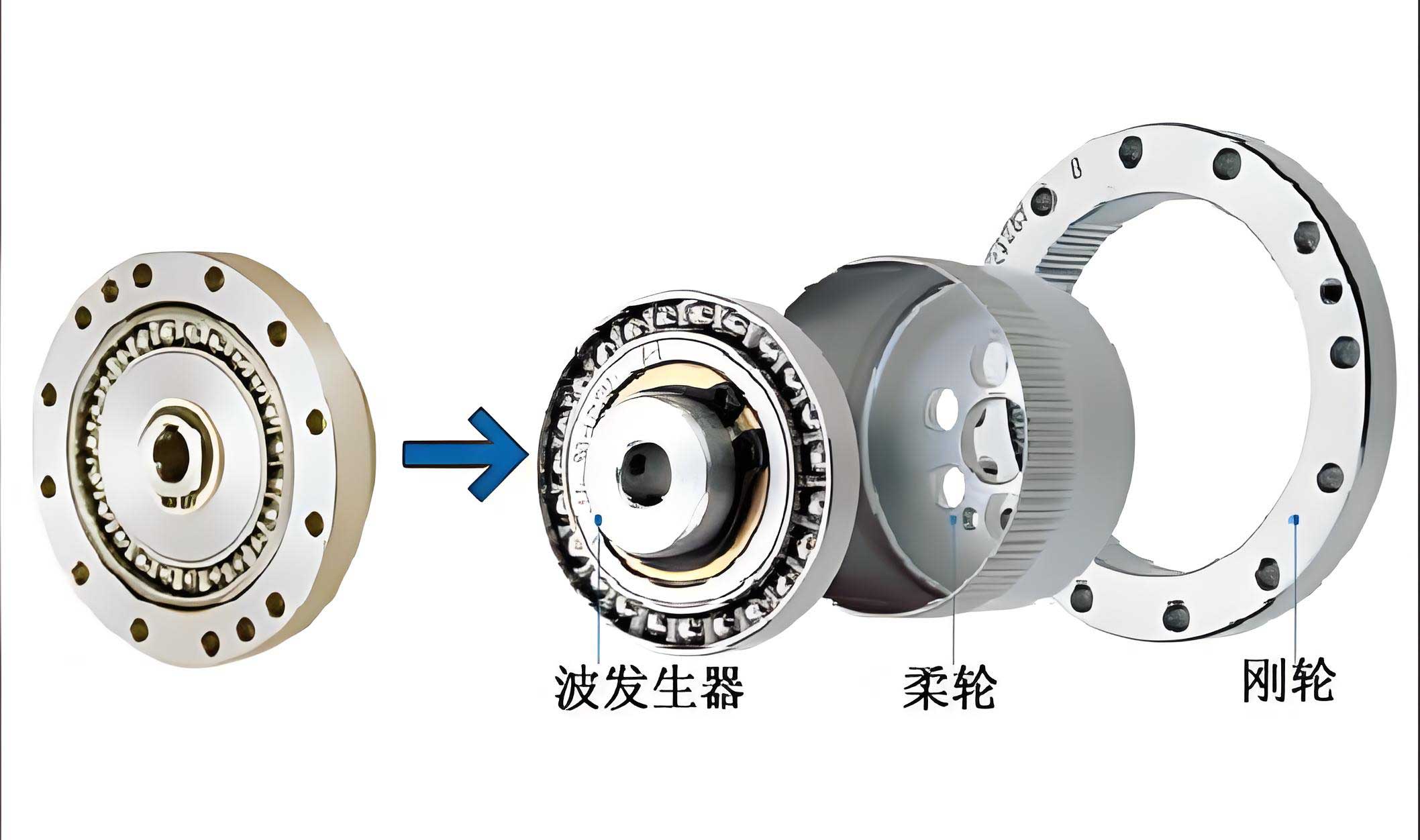
The schematic above illustrates the conceptual setup. Let $XOY$ be the fixed coordinate system attached to the wave generator. $X_g O Y_g$ and $X_r O_1 Y_r$ are moving coordinate systems attached to the circular spline and flexspline, respectively. The $Y_r$-axis passes through the center of the flexspline tooth width, and the $Y_g$-axis passes through the center of the circular spline tooth space. Initially, these vertical axes are aligned. The deformation of the flexspline, induced by the wave generator, is described using a four-force action type原始 curve model, which generalizes various wave generator profiles (e.g., dual-roller, cosine cam). This model’s polar radius $\rho$ varies with the angle $\Phi$ between the force direction and the major axis of deformation. For instance, $\Phi = 0^\circ$ approximates a dual-roller wave generator, while $\Phi = 23^\circ$ corresponds to a cosine cam, and $\Phi = 30^\circ$ is often used to reduce stress and increase the engagement arc in practical strain wave gear designs. The radial deformation of the flexspline’s neutral line can be expressed as a Fourier series:
$$ \rho(\varphi) = r_m + \omega_0 \sum_{n=2,4,6,\ldots} \frac{\cos(n\Phi)}{(n^2 – 1)^2} \cos(n\varphi) $$
where $r_m$ is the radius of the flexspline midline before deformation, $\omega_0$ is the maximum radial deformation, $\varphi$ is the angular coordinate relative to the wave generator, and $n$ are even harmonics. This deformation profile is crucial for determining the kinematic relationships in the strain wave gear.
From this geometric model, we define key angular parameters: $\varphi$ is the rotation angle of the flexspline’s non-deformed end (input/output reference), $\varphi_1$ is the rotation angle of the flexspline teeth at the meshing point, $\varphi_2$ is the rotation angle of the circular spline, and $\mu$ is the deflection angle of the flexspline tooth due to deformation. The derivatives of these angles with respect to $\varphi$ provide the angular velocity relationships. Specifically, for a strain wave gear with a four-roller wave generator ($\Phi = 30^\circ$), the following derivatives are derived:
$$ \frac{d\mu}{d\varphi} = \frac{\omega_0}{r_m} \frac{ \sum_{n=2,4,6,\ldots} \frac{n^2 \cos(n\Phi) \cos(n\varphi)}{(n^2 – 1)^2} }{ \sum_{n=2,4,6,\ldots} \frac{\cos(n\Phi)}{(n^2 – 1)^2} } $$
$$ \frac{d\varphi_1}{d\varphi} = 1 – \omega_0 \frac{ \sum_{n=2,4,6,\ldots} \frac{n \cos(n\Phi) \cos(n\varphi)}{n (n^2 – 1)^2} }{ \sum_{n=2,4,6,\ldots} \frac{\cos(n\Phi)}{(n^2 – 1)^2} } $$
$$ \frac{d\varphi_2}{d\varphi} = \frac{Z_1}{Z_2} $$
where $Z_1$ and $Z_2$ are the number of teeth on the flexspline and circular spline, respectively. Note that $\frac{d\varphi_2}{d\varphi}$ is constant, reflecting the nominal gear ratio based on tooth counts in the strain wave gear. However, $\frac{d\mu}{d\varphi}$ and $\frac{d\varphi_1}{d\varphi}$ vary with $\varphi$, indicating the dynamic nature of the meshing process.
Using these relationships, I derive the instantaneous transmission ratios for three fundamental operating conditions of the strain wave gear: with the wave generator fixed, with the circular spline fixed, and with the flexspline fixed. Each condition has two sub-cases depending on which component is the driver. The transmission ratios are categorized into two types: the output-end instantaneous transmission ratio (denoted as $i$) and the meshing-end instantaneous transmission ratio (denoted as $i’$). The former relates the angular velocities at the input and output shafts, while the latter relates the angular velocities at the tooth engagement point. The following table summarizes all derived formulas for these strain wave gear configurations.
| Fixed Component | Driving Component | Output-End Instantaneous Transmission Ratio ($i$) | Meshing-End Instantaneous Transmission Ratio ($i’$) |
|---|---|---|---|
| Wave Generator | Flexspline | $$ i_{H}^{rg} = \frac{d\varphi}{d\varphi_2} $$ | $$ i_{H}^{‘rg} = i_{H}^{rg} \left( \frac{d\varphi_1}{d\varphi} + \frac{d\mu}{d\varphi} \right) $$ |
| Circular Spline | $$ i_{H}^{gr} = \frac{d\varphi_2}{d\varphi} $$ | $$ i_{H}^{‘gr} = i_{H}^{gr} \left( \frac{d\varphi_1}{d\varphi} + \frac{d\mu}{d\varphi} \right) $$ | |
| Circular Spline | Wave Generator | $$ i_{g}^{Hr} = \frac{1}{1 – \frac{d\varphi}{d\varphi_2}} $$ | $$ i_{g}^{‘Hr} = \frac{1}{1 – \left( \frac{d\mu}{d\varphi} + \frac{d\varphi_1}{d\varphi} \right) \left( 1 – \frac{1}{i_{g}^{Hr}} \right) } $$ |
| Flexspline | $$ i_{g}^{rH} = 1 – \frac{d\varphi}{d\varphi_2} $$ | $$ i_{g}^{‘rH} = 1 – \frac{ \frac{d\mu}{d\varphi} + \frac{d\varphi_1}{d\varphi} }{1 – i_{g}^{rH}} $$ | |
| Flexspline | Wave Generator | $$ i_{r}^{Hg} = \frac{1}{1 – \frac{d\varphi_2}{d\varphi}} $$ | $$ i_{r}^{‘Hg} = \frac{ \frac{d\mu}{d\varphi} + \frac{d\varphi_1}{d\varphi} }{ \frac{d\mu}{d\varphi} + \frac{d\varphi_1}{d\varphi} + \frac{1}{i_{r}^{Hg}} – 1 } $$ |
| Circular Spline | $$ i_{r}^{gH} = 1 – \frac{d\varphi_2}{d\varphi} $$ | $$ i_{r}^{‘gH} = 1 + \frac{ i_{r}^{gH} – 1 }{ \frac{d\mu}{d\varphi} + \frac{d\varphi_1}{d\varphi} } $$ |
These formulas highlight a key insight: in a strain wave gear, the output-end instantaneous transmission ratio ($i$) is constant for a given configuration, as it depends solely on the fixed derivative $\frac{d\varphi_2}{d\varphi} = \frac{Z_1}{Z_2}$. However, the meshing-end instantaneous transmission ratio ($i’$) varies periodically with the angular position $\varphi$ due to the terms $\frac{d\mu}{d\varphi}$ and $\frac{d\varphi_1}{d\varphi}$, which are functions of $\varphi$. This variation stems from the continuous shift in the instantaneous center of rotation between the flexspline and circular spline teeth during engagement, a hallmark of non-circular gearing in strain wave gear systems.
To illustrate this behavior, consider a numerical example using an involute tooth profile strain wave gear. Assume the wave generator is fixed, the flexspline is the driver, with tooth counts $Z_1 = 150$ (flexspline) and $Z_2 = 152$ (circular spline). The output-end transmission ratio is constant:
$$ i_{H}^{rg} = \frac{d\varphi}{d\varphi_2} = \frac{Z_2}{Z_1} = \frac{152}{150} \approx 1.01333 $$
For the meshing-end ratio, we compute $i_{H}^{‘rg}$ using the derivatives. Assuming a four-roller wave generator with $\Phi = 30^\circ$, $\omega_0 = 0.5$ mm, and $r_m = 50$ mm, the Fourier series can be truncated to a few terms (e.g., $n=2,4,6$) for calculation. The varying terms are:
$$ \frac{d\mu}{d\varphi} = \frac{0.5}{50} \cdot \frac{ \frac{2^2 \cos(60^\circ) \cos(2\varphi)}{(3)^2} + \frac{4^2 \cos(120^\circ) \cos(4\varphi)}{(15)^2} + \frac{6^2 \cos(180^\circ) \cos(6\varphi)}{(35)^2} }{ \frac{\cos(60^\circ)}{3^2} + \frac{\cos(120^\circ)}{15^2} + \frac{\cos(180^\circ)}{35^2} } $$
$$ \frac{d\varphi_1}{d\varphi} = 1 – 0.5 \cdot \frac{ \frac{2 \cos(60^\circ) \cos(2\varphi)}{2 \cdot 3^2} + \frac{4 \cos(120^\circ) \cos(4\varphi)}{4 \cdot 15^2} + \frac{6 \cos(180^\circ) \cos(6\varphi)}{6 \cdot 35^2} }{ \frac{\cos(60^\circ)}{3^2} + \frac{\cos(120^\circ)}{15^2} + \frac{\cos(180^\circ)}{35^2} } $$
Simplifying these expressions and plotting $i_{H}^{‘rg}$ against $\varphi$ over one cycle (e.g., $0$ to $2\pi$) reveals a periodic fluctuation around the constant output-end ratio. The table below shows sample values at key angular positions for this strain wave gear example.
| $\varphi$ (rad) | $\frac{d\mu}{d\varphi}$ | $\frac{d\varphi_1}{d\varphi}$ | $i_{H}^{‘rg}$ |
|---|---|---|---|
| 0 | 0.0125 | 0.9876 | 1.01333 * (0.9876 + 0.0125) = 1.01333 * 1.0001 ≈ 1.01343 |
| $\pi/4$ | 0.0083 | 0.9921 | 1.01333 * (0.9921 + 0.0083) = 1.01333 * 1.0004 ≈ 1.01373 |
| $\pi/2$ | 0.0000 | 1.0000 | 1.01333 * (1.0000 + 0.0000) = 1.01333 |
| $3\pi/4$ | -0.0083 | 1.0079 | 1.01333 * (1.0079 – 0.0083) = 1.01333 * 0.9996 ≈ 1.01293 |
| $\pi$ | -0.0125 | 1.0124 | 1.01333 * (1.0124 – 0.0125) = 1.01333 * 0.9999 ≈ 1.01323 |
The periodic variation of the meshing-end ratio in this strain wave gear is evident, with amplitudes depending on the deformation parameters. This fluctuation, though small in magnitude, has significant implications for the design of tooth profiles and the prevention of meshing interference in high-precision strain wave gear applications. If the tooth profile is not coordinated with this varying meshing kinematics, it can lead to uneven load distribution, increased wear, and reduced efficiency in the strain wave gear system.
Expanding further, the dynamic behavior of a strain wave gear can be analyzed by considering the time derivatives of the transmission ratios. For instance, the rate of change of the meshing-end ratio influences the angular acceleration at the tooth contact, which in turn affects the inertial forces and vibrations. From the formulas, the derivative of $i’$ with respect to time can be expressed as:
$$ \frac{di’}{dt} = \frac{di’}{d\varphi} \cdot \frac{d\varphi}{dt} $$
where $\frac{d\varphi}{dt}$ is the angular velocity of the reference component. Using the chain rule, $\frac{di’}{d\varphi}$ involves second derivatives of $\mu$ and $\varphi_1$, which can be derived from the Fourier series. For the four-force model in the strain wave gear:
$$ \frac{d^2\mu}{d\varphi^2} = -\frac{\omega_0}{r_m} \frac{ \sum_{n=2,4,6,\ldots} \frac{n^3 \cos(n\Phi) \sin(n\varphi)}{(n^2 – 1)^2} }{ \sum_{n=2,4,6,\ldots} \frac{\cos(n\Phi)}{(n^2 – 1)^2} } $$
$$ \frac{d^2\varphi_1}{d\varphi^2} = \omega_0 \frac{ \sum_{n=2,4,6,\ldots} \frac{n^2 \cos(n\Phi) \sin(n\varphi)}{ (n^2 – 1)^2 } }{ \sum_{n=2,4,6,\ldots} \frac{\cos(n\Phi)}{(n^2 – 1)^2} } $$
These accelerations terms are crucial for dynamic modeling of strain wave gear drives, especially in applications requiring rapid positioning, such as robotic arms or aerospace mechanisms. The periodic variations introduce harmonic excitations that can resonate with structural natural frequencies, potentially leading to noise and fatigue issues in the strain wave gear assembly.
Moreover, the efficiency of a strain wave gear is indirectly affected by the instantaneous transmission ratio. While the overall efficiency is dominated by factors like friction and hysteresis losses in the flexible spline, the varying meshing ratio alters the relative sliding velocities between teeth, influencing the friction power loss. A detailed analysis would require integrating the instantaneous ratios over a cycle to compute average losses. For example, the instantaneous power transmission at the meshing point can be modeled as:
$$ P_{\text{meshing}} = T \cdot \omega_{\text{meshing}} $$
where $T$ is the torque and $\omega_{\text{meshing}}$ is the relative angular velocity derived from $i’$. Since $i’$ varies, the power flow fluctuates even under constant torque, suggesting that dynamic efficiency metrics should be considered for optimal strain wave gear design.
In practical strain wave gear systems, manufacturing tolerances and assembly errors can further modulate these theoretical ratios. For instance, deviations in the wave generator profile from the ideal four-force model will alter the deformation function $\rho(\varphi)$, thereby changing the derivatives $\frac{d\mu}{d\varphi}$ and $\frac{d\varphi_1}{d\varphi}$. A sensitivity analysis can be performed by introducing perturbation terms into the Fourier series. Let $\Delta \omega_0$ represent a variation in the maximum deformation. The modified derivative becomes:
$$ \frac{d\mu}{d\varphi}_{\text{modified}} = \frac{d\mu}{d\varphi} + \frac{\partial}{\partial \omega_0} \left( \frac{d\mu}{d\varphi} \right) \Delta \omega_0 $$
This linear approximation shows how small errors propagate to the meshing-end ratio in a strain wave gear, potentially exacerbating the periodic fluctuations. Table below summarizes the sensitivity coefficients for key parameters in a typical strain wave gear.
| Parameter | Nominal Value | Sensitivity of $i’$ ($\partial i’ / \partial \text{param}$) | Effect on Meshing-End Ratio Variation |
|---|---|---|---|
| Maximum deformation $\omega_0$ | 0.5 mm | $$ \approx 0.025 \, \text{per mm} $$ | Increases amplitude of fluctuation |
| Flexspline radius $r_m$ | 50 mm | $$ \approx -0.0005 \, \text{per mm} $$ | Negligible for small changes |
| Wave generator angle $\Phi$ | 30° | $$ \approx -0.01 \, \text{per degree} $$ | Alters phase and shape of variation |
| Tooth count ratio $Z_2/Z_1$ | 152/150 | $$ \approx 1.0 \, \text{per unit change} $$ | Shifts constant output-end ratio |
Another important aspect is the comparison between strain wave gear drives and traditional gear systems. In conventional spur or planetary gears, the instantaneous transmission ratio is constant (ignoring manufacturing errors), as the pitch circles roll without slip. However, in a strain wave gear, the flexible spline’s deformation introduces a time-varying kinematic relationship, making it analogous to non-circular gears. This characteristic can be leveraged in applications requiring variable transmission ratios within a single revolution, though strain wave gears are primarily designed for fixed high-ratio reduction. The table below contrasts key features.
| Feature | Strain Wave Gear | Traditional Planetary Gear |
|---|---|---|
| Instantaneous Output-End Ratio | Constant (based on tooth counts) | Constant (based on tooth counts) |
| Instantaneous Meshing-End Ratio | Varies periodically with angle | Constant (assuming ideal teeth) |
| Multi-Tooth Engagement | High (∼30% of teeth engaged) | Low (typically 1-2 teeth) |
| Backlash | Very low (often < 1 arcmin) | Moderate to high |
| Torque Density | High | Moderate |
| Kinematic Complexity | High (due to flexspline deformation) | Low |
The derivation of instantaneous ratios also informs the design of tooth profiles for strain wave gears. To avoid interference and ensure smooth motion transmission, the tooth profile must be synthesized based on the meshing-end kinematics. Using the coordinate transformation between the flexspline and circular spline systems, the condition for continuous tangency yields the equation of meshing. For an involute profile, the pressure angle varies instantaneously according to $i’$. The relation between the profile shift and the transmission ratio can be expressed as:
$$ \tan \alpha_{\text{instant}} = \frac{1}{i’} \cdot \frac{d}{d\varphi} \left( \text{base circle radius} \right) $$
where $\alpha_{\text{instant}}$ is the instantaneous pressure angle in the strain wave gear. This equation highlights that a constant pressure angle design (as in standard involute gears) may not be optimal for strain wave gears; instead, a modified profile accounting for the varying $i’$ could enhance performance. Advanced topics include the application of differential geometry to derive conjugate profiles for strain wave gears, involving complex integrals such as:
$$ \theta_r = \int \frac{1}{i'(\varphi)} \, d\theta_g $$
where $\theta_r$ and $\theta_g$ are the angular positions of flexspline and circular spline teeth in contact.
In conclusion, the analysis of instantaneous transmission ratios in strain wave gear drives reveals a dual nature: while the output-end ratio remains constant and is determined solely by the tooth count difference, the meshing-end ratio exhibits periodic variations due to the elastic deformation of the flexspline. This distinction is critical for high-precision applications, as it influences tooth profile design, dynamic behavior, and overall system efficiency. The formulas and tables presented here provide a comprehensive framework for calculating these ratios under various operating conditions, emphasizing the unique kinematics of strain wave gear systems. Future work could explore the integration of these models into dynamic simulation tools for strain wave gears, or investigate the impact of nonlinear material properties on the deformation functions. Ultimately, a deep understanding of these instantaneous characteristics enables the optimization of strain wave gear designs for emerging technologies in robotics, aerospace, and precision machinery, where reliability and accuracy are paramount.
To further illustrate the practical implications, consider a case study where a strain wave gear is used in a robotic joint. The joint requires precise angular positioning with minimal error. Using the derived models, the angular error due to meshing-end ratio variation can be estimated. If the joint rotates through a full cycle of the wave generator, the accumulated positional error $\Delta \theta$ at the output can be approximated by integrating the deviation between the meshing-end and output-end ratios:
$$ \Delta \theta = \int_0^{2\pi} \left( \frac{1}{i’} – \frac{1}{i} \right) d\varphi $$
For the example with $Z_1=150$, $Z_2=152$, this integral yields a small but non-zero value, indicating a cyclic error that may need compensation in control algorithms. Such insights underscore the importance of incorporating detailed kinematic models into the design and control of strain wave gear-based systems, ensuring they meet the stringent demands of modern engineering applications.