
In today’s era of explosive technological advancement, I observe that humanoid robot technology has emerged as a cutting-edge frontier, integrating knowledge from mechanical engineering, electronic information technology, computer science, and other disciplines to exhibit highly intelligent and lifelike human-like characteristics. As a foundational core course in electronic information majors, “Digital Electronics” provides the underlying logical support for numerous high-tech applications. From my perspective, integrating humanoid robot technology into the “Digital Electronics” curriculum holds significant practical and theoretical importance. On one hand, it can animate abstract and obscure digital electronics knowledge, transforming it into tangible application scenarios that students can interact with, thereby allowing them to genuinely perceive how learned knowledge is applied in advanced fields and greatly stimulating their interest and enthusiasm for exploration. On the other hand, it fosters the development of versatile talents who not only understand digital electronics principles but can also skillfully apply them to practical tasks such as humanoid robot development and maintenance, meeting the urgent demand for diverse skills in industrial upgrading and aligning with the goal of cultivating application-oriented talents at institutions like mine.
Globally, universities and research institutions have started early in exploring interdisciplinary education integration. Some institutions have boldly attempted to incorporate humanoid robot projects into electronic engineering-related courses, guiding students through project-based learning models to participate deeply in the entire robot development process. However, there remains room for optimization in the systematic integration of course knowledge. Domestically, education has increasingly emphasized the combination of cutting-edge technologies and foundational courses in recent years, with many universities actively engaging in similar teaching reform explorations. Yet, most reforms focus on robot competition coaching and have not deeply permeated regular course teaching, leaving aspects such as teaching method innovation and assessment system adaptation to be further explored.
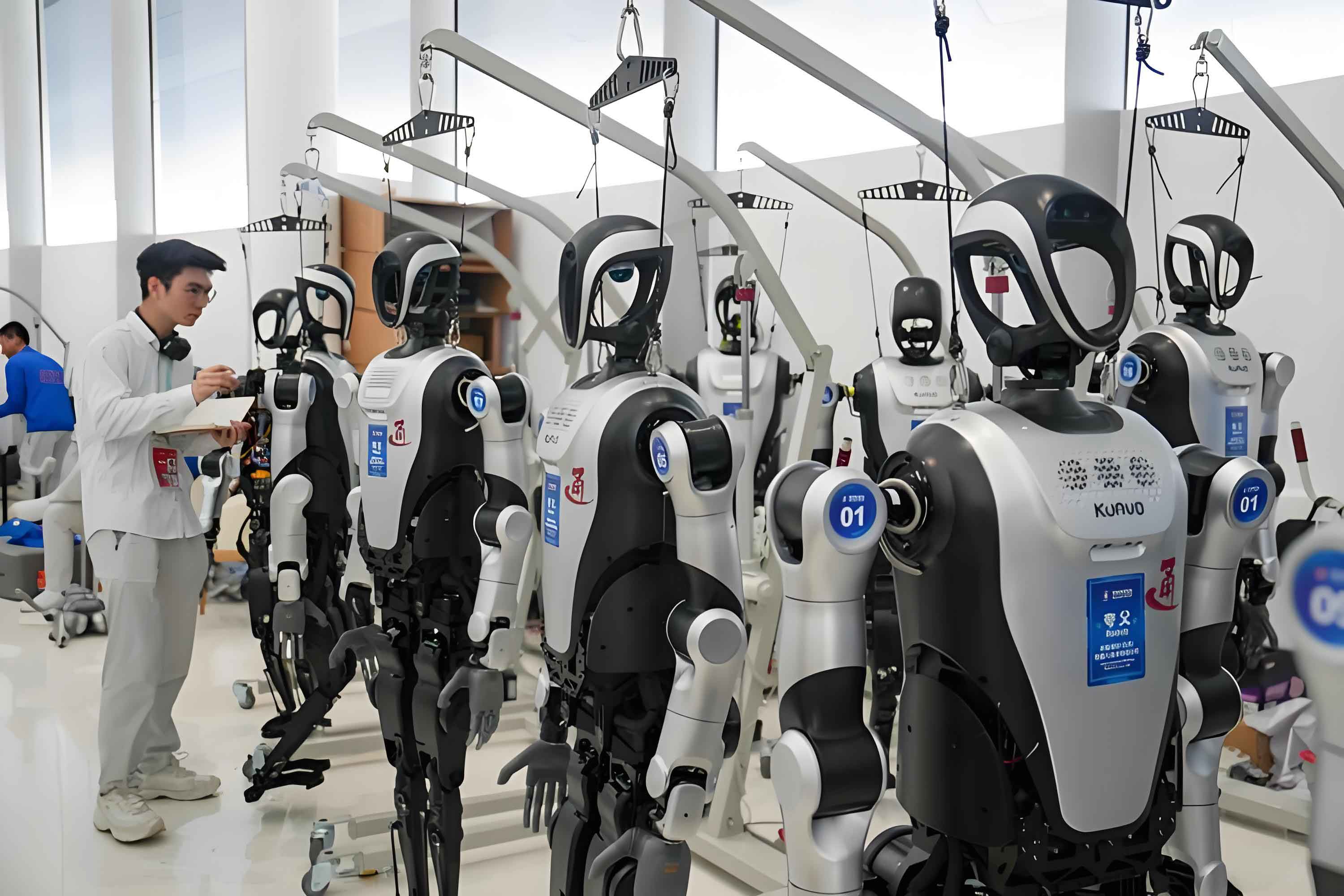
The hardware system of a humanoid robot, akin to its robust body, includes precise mechanical structures, diverse sensors (such as integrated visual, auditory, and tactile systems), and efficient actuators (e.g., motors, servos). Digital electronics technology plays a crucial role in enabling the precise driving, coordinated control, and smooth operation of these hardware components. From a software perspective, the software system of a humanoid robot encompasses the robot operating system, motion control algorithms, and intelligent decision-making programs, where underlying operations like digital signal processing, complex logic operations, and data storage rely on digital electronics. For example, image data collected by visual sensors must undergo high-speed sampling, quantization, and encoding via digital circuits to be converted into digital signals for subsequent algorithm analysis, facilitating the robot’s perception and understanding of its environment after analog-to-digital conversion. The integration can be summarized in the following table:
| Humanoid Robot Component | Digital Electronics Technology Application | Key Functions |
|---|---|---|
| Sensors (e.g., vision, touch) | Analog-to-Digital Converters (ADCs), filters | Convert analog signals to digital for processing; use filters like $$H(f) = \frac{1}{1 + j2\pi fRC}$$ to remove noise. |
| Actuators (e.g., motors, servos) | Microcontroller Units (MCUs), pulse-width modulation (PWM) | Generate control signals; PWM duty cycle $$D = \frac{T_{on}}{T} \times 100\%$$ regulates speed/torque. |
| Decision-making core | Digital logic circuits, finite state machines | Implement logic functions, e.g., $$F = A \cdot \overline{B} + C$$ for action selection; state transitions defined by $$S_{next} = f(S_{current}, input)$$. |
| Communication interfaces | Serial/parallel interfaces, bus systems | Enable data exchange; use protocols like I²C with address decoding. |
In motion control, the Microcontroller Unit (MCU) in digital electronics generates precise pulse signal sequences based on preset motion trajectory algorithms to drive motors and servos, ensuring smooth and natural limb movements. In perception processing, digital circuits filter and identify valid information from vast data streams from sensors, aiding the humanoid robot in real-time environmental judgment. In the decision-making system, intelligent logic modules built on digital logic circuits integrate perceptual information to make decisions. This synergy highlights how digital electronics underpins critical functionalities in humanoid robots, from basic operations to advanced autonomy.
However, I identify several persistent issues in the current teaching of “Digital Electronics.” Firstly, the content often diverges from practical applications. The course emphasizes theoretical knowledge, with a complete theoretical system, but experimental teaching is usually limited to basic verification-level experiments like circuit搭建. Students struggle to connect classroom knowledge with complex real-world scenarios, leading to a disconnect between learning and application. Secondly, teaching methods tend to be monotonous. Traditional instruction relies heavily on teacher-led lectures, even with blended online-offline reforms focused on theory, leaving students in a passive listening role. While tools like blackboards, PPTs, and videos can clearly present theoretical derivations, students lack opportunities for autonomous exploration. For engaging fields like humanoid robots, which require high practicality and interest,单一的讲授法 can dampen enthusiasm, making it hard to motivate students to explore the application potential of digital electronics, resulting in suboptimal teaching effectiveness. Thirdly, assessment methods are inadequate. The current assessment system for “Digital Electronics” prioritizes theoretical knowledge evaluation, typically dominated by closed-book final exams supplemented by attendance, daily work, and lab reports. Subjective questions generally revolve around concepts, circuit analysis, small circuit design, and simple calculations, seldom involving in-depth analysis of practical project cases like humanoid robots or hands-on operation assessments. This encourages rote memorization, neglecting knowledge application, innovative thinking, and the ability to link learned knowledge with前沿技术, leaving students ill-prepared for real-world demands after graduation.
To address these challenges, I propose teaching reform goals and principles. The reform aims to innovate the teaching model of “Digital Electronics,” ensuring students deeply master the digital electronics knowledge and skills necessary for humanoid robot technology. Through project practice, it seeks to comprehensively exercise students’ hands-on abilities, cultivate their skills in solving complex engineering problems in humanoid robots using digital electronics—such as optimizing motion control circuit architectures or improving perception data processing efficiency—and emphasize igniting innovative thinking and fostering teamwork spirit. This prepares students with comprehensive literacy to face future iterations of humanoid robot technology, supplying continuous talent for related industries. The reform principles include the close integration of theory and practice, ensuring course knowledge delivery synchronizes with humanoid robot project practice, allowing students to grasp the importance of theory guiding practice and practice deepening theoretical understanding through hands-on operations, achieving a virtuous cycle of “learning by doing and doing by learning.”
Based on humanoid robot technology, I implement the following teaching reform strategies. First, optimizing教学内容: Introducing humanoid robot cases—such as showcasing热点应用 videos like dynamic dance performances or rescue simulations at the course start—can captivate students and spark curiosity about the underlying digital electronics. When teaching combinational logic circuits, I integrate cases like humanoid robot hand motion control, analyzing how logic gates design circuits to convert finger gripping commands, using Boolean algebra expressions like $$G = S_1 \cdot S_2 + \overline{S_3}$$ for grip logic. For sequential logic circuits, I use robot walking gait control as an example, explaining counters and registers in generating periodic control signals, with timing diagrams represented as $$Q_{n+1} = D$$ for D flip-flops. Additionally, I restructure knowledge points by breaking traditional textbook chapter limits, building a new knowledge acceptance system guided by humanoid robot applications. For instance, following the workflow from perception to decision-making to execution, I integrate sensor interface circuit design, digital signal processing algorithms, and MCU programming to help students construct a complete knowledge chain for the humanoid robot’s “information acquisition-processing-response,” enhancing comprehensive application skills.
Second, innovating教学方法: I adopt project-driven teaching by designing a series of practical projects covering different humanoid robot functional modules, such as a simple facial expression control system or an autonomous obstacle-avoidance mobile platform. Students are grouped to take charge of a project,负责 from需求分析 to调试优化. I also employ virtual simulation teaching using software like Proteus or MATLAB to create virtual humanoid robot environments where students design and test digital electronic circuits safely and repeatedly, simulating processes like motion control. For example, in simulating a视觉追踪 system, students adjust circuit parameters and observe output effects, with transfer functions like $$G(s) = \frac{K}{s^2 + 2\zeta\omega_n s + \omega_n^2}$$ for system modeling, improving design ability while reducing costs. Furthermore, I implement group cooperative learning by forming 4-6 person teams based on diverse abilities and personalities, with clear分工 for tasks like hardware搭建, software programming, documentation, and testing. In projects like a humanoid robot music performance, students collaborate on circuit design and programming, fostering teamwork and knowledge sharing. The methods are summarized below:
| Teaching Method | Application in Humanoid Robot Context | Key Benefits |
|---|---|---|
| Project-Driven Learning | Develop functional modules (e.g., gesture control,避障) | Enhances practical skills, problem-solving; uses iterative design cycles. |
| Virtual Simulation | Simulate circuits for motion or perception in software | Allows risk-free experimentation; models like $$V_{out} = V_{in} \cdot \frac{R_2}{R_1 + R_2}$$ for voltage dividers. |
| Group Cooperation | Divide tasks in robot projects (hardware, software, etc.) | Builds teamwork, communication; shares knowledge across disciplines. |
Third,完善考核方式: I shift from单一理论考试 to a多元化考核体系 with indicators: theoretical knowledge (30-40%), practical ability (30-40%), project outcomes (10-20%), and teamwork (10-20%). Theoretical assessments include humanoid robot application scenarios, such as analyzing logic circuits for robot decision-making. Practical ability is evaluated through lab operations and project defenses; project outcomes are scored based on innovation, functionality, and stability; teamwork assesses division of labor and problem-solving synergy. Additionally, I strengthen过程性评价 by incorporating classroom performance (10-20%), project progress (30-40%), and lab reports (30-40%) to track participation and文档撰写, using rubrics to grade ongoing efforts. For instance, lab reports require detailing experiments with equations like $$V_{pp} = 2\sqrt{2}V_{rms}$$ for signal measurements, fostering habitual learning记录.
To validate these reforms, I conduct a practical case analysis. In an electronics major, I select two classes: one as an experimental group implementing the reform, and another as a control group using traditional teaching. In the experimental group, I start with科普讲座 on humanoid robots, then group students for project-driven learning with simulation support, followed by regular汇报 and a final project exhibition. The control group follows textbook chapters with lectures and simple experiments, assessed traditionally. After a semester, I compare results: the experimental group’s average final exam score is nearly 10 points higher, showing significant advantage; they demonstrate stronger innovation in projects, such as designing smarter gesture recognition systems for humanoid robots; and interest surveys show over 80% of the experimental group is highly engaged,远超 the control group by about 25%. This indicates the reforms effectively enhance learning outcomes and initiative. However, challenges arise, such as limited hardware access for humanoid robots, causing queueing issues, and some students with weak foundations struggling with跨学科 integration. To改进, I pursue industry collaboration to expand equipment and introduce blended learning with pre-class materials and online tutoring to support all students.
In conclusion, by deeply integrating humanoid robot technology into “Digital Electronics” teaching, I achieve progress in content, methods, and assessment. Content becomes案例化 and integrated, making knowledge vivid; innovative methods unlock student enthusiasm and potential; and improved assessment accurately measures comprehensive growth. Students not only solidify theoretical foundations in digital electronics but also excel in humanoid robot applications, laying a robust groundwork for future careers. Looking ahead, as humanoid robot technology advances toward greater intelligence and flexibility, I plan to expand跨学科 fusion by incorporating fields like biology and psychology, strengthen international exchanges for advanced teaching insights, and develop more open and challenging实践项目 to cultivate卓越人才 for the humanoid robot era. Throughout this journey, the focus on humanoid robot technology remains central, driving continuous improvement in digital electronics education.