
In the field of robotics, the development of dexterous robotic hands represents a significant milestone, enabling machines to perform complex manipulation tasks that mimic human capabilities. My research focuses on the critical aspect of finger position control, which serves as the foundation for force regulation and multi-finger coordination in manipulation. Without precise position control, advanced operations such as grasping, twisting, or fine object handling become unattainable. This article delves into the methodologies and implementations for achieving robust position control in a high-performance dexterous robotic hand, drawing from extensive experimental and theoretical work. Throughout this discussion, the term ‘dexterous robotic hand’ will be frequently emphasized to highlight its centrality in intelligent engineering systems.
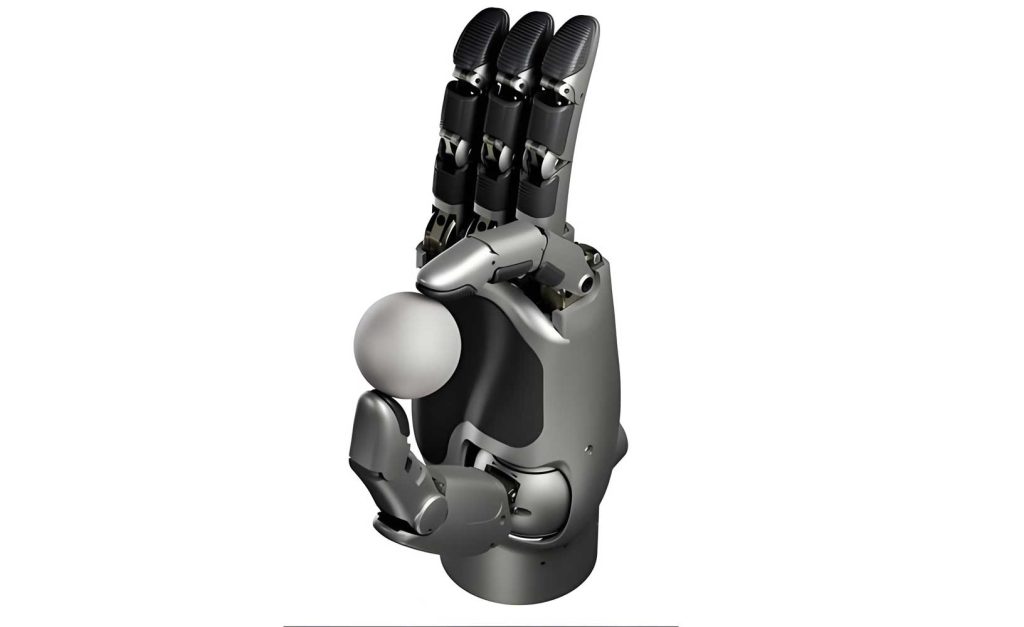
The dexterous robotic hand I studied features a modular design with four fingers, each possessing multiple degrees of freedom, allowing for versatile movements. Position control in such a system is not straightforward due to the intricate kinematics and dynamics involved. To address this, I have developed a hierarchical control framework that spans from motor-level actuation to Cartesian-space trajectory tracking. This approach ensures that the dexterous robotic hand can execute precise motions required for real-world applications, from industrial assembly to robotic prosthetics. In the following sections, I will elaborate on the control spaces, controller design, and experimental validations that underpin this research.
First, let us consider the hierarchical control space of the dexterous robotic hand. The finger can be modeled as a serial kinematic chain, similar to a small robotic manipulator. I established a coordinate system using the Denavit-Hartenberg (D-H) convention to describe the finger’s geometry. The control space is divided into four distinct layers: Cartesian space (task space), joint space, drive space, and motor space. This stratification is essential because sensors are not directly available in all spaces; for instance, position feedback is primarily obtained in the drive and motor spaces, necessitating kinematic transformations for control in higher-level spaces.
The D-H parameters for the finger are summarized in the table below. These parameters define the relationship between consecutive links, enabling the computation of forward and inverse kinematics.
| Joint | $\theta_i$ (range in degrees) | $\alpha_{i-1}$ (rad) | $a_{i-1}$ (mm) | $d_i$ (mm) |
|---|---|---|---|---|
| 1 | $\theta_1$ [0, 90] | $-\pi/2$ | 0.0 | 0 |
| 2 | $\theta_2$ [-20, 20] | $-\pi/2$ | 67.8 | 0 |
| 3 | $\theta_3$ [0, 90] | $\pi/2$ | 30.0 | 0 |
| 4 | $\theta_4$ [0, 90] | 0 | 29.5 | 0 |
The forward kinematics map from joint angles to fingertip position in Cartesian space is given by the homogeneous transformation matrix. For a finger with $n$ joints, the position and orientation of the end-effector relative to the base frame is computed as:
$$ T_n^0 = A_1^0 \cdot A_2^1 \cdots A_n^{n-1} $$
where $A_i^{i-1}$ is the D-H transformation matrix for joint $i$. Specifically, for joint $i$,
$$ A_i^{i-1} = \begin{bmatrix}
\cos\theta_i & -\sin\theta_i \cos\alpha_{i-1} & \sin\theta_i \sin\alpha_{i-1} & a_{i-1} \cos\theta_i \\
\sin\theta_i & \cos\theta_i \cos\alpha_{i-1} & -\cos\theta_i \sin\alpha_{i-1} & a_{i-1} \sin\theta_i \\
0 & \sin\alpha_{i-1} & \cos\alpha_{i-1} & d_i \\
0 & 0 & 0 & 1
\end{bmatrix} $$
In the dexterous robotic hand, the drive space corresponds to the actuator positions, which are measured via absolute position sensors. The relationship between joint angles and drive positions is derived from the finger’s differential mechanism and gear trains. For the base joint, which has two degrees of freedom, the joint angles $\theta_1$ and $\theta_2$ are computed from two drive positions $\phi_1$ and $\phi_2$ using:
$$ \theta_1 = \frac{\phi_1 + \phi_2}{2}, \quad \theta_2 = \frac{\phi_1 – \phi_2}{2} $$
This kinematic coupling is crucial for control design. The hierarchical control space enables modular control strategies, where high-level tasks in Cartesian space are decomposed into lower-level commands in drive space. This dexterous robotic hand architecture enhances flexibility and precision.
Now, focusing on the drive space, I designed a sliding mode variable structure position controller to achieve robust tracking. Sliding mode control is renowned for its insensitivity to parameter variations and disturbances, making it ideal for the dexterous robotic hand where model uncertainties exist. The control objective is to drive the actuator position $\theta_d(t)$ to a desired reference $\theta_r(t)$. Define the tracking error as $e(t) = \theta_r(t) – \theta_d(t)$. A sliding surface $s(t)$ is chosen as a linear combination of error and its derivative:
$$ s(t) = c_1 e(t) + c_2 \dot{e}(t) $$
where $c_1$ and $c_2$ are positive constants that determine the dynamics on the sliding surface. The control law $u_c(t)$ is formulated to force the system trajectories onto the sliding surface and maintain them there. It consists of equivalent control and a discontinuous term:
$$ u_c(t) = \chi_1 e(t) + \chi_2 \dot{e}(t) + \eta \, \text{sgn}(s(t)) $$
Here, $\chi_1$ and $\chi_2$ are feedback gains, $\eta$ is a positive constant that ensures reaching condition, and $\text{sgn}(\cdot)$ is the signum function. The reaching condition guarantees that $s \dot{s} < 0$, which drives $s$ to zero in finite time. This control law effectively handles nonlinearities in the dexterous robotic hand’s actuation system.
To validate the controller, I conducted experiments on a single actuator. The step response from 0° to 50° demonstrated fast dynamics with a settling time under 0.2 ms, no overshoot, and minimal chattering. The robustness of sliding mode control makes it suitable for the dexterous robotic hand, where precise positioning is paramount. The controller’s performance can be summarized by the following differential equation governing the closed-loop system:
$$ \ddot{\theta}_d + k_1 \dot{\theta}_d + k_2 \theta_d = u_c + d(t) $$
where $d(t)$ represents bounded disturbances. The sliding mode controller ensures that the tracking error remains within a bounded region despite $d(t)$.
Transitioning to joint space position control, the challenge lies in converting joint-level commands to drive-level actions. Given a desired joint trajectory $\theta_j^r(t)$, I first use the inverse joint-to-drive kinematics to compute the desired drive positions $\theta_d^r(t)$. Then, a trajectory planner generates smooth reference signals for the drive space. I employed a fourth-order polynomial interpolation algorithm to ensure continuity in position, velocity, and acceleration. The trajectory for each drive axis is given by:
$$ \theta_d^r(t) = a_0 + a_1 t + a_2 t^2 + a_3 t^3 + a_4 t^4 $$
where coefficients $a_i$ are determined from boundary conditions at waypoints. This planning occurs in the drive space, and the sliding mode controller tracks the planned trajectory. The overall joint space control system is depicted in the block diagram below (described textually): the joint reference is transformed to drive reference via inverse kinematics, planned via the polynomial, and controlled by the sliding mode controller; feedback from drive sensors is transformed back to joint space for monitoring.
I tested this approach on the third joint of the dexterous robotic hand finger, commanding a move from 0° to 80°. The joint accurately tracked the planned trajectory with steady-state error less than 0.5°. The results confirm that joint space control via drive space manipulation is effective for the dexterous robotic hand. The error dynamics can be expressed as:
$$ e_j(t) = \theta_j^r(t) – \theta_j(t) $$
where $\theta_j(t)$ is derived from drive positions through forward kinematics. The RMS error during the motion was below 1°, showcasing high precision.
For Cartesian space position control, the goal is to control the fingertip position $(x, y, z)$ in task space. This is essential for dexterous robotic hand operations like object grasping. Given a desired Cartesian trajectory $X^r(t) = [x^r(t), y^r(t), z^r(t)]^T$, I compute the required joint angles through inverse kinematics. For the finger with four joints, the inverse kinematics may involve analytical or numerical methods due to redundancy. I used an analytical solution based on the geometric structure. The joint references are then processed as in joint space control. The Cartesian control structure involves: Cartesian reference → inverse kinematics → joint reference → inverse joint-drive kinematics → drive planning → sliding mode control → drive output → forward kinematics to Cartesian output for feedback.
An experiment was conducted where the fingertip traced a rectangular path in space: from (70, 0, 90) mm to (80, 10, 85) mm, then to (100, 0, 70) mm, to (90, -10, 80) mm, and back to start, with pauses at each point. The dexterous robotic hand successfully tracked the path with position errors under 2 mm. This demonstrates the efficacy of the hierarchical control scheme for dexterous manipulation. The Cartesian error vector $E_c(t)$ is defined as:
$$ E_c(t) = X^r(t) – X(t) $$
where $X(t)$ is the actual fingertip position from forward kinematics. The control system minimizes $\|E_c(t)\|$ over time.
To further illustrate the performance metrics, I summarize key experimental data in the table below. These results underscore the capabilities of the dexterous robotic hand under the proposed control strategies.
| Control Space | Test Trajectory | Maximum Error | Settling Time | Remarks |
|---|---|---|---|---|
| Drive Space | Step from 0° to 50° | < 0.1° | 0.2 ms | No overshoot, robust to disturbances |
| Joint Space | Joint 3: 0° to 80° | < 0.5° | 0.5 s | Smooth tracking with polynomial planning |
| Cartesian Space | Rectangular path in 3D | < 2 mm | 1 s per segment | Accurate for manipulation tasks |
The integration of multiple sensors enhances the dexterous robotic hand’s functionality. Absolute position sensors at the drive level provide high-resolution feedback, while motor Hall-effect sensors offer relative position and velocity information. The velocity $\dot{\theta}_m$ derived from motor sensors is used for feedback in the sliding mode controller, improving dynamic response. The sensor fusion can be modeled as:
$$ \dot{\theta}_d \approx \frac{\Delta \theta_m}{\Delta t} \cdot N $$
where $\Delta \theta_m$ is the motor position change and $N$ is the gear ratio. This approach leverages the higher resolution of motor sensors for velocity estimation.
In terms of trajectory planning, the fourth-order polynomial ensures smooth transitions. For a segment starting at time $t_0$ and ending at $t_f$, with initial and final positions, velocities, and accelerations specified, the coefficients are solved from:
$$ \begin{bmatrix}
1 & t_0 & t_0^2 & t_0^3 & t_0^4 \\
0 & 1 & 2t_0 & 3t_0^2 & 4t_0^3 \\
0 & 0 & 2 & 6t_0 & 12t_0^2 \\
1 & t_f & t_f^2 & t_f^3 & t_f^4 \\
0 & 1 & 2t_f & 3t_f^2 & 4t_f^3 \\
0 & 0 & 2 & 6t_f & 12t_f^2
\end{bmatrix}
\begin{bmatrix}
a_0 \\ a_1 \\ a_2 \\ a_3 \\ a_4
\end{bmatrix}
=
\begin{bmatrix}
\theta_0 \\ \dot{\theta}_0 \\ \ddot{\theta}_0 \\ \theta_f \\ \dot{\theta}_f \\ \ddot{\theta}_f
\end{bmatrix} $$
This planning is computationally efficient and suitable for real-time control in the dexterous robotic hand.
The sliding mode controller’s stability can be analyzed using Lyapunov theory. Consider a Lyapunov candidate $V = \frac{1}{2} s^2$. Its derivative is:
$$ \dot{V} = s \dot{s} $$
Substituting the system dynamics and control law, it can be shown that $\dot{V} \leq -\eta |s|$, ensuring finite-time convergence to the sliding surface. This theoretical guarantee is crucial for the reliable operation of the dexterous robotic hand in unpredictable environments.
Moreover, the hierarchical control framework scales to multi-finger coordination. For a dexterous robotic hand with four fingers, the position control of each finger can be managed independently in drive space, while high-level coordinators manage task-space objectives. This modularity is a key advantage. The overall system can be viewed as a network of controllers, each adhering to the principles outlined above.
In conclusion, my research on finger position control for dexterous robotic hands has established a comprehensive methodology spanning from low-level actuation to high-level task execution. The hierarchical control space, coupled with sliding mode control and advanced trajectory planning, enables precise and robust positioning in joint and Cartesian spaces. The dexterous robotic hand, equipped with multi-sensory feedback, demonstrates exceptional performance in various manipulation tasks. Future work will focus on integrating force control and adaptive algorithms to further enhance the dexterity of robotic hands. The insights gained here contribute significantly to the field of intelligent engineering, paving the way for more autonomous and capable robotic systems.
Throughout this article, the emphasis on dexterous robotic hand technologies underscores their transformative potential in robotics. By refining position control strategies, we move closer to achieving human-like manipulation capabilities in machines. The experiments and analyses presented confirm the viability of the proposed approaches, offering a solid foundation for ongoing innovation in dexterous robotic hand design and control.