
From my experience in precision mechanical design, the pursuit of high accuracy and minimal backlash in gear transmissions leads directly to the sophisticated domain of strain wave gearing. Often referred to as harmonic drives, strain wave gear systems are fundamentally a specialized form of internal gear mesh. A core principle governing their design states that if one member, typically the flexspline, employs an involute profile, the conjugate profile for the other member, the circular spline, is not a standard involute. However, for the practical benefits of manufacturability and inspection, it is common to design both the flexspline and circular spline with involute teeth. This design choice immediately subjects the pair to all the potential interference conditions inherent to internal gear meshing. Consequently, the selection and precise modification of the profile shift coefficients for the circular spline (denoted $\xi_G$) and the flexspline (denoted $\xi_R$) become critical, governed entirely by the rules for avoiding internal gear interference.
In practice, both the flexspline and circular spline teeth are given positive profile shifts to prevent one type of interference. To guard against others, it is often advisable to reduce the addendum coefficient of the flexspline. Furthermore, to enhance the contact ratio—a factor beneficial for reducing backlash—a negative gear drive modification is frequently employed, where the circular spline’s shift coefficient $\xi_G$ is made slightly smaller than the flexspline’s $\xi_R$. The complete landscape of potential interferences in an internal mesh, which directly applies to the strain wave gear tooth interaction, along with their prevention strategies, is summarized in the following comprehensive tables.
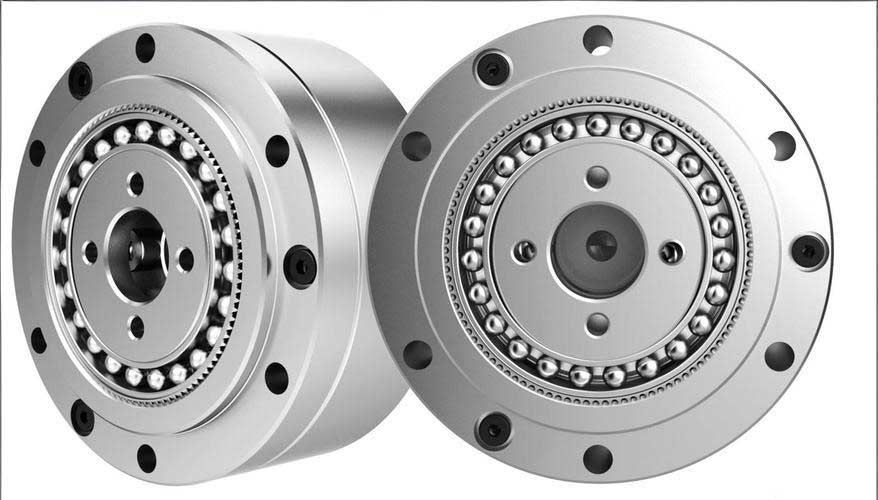
The kinematic essence of a strain wave gear lies in the controlled elastic deformation of the flexspline. This deformation, induced by an elliptical wave generator, creates two opposing regions of deep mesh between the flexspline and the circular spline. As the wave generator rotates, these meshing regions travel around the circumference, resulting in a large speed reduction between the input (wave generator) and output (flexspline or circular spline). The integrity of this motion transfer is wholly dependent on clean, uninterrupted tooth engagement, making interference prevention paramount.
| Interference Type | Definition | Non-Interference Condition | Preventive Measures |
|---|---|---|---|
| Involute Interference | Occurs when the endpoint $B_2$ of the actual path of contact lies to the left of the limit point $N_1$ on the theoretical line of action. | $$\frac{Z_1}{Z_2} \geq 1 – \frac{\tan\alpha_{a2}}{\tan\alpha’}$$ where $Z_1$ is pinion teeth, $Z_2$ is gear teeth, $\alpha’$ is operating pressure angle, $\alpha_{a2}$ is gear tip pressure angle. | 1. Increase the pressure angle. 2. Increase the profile shift coefficients of both internal gear and pinion. |
| Interference Type | Definition | Non-Interference Condition | Preventive Measures |
|---|---|---|---|
| Profile Overlap Interference | The pinion tooth tip, upon exiting the internal gear tooth space, interferes with (overlaps) the tip of the internal gear tooth. | For standard gears ($x_1=x_2=0$): $$Z_2 \geq \frac{Z_1^2 \sin^2\alpha – 4(h_{a2}^*/m)^2}{2Z_1\sin^2\alpha – 4(h_{a2}^*/m)}$$ | 1. Increase the pressure angle. 2. Reduce the addendum height. 3. Increase the difference in tooth numbers between internal gear and pinion. 4. Increase the profile shift coefficient of the internal gear. |
| Interference Type | Definition | Non-Interference Condition | Preventive Measures |
|---|---|---|---|
| Radial Interference | Occurs during the radial assembly of the pinion into the internal gear if the clearance on the approach side is insufficient (conceptually, if $CD > EF$ in standard interference diagrams). | $$\theta_a + (\text{inv }\alpha’ – \text{inv }\alpha_{a2}) \geq \arccos\left( \frac{a^2 + r_{a2}^2 – r_{a1}^2}{2 r_{a2} a} \right)$$ where $\theta$ is found from: $$\cos[\theta – (\text{inv }\alpha_{a1} – \text{inv }\alpha’)] = \frac{r_{a2}^2 – r_{a1}^2 – a^2}{2 r_{a1} a}$$ | 1. Increase the pressure angle. 2. Reduce the addendum height. 3. Increase the tooth number difference. 4. Increase the internal gear’s profile shift coefficient. |
| Interference Type | Definition | Non-Interference Condition | Preventive Measures |
|---|---|---|---|
| Undercut (Fillet) Interference | Contact occurs between the pinion tooth tip and the fillet/undercut region of the internal gear tooth root, or vice-versa. | Condition to avoid internal gear fillet interference: $$(Z_2 – Z_1)\tan\alpha’ + Z_1\tan\alpha_{a1} \leq (Z_2 – Z_1)\tan\alpha’_{a2} + Z_2\tan\alpha_{a2}$$ A related general condition involves a lengthy expression with arcsin and involute functions ensuring non-negative clearance. | 1. Increase the profile shift coefficient of the internal gear. 2. Reduce the addendum height. |
The design of a high-precision strain wave gear set, therefore, revolves around navigating these constraints. The goal is to select and then meticulously modify the profile shift coefficients such that the clearance between the flexspline tooth tip and the circular spline tooth profile, or vice-versa, is neither negative (causing interference) nor excessively positive (leading to increased backlash). This clearance, often calculated point-by-point around the mesh, must be optimized.
Determination and Modification of Meshing Parameters and Profile Shift Coefficients
The process begins with an initial estimate of the shift coefficients based on established empirical formulas for strain wave gear design. For a pressure angle $\alpha = 20^\circ$, the initial flexspline shift coefficient $\xi_{R0}$ can be estimated as:
$$
\xi_{R0} = K_a K_i \sqrt[3]{\frac{2 i_{BR}}{G}}
$$
where $K_a$ is a coefficient related to the pressure angle (1 for $\alpha=20^\circ$), $K_i$ is related to the gear ratio (e.g., 0.59 for $i=45-100$), and $i_{BR}/G$ relates to the tooth difference. The initial circular spline coefficient is then set slightly higher to promote a slight backlash condition for assembly: $\xi_{G0} = \xi_{R0} + (0.2 \ldots 0.25)m$, where $m$ is the module.
For a specific case, consider a strain wave gear with the following initial data:
- Flexspline (Pinion analog): $m=0.3 \text{ mm}$, $Z_R=170$, $\alpha=20^\circ$, $h_{aR}^*=0.408$.
- Circular Spline (Internal Gear analog): $m=0.3 \text{ mm}$, $Z_G=172$, $\alpha=20^\circ$, $h_{aG}^*=1.0$.
Applying the formulas yields initial values: $\xi_{R0} \approx 3.2684$ and $\xi_{G0} \approx 3.335$.
The next critical step is to model the clearance between the tooth profiles. The clearance $H_{RG}$ at any meshing position is given by the distance from the flexspline tooth tip to the circular spline tooth flank:
$$
H_{RG} = \pm \sqrt{ (x_{aR}^G – x_{RG})^2 + (y_{aR}^G – y_{RG})^2 }
$$
where $(x_{aR}^G, y_{aR}^G)$ are the coordinates of the flexspline tip in the circular spline coordinate system, and $(x_{RG}, y_{RG})$ are the corresponding points on the circular spline profile. Calculating this clearance over the entire mesh angle $\psi_N$ (typically 210 discrete points for a double-wave strain wave gear) reveals the minimum clearance $H_{RGmin}$. In our example, this might be found at a specific rotation angle, e.g., $H_{RGmin} = 0.00539 \text{ mm}$.
The Art of Profile Shift Modification for Zero-Backlash
The initial coefficients generally ensure no interference (all $H_{RG} > 0$), but the minimum clearance is often larger than the desired near-zero value required for minimal-backlash operation. The target is to achieve a controlled “negative clearance” or interference fit over a portion of the teeth, which will be accommodated by elastic deformation in the actual strain wave gear assembly, thereby eliminating functional backlash.
The modification amount $\Delta\xi_R$ is conceptually determined from the geometry of the line-of-action. If we approximate the tooth profiles as straight lines near the contact point, the relationship between shift change and clearance change is:
$$
\Delta\xi_R \approx \frac{H_{RGmin} – [H]}{m \sin(\alpha + \delta)}
$$
where $[H]$ is the allowable minimum clearance target. A first calculation might give a small positive $\Delta\xi_R$, but this merely reduces positive clearance. To achieve the desired state of partial negative engagement, a significantly larger modification $\Delta\xi_{RW}$ must be applied through iterative numerical optimization.
The objective is to adjust $\xi_R$ (and sometimes $\xi_G$) so that:
– Approximately 30-40% of the mesh positions exhibit a small negative clearance (e.g., $0$ to $-0.0055 \text{ mm}$), creating an elastic preload.
– The remaining 60-70% of positions retain a small positive clearance (e.g., $0$ to $+0.0117 \text{ mm}$).
– The maximum negative value is within the elastic deformation capacity of the system to avoid jamming.
Using a numerical search method (like a golden-section search) over the clearance data, we find the $\Delta\xi_{RW}$ that makes the clearance zero at a point around the 0.618 fraction of the maximum clearance range. For our example, this optimal modification was found to be $\Delta\xi_{RW} = 0.1066$.
Applying this final modification yields the definitive profile shift coefficients for our high-precision strain wave gear set:
$$
\begin{aligned}
\xi_R &= \xi_{R0} + \Delta\xi_{RW} = 3.2684 + 0.1066 = 3.3750 \\
\xi_G &= \xi_{G0} = 3.3350
\end{aligned}
$$
With these values, analysis confirms:
– About 76 out of 210 mesh positions are in a state of negative clearance (elastic interference).
– The maximum negative clearance is $H_{RG\xi min} = -0.00563 \text{ mm}$.
– The maximum positive clearance is $H_{RG\xi max} = +0.01172 \text{ mm}$.
– Several teeth are always in a near-zero-clearance contact, ensuring minimal functional backlash.
This state of controlled elastic interference, made possible by the flexible nature of the flexspline in a strain wave gear, is the key to achieving ultra-high positional accuracy and torsional stiffness. The micro-deformation of the teeth and the flexspline body absorbs the calculated negative clearances without causing damage, effectively eliminating dead zone or backlash in the transmission. This meticulous process of interference analysis, initial parameter selection, and precise profile shift modification transcends standard gear design, becoming a specialized discipline essential for unlocking the full potential of the strain wave gear principle in robotics, aerospace, and other demanding precision applications. The final performance is a direct result of respecting the intricate constraints of internal gear meshing while strategically leveraging the unique elastic capabilities of the harmonic drive system.