
The inverted planetary roller screw mechanism (IPRSM) represents a highly efficient and robust variant of the standard planetary roller screw. Its defining architectural feature—the inverted arrangement where the nut serves as the rotational input stator—enables its direct integration with frameless motors. This integration facilitates a compact, high-performance linear actuator ideal for demanding applications such as aerospace flight control systems, precision machine tools, and robotic manipulators. These applications often subject the mechanism to complex and unpredictable operational loads, including sudden impact forces or rapid load shifts during gripping or machining operations. Predicting the dynamic behavior of the inverted planetary roller screw under such variable, and particularly transient, load conditions is a critical yet challenging task. This analysis is paramount for ensuring system stability, positional accuracy, and operational longevity. While significant research exists on the static and kinematic properties of standard planetary roller screws, a focused investigation into the dynamic response of the inverted configuration to load transients, coupled with strategies for its control, remains underexplored. This work aims to bridge this gap through a combined theoretical and simulation-based approach.
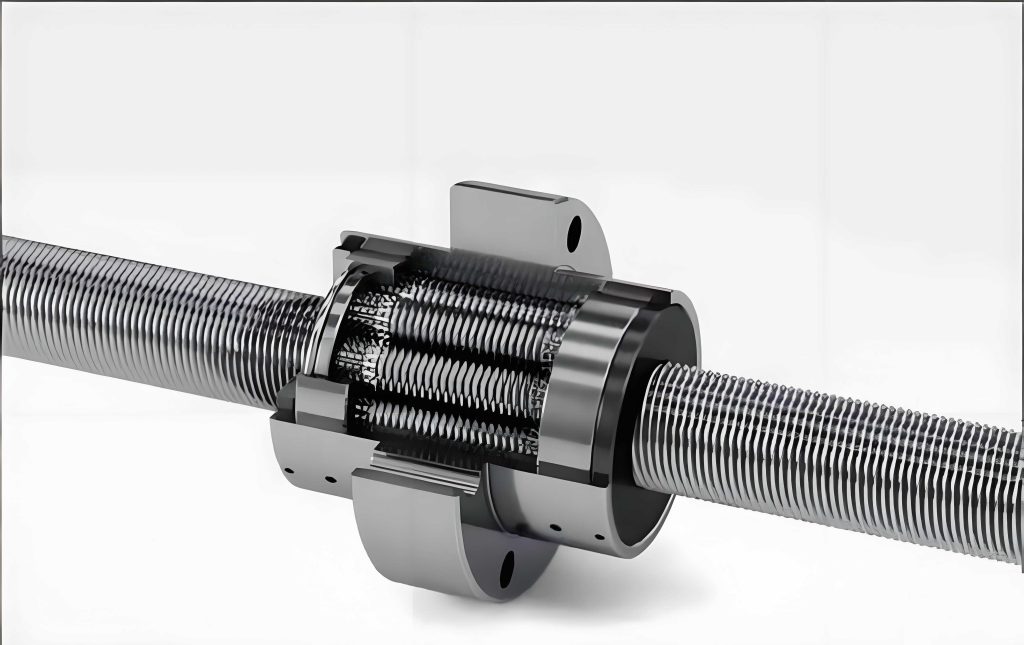
Understanding the fundamental motion relationships within an inverted planetary roller screw is essential for dynamic analysis. The mechanism operates on principles analogous to a planetary gear train combined with screw kinematics. The nut, which is rotationally driven and axially fixed, meshes with the rollers via multi-start threads. The rollers, in turn, engage with the central screw, which is rotationally fixed but free to translate axially. The engagement between the roller gears and the screw gears ensures pure rolling at that interface. A retainer or cage maintains the angular position of the rollers relative to each other, causing them to revolve around the screw axis—this is the planetary motion.
Based on kinematic analysis of planetary systems and screw theory, the internal velocity relationships can be derived. Considering the contact points and velocity instant centers, the angular velocity of the roller’s revolution (or the cage velocity, $\omega_G$) and the roller’s spin about its own axis ($\omega_R$) relative to the input nut angular velocity ($\omega_N$) are given by:
$$
\omega_G = \frac{d_N}{2(d_N + d_S)} \cdot \omega_N
$$
$$
\omega_R = \frac{d_S (d_S + 2d_R)}{2d_R(d_S + d_N)} \cdot \omega_N
$$
where $d_S$, $d_N$, and $d_R$ are the pitch diameters of the screw, nut, and roller, respectively. Finally, the linear output velocity of the screw ($v_S$) is directly proportional to the nut’s rotational speed and the effective lead of the mechanism:
$$
v_S = \frac{n_N \cdot P}{2\pi} \cdot \omega_N
$$
where $n_N$ is the number of starts on the screw/nut and $P$ is the pitch. This linear relationship forms the basis for precise positional control of the inverted planetary roller screw by regulating the nut’s rotation.
To investigate the dynamic response of the inverted planetary roller screw to variable loads, a high-fidelity multi-body dynamics model was developed. The design and simulation were based on a parameter-matching methodology to ensure proper meshing and load distribution. The key geometrical parameters for the model are summarized in Table 1.
| Component | Pitch Diameter (mm) | Lead (mm) | Number of Starts | Quantity |
|---|---|---|---|---|
| Screw | 14.0 | 2.0 | 4 | 1 |
| Nut | 21.6 | 2.0 | 4 | 1 |
| Roller | 3.6 | 0.5 | 1 | 10 |
The three-dimensional model was assembled and imported into a multi-body dynamics simulation environment. Appropriate kinematic joints were applied: a revolute joint for the nut (input), a translational joint for the screw (output), revolute joints between each roller and the cage, and a cylindrical joint for the cage itself. Contact forces between the screw, rollers, and nut were modeled using an impact function method, with stiffness, damping, and friction parameters defined for the bearing steel material (GCr15). A Coulomb friction model was implemented at the threaded contacts. To simulate operational scenarios like tool impact or sudden gripping, a variable axial load was applied to the screw using a step function, creating a load transient from a baseline of 500 N to higher values (1000 N, 1500 N, 2000 N) during the simulation. A PID controller was implemented to regulate the nut’s angular speed, simulating a closed-loop motor drive attempting to maintain a constant screw velocity despite load disturbances. The control law is given by:
$$
u(t) = K_p \cdot e(t) + K_i \int e(t) dt + K_d \frac{de(t)}{dt}
$$
where $e(t)$ is the error between the target and actual nut speed, and $K_p$, $K_i$, $K_d$ are the proportional, integral, and derivative gains, respectively.
The validity of the inverted planetary roller screw dynamics model was first established under steady-state conditions. With the nut commanded to 300 rpm and a constant 5000 N load, the simulated steady-state angular velocities of the cage ($\omega_G$) and roller spin ($\omega_R$), as well as the screw linear velocity ($v_S$), were compared to theoretical values derived from the kinematic equations. The results, shown in Table 2, demonstrate excellent agreement with errors below 3.5%, primarily attributable to contact compliance and micro-vibrations not captured in the rigid-body theory.
| Parameter | Simulated Value | Theoretical Value | Relative Error |
|---|---|---|---|
| $\omega_G$ (rad/s) | 31.30 | 30.30 | 3.3% |
| $\omega_R$ (rad/s) | 120.88 | 121.23 | 0.3% |
| $v_S$ (mm/s) | 16.25 | 16.07 | 1.1% |
The core investigation focused on the system’s response to sudden load increases applied at 0.2 seconds. The dynamic behavior was analyzed across three load-step magnitudes.
Speed Response: A load transient causes an immediate drop in the rotational speeds of all moving components—the nut, the rollers, and the cage. This is a consequence of the instantaneous increase in friction torque at the thread contacts due to higher normal loads (Hertzian contact deformation) and the system’s inertial lag; the motor’s input torque cannot increase instantaneously to compensate, causing a temporary speed reduction. The magnitude of the speed drop is directly correlated with the magnitude of the load step. For instance, when the load jumped from 500 N to 2000 N, the nut speed dropped by approximately 3.52 rad/s, the roller spin by 1.93 rad/s, and the cage speed by 9.56 rad/s. These values were proportionally smaller for the 1000 N and 1500 N steps.
Contact Force Fluctuation: The load transient also significantly increases the fluctuation amplitude of the contact forces at the nut-roller and screw-roller interfaces. Under higher loads, the non-uniform distribution of force along the engaged threads is exacerbated. Furthermore, micro-clearances in the assembly lead to increased axial play and impact forces. As summarized in Table 3, both the mean value and the range of fluctuation of the contact forces increase with the applied load. The contact force on the nut side is consistently higher than on the screw side for the same axial load, which is attributed to the difference in thread helix angles resulting from the different pitch diameters.
| Load Step (N) | Nut-Roller Force Range (N) | Screw-Roller Force Range (N) | Mean Nut-Roller Force (N) | Mean Screw-Roller Force (N) |
|---|---|---|---|---|
| 500 -> 1000 | 1625.9 – 2411.3 | 1545.7 – 1869.6 | ~2018 | ~1707 |
| 500 -> 1500 | 2425.2 – 3450.4 | 2309.1 – 2830.6 | ~2938 | ~2570 |
| 500 -> 2000 | 3196.7 – 4541.3 | 3073.9 – 3709.6 | ~3869 | ~3392 |
The presence of the PID controller is crucial for recovering from the speed drop and maintaining accuracy. The effect of tuning the proportional ($K_p$) and integral ($K_i$) gains was investigated.
Effect of Proportional Gain ($K_p$): Increasing $K_p$ significantly improves the system’s responsiveness to the load disturbance. A higher $K_p$ results in a stronger corrective torque from the controller for a given speed error, leading to a faster recovery time and a smaller ultimate speed deviation (steady-state error). For example, with $K_p$=10, the steady-state error for the nut speed after the transient was about -1.7 rad/s, whereas with $K_p$=90, this error was reduced to approximately -0.3 rad/s.
Effect of Integral Gain ($K_i$): The integral term is responsible for eliminating steady-state error. Increasing $K_i$ (with $K_p$ fixed) was observed to reduce the final offset in the nut, roller, and cage speeds after the transient. However, an excessively high $K_i$ can lead to overshoot and oscillation. The simulations confirmed that while the $K_p$ value primarily governs the speed of response, a properly tuned $K_i$ is necessary to bring the system speed precisely back to its target setpoint after a load change.
This study provides a comprehensive analysis of the dynamic characteristics of the inverted planetary roller screw mechanism under variable loading conditions. The key findings are:
- A validated multi-body dynamics model for the inverted planetary roller screw was established, demonstrating high fidelity with theoretical kinematic predictions.
- Load transients induce a characteristic speed drop in all rotational components (nut, rollers, cage), with the severity scaling directly with the magnitude of the load change. Concurrently, contact force fluctuations at the threaded interfaces are amplified, indicating increased dynamic stress and potential for accelerated wear under such conditions.
- Closed-loop speed control via a PID regulator is effective in mitigating the impact of load disturbances. Tuning the proportional gain ($K_p$) enhances the recovery speed and reduces the transient speed dip, while the integral gain ($K_i$) is essential for eliminating steady-state following error.
These insights are vital for the design, application, and control system development of inverted planetary roller screw-based actuation systems destined for high-performance, dynamically challenging environments. The methodology and results offer a predictive tool for assessing performance under complex operational scenarios and a guideline for optimizing control parameters to maintain precision and stability.