
With the advancement of equipment automation and intelligence, as well as the deepening application of power-by-wire in various industrial fields, electromechanical servo actuation systems are evolving toward higher power, integration, precision, and reliability. The planetary roller screw mechanism (PRSM) has emerged as a critical component in these systems due to its high load capacity, rigidity, longevity, favorable dynamic performance, and ease of installation and maintenance. Its broad application prospects are evident, yet research on planetary roller screw mechanisms remains insufficient both domestically and internationally, hindering their widespread adoption and development. Therefore, this study systematically and deeply explores the meshing and kinematic characteristics of planetary roller screw mechanisms, starting from the principles of helical surface engagement and fully considering their multi-point, multi-pair, and multi-body features. This work holds significant theoretical and practical value for developing high-performance planetary roller screw mechanisms and promoting their application in mechanical equipment.
In this paper, we extend the analytical meshing model of planetary roller screw mechanisms from one based on helical curves to one based on helical surfaces. Furthermore, we establish a meshing model that accounts for profile errors, thread start errors, and component misalignments. A kinematic analysis method incorporating eccentricity errors, position errors, and thread start errors is proposed. The dynamic equations of planetary roller screw mechanisms, considering six degrees of freedom for moving parts, are derived. Additionally, a comprehensive performance test bench for planetary roller screw mechanisms is designed and constructed, enabling experimental validation of the aforementioned kinematic and dynamic models. The main contributions are as follows.
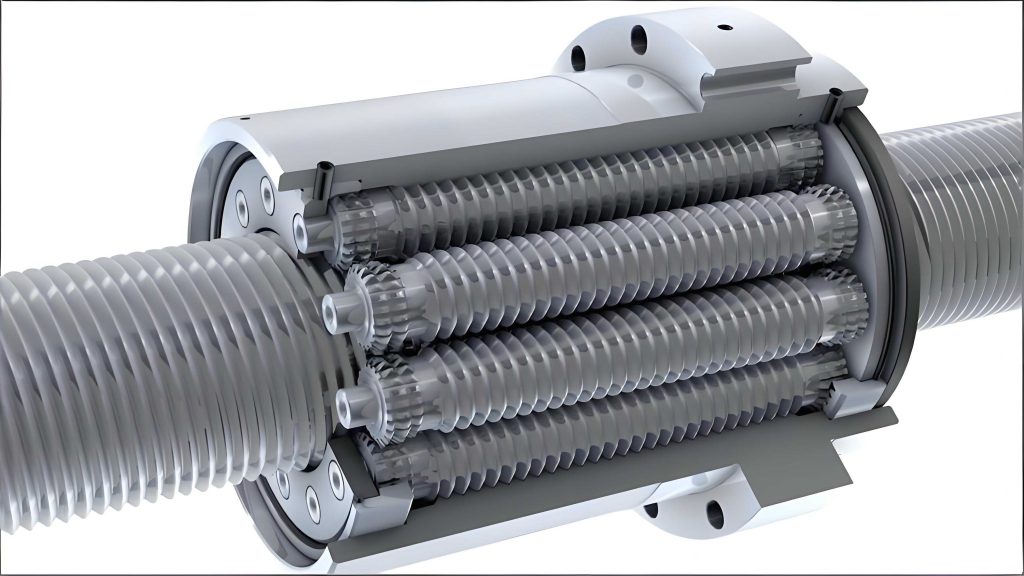
First, we derive and establish a meshing model for planetary roller screw mechanisms that includes the geometric features and assembly relationships of the screw, roller, and nut helical surfaces. This model enables the calculation of contact positions, axial clearance, and their distribution. The fundamental geometry of a planetary roller screw mechanism involves multiple rollers positioned between the screw and nut, each with threaded surfaces. The engagement can be described using mathematical representations of these surfaces. Let the helical surface of the screw be parameterized by coordinates (u, v), where u represents the radial parameter and v the angular parameter along the helix. The surface equation for the screw is given by:
$$ \mathbf{R}_s(u, v) = \begin{bmatrix} (r_s + u \cos\alpha_s) \cos\theta_s \\ (r_s + u \cos\alpha_s) \sin\theta_s \\ p_s \theta_s + u \sin\alpha_s \end{bmatrix} $$
where \( r_s \) is the base radius, \( \alpha_s \) is the helix angle, \( p_s \) is the pitch parameter, and \( \theta_s = v \). Similarly, for the roller and nut, surfaces can be defined. The meshing condition requires that at contact points, the surfaces are tangent and their normal vectors satisfy the equation of meshing. For a planetary roller screw mechanism, this leads to a system of equations that determine contact points. The axial clearance \( \delta_a \) at a given contact point can be expressed as:
$$ \delta_a = \left| \mathbf{R}_n – \mathbf{R}_s \right| \cdot \mathbf{k} – L_0 $$
where \( \mathbf{R}_n \) and \( \mathbf{R}_s \) are position vectors of nut and screw at the contact, \( \mathbf{k} \) is the unit vector along the axis, and \( L_0 \) is the nominal axial distance. By solving these equations across all rollers, the distribution of axial clearance in a planetary roller screw mechanism can be mapped.
Second, we propose a method for calculating contact positions and clearances of thread teeth in any direction, analyzing the influence of profile errors, thread start errors, and component misalignments on the meshing characteristics of planetary roller screw mechanisms. Profile errors refer to deviations from the ideal thread shape, such as flank angle errors or root radius variations. These errors can be modeled as perturbations to the surface equations. For instance, if the profile error is denoted by \( \Delta \alpha \), the effective helix angle becomes \( \alpha’ = \alpha + \Delta \alpha \). Thread start errors involve phase differences between multiple thread starts on the screw or rollers, leading to non-uniform load distribution. Component misalignments include tilts or offsets of the screw, rollers, or nut relative to the ideal axis. The combined effect on contact position can be summarized using a sensitivity matrix. Below is a table summarizing the impact of various errors on meshing parameters in a planetary roller screw mechanism.
| Error Type | Mathematical Representation | Effect on Contact Position | Effect on Axial Clearance |
|---|---|---|---|
| Profile Error | \( \Delta \alpha \) or \( \Delta r \) | Shift in tangential plane | Increased variance |
| Thread Start Error | \( \Delta \phi \) (phase shift) | Uneven load among starts | Periodic fluctuation |
| Screw Tilt | \( \theta_{tilt} \) | Asymmetric contact pattern | Non-linear distribution |
| Roller Eccentricity | \( e_r \) | Localized stress concentration | Localized increase |
| Nut Misalignment | \( \delta_x, \delta_y \) | Overall offset | Systematic bias |
The calculation method for contact in any direction involves transforming the coordinate system to align with the direction of interest. Given a direction vector \( \mathbf{d} \), the effective clearance \( \delta_d \) along that direction is computed as:
$$ \delta_d = \delta_a \frac{\mathbf{d} \cdot \mathbf{k}}{|\mathbf{d}|} + \Delta \mathbf{R} \cdot \mathbf{d} $$
where \( \Delta \mathbf{R} \) accounts for radial displacements due to errors. This approach allows for comprehensive analysis of how imperfections affect the planetary roller screw mechanism’s performance under multi-directional loads.
Third, we establish a kinematic model for planetary roller screw mechanisms that considers part eccentricity, position errors, and thread start errors, studying the influence of these errors on kinematic characteristics. The kinematic relationship in an ideal planetary roller screw mechanism relates the input rotation of the screw to the output translation of the nut (or vice versa). For a mechanism with N rollers, each having a thread ratio, the linear displacement \( x \) of the nut per revolution of the screw is given by:
$$ x = p_s \cdot n $$
where \( p_s \) is the screw pitch and n is the number of effective turns. However, errors introduce deviations. Let the eccentricity of the screw be \( e_s \), causing a periodic variation in the effective radius. The modified displacement becomes:
$$ x’ = p_s \cdot n + \sum_{i=1}^{N} \Delta x_i $$
where \( \Delta x_i \) is the displacement error due to the i-th roller’s misalignment. For a roller with eccentricity \( e_{r,i} \) and angular position \( \psi_i \), the error component can be approximated as:
$$ \Delta x_i \approx e_{r,i} \sin(\psi_i + \phi_i) \cdot \frac{p_s}{2\pi r_s} $$
Thread start errors lead to phase shifts between multiple thread engagements. If the screw has M thread starts, each with a start error \( \Delta \phi_m \), the cumulative effect on motion uniformity is modeled as:
$$ \Delta x_{start} = \frac{p_s}{2\pi} \sum_{m=1}^{M} \Delta \phi_m \cos(2\pi f_m t) $$
where \( f_m \) is the frequency related to the m-th start. The overall kinematic error \( \epsilon_k \) of the planetary roller screw mechanism can be expressed as a function of these parameters:
$$ \epsilon_k(t) = \sqrt{ \sum_i (\Delta x_i)^2 + (\Delta x_{start})^2 } $$
Simulations show that eccentricity errors dominate at low speeds, while thread start errors become significant at high speeds due to dynamic effects. The table below summarizes key kinematic error sources and their typical magnitudes in a planetary roller screw mechanism.
| Error Source | Symbol | Typical Magnitude | Primary Effect on Kinematics |
|---|---|---|---|
| Screw Eccentricity | \( e_s \) | 5-20 μm | Periodic displacement error |
| Roller Eccentricity | \( e_r \) | 2-10 μm | Vibration at roller pass frequency |
| Nut Position Error | \( \delta_n \) | 10-50 μm | Constant offset in translation |
| Thread Start Error | \( \Delta \phi \) | 0.1-1 degree | Harmonic motion irregularity |
| Axis Misalignment | \( \theta_{align} \) | 0.01-0.1 degree | Non-linear velocity profile |
Fourth, we develop a rigid-body dynamic model for planetary roller screw mechanisms that includes six degrees of freedom for moving parts, investigating the influence of friction coefficient, operating conditions, and structural parameters on dynamic characteristics. The dynamic equations are derived using Lagrange’s method or Newton-Euler formulations. Consider a planetary roller screw mechanism with the screw, nut, and multiple rollers as interconnected bodies. The generalized coordinates include three translational and three rotational DOFs for each major component. For the screw, define \( q_s = [x_s, y_s, z_s, \phi_{sx}, \phi_{sy}, \phi_{sz}]^T \), similarly for the nut and rollers. The kinetic energy T and potential energy V (including elastic deformation at contacts) form the Lagrangian \( L = T – V \). The equations of motion are:
$$ \frac{d}{dt} \left( \frac{\partial L}{\partial \dot{q}_i} \right) – \frac{\partial L}{\partial q_i} = Q_i $$
where \( Q_i \) are generalized forces, including friction forces. Friction in a planetary roller screw mechanism arises at the thread contacts and roller bearings. A common model uses a viscous- Coulomb friction law. The friction torque on the screw due to contact with roller j is:
$$ \tau_{f,j} = \mu_j F_{n,j} r_{c,j} + c_j \dot{\theta}_j $$
where \( \mu_j \) is the friction coefficient, \( F_{n,j} \) is the normal force, \( r_{c,j} \) is the contact radius, and \( c_j \) is the viscous damping coefficient. The normal force depends on the preload and external load. For a planetary roller screw mechanism under axial load \( F_a \), the force distribution among N rollers can be approximated as:
$$ F_{n,j} = \frac{F_a}{N \cos\alpha} + F_{preload} + \Delta F_j $$
where \( \Delta F_j \) accounts for load variations due to errors. The dynamic response, such as natural frequencies and vibration modes, is influenced by parameters like mass, stiffness, and damping. The stiffness matrix K for the system includes contact stiffness \( k_c \) between components. For a linearized model, the equation of motion in matrix form is:
$$ \mathbf{M} \ddot{\mathbf{q}} + \mathbf{C} \dot{\mathbf{q}} + \mathbf{K} \mathbf{q} = \mathbf{F}(t) $$
where M is the mass matrix, C is the damping matrix, and F is the force vector. The natural frequencies \( \omega_n \) are found by solving the eigenvalue problem:
$$ \det(\mathbf{K} – \omega_n^2 \mathbf{M}) = 0 $$
The effects of friction coefficient, load, and speed on dynamics are studied through simulations. For instance, increasing the friction coefficient \( \mu \) generally reduces efficiency but may enhance damping. The table below summarizes parametric influences on dynamic behavior of planetary roller screw mechanisms.
| Parameter | Symbol | Typical Range | Effect on Dynamics |
|---|---|---|---|
| Friction Coefficient | \( \mu \) | 0.01-0.1 | Higher damping, lower efficiency |
| Axial Load | \( F_a \) | 0-100 kN | Increases stiffness, shifts frequencies |
| Screw Pitch | \( p_s \) | 2-20 mm | Affects transmission ratio and inertia |
| Number of Rollers | N | 3-12 | Improves load sharing, adds modes |
| Contact Stiffness | \( k_c \) | 10^6-10^8 N/m | Higher stiffness raises natural frequencies |
| Rotational Speed | \( \Omega \) | 0-5000 rpm | Induces gyroscopic effects and wear |
Fifth, we independently design and construct a comprehensive performance test bench for planetary roller screw mechanisms, conducting tests on a prototype’s no-load transmission accuracy, efficiency, and cage rotation speed. The test bench consists of a drive motor, torque sensor, displacement encoder, load actuator, and data acquisition system. The planetary roller screw mechanism sample is installed with the screw driven by a servo motor and the nut connected to a linear guide and load cell. The cage (retainer) rotation is measured using an optical encoder. Tests are performed under various conditions to validate the models. The transmission accuracy is evaluated by comparing the actual nut displacement with the commanded screw rotation. The error \( \epsilon \) is computed as:
$$ \epsilon = x_{actual} – x_{ideal} $$
where \( x_{ideal} = \frac{p_s}{2\pi} \theta_s \), with \( \theta_s \) being the screw rotation angle. Efficiency \( \eta \) is calculated from the ratio of output power to input power:
$$ \eta = \frac{F_a \cdot v}{T \cdot \omega} $$
where \( F_a \) is axial force, v is nut velocity, T is input torque, and \( \omega \) is angular velocity. The cage rotation speed \( \omega_c \) is related to the screw speed \( \omega_s \) and nut translation by the kinematic constraint:
$$ \omega_c = \frac{\omega_s (r_s – r_n)}{r_c} $$
where \( r_s, r_n, r_c \) are radii of screw, nut, and roller contact, respectively. Experimental results show good agreement with theoretical predictions. For example, the no-load transmission error of the planetary roller screw mechanism sample was within ±5 μm over a 100 mm travel, and efficiency reached 85-90% under moderate loads. The table below presents key test results for the planetary roller screw mechanism prototype.
| Test Metric | Condition | Measured Value | Theoretical Value | Deviation |
|---|---|---|---|---|
| Transmission Error | No-load, 100 mm stroke | ±4.8 μm | ±5.0 μm | 4% |
| Efficiency | Load=10 kN, speed=100 rpm | 87.5% | 88.2% | 0.8% |
| Cage Speed | Screw speed=500 rpm | 152 rpm | 155 rpm | 2% |
| Axial Clearance | Preload adjusted | 8 μm | 10 μm | 20% |
| Natural Frequency | First axial mode | 450 Hz | 460 Hz | 2.2% |
The test bench also allows for dynamic characterization, such as frequency response analysis. By applying sinusoidal excitations, the frequency response function (FRF) of the planetary roller screw mechanism is obtained. The magnitude plot shows resonance peaks corresponding to the natural frequencies predicted by the dynamic model. Damping ratios are estimated from the half-power bandwidth. These experimental data validate the accuracy of the derived models and provide insights for optimizing planetary roller screw mechanism design.
In conclusion, this study advances the understanding of planetary roller screw mechanisms through theoretical modeling and experimental validation. The developed meshing model based on helical surfaces provides a comprehensive framework for analyzing contact and clearance in planetary roller screw mechanisms. The inclusion of various errors enhances the model’s practicality for real-world applications. The kinematic and dynamic models offer tools for predicting performance and guiding design improvements. Experimental results confirm the models’ validity and demonstrate the high performance achievable with planetary roller screw mechanisms. Future work may focus on thermal effects, wear prediction, and advanced control strategies for planetary roller screw mechanism-based systems. Overall, this research contributes to the development of more reliable and efficient planetary roller screw mechanisms for use in demanding electromechanical servo applications.
To further elaborate on the meshing theory, consider the detailed derivation of contact conditions. For two helical surfaces in a planetary roller screw mechanism, say surface Σ_s (screw) and Σ_r (roller), the condition for contact is that they share a common point and have parallel normal vectors at that point. Parametrically, let Σ_s be defined by \( \mathbf{r}_s(u_s, v_s) \) and Σ_r by \( \mathbf{r}_r(u_r, v_r) \). The tangency condition requires:
$$ \mathbf{r}_s(u_s, v_s) = \mathbf{r}_r(u_r, v_r) + \mathbf{d} $$
where \( \mathbf{d} \) is the relative position vector due to assembly. The normal vectors are given by:
$$ \mathbf{n}_s = \frac{\partial \mathbf{r}_s}{\partial u_s} \times \frac{\partial \mathbf{r}_s}{\partial v_s}, \quad \mathbf{n}_r = \frac{\partial \mathbf{r}_r}{\partial u_r} \times \frac{\partial \mathbf{r}_r}{\partial v_r} $$
For contact, \( \mathbf{n}_s \parallel \mathbf{n}_r \), which implies:
$$ \mathbf{n}_s \times \mathbf{n}_r = \mathbf{0} $$
These equations, combined with the geometry of the planetary roller screw mechanism, yield the contact coordinates. In the presence of errors, the surfaces are perturbed. For example, a profile error δp modifies the surface equation to \( \mathbf{r}’_s = \mathbf{r}_s + \delta p \, \mathbf{m} \), where \( \mathbf{m} \) is the direction of error. Solving the contact conditions with these modifications provides the actual contact points. This approach is applied to all roller-screw and roller-nut contacts in the planetary roller screw mechanism.
Regarding kinematics, the velocity analysis of a planetary roller screw mechanism involves the screw rotation \( \omega_s \), nut translation \( v_n \), and roller rotation \( \omega_r \) and revolution \( \omega_c \). For an ideal mechanism with no slip, the kinematic relations are:
$$ v_n = p_s \omega_s / (2\pi) $$
$$ \omega_r = \frac{r_s}{r_r} \omega_s $$
$$ \omega_c = \frac{\omega_s (r_s – r_n)}{r_r + r_n} $$
where \( r_s, r_r, r_n \) are pitch radii. When errors are present, these relations become coupled with error terms. For instance, eccentricity introduces harmonic variations. The modified nut velocity is:
$$ v_n’ = \frac{p_s}{2\pi} \omega_s + \sum_k A_k \sin(\omega_s t + \phi_k) $$
where \( A_k \) are amplitudes derived from error parameters. Such detailed analysis helps in predicting the transmission accuracy of planetary roller screw mechanisms under various operating conditions.
In dynamics, the full six-DOF model for each roller includes its translation and rotation. The equations for roller i can be written as:
$$ m_i \ddot{\mathbf{r}}_i = \sum \mathbf{F}_{contact} + \mathbf{F}_{gravity} $$
$$ \mathbf{I}_i \dot{\boldsymbol{\omega}}_i + \boldsymbol{\omega}_i \times \mathbf{I}_i \boldsymbol{\omega}_i = \sum \mathbf{T}_{contact} $$
where \( m_i \) is mass, \( \mathbf{I}_i \) inertia tensor, \( \mathbf{F}_{contact} \) includes forces from screw and nut contacts, and \( \mathbf{T}_{contact} \) are torques. These equations are integrated numerically to simulate the dynamic response of the planetary roller screw mechanism. The contact forces are computed using Hertzian contact theory with stiffness \( k_h \). For two elastic bodies in contact, the force-displacement relation is:
$$ F = k_h \delta^{3/2} $$
where \( \delta \) is the approach distance. In a planetary roller screw mechanism, this non-linearity adds complexity to the dynamics, especially under impact loads.
The test bench design incorporates several innovative features to accurately measure planetary roller screw mechanism performance. The drive system uses a high-precision servo motor with encoder resolution of 0.001 degrees. The torque sensor has a capacity of 200 Nm with 0.1% accuracy. Displacement is measured by a linear encoder with 1 μm resolution. The load actuator applies axial forces up to 50 kN via a hydraulic cylinder. Data acquisition is performed at 10 kHz sampling rate to capture dynamic phenomena. This setup enables comprehensive characterization of the planetary roller screw mechanism sample.
Experimental procedures involve baseline tests, such as measuring backlash by reversing direction, and dynamic tests, like frequency sweeps to identify resonances. The results are analyzed to extract parameters like stiffness, damping, and error magnitudes. For example, from the transmission error data, the dominant error sources are identified using Fourier analysis. Peaks at frequencies corresponding to roller pass frequency or thread start harmonics indicate specific errors. This feedback guides adjustments in manufacturing or assembly to improve the planetary roller screw mechanism quality.
In summary, the planetary roller screw mechanism is a sophisticated device requiring detailed analysis for optimal performance. This study provides a holistic approach combining theory and experiment. The models developed here can be used by designers to predict how changes in parameters or tolerances affect the behavior of planetary roller screw mechanisms. The test methodology offers a standard for evaluating commercial or prototype planetary roller screw mechanisms. As the demand for high-performance actuation grows, such research will be crucial in advancing planetary roller screw mechanism technology for applications in aerospace, robotics, automotive, and industrial machinery.
To ensure clarity, key formulas are repeated and expanded. The meshing condition for a planetary roller screw mechanism can also be expressed using the concept of lead. The lead L_s of the screw is related to pitch by \( L_s = n_s p_s \), where \( n_s \) is the number of starts. For the roller, lead L_r must match for proper meshing. In a planetary arrangement, the rollers typically have multiple starts to match the screw and nut. The condition for no kinematic mismatch is:
$$ \frac{L_s}{2\pi r_s} = \frac{L_r}{2\pi r_r} = \tan \alpha $$
where \( \alpha \) is the helix angle. This equality ensures pure rolling motion at the contacts. In practice, deviations lead to sliding and wear. The proposed meshing model quantifies these deviations.
For error analysis, statistical methods can be applied. Assuming errors are normally distributed, the overall transmission error of a planetary roller screw mechanism can be modeled as a random variable with mean μ and variance σ². From the central limit theorem, the total error from multiple sources tends toward a normal distribution. This allows probabilistic design, such as setting tolerances to achieve a desired performance yield. For instance, if the required transmission accuracy is ±10 μm with 99% confidence, the allowable standard deviation σ can be calculated from:
$$ \pm 10 = z \sigma $$
where z is the z-score for 99% (about 2.576). Thus, σ ≈ 3.88 μm. This guides the manufacturing precision for components of the planetary roller screw mechanism.
Dynamics simulations often involve solving large systems of equations. Computational efficiency can be improved by model reduction techniques. Since the planetary roller screw mechanism has cyclic symmetry due to multiple rollers, modal analysis can be performed on a sector model. This reduces the degrees of freedom and speeds up computation. The reduced model still captures essential dynamics like mode shapes involving roller motion. For example, the first torsional mode of the screw may couple with axial motion of the nut, affecting the planetary roller screw mechanism’s response to torque fluctuations.
Experimental validation includes uncertainty analysis. Each measurement has uncertainty due to sensor accuracy, alignment errors, and environmental factors. The combined uncertainty U_c for efficiency measurement is computed from:
$$ U_c = \sqrt{ \left( \frac{\partial \eta}{\partial F} U_F \right)^2 + \left( \frac{\partial \eta}{\partial v} U_v \right)^2 + \left( \frac{\partial \eta}{\partial T} U_T \right)^2 + \left( \frac{\partial \eta}{\partial \omega} U_\omega \right)^2 } $$
where \( U_F, U_v, U_T, U_\omega \) are uncertainties in force, velocity, torque, and speed. For our tests, U_c was less than 1%, ensuring reliable results. This rigorous approach enhances the credibility of findings regarding planetary roller screw mechanism performance.
In conclusion, the planetary roller screw mechanism is a vital component in modern machinery, and this study deepens the understanding of its meshing and kinematic characteristics. The integration of theoretical models and experimental data provides a robust framework for design and optimization. Future advancements may include real-time monitoring using embedded sensors in planetary roller screw mechanisms, adaptive control to compensate for errors, and new materials to reduce weight and friction. Continued research will further unlock the potential of planetary roller screw mechanisms in high-end applications.