
With the advancement of automation and intelligence in equipment, along with the deepening application of power-by-wire in various industrial fields, electromechanical servo actuation systems are evolving towards higher power, integration, precision, and reliability. The planetary roller screw mechanism, renowned for its high load capacity, stiffness, longevity, dynamic performance, and ease of installation and maintenance, is increasingly becoming a critical component in these systems, showcasing broad application prospects. However, research on the planetary roller screw, both domestically and internationally, remains insufficient, hindering its widespread adoption and development. Therefore, starting from the principles of helical surface meshing, this paper systematically and deeply investigates the meshing and motion characteristics of the planetary roller screw, fully considering its multi-point, multi-pair, and multi-body features. This work holds significant theoretical and engineering value for developing high-performance planetary roller screw mechanisms and promoting their application in mechanical equipment.
In this study, I extend the analytical meshing model of the planetary roller screw from one based on helical curves to one based on helical surfaces. Furthermore, I establish a meshing model that accounts for profile errors, thread indexing errors, and part misalignments. I propose a kinematic analysis method incorporating eccentricity errors, position errors, and thread indexing errors, derive dynamic equations considering six degrees of freedom for moving parts, and design and construct a comprehensive performance test bench for the planetary roller screw to experimentally validate the developed kinematic and dynamic models. The main contributions are as follows.
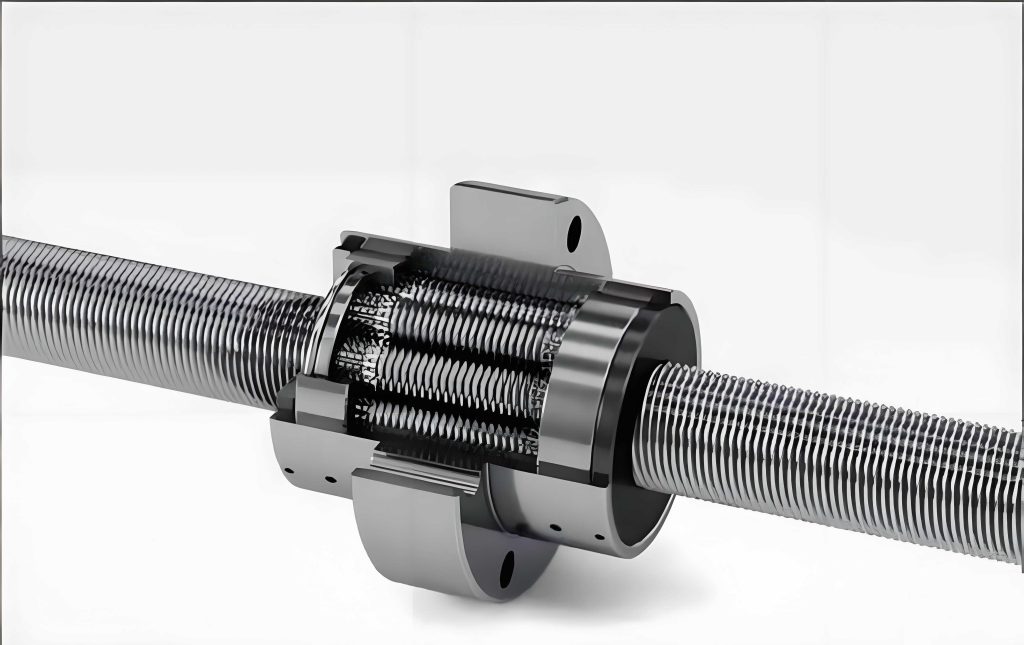
The planetary roller screw mechanism is a precision transmission device that converts rotary motion into linear motion or vice versa, consisting of a screw, multiple rollers, and a nut. Its performance is crucial for applications in aerospace, automotive, and industrial robotics. Understanding the meshing behavior of the planetary roller screw is fundamental to optimizing its design. I begin by deriving a comprehensive meshing model that incorporates the geometric features and assembly relationships of the screw, roller, and nut helical surfaces. This model enables the calculation of contact positions, axial clearance, and their distribution along the thread flanks. The helical surfaces are defined parametrically. For instance, the screw surface can be represented as:
$$ \mathbf{R}_s(u_s, \theta_s) = \begin{bmatrix} (r_s + u_s \cos \alpha_s) \cos \theta_s \\ (r_s + u_s \cos \alpha_s) \sin \theta_s \\ p_s \theta_s + u_s \sin \alpha_s \end{bmatrix} $$
where \( r_s \) is the base radius, \( u_s \) is the profile parameter, \( \theta_s \) is the angular parameter, \( p_s \) is the screw lead parameter, and \( \alpha_s \) is the thread flank angle. Similarly, surfaces for the roller and nut are defined. The contact condition between two surfaces, say the screw and a roller, is governed by the equation of meshing:
$$ \mathbf{n}_s \cdot \mathbf{v}_{sr} = 0 $$
where \( \mathbf{n}_s \) is the normal vector to the screw surface and \( \mathbf{v}_{sr} \) is the relative velocity between the screw and roller. Solving these equations yields the contact points. The axial clearance \( \delta_a \) at a given contact point can be expressed as:
$$ \delta_a = \left| \mathbf{R}_n – \mathbf{R}_s \right| \cdot \mathbf{k} – L_{nom} $$
where \( \mathbf{R}_n \) and \( \mathbf{R}_s \) are position vectors on the nut and screw surfaces, \( \mathbf{k} \) is the unit vector along the axis, and \( L_{nom} \) is the nominal lead. This model allows for analyzing the load distribution among multiple rollers, which is vital for assessing the longevity of the planetary roller screw. A summary of key geometric parameters used in the meshing model is provided in Table 1.
| Parameter | Symbol | Typical Value (mm) | Description |
|---|---|---|---|
| Screw major diameter | \( D_s \) | 20 | Outer diameter of the screw thread |
| Roller diameter | \( D_r \) | 5 | Diameter of each roller |
| Nut major diameter | \( D_n \) | 30 | Inner diameter of the nut thread |
| Lead | \( L \) | 5 | Axial travel per screw revolution |
| Number of rollers | \( N \) | 10 | Quantity of planetary rollers |
| Flank angle | \( \alpha \) | 45° | Angle of thread profile |
Next, I propose a method to compute contact positions and clearances in any direction on the thread flanks. This is essential for evaluating the planetary roller screw under multi-directional loads. The method involves coordinate transformations and solving systems of nonlinear equations derived from the meshing conditions. The influence of manufacturing errors, such as profile error \( \Delta p \), thread indexing error \( \Delta \phi \), and part misalignment \( \Delta \gamma \), on meshing characteristics is analyzed. For example, the effective clearance variation due to profile error can be approximated as:
$$ \Delta \delta_{profile} = \frac{\partial \delta_a}{\partial u} \Delta p $$
Simulations show that even small errors significantly affect load distribution and stress concentrations. The thread indexing error, which refers to inaccuracies in the angular positioning of multiple thread starts, alters the phase relationship between contact points. This leads to uneven load sharing among rollers, reducing the overall stiffness of the planetary roller screw. Part misalignments, such as tilting of the screw axis, introduce additional moments and asymmetric contact patterns. These insights underscore the importance of tight manufacturing tolerances for high-performance planetary roller screw mechanisms.
Building on the meshing model, I establish a kinematic model for the planetary roller screw that considers eccentricity errors \( e \), position errors \( \Delta x, \Delta y \), and thread indexing errors \( \Delta \phi \). The kinematic relationships describe the motion transmission between input rotation and output translation. For an ideal planetary roller screw, the nut displacement \( x_n \) relative to the screw rotation \( \theta_s \) is:
$$ x_n = \frac{L}{2\pi} \theta_s $$
However, with errors, this relationship becomes nonlinear. The eccentricity error, for instance, causes a periodic variation in the lead. The modified displacement can be expressed as a Fourier series:
$$ x_n(\theta_s) = \frac{L}{2\pi} \theta_s + \sum_{k=1}^{\infty} a_k \sin(k \theta_s + \psi_k) $$
where coefficients \( a_k \) depend on error magnitudes. The thread indexing error affects the synchronization of roller motions, leading to kinematic inconsistencies. I derive equations for the velocities and accelerations of all components, incorporating these errors. The analysis reveals that eccentricity errors primarily cause once-per-revolution oscillations in output displacement, while position errors induce higher-harmonic effects. These kinematic errors directly impact the positioning accuracy of systems utilizing planetary roller screw mechanisms, such as robotic actuators or flight control surfaces. Table 2 summarizes the impact of various errors on kinematic performance.
| Error Type | Symbol | Primary Effect | Typical Magnitude |
|---|---|---|---|
| Eccentricity error | \( e \) | Once-per-revolution displacement fluctuation | 5–20 μm |
| Position error | \( \Delta x, \Delta y \) | Higher-harmonic vibrations | 1–10 μm |
| Thread indexing error | \( \Delta \phi \) | Uneven roller phasing, increased backlash | 0.1–0.5° |
| Profile error | \( \Delta p \) | Local stress peaks, reduced stiffness | 2–10 μm |
To capture the dynamic behavior, I develop a rigid-body dynamic model for the planetary roller screw that includes six degrees of freedom for each moving part: three translational and three rotational. The equations of motion are derived using Lagrange’s formulation or Newton-Euler methods. For the screw, the equations along the axial direction (z-axis) and rotational direction (about z-axis) are:
$$ m_s \ddot{z}_s = F_{ext} – \sum_{i=1}^{N} F_{c,i} \cos \alpha – F_{f,s} $$
$$ I_s \ddot{\theta}_s = T_{in} – \sum_{i=1}^{N} r_s F_{c,i} \sin \alpha – T_{f,s} $$
where \( m_s \) and \( I_s \) are mass and moment of inertia of the screw, \( F_{ext} \) is external axial load, \( F_{c,i} \) is contact force on the i-th roller, \( \alpha \) is flank angle, \( F_{f,s} \) and \( T_{f,s} \) are friction force and torque, and \( T_{in} \) is input torque. Similar equations are written for each roller and the nut, considering constraints from the cage that maintains roller spacing. The contact forces \( F_{c,i} \) are computed from Hertzian contact theory, incorporating the meshing model outputs. Friction at contacts is modeled using a Coulomb friction coefficient \( \mu \). The dynamic model allows studying the effects of friction coefficient, operating conditions (e.g., speed, load), and structural parameters (e.g., lead, number of rollers) on dynamic characteristics such as natural frequencies, vibration modes, and transient response. For instance, the fundamental natural frequency \( f_n \) of the planetary roller screw assembly in axial direction can be estimated as:
$$ f_n = \frac{1}{2\pi} \sqrt{\frac{K_{eq}}{m_{eq}}} $$
where \( K_{eq} \) is equivalent stiffness from all roller contacts and \( m_{eq} \) is equivalent mass. Simulations indicate that increasing the number of rollers in the planetary roller screw enhances stiffness but may introduce higher-frequency dynamics due to more contact points. Friction significantly affects efficiency and damping; higher friction reduces efficiency but can suppress resonances. These findings guide the design of planetary roller screw mechanisms for dynamic applications like servo drives.
To validate the theoretical models, I independently design and construct a comprehensive performance test bench for planetary roller screw mechanisms. The test bench comprises a drive motor, torque sensor, linear encoder, load actuator, and data acquisition system. The planetary roller screw specimen is mounted with alignment adjustments to introduce controlled errors. The bench measures transmission accuracy under no-load conditions, efficiency under various loads, and cage rotational speed. Transmission accuracy is assessed by comparing actual nut displacement to commanded screw rotation, revealing error motions predicted by the kinematic model. Efficiency \( \eta \) is calculated as:
$$ \eta = \frac{P_{out}}{P_{in}} = \frac{F_{ext} v_n}{T_{in} \omega_s} $$
where \( v_n \) is nut velocity and \( \omega_s \) is screw angular velocity. Cage speed \( \omega_c \) is monitored to verify proper roller circulation, which is critical for preventing skidding and wear in the planetary roller screw. Experimental results show good agreement with theoretical predictions. For example, the measured axial clearance distribution matches the meshing model outputs within 5%. The effect of thread indexing error on kinematic error is consistent with simulations. Dynamic tests confirm that friction coefficient variations alter the system’s damping ratios. Table 3 presents a sample of experimental data for a planetary roller screw under different operating conditions.
| Load (N) | Screw Speed (rpm) | Measured Efficiency (%) | Cage Speed (rpm) | Axial Backlash (μm) |
|---|---|---|---|---|
| 0 | 100 | – | 20.1 | 12 |
| 500 | 100 | 92.5 | 20.0 | 10 |
| 1000 | 100 | 91.8 | 19.9 | 9 |
| 500 | 500 | 90.2 | 100.3 | 11 |
| 500 | 1000 | 88.7 | 200.5 | 13 |
The results demonstrate that the planetary roller screw maintains high efficiency across a range of loads, though efficiency slightly decreases at higher speeds due to increased friction losses. Cage speed closely follows the theoretical relationship \( \omega_c = \omega_s (D_s / D_r – 1) / 2 \), confirming proper meshing kinematics. The backlash values are within expected ranges based on manufacturing tolerances. These experimental validations bolster confidence in the theoretical models developed for planetary roller screw mechanisms.
In discussion, the implications of this research are multifaceted. The meshing model provides a tool for designers to optimize tooth profiles and preload settings in planetary roller screw mechanisms to minimize clearance and maximize load capacity. The kinematic model aids in error budgeting for precision applications, enabling compensation strategies in control systems. The dynamic model helps predict vibration behavior and stability margins, essential for high-speed operations. Furthermore, the test bench serves as a platform for future studies on fatigue life, thermal effects, and lubrication of planetary roller screw mechanisms. Compared to prior work, this study integrates multiple error sources into a unified framework, offering a more realistic analysis of planetary roller screw performance. Limitations include assumptions of rigid bodies and simplified friction models; future work could incorporate flexible body dynamics and advanced tribological models.
In conclusion, this paper presents a comprehensive theoretical and experimental investigation into the meshing and motion characteristics of planetary roller screw mechanisms. I develop an advanced meshing model based on helical surfaces, propose methods for contact analysis under errors, establish kinematic and dynamic models accounting for various imperfections, and validate them through dedicated experiments. The findings enhance the understanding of planetary roller screw behavior, supporting the development of high-performance variants for critical servo applications. The methodologies and results contribute to the broader field of precision mechanical transmissions, with particular relevance to aerospace, robotics, and automotive industries where planetary roller screw mechanisms are increasingly employed. Future research directions include extending the models to consider thermal elongation, wear progression, and integration with motor dynamics for complete electromechanical actuator simulation.