
On September 2, a signing ceremony for Jiangxi Luyou Robotics Joint Venture Company was held in Xun, marking the formal start of Jiangxi’s first self-owned humanoid robot brand. The event signaled the beginning of a new phase in the province’s effort to build a localized humanoid robot manufacturing base, strengthen the humanoid robot industrial chain, and connect humanoid robot development with real application scenarios, data systems, and operating-system integration.
The project is an embodied intelligence initiative jointly built through cooperation between state-owned capital and social capital. It takes independent-brand whole-machine manufacturing as its lead and is designed to focus on supplementing and strengthening the full humanoid robot industrial chain. The project is expected to reinforce core capabilities in humanoid robot whole-machine assembly while addressing shortfalls in key links such as components, data, algorithms, and operating systems. It will also link key enterprises within Jiangxi with high-quality external resources to build an industrial ecosystem characterized by whole-machine traction, component support, data empowerment, and scenario iteration.
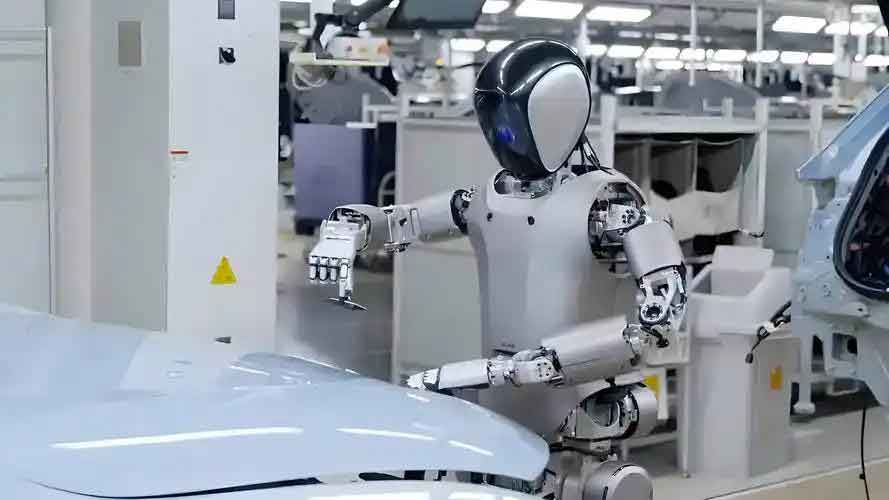
1. Signing Marks Formal Start of Jiangxi Humanoid Robot Brand
The signing of the joint venture is a concrete step toward filling the gap in Jiangxi’s localized large-scale humanoid robot manufacturing and self-owned humanoid robot brand development. The project is not limited to a single product line or a single technology link. Instead, it is positioned as a platform for building a broader humanoid robot industrial system that can support manufacturing, application, data accumulation, and technology adaptation in a coordinated manner.
The announcement stated that the project will build an independent-brand whole-machine production line in Poyang Lake Eco-Technology City. This production line is intended to support humanoid robot research and development as well as production for multiple scenarios, including industrial operations, government services, cultural tourism and health care, park operations, and ecological governance. The combination of whole-machine manufacturing and scenario-oriented development is central to the project’s approach to humanoid robot industrialization.
The launch of a self-owned humanoid robot brand in Jiangxi reflects a wider effort to connect regional manufacturing capacity with the emerging embodied intelligence sector. For the humanoid robot industry, the ability to move from prototype development to whole-machine assembly, testing, debugging, small-batch trial production, and large-scale production is a critical pathway. The project is designed to address these stages in an integrated manner, giving the humanoid robot brand a practical manufacturing foundation rather than a purely research-oriented identity.
2. Capital Cooperation and Industrial Mission
The humanoid robot project is structured as a joint venture involving state-owned capital and social capital. This cooperative model is intended to combine public-sector strategic support with market-oriented resources and operational flexibility. For a humanoid robot project that spans manufacturing, software, data, and application scenarios, such cooperation can help align long-term industrial development with commercial viability and local ecosystem building.
The industrial mission of the project is broad. It will focus on the full humanoid robot industrial chain, with whole-machine assembly as the core capability. At the same time, it will seek to strengthen weak links in components, data, algorithms, and operating systems. This approach recognizes that a humanoid robot brand cannot be built through assembly alone. It requires coordinated progress in hardware, software, data, and scenario adaptation, all of which are essential to the performance and reliability of humanoid robot products.
The project will also link key enterprises within Jiangxi and external high-quality resources. This is important for a humanoid robot ecosystem because the technology and supply chain requirements of humanoid robot development are highly interdisciplinary. By connecting local enterprises with external capabilities, the project aims to create a humanoid robot industrial network that supports whole-machine production while gradually improving local supporting capacity.
3. Whole-Machine Manufacturing at the Core
Whole-machine assembly is positioned as the leading capability of the project. The project will build an independent-brand humanoid robot whole-machine production line and will focus on research, development, and production of humanoid robot products suitable for multiple scenarios. The emphasis on whole-machine manufacturing gives the humanoid robot brand a clear industrial anchor and provides a basis for integrating components, software, data, and application requirements into a complete product system.
The production line is expected to cover whole-machine assembly, debugging, testing, small-batch trial production, and large-scale production. These stages are essential for transforming humanoid robot designs into market-ready products. In the humanoid robot sector, assembly and testing are not simple tasks because humanoid robot systems involve complex mechanical structures, sensors, control systems, and software stacks. The project’s focus on these processes suggests that the humanoid robot brand will be built around practical manufacturing capabilities and productization pathways.
The whole-machine manufacturing approach also provides a platform for attracting upstream and downstream supporting enterprises to gather in Poyang Lake Eco-Technology City. As the humanoid robot production line develops, component suppliers, software developers, testing service providers, and data-related enterprises may find opportunities to participate in the humanoid robot industrial chain. This clustering effect is important for reducing coordination costs and improving the responsiveness of the humanoid robot supply chain.
4. Full-Chain Strategy and Localization
The project will focus on supplementing and strengthening the full humanoid robot industrial chain. It will reinforce the core capability of whole-machine assembly while addressing key shortcomings in components, data, algorithms, and operating systems. This full-chain strategy is essential for building a sustainable humanoid robot industry. A self-owned humanoid robot brand needs not only final assembly capacity but also a reliable supply of components, a robust data pipeline, and software systems that can be adapted to local requirements.
The project will rely on UBTECH’s mature whole-machine technology and combine it with local scenario requirements to carry out localized secondary development. This approach is significant for the humanoid robot brand because it enables the project to build on proven whole-machine technology while adapting humanoid robot products to the specific needs of Jiangxi’s industrial, public-service, cultural, health-care, park-operation, and ecological-governance scenarios. Localized secondary development can help bridge the gap between general humanoid robot platforms and practical deployment requirements.
Through this localization strategy, the project aims to support humanoid robot assembly, debugging, testing, small-batch trial production, and large-scale production. It also aims to drive the aggregation of upstream and downstream supporting enterprises in Poyang Lake Eco-Technology City. The humanoid robot industrial chain is long and interconnected, and localization efforts can help create a denser network of suppliers and service providers around the humanoid robot production base.
5. Application Scenarios for Humanoid Robot Deployment
The project will focus on developing and producing humanoid robot products adapted to multiple scenarios. These scenarios include industrial operations, government services, cultural tourism and health care, park operations, and ecological governance. The selection of these scenarios indicates that the humanoid robot brand is being positioned for practical deployment across both economic production and public-service environments.
In industrial settings, humanoid robot products may support tasks that require mobility, perception, and interaction in complex environments. In government services, humanoid robot systems may be used to support service delivery and public interaction. In cultural tourism and health care, humanoid robot products may be adapted for visitor services, cultural experiences, and care-related assistance. In park operations and ecological governance, humanoid robot systems may support inspection, monitoring, and environmental management tasks. These scenario categories provide a broad testing ground for humanoid robot development and iterative improvement.
Scenario iteration is a key part of the project’s industrial ecosystem model. By deploying humanoid robot products in real environments, the project can collect operational feedback and use it to improve humanoid robot performance, reliability, and usability. This scenario-driven approach is important for the humanoid robot industry because real-world deployment often reveals requirements that cannot be fully anticipated in laboratory settings.
6. Data, Algorithms, and Training Infrastructure
The project will link with artificial intelligence, big data, and large-model training enterprises within Jiangxi to build a robot training dataset system. It will carry out multi-domain data collection and processing to provide data support for humanoid robot model iteration and optimization. Data is a foundational element for humanoid robot intelligence, and the ability to collect, process, and use data effectively can influence the pace of humanoid robot development.
The creation of a robot training dataset system is closely connected to the project’s broader humanoid robot industrial strategy. Humanoid robot systems need diverse data inputs to support perception, decision-making, interaction, and task execution. By building a dataset system across multiple domains, the project aims to create a data foundation that can support humanoid robot model training and continuous improvement. This data infrastructure is expected to complement the whole-machine manufacturing and scenario deployment activities of the humanoid robot brand.
The involvement of artificial intelligence, big data, and large-model training enterprises also reflects the interdisciplinary nature of humanoid robot development. A humanoid robot brand cannot rely solely on mechanical engineering or hardware assembly. It must integrate data processing, algorithm development, model training, and system-level optimization. The project’s emphasis on data empowerment is therefore an important part of its effort to build a competitive humanoid robot ecosystem.
7. HarmonyOS Integration and Interconnectivity
The project will fully connect with Huawei HarmonyOS and promote system adaptation and porting for humanoid robot products. This integration is intended to support interconnection among robots, terminal devices, and platform backends. Operating-system integration is a significant step for humanoid robot deployment because it can affect compatibility, device coordination, and platform-level service integration.
For a self-owned humanoid robot brand, operating-system adaptation is not merely a technical detail. It is part of the broader product architecture that determines how humanoid robot systems interact with other devices and digital platforms. By promoting HarmonyOS adaptation and porting, the project aims to strengthen the humanoid robot brand’s ability to operate within connected environments and to support platform-based service models.
The interconnection among robots, terminal devices, and platform backends can also support scenario expansion. In complex application environments, humanoid robot products may need to exchange information with sensors, management platforms, and service systems. The project’s operating-system integration work is therefore aligned with its scenario-oriented humanoid robot development strategy and its goal of building a connected humanoid robot ecosystem.
8. Ecosystem Building and Regional Industrial Clustering
The project is designed to build an industrial ecosystem characterized by whole-machine traction, component support, data empowerment, and scenario iteration. This model places whole-machine manufacturing at the center while recognizing that components, data, and scenarios are essential supporting elements. For the humanoid robot industry, such an ecosystem approach can help coordinate different parts of the value chain and accelerate the transition from development to deployment.
The project’s location in Poyang Lake Eco-Technology City is central to its ecosystem-building strategy. The project will build an independent-brand whole-machine production line there and will seek to attract upstream and downstream supporting enterprises to gather in the same area. This clustering approach can support the humanoid robot supply chain by bringing component suppliers, software developers, data service providers, and application partners into closer proximity.
The project will also link key enterprises within Jiangxi and external high-quality resources. This combination of local and external capabilities can help the humanoid robot brand access specialized knowledge while building local industrial capacity. Over time, the humanoid robot ecosystem in Poyang Lake Eco-Technology City is expected to support a wider range of humanoid robot products and applications, strengthening Jiangxi’s position in the embodied intelligence sector.
9. Humanoid Robot Project Dimensions
| Project Dimension | Publicly Stated Focus |
|---|---|
| Location | Poyang Lake Eco-Technology City, Jiangxi |
| Brand Status | Jiangxi’s first self-owned humanoid robot brand |
| Capital Structure | Cooperation between state-owned capital and social capital |
| Manufacturing Focus | Independent-brand humanoid robot whole-machine production line |
| Industrial Chain Priorities | Components, data, algorithms, and operating systems |
| Technology Foundation | UBTECH mature whole-machine technology with localized secondary development |
| Application Scenarios | Industrial, government services, cultural tourism and health care, park operations, and ecological governance |
| Data and AI | Robot training dataset system with multi-domain data collection and processing |
| Operating System Integration | Huawei HarmonyOS adaptation and porting |
| Ecosystem Model | Whole-machine traction, component support, data empowerment, and scenario iteration |
10. Significance for Jiangxi’s Advanced Manufacturing
The launch of Jiangxi’s first self-owned humanoid robot brand is significant for the province’s advanced manufacturing development. The humanoid robot sector combines mechanical engineering, electronics, software, artificial intelligence, data processing, and system integration. By establishing a humanoid robot whole-machine production line and a self-owned humanoid robot brand, the project can help build local capabilities across multiple technology and manufacturing domains.
The project also addresses a specific gap in localized large-scale humanoid robot manufacturing and independent brand development. The humanoid robot industry requires not only research and development but also production engineering, testing, quality control, and supply-chain coordination. The project’s emphasis on whole-machine assembly, debugging, testing, small-batch trial production, and large-scale production reflects an awareness of these requirements and provides a practical path for humanoid robot industrialization in Jiangxi.
For local enterprises, participation in the humanoid robot industrial chain can create opportunities in components, software, data services, testing, and application integration. As the humanoid robot brand develops, these enterprises may become part of a broader humanoid robot ecosystem that supports both local deployment and external market expansion. The project’s linkage with key enterprises within Jiangxi and external high-quality resources is intended to support this ecosystem-building process.
11. Outlook for Humanoid Robot Industrialization
The humanoid robot industry is moving toward closer integration of manufacturing, data, software, and application scenarios. The project in Poyang Lake Eco-Technology City reflects this trend by combining whole-machine manufacturing with localized secondary development, robot training datasets, and operating-system integration. This integrated approach can support the humanoid robot brand’s efforts to move from product development to practical deployment.
In the coming development process, the humanoid robot project is expected to focus on strengthening whole-machine assembly capabilities while improving the supporting industrial chain. The project’s scenario-oriented strategy will provide opportunities for humanoid robot products to be tested and refined in real environments. The data and AI components will support humanoid robot model iteration, while HarmonyOS integration will support connectivity among robots, terminal devices, and platform backends.
The project’s ecosystem model, based on whole-machine traction, component support, data empowerment, and scenario iteration, provides a structured framework for humanoid robot industrialization. By linking manufacturing, technology, data, and application resources, the project aims to build a self-owned humanoid robot brand that can support multiple scenarios and contribute to the growth of Jiangxi’s embodied intelligence sector.
12. Conclusion
The signing of Jiangxi Luyou Robotics Joint Venture Company marks the formal start of Jiangxi’s first self-owned humanoid robot brand. The project will be located in Poyang Lake Eco-Technology City and will build an independent-brand humanoid robot whole-machine production line. It will focus on the full humanoid robot industrial chain, reinforce whole-machine assembly capabilities, and address key links in components, data, algorithms, and operating systems.
The humanoid robot project will rely on UBTECH’s mature whole-machine technology and carry out localized secondary development based on Jiangxi’s scenario requirements. It will support humanoid robot assembly, debugging, testing, small-batch trial production, and large-scale production, while attracting upstream and downstream supporting enterprises to gather in Poyang Lake Eco-Technology City. The project will also link artificial intelligence, big data, and large-model training enterprises to build a robot training dataset system and will fully connect with Huawei HarmonyOS to promote system adaptation and porting.
With its focus on industrial, government-service, cultural tourism and health-care, park-operation, and ecological-governance scenarios, the humanoid robot brand is positioned to support practical deployment and continuous iteration. The project reflects a coordinated effort to build a humanoid robot ecosystem that combines whole-machine manufacturing, component support, data empowerment, and scenario-driven development. As the humanoid robot initiative moves forward, it is expected to strengthen Jiangxi’s humanoid robot industrial chain and contribute to the broader development of embodied intelligence and advanced manufacturing in the region.