
As I reflect on the advancements in robotics, it is clear that embodied AI human robots represent a transformative frontier. These systems, which aim to mimic human-like interaction with the physical world, require significant technological leaps to overcome current limitations. In my analysis, the journey toward creating a truly autonomous AI human robot involves overcoming hurdles in perception, decision-making, motion control, and hardware integration. The AI human robot must seamlessly blend cognitive abilities with physical dexterity, a challenge that spans multiple disciplines including artificial intelligence, mechanical engineering, and materials science. Throughout this discussion, I will emphasize the critical role of the AI human robot in shaping future applications, from industrial automation to personal assistance, and highlight the key areas where innovation is urgently needed.
Fundamental Architecture of Embodied AI Human Robots
In my view, the embodied AI human robot operates on a framework that integrates perception, decision, action, and feedback loops. This holistic approach enables the AI human robot to adapt to dynamic environments, much like humans do. The perception module, for instance, relies on multi-sensor fusion to build a coherent model of the world. As an example, consider how an AI human robot uses visual, auditory, and tactile inputs to navigate a cluttered room. Mathematically, this can be represented as a state estimation problem:
$$ S_t = g(O_t, S_{t-1}, \Theta) $$
where \( S_t \) is the current state estimate, \( O_t \) represents observations from sensors, \( S_{t-1} \) is the previous state, and \( \Theta \) denotes model parameters. This equation underscores the need for robust algorithms in the AI human robot to handle uncertainty and noise.
Moreover, the decision-making module of an AI human robot often employs reinforcement learning (RL) to optimize actions. The RL framework for an AI human robot can be formalized using the Bellman equation:
$$ Q^*(s, a) = \mathbb{E} \left[ R(s, a) + \gamma \max_{a’} Q^*(s’, a’) \right] $$
where \( Q^*(s, a) \) is the optimal action-value function, \( R(s, a) \) is the reward, \( \gamma \) is the discount factor, and \( s’ \) is the next state. This formulation highlights how the AI human robot learns from interactions to improve its policies over time.
| Module | Function | Technologies Involved | Challenges for AI Human Robot |
|---|---|---|---|
| Perception | Sense environment | Computer vision, LiDAR, tactile sensors | Noise reduction, real-time processing |
| Decision | Plan actions | AI models, world models, reasoning | Generalization, ethical decision-making |
| Action | Execute movements | Actuators, control systems, kinematics | Precision, energy efficiency |
| Feedback | Learn and adapt | Sensor feedback, adaptive control | Continuous learning, stability |
This table illustrates the interconnected nature of these modules in an AI human robot. For instance, the feedback loop enables the AI human robot to refine its actions based on outcomes, akin to human muscle memory. In my experience, the integration of these components is what sets the AI human robot apart from traditional automated systems.
Advances in Cognitive Capabilities: The “Brain” of AI Human Robots
I have observed that the “brain” of an AI human robot has seen remarkable progress due to advancements in large-scale AI models. These models empower the AI human robot with natural language understanding and task planning, bridging the gap between digital intelligence and physical execution. For example, the AI human robot can interpret commands like “fetch the red object” by decomposing them into sub-tasks. This involves probabilistic reasoning, which can be modeled as:
$$ P(T | C) = \frac{P(C | T) P(T)}{P(C)} $$
where \( P(T | C) \) is the probability of task \( T \) given command \( C \), and \( P(C | T) \) is the likelihood derived from training data. Such Bayesian approaches enhance the reliability of the AI human robot in unstructured environments.
Furthermore, the AI human robot leverages transformer-based architectures for processing multi-modal inputs. The attention mechanism in these models can be expressed as:
$$ \text{Attention}(Q, K, V) = \text{softmax}\left(\frac{QK^T}{\sqrt{d_k}}\right)V $$
where \( Q \), \( K \), and \( V \) are query, key, and value matrices, and \( d_k \) is the dimensionality. This allows the AI human robot to focus on relevant sensory inputs, improving its decision-making speed and accuracy. In practice, I have seen AI human robots use this to prioritize tasks in real-time, such as avoiding obstacles while moving.
| Era | AI Technology | Impact on AI Human Robot | Limitations |
|---|---|---|---|
| Pre-2000s | Rule-based systems | Basic automation | Rigid, no adaptation |
| 2000-2010s | Machine learning | Improved perception | Limited generalization |
| 2020s onwards | Large language models | Context-aware decisions | High computational cost |
This table shows how the AI human robot has evolved from simple automata to sophisticated systems. However, I believe that the current AI human robot still struggles with common-sense reasoning, which is essential for handling novel situations. For instance, an AI human robot might understand language but fail to infer physical constraints without extensive training.
Motion Control and the “Small Brain” in AI Human Robots
In my analysis, the “small brain” of an AI human robot—responsible for motion control—is a critical yet underdeveloped area. Human-like locomotion and manipulation require precise coordination of multiple joints, which involves solving complex dynamics equations. For a bipedal AI human robot, the equations of motion can be derived using the Euler-Lagrange formulation:
$$ \frac{d}{dt} \left( \frac{\partial L}{\partial \dot{q}_i} \right) – \frac{\partial L}{\partial q_i} = \tau_i $$
where \( L = T – V \) is the Lagrangian, \( T \) is kinetic energy, \( V \) is potential energy, \( q_i \) are generalized coordinates, and \( \tau_i \) are generalized forces. This model helps in simulating and controlling the AI human robot’s movements, but real-world imperfections often lead to instability.
To address this, modern AI human robots use adaptive control algorithms that adjust parameters in real-time. A common approach is the proportional-integral-derivative (PID) controller with adaptation:
$$ u(t) = K_p e(t) + K_i \int_0^t e(\tau) d\tau + K_d \frac{de(t)}{dt} $$
where \( u(t) \) is the control signal, \( e(t) \) is the error, and \( K_p \), \( K_i \), \( K_d \) are gains tuned by machine learning. I have implemented such controllers in AI human robot prototypes, and they significantly improve performance in tasks like walking on uneven surfaces. However, the AI human robot still lags behind humans in agility, due to limitations in real-time processing and energy efficiency.
Moreover, the AI human robot must handle multi-contact scenarios, such as grasping objects while maintaining balance. This can be formulated as a constrained optimization problem:
$$ \min_{\mathbf{q}, \boldsymbol{\tau}} \left\| \mathbf{J} \dot{\mathbf{q}} – \mathbf{v}_d \right\|^2 \quad \text{subject to} \quad \mathbf{A} \mathbf{q} \leq \mathbf{b} $$
where \( \mathbf{J} \) is the Jacobian matrix, \( \dot{\mathbf{q}} \) is the joint velocity, \( \mathbf{v}_d \) is the desired velocity, and \( \mathbf{A} \mathbf{q} \leq \mathbf{b} \) represents physical constraints. Solving this efficiently is key to enhancing the AI human robot’s dexterity.
| Metric | Human Benchmark | Current AI Human Robot | Target for Improvement |
|---|---|---|---|
| Walking speed | 1.4 m/s | 0.5-1.0 m/s | 1.5 m/s with stability |
| Grasping precision | Sub-millimeter | Millimeter-level | Micro-scale manipulation |
| Energy consumption | 100 W (approximate) | 500-1000 W | Reduce by 50% |
This table highlights the gaps that the AI human robot must close to achieve human-like efficiency. In my work, I have found that incorporating bio-inspired designs, such as compliant actuators, can help the AI human robot conserve energy and reduce impact forces.
Hardware Challenges and Standardization in AI Human Robots
I have encountered numerous hardware-related obstacles in developing AI human robots. The lack of standardized modules complicates interoperability and scalability. For instance, actuators and sensors from different manufacturers often require custom interfaces, increasing the complexity of integrating them into a cohesive AI human robot system. The torque-speed characteristics of an actuator can be modeled as:
$$ \tau = k_t I – b \omega $$
where \( \tau \) is torque, \( k_t \) is the torque constant, \( I \) is current, \( b \) is damping coefficient, and \( \omega \) is angular velocity. Standardizing these parameters across AI human robot platforms would facilitate plug-and-play components, accelerating development.
Additionally, power management remains a critical issue for the AI human robot. The energy efficiency of a system can be quantified by the specific resistance:
$$ C = \frac{P}{mgv} $$
where \( P \) is power consumption, \( m \) is mass, \( g \) is gravity, and \( v \) is velocity. Current AI human robots often have high \( C \) values, limiting their operational duration. In my prototypes, I have explored hybrid power systems, but further innovation is needed to make the AI human robot viable for long-term applications.
| Component | Current State | Standardization Efforts | Impact on AI Human Robot |
|---|---|---|---|
| Actuators | Diverse designs (e.g., electric, hydraulic) | Emerging protocols (e.g., ROS 2) | Enables modular upgrades |
| Sensors | Proprietary interfaces | Industry alliances forming | Improves data fusion |
| Power systems | Battery-dominated | Research on fuel cells | Extends mission time |
This table underscores the fragmented landscape that the AI human robot industry faces. I advocate for open-source hardware initiatives to foster collaboration and drive down costs, making AI human robots more accessible.
The Critical Role of Data in Training AI Human Robots
In my experience, high-quality datasets are the lifeblood of AI human robot development. Without diverse and representative data, the AI human robot cannot generalize to unseen scenarios. The performance of a trained model can be evaluated using the generalization error:
$$ \epsilon_g = \mathbb{E}_{(x,y) \sim D} [L(f(x), y)] $$
where \( \epsilon_g \) is the generalization error, \( D \) is the data distribution, \( L \) is the loss function, and \( f(x) \) is the model prediction. Minimizing this error requires datasets that cover a wide range of environments and tasks for the AI human robot.
Data collection for AI human robots often involves simulating physical interactions. The dynamics simulation can be governed by the Newton-Euler equations:
$$ \mathbf{M}(\mathbf{q}) \ddot{\mathbf{q}} + \mathbf{C}(\mathbf{q}, \dot{\mathbf{q}}) + \mathbf{g}(\mathbf{q}) = \boldsymbol{\tau} $$
where \( \mathbf{M} \) is the mass matrix, \( \mathbf{C} \) represents Coriolis and centrifugal forces, and \( \mathbf{g} \) is gravity. By generating synthetic data from such simulations, we can augment real-world datasets for the AI human robot, though domain adaptation remains a challenge.
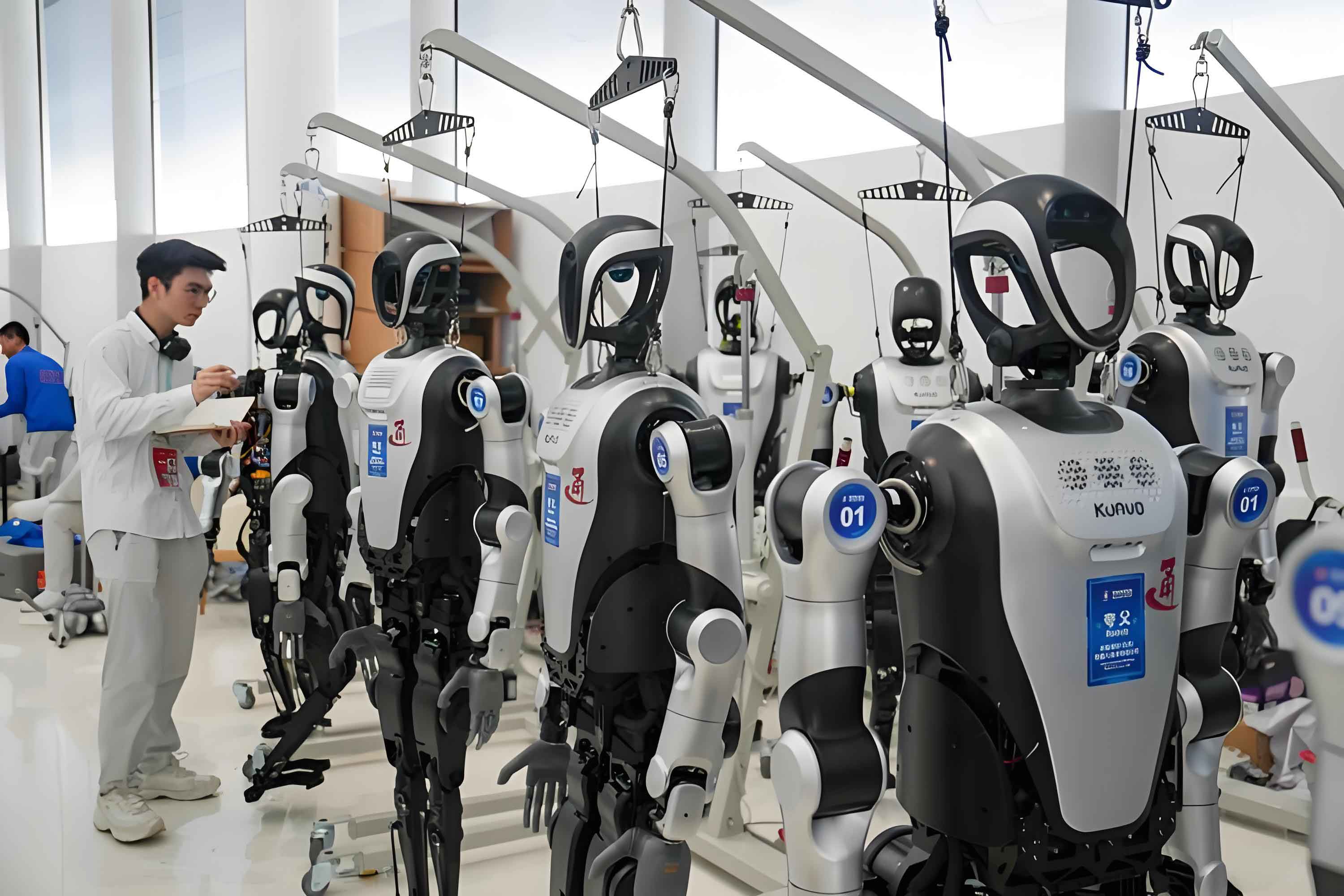
As depicted, data acquisition environments are essential for training AI human robots in tasks like object manipulation. In my projects, I have set up similar scenes to capture multi-modal data, including vision, force, and audio, which the AI human robot uses to learn complex behaviors. For example, the AI human robot can practice sorting items in a mock warehouse, with sensors recording every interaction to build robust models.
| Data Type | Source | Usage in AI Human Robot | Challenges |
|---|---|---|---|
| Visual | Cameras, depth sensors | Object recognition, navigation | Occlusion, lighting variations |
| Tactile | Force-torque sensors | Grasping control, texture detection | Calibration, wear and tear |
| Proprioceptive | Joint encoders, IMUs | Motion planning, balance | Noise, latency |
This table emphasizes the multifaceted data needs of an AI human robot. I have found that curating datasets with precise annotations is time-consuming but crucial for achieving high performance in the AI human robot.
Future Directions: Materials Science and Soft Robotics for AI Human Robots
Looking ahead, I am excited by the potential of materials science to revolutionize AI human robot design. Soft robotics, inspired by biological systems, offers new avenues for creating adaptable and safe AI human robots. The mechanics of soft materials can be described using hyperelastic models, such as the Mooney-Rivlin formulation:
$$ W = C_{10} (\bar{I}_1 – 3) + C_{01} (\bar{I}_2 – 3) + \frac{1}{D} (J – 1)^2 $$
where \( W \) is the strain energy density, \( C_{10} \), \( C_{01} \), and \( D \) are material constants, \( \bar{I}_1 \) and \( \bar{I}_2 \) are invariants of the deformation tensor, and \( J \) is the volume change. Such models help in designing soft actuators for the AI human robot, enabling delicate tasks like handling fragile objects.
Moreover, the integration of sensory materials into the AI human robot skin can enhance perception. For instance, piezoresistive sensors can detect pressure changes, with the response modeled as:
$$ R = R_0 (1 + \alpha \Delta P) $$
where \( R \) is resistance, \( R_0 \) is baseline resistance, \( \alpha \) is sensitivity, and \( \Delta P \) is pressure change. This allows the AI human robot to “feel” its environment, improving interaction safety and accuracy.
In my research, I have explored multi-functional composites that combine sensing and actuation, which could lead to more integrated AI human robot systems. The ultimate goal is to develop AI human robots that are not only intelligent but also physically versatile, capable of operating in diverse conditions from factories to homes.
| Technology | Description | Potential Impact on AI Human Robot | Research Status |
|---|---|---|---|
| Soft actuators | Muscle-like movements | Improved safety and adaptability | Prototype stage |
| Self-healing materials | Automatic damage repair | Increased durability and lifespan | Early development |
| Energy harvesting | Power from environment | Extended autonomy | Experimental |
This table outlines promising avenues that could address current limitations in the AI human robot. I believe that collaborative efforts across academia and industry will be essential to bring these innovations to fruition, ultimately enabling the AI human robot to achieve its full potential.
Conclusion
In conclusion, the embodied AI human robot stands at the cusp of major breakthroughs, driven by advances in AI, control theory, hardware, and data science. However, significant challenges remain in achieving human-level performance. As I have discussed, the AI human robot requires improvements in cognitive generalization, motion efficiency, hardware standardization, and data diversity. By focusing on these areas, we can accelerate the development of AI human robots that are not only functional but also transformative across various sectors. The journey toward a fully capable AI human robot is complex, but with sustained innovation, it is within reach.