
The development of anthropomorphic robotic end-effectors, particularly dexterous robotic hands, represents a significant frontier in robotics, aiming to replicate the versatile manipulation capabilities of the human hand. These systems are crucial for applications in prosthetics, space exploration, and advanced industrial automation. One promising actuation technology for such devices is the Pneumatic Artificial Muscle (PAM), which offers a high power-to-weight ratio and inherent compliance, mimicking biological muscles. Our research focuses on the comprehensive analysis and control of a five-fingered, PAM-driven dexterous robotic hand. This article details the establishment of its complete kinematic model, presents an efficient inverse dynamics solution using the Newton-Euler formulation, and demonstrates preliminary master-slave control based on these models.
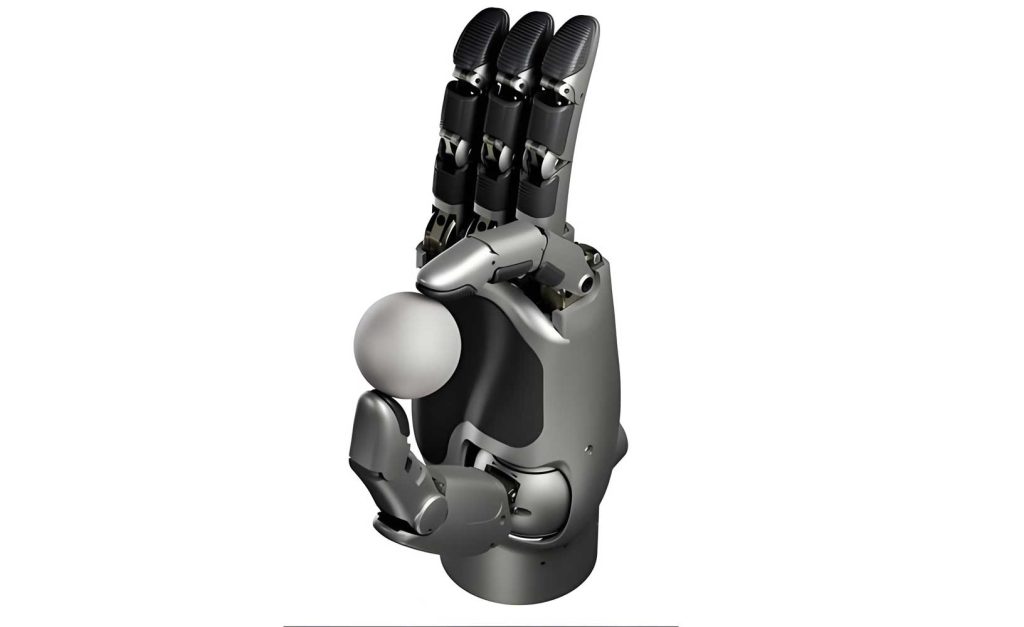
The designed dexterous robotic hand features an anthropomorphic structure with 17 degrees of freedom (DOF), excluding the wrist. The thumb possesses 4 DOF, the index, middle, and ring fingers have 3 DOF each, and the little finger has 4 DOF. The distal interphalangeal (DIP) and proximal interphalangeal (PIP) joints of the four fingers (excluding the thumb) are mechanically coupled, reducing control complexity while maintaining natural motion. The actuation system utilizes PAMs housed in the forearm, transmitting force and motion to the joints via synthetic tendons, enabling a compact and biomimetic design. This configuration presents unique challenges for accurate modeling and control, necessitating a thorough analysis of its kinematic and dynamic properties.
1. Kinematic Modeling of the Dexterous Robotic Hand
Kinematic modeling establishes the geometric relationship between joint angles and the position and orientation (pose) of the hand’s links, particularly the fingertips. This is fundamental for trajectory planning and solving the inverse kinematics problem: determining the required joint angles to achieve a desired fingertip pose.
1.1 Coordinate Frame Assignment using the Denavit-Hartenberg Convention
We employ the standard Denavit-Hartenberg (D-H) convention to systematically assign coordinate frames to each link of the dexterous robotic hand. The palm coordinate frame is established as the base reference. For each finger, local frames are attached from the metacarpophalangeal (MCP) joint to the fingertip. The z-axis of frame i is aligned with the axis of joint i+1. The x-axis is chosen along the common normal between z-axes of consecutive frames. The D-H parameters for a representative finger (the index finger) are summarized in Table 1.
| Joint i | $\theta_i$ (Joint Variable) | $d_i$ | $a_{i-1}$ | $\alpha_{i-1}$ |
|---|---|---|---|---|
| 1 | $\theta_1$ | 0 | $a_0 = 11$ mm | $90^\circ$ |
| 2 | $\theta_2$ | 0 | $a_1 = 50$ mm | $0^\circ$ |
| 3 | $\theta_3$ | 0 | $a_2 = 30$ mm | $0^\circ$ |
| 4 | $\theta_4$ (Coupled: $\theta_4 = \theta_3$) | 0 | $a_3 = 25$ mm | $0^\circ$ |
1.2 Forward Kinematics Solution
The homogeneous transformation matrix ${^{i-1}}\mathbf{T}_{i}$ describing the pose of frame i relative to frame i-1 is given by the standard D-H formula:
$$ {^{i-1}}\mathbf{T}_{i} = \begin{bmatrix}
\cos\theta_i & -\sin\theta_i \cos\alpha_{i-1} & \sin\theta_i \sin\alpha_{i-1} & a_{i-1} \cos\theta_i \\
\sin\theta_i & \cos\theta_i \cos\alpha_{i-1} & -\cos\theta_i \sin\alpha_{i-1} & a_{i-1} \sin\theta_i \\
0 & \sin\alpha_{i-1} & \cos\alpha_{i-1} & d_i \\
0 & 0 & 0 & 1
\end{bmatrix} $$
The pose of the index fingertip (frame 4) relative to the palm base (frame 0) is obtained by the consecutive product of these transformations:
$$ {^{0}}\mathbf{T}_{4} = {^{0}}\mathbf{T}_{1} \cdot {^{1}}\mathbf{T}_{2} \cdot {^{2}}\mathbf{T}_{3} \cdot {^{3}}\mathbf{T}_{4} = \begin{bmatrix}
\mathbf{n} & \mathbf{o} & \mathbf{a} & \mathbf{p} \\
0 & 0 & 0 & 1
\end{bmatrix} $$
where $\mathbf{n}$, $\mathbf{o}$, $\mathbf{a}$ are the orientation vectors and $\mathbf{p}=[p_x, p_y, p_z]^T$ is the position vector of the fingertip. The explicit expressions for the index finger are:
$$
\begin{aligned}
p_x &= a_3 c_1 (c_2 c_3 – s_2 s_3) + a_2 c_1 c_2 + a_0 c_1 \\
p_y &= a_3 s_1 (c_2 c_3 – s_2 s_3) + a_2 s_1 c_2 + a_0 s_1 \\
p_z &= a_3 (s_2 c_3 + c_2 s_3) + a_2 s_2
\end{aligned}
$$
Here, $c_i = \cos\theta_i$ and $s_i = \sin\theta_i$. Similar forward kinematics equations are derived for all fingers of the dexterous robotic hand and expressed in the unified palm coordinate frame. Simulation of these equations in MATLAB reveals the detailed workspace of each fingertip, which is essential for grasp planning.
1.3 Analytical Inverse Kinematics Solution
To command the dexterous robotic hand to achieve a desired fingertip pose, we must solve the inverse kinematics. We employ an algebraic approach, successively premultiplying the forward kinematics equation by inverse transformation matrices to isolate joint variables. For the index finger, given the desired pose ${^{0}}\mathbf{T}_{4}^{des}$, we solve for $\theta_1$ by examining elements of $({^{0}}\mathbf{T}_{1})^{-1} \cdot {^{0}}\mathbf{T}_{4}^{des}$:
$$ \theta_1 = \arctan2(p_y^{des}, p_x^{des}) $$
Proceeding sequentially, $\theta_2$ and $\theta_3$ are solved from subsequent equations:
$$
\begin{aligned}
\theta_2 &= \arctan2\left( a_z^{des}, \ (a_x^{des} \cos\theta_1 + a_y^{des} \sin\theta_1) \right) \\
\theta_3 &= \arctan2\left( \Gamma_1, \ \Gamma_2 \right) – \theta_2
\end{aligned}
$$
where $\Gamma_1$ and $\Gamma_2$ are expressions involving the desired position components and the previously solved angles. Finally, due to mechanical coupling, $\theta_4 = \theta_3$. This analytical solution provides a fast and deterministic method for controlling the pose of our dexterous robotic hand.
2. Dynamic Modeling of the Dexterous Robotic Hand
While kinematics deals with motion geometry, dynamics relates the forces causing the motion. An accurate dynamic model is vital for force control, simulation, and optimizing the actuation system of the dexterous robotic hand. We focus on the inverse dynamics problem: computing the joint torques/forces required to produce a given motion (joint positions, velocities, and accelerations).
2.1 Newton-Euler Recursive Formulation
The Newton-Euler method is computationally efficient for serial chain mechanisms like robotic fingers. It is based on two fundamental laws: Newton’s second law for translational motion and the Euler equation for rotational motion. The algorithm proceeds in two recursive passes:
- Forward Recursion (Outward from base to tip): Propagates kinematic information (velocities, accelerations) along the chain.
$$ {^{i}}\omega_{i} = {^{i}}\mathbf{R}_{i-1} \cdot {^{i-1}}\omega_{i-1} + \dot{\theta}_i \cdot {^{i}}\hat{\mathbf{z}} $$
$$ {^{i}}\dot{\omega}_{i} = {^{i}}\mathbf{R}_{i-1} \cdot {^{i-1}}\dot{\omega}_{i-1} + {^{i}}\mathbf{R}_{i-1} \cdot {^{i-1}}\omega_{i-1} \times \dot{\theta}_i \cdot {^{i}}\hat{\mathbf{z}} + \ddot{\theta}_i \cdot {^{i}}\hat{\mathbf{z}} $$
$$ {^{i}}\dot{v}_{i} = {^{i}}\mathbf{R}_{i-1} \left( {^{i-1}}\dot{\omega}_{i-1} \times {^{i-1}}\mathbf{p}_{i} + {^{i-1}}\omega_{i-1} \times ({^{i-1}}\omega_{i-1} \times {^{i-1}}\mathbf{p}_{i}) + {^{i-1}}\dot{v}_{i-1} \right) $$
$$ {^{i}}\dot{v}_{Ci} = {^{i}}\dot{\omega}_{i} \times {^{i}}\mathbf{r}_{Ci} + {^{i}}\omega_{i} \times ({^{i}}\omega_{i} \times {^{i}}\mathbf{r}_{Ci}) + {^{i}}\dot{v}_{i} $$ - Backward Recursion (Inward from tip to base): Computates forces and torques acting on each link.
$$ {^{i}}\mathbf{f}_{i} = m_i \cdot {^{i}}\dot{v}_{Ci} $$
$$ {^{i}}\mathbf{n}_{i} = {^{i}}\mathbf{I}_{Ci} \cdot {^{i}}\dot{\omega}_{i} + {^{i}}\omega_{i} \times ({^{i}}\mathbf{I}_{Ci} \cdot {^{i}}\omega_{i}) $$
$$ {^{i}}\mathbf{F}_{i} = {^{i}}\mathbf{f}_{i} + {^{i}}\mathbf{R}_{i+1} \cdot {^{i+1}}\mathbf{F}_{i+1} $$
$$ {^{i}}\mathbf{N}_{i} = {^{i}}\mathbf{n}_{i} + {^{i}}\mathbf{R}_{i+1} \cdot {^{i+1}}\mathbf{N}_{i+1} + {^{i}}\mathbf{r}_{Ci} \times {^{i}}\mathbf{f}_{i} + {^{i}}\mathbf{p}_{i+1} \times ({^{i}}\mathbf{R}_{i+1} \cdot {^{i+1}}\mathbf{F}_{i+1}) $$
The joint torque $\tau_i$ is then extracted from the projection of ${^{i}}\mathbf{N}_{i}$ onto the joint axis: $\tau_i = {^{i}}\mathbf{N}_{i}^T \cdot {^{i}}\hat{\mathbf{z}}$.
2.2 Dynamic Parameters and Simulation for the Dexterous Robotic Hand
Applying the Newton-Euler formulation to our dexterous robotic hand requires the dynamic parameters for each phalanx: mass ($m_i$), center of mass location ($\mathbf{r}_{Ci}$), and inertia tensor ($\mathbf{I}_{Ci}$) about the center of mass. Each phalanx is modeled as a homogeneous cylindrical link with equivalent length and radius. The parameters for the index finger links are summarized in Table 2.
| Link i | Mass $m_i$ (kg) | CoM Vector ${^{i}}\mathbf{r}_{Ci}$ (m) | Inertia Tensor ${^{i}}\mathbf{I}_{Ci}$ (kg·m²) |
|---|---|---|---|
| 1 | $m_1$ | $[-0.033l_1, -0.038l_1, 0]^T$ | $\text{diag}\left( \frac{m_1 r_1^2}{2}, \frac{m_1 l_1^2}{12}, \frac{m_1 l_1^2}{12} \right)$ |
| 2 | $m_2$ | $[-l_2/2, 0, 0]^T$ | $\text{diag}\left( \frac{m_2 l_2^2}{12}, \frac{m_2 r_2^2}{2}, \frac{m_2 l_2^2}{12} \right)$ |
| 3 | $m_3$ | $[-l_3/2, 0, 0]^T$ | $\text{diag}\left( \frac{m_3 r_3^2}{2}, \frac{m_3 l_3^2}{12}, \frac{m_3 l_3^2}{12} \right)$ |
| 4 | $m_4$ | $[l_4/2, 0, 0]^T$ | $\text{diag}\left( \frac{m_4 r_4^2}{2}, \frac{m_4 l_4^2}{12}, \frac{m_4 l_4^2}{12} \right)$ |
We implemented the recursive Newton-Euler algorithm in MATLAB to simulate the inverse dynamics for a specific motion: a finger curling gesture where joints 2, 3, and 4 move synchronously while joint 1 is fixed. The required joint torques were computed for three key gravitational orientations of the dexterous robotic hand: fingertip pointing down (gravity aligned with the base z-axis), finger side parallel to ground, and finger back parallel to ground. The simulation results showed that the maximum required joint torque for this unloaded motion was approximately 0.04 N·m. Given an average joint pulley radius of 5 mm, this translates to a required tendon force of about 0.8 N. The PAMs used in our system (e.g., 6 mm diameter muscles) can generate forces over 7 N, confirming that the actuation system is sufficiently powerful for the dynamic demands of the dexterous robotic hand.
3. Model-Based Master-Slave Control Implementation
To validate the models and demonstrate basic functionality of the dexterous robotic hand, we implemented an open-loop, model-based master-slave control strategy. The system architecture integrates the robotic hand, 34 PAMs with corresponding pressure proportional valves, a data glove for motion capture, an industrial PC, and interface hardware.
The control law leverages both the kinematic/dynamic models of the hand and the static model of the PAMs. The data glove captures the joint angle trajectories $\mathbf{q}_{human}(t)$ of the human operator’s hand. The inverse kinematics model of the robotic hand is used if Cartesian mapping is desired, though direct joint-to-joint mapping was initially employed. The core of the controller uses the inverse dynamics model to compute the nominal joint torques $\boldsymbol{\tau}_{req}(t)$ required to achieve the commanded motion $\mathbf{q}_{cmd}(t)$, $\dot{\mathbf{q}}_{cmd}(t)$, $\ddot{\mathbf{q}}_{cmd}(t)$, considering link masses and gravity:
$$ \boldsymbol{\tau}_{req}(t) = \mathbf{M}(\mathbf{q}_{cmd})\ddot{\mathbf{q}}_{cmd} + \mathbf{C}(\mathbf{q}_{cmd}, \dot{\mathbf{q}}_{cmd})\dot{\mathbf{q}}_{cmd} + \mathbf{G}(\mathbf{q}_{cmd}) $$
where $\mathbf{M}$ is the mass matrix, $\mathbf{C}$ represents Coriolis and centrifugal terms, and $\mathbf{G}$ is the gravity vector, all derived from the Newton-Euler formulation. This required torque is then converted into a required tendon force. Finally, the static model of the PAM, which relates muscle pressure to contraction force, is inverted to calculate the necessary pressure command $P_{cmd}$ for each valve:
$$ P_{cmd, i} = f_{PAM}^{-1}(F_{tendon,i}(\tau_{req,i})) $$
This open-loop feedforward strategy, while sensitive to model inaccuracies and disturbances, successfully demonstrated the ability of the dexterous robotic hand to mimic human hand motions and perform basic grasping tasks on objects of various shapes, as shown in the system’s operation. The results confirm the functional validity of the derived kinematic and dynamic models for this complex anthropomorphic system.
4. Conclusion
This work presents a complete framework for the modeling and preliminary control of a pneumatically actuated five-fingered dexterous robotic hand. We derived and solved the forward and inverse kinematics using the D-H convention, providing analytical solutions essential for real-time pose control. The inverse dynamics were efficiently formulated using the recursive Newton-Euler method, and simulations quantified the joint torque requirements for typical motions, verifying the adequacy of the PAM-based actuation system. Finally, integrating these models with actuator static models enabled a successful master-slave control demonstration, where the dexterous robotic hand replicated human gestures and executed simple grasps. The kinematic analysis forms the basis for advanced grasp planning algorithms, while the dynamic model is a crucial step toward implementing robust force and impedance control strategies for dexterous, compliant manipulation in unstructured environments. Future work will focus on integrating joint sensors for closed-loop control, refining the PAM dynamic models, and developing higher-level autonomous grasping algorithms for the dexterous robotic hand.