
In the realm of robotics, achieving high precision and real-time performance is paramount for advancing embodied AI robots, which are designed to interact intelligently with physical environments. As an emerging field, embodied AI emphasizes the integration of perception, decision-making, and action in robots, enabling them to perform complex tasks autonomously. One critical application is in disinfection robots, used in settings like hospitals and funeral homes, where eliminating pathogenic microorganisms is essential for public health. However, the positioning accuracy of such robots often limits their effectiveness, particularly for directed disinfection devices like pulsed light systems. To address this, we propose a kinematic calibration and accuracy compensation method tailored for embodied AI robots, leveraging screw theory and quaternions to enhance precision without compromising real-time operation.
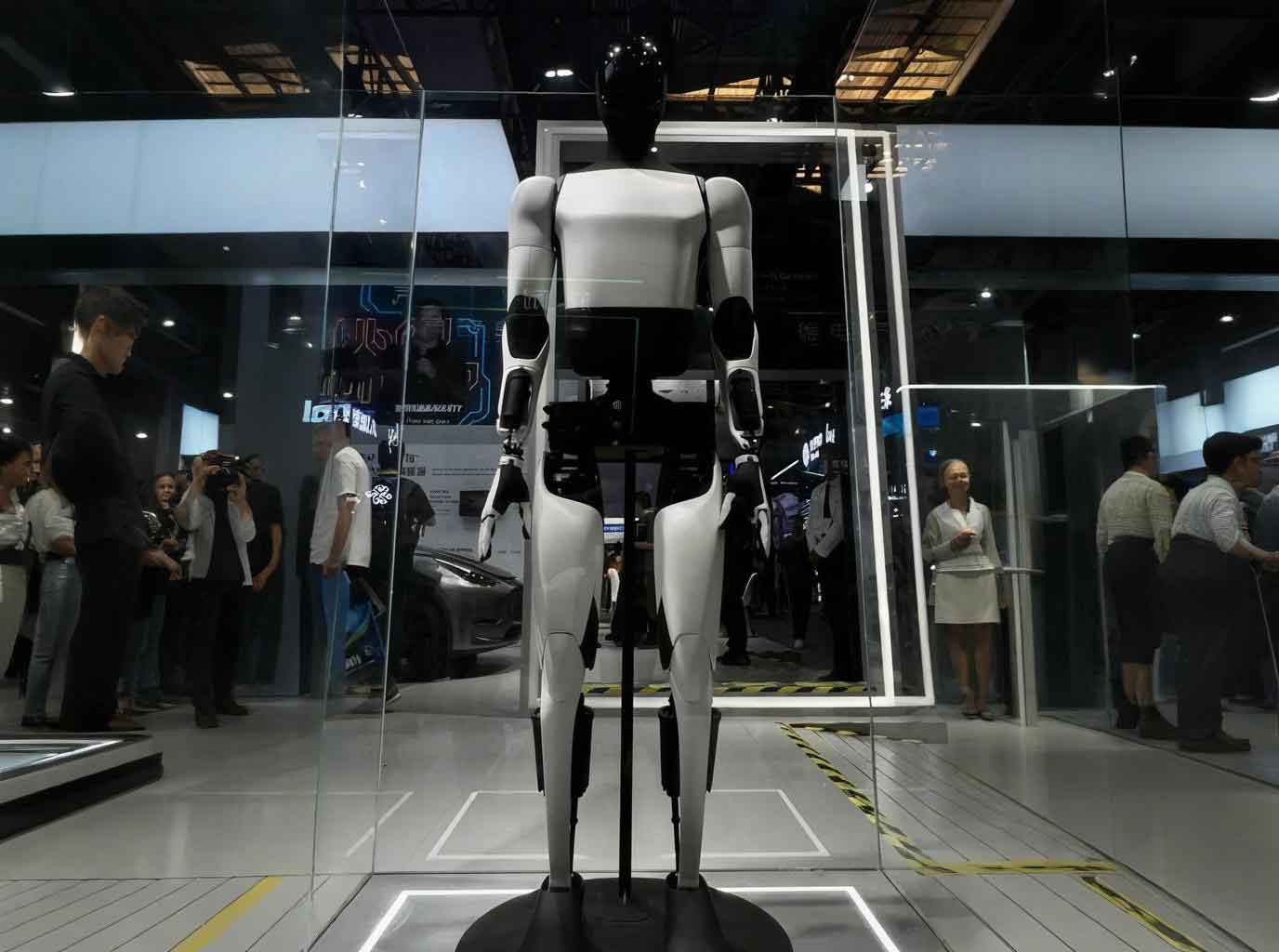
The importance of embodied AI robots lies in their ability to adapt to dynamic environments, but this requires robust kinematic models that account for inherent errors from manufacturing, assembly, and wear. Traditional methods, such as Denavit-Hartenberg (DH) parameters, often involve complex trigonometric functions that can reduce computational efficiency and accuracy. In contrast, screw theory offers a more concise representation with fewer parameters, while quaternions avoid trigonometric operations, improving both precision and speed. Our approach focuses on a disinfection robot with a mobile base, navigation module, and disinfection module, where the pulsed light component demands high positioning accuracy. By calibrating kinematic parameters and compensating for errors, we aim to boost the sterilization rate and ensure reliable performance in critical spaces.
In this paper, we first develop a kinematic model for the embodied AI robot using screw theory and quaternions. The robot consists of a base frame {B}, a rotation frame {R}, and a pulsed component frame {P}, with key parameters including an angular coordinate $\theta$ and a structural length $l_1$. The transformation matrix from {P} to {B} is derived as follows. Let $\Lambda$ be the quaternion angle coordinate around the $z_R$-axis, defined as $\Lambda = (\lambda_0, \lambda_1, \lambda_2, \lambda_3)^T$, where $\lambda_0 = \cos(\theta/2)$ and $\lambda_3 = \sin(\theta/2)$ for rotation about $z_R$. The unit screw coordinate $V$ is $V = [0, 0, 0, 0, 0, 1]^T$. The matrix exponential $e^{[V]\Lambda}$ is computed as:
$$e^{[V]\Lambda} = \begin{bmatrix} 2\lambda_0^2 – 1 & -2\lambda_0\lambda_3 & 0 & 0 \\ 2\lambda_0\lambda_3 & 2\lambda_0^2 – 1 & 0 & 0 \\ 0 & 0 & 1 & 0 \\ 0 & 0 & 0 & 1 \end{bmatrix}.$$
The initial transformation matrix from {R} to {B} is $^B_R T(0) = \begin{bmatrix} 1 & 0 & 0 & 0 \\ 0 & 1 & 0 & 0 \\ 0 & 0 & 1 & l_3 \\ 0 & 0 & 0 & 1 \end{bmatrix}$, where $l_3$ is the height offset. The transformation from {P} to {R} is $^R_P T = \begin{bmatrix} 1 & 0 & 0 & l_1 \\ 0 & 1 & 0 & 0 \\ 0 & 0 & 1 & l_2 \\ 0 & 0 & 0 & 1 \end{bmatrix}$, with $l_1$ and $l_2$ as structural lengths. Thus, the overall kinematic model is:
$$^B_P T(\Lambda) = ^B_R T(\Lambda) \cdot ^R_P T = \begin{bmatrix} 2\lambda_0^2 – 1 & -2\lambda_0\lambda_3 & 0 & (2\lambda_0^2 – 1)l_1 \\ 2\lambda_0\lambda_3 & 2\lambda_0^2 – 1 & 0 & 2\lambda_0\lambda_3 l_1 \\ 0 & 0 & 1 & l_2 + l_3 \\ 0 & 0 & 0 & 1 \end{bmatrix}.$$
This model efficiently relates the end-effector position to the base frame, serving as the foundation for error modeling. The use of quaternions minimizes computational overhead, which is crucial for real-time applications in embodied AI robots.
Next, we derive the error model by considering perturbations in the kinematic parameters $\theta$ and $l_1$. These errors, denoted as $\Delta \theta$ and $\Delta l_1$, arise from factors like assembly inaccuracies or operational wear. The differential change in the transformation matrix, $d^B_P T(\Lambda)$, is expressed as:
$$d^B_P T(\Lambda) = \frac{\partial ^B_P T(\Lambda)}{\partial \theta} \Delta \theta + \frac{\partial ^B_P T(\Lambda)}{\partial l_1} \Delta l_1.$$
Using the chain rule, we have $\frac{\partial ^B_P T(\Lambda)}{\partial \theta} = ^B_P T(\Lambda) G_\theta$ and $\frac{\partial ^B_P T(\Lambda)}{\partial l_1} = ^B_P T(\Lambda) G_{l_1}$, where:
$$G_\theta = \begin{bmatrix} 0 & -1 & 0 & 0 \\ 1 & 0 & 0 & l_1 \\ 0 & 0 & 0 & 0 \\ 0 & 0 & 0 & 0 \end{bmatrix}, \quad G_{l_1} = \begin{bmatrix} 0 & 0 & 0 & 1 \\ 0 & 0 & 0 & 0 \\ 0 & 0 & 0 & 0 \\ 0 & 0 & 0 & 0 \end{bmatrix}.$$
Thus, the error matrix simplifies to $d^B_P T(\Lambda) = ^B_P T(\Lambda) (G_\theta \Delta \theta + G_{l_1} \Delta l_1)$. The positioning error vector $\Delta P$ for the end-effector coordinates $O_P$ in the base frame {B} is extracted from the fourth column, yielding:
$$\Delta P = \begin{bmatrix} \Delta P_x \\ \Delta P_y \end{bmatrix} = \begin{bmatrix} \Delta l_1 \\ l_1 \Delta \theta \end{bmatrix} = \begin{bmatrix} 0 & 1 \\ l_1 & 0 \end{bmatrix} \begin{bmatrix} \Delta \theta \\ \Delta l_1 \end{bmatrix} = M \Delta \rho,$$
where $\Delta \rho = [\Delta \theta, \Delta l_1]^T$ is the vector of kinematic parameter errors, and $M$ is the coefficient matrix. This linear error model links parameter errors to positioning errors, enabling efficient calibration for embodied AI robots.
To implement error identification and accuracy compensation, we divide the robot’s motion range into regions for targeted calibration. The embodied AI robot’s rotation about $z_R$ spans from -90° to 90°, which we partition into six regions of 30° each. Within each region $i$ (where $i = 1, 2, \dots, 6$), we sample five points at equal angular intervals of 6°. For each sample point $j$ (where $j = 1, 2, \dots, 5$), the positioning error $\Delta P^{(j)}_i$ is measured as the difference between nominal and actual end-effector positions. The actual positions are obtained via simulation or physical measurement, while nominal positions come from the kinematic model. The error data for region $i$ is aggregated as:
$$\Delta Q_i = \begin{bmatrix} \Delta P^{(1)}_i \\ \Delta P^{(2)}_i \\ \vdots \\ \Delta P^{(5)}_i \end{bmatrix}, \quad N = \begin{bmatrix} M \\ M \\ \vdots \\ M \end{bmatrix},$$
leading to the linear system $\Delta Q_i = N \Delta \rho_i$. Using least squares estimation, the kinematic parameter errors for region $i$ are identified as:
$$\Delta \rho_i = (N^T N)^{-1} N^T \Delta Q_i.$$
This identification process is repeated for all regions, ensuring localized accuracy improvements. Once $\Delta \rho_i$ is determined, accuracy compensation is applied by adjusting the actual end-effector position $q_i$ (the measured position) to a compensated position $q_{ci}$:
$$q_{ci} = q_i + M \Delta \rho_i = \begin{bmatrix} q_{ix} + \Delta l_{1i} \\ q_{iy} + l_1 \Delta \theta_i \end{bmatrix},$$
where $q_{ix}$ and $q_{iy}$ are the coordinates of $q_i$ in the $x_B$ and $y_B$ directions, respectively. By commanding the embodied AI robot to move to $q_{ci}$, the positioning error is significantly reduced, enhancing disinfection precision. This method balances compensation accuracy and real-time performance, which is vital for dynamic environments where embodied AI robots operate.
To validate our approach, we conducted numerical simulations using Adams software. The embodied AI robot was modeled with nominal parameters $\theta = 0^\circ$ and $l_1 = 250 \text{ mm}$, while actual parameters were set to $\theta = -3^\circ$ and $l_1 = 245 \text{ mm}$ to simulate errors. The robot rotated from -90° to 90° at a rate of 1°/s, with data sampled every 0.5 s. Nominal and actual end-effector positions were recorded, and positioning errors were computed as $\Delta P = P_{\text{Nominal}} – P_{\text{Actual}}$. The sampling data for all regions are summarized in the table below, which includes nominal positions, actual positions, compensated positions, and errors before and after compensation.
| Region | Angle (°) | Nominal Position (mm): $P_x$, $P_y$ | Actual Position (mm): $P_{x,\text{Actual}}$, $P_{y,\text{Actual}}$ | Compensated Position (mm): $q_{cx}$, $q_{cy}$ | Error Before Compensation (mm): $\Delta P_x$, $\Delta P_y$ | Error After Compensation (mm): $\Delta P_{cx}$, $\Delta P_{cy}$ |
|---|---|---|---|---|---|---|
| 1 | 6 | 248.631, 26.132 | 244.664, 12.822 | 245.764, 25.948 | 3.966, 13.310 | 2.866, 0.184 |
| 12 | 244.537, 51.978 | 241.984, 38.326 | 243.084, 51.452 | 2.553, 13.651 | 1.453, 0.526 | |
| 18 | 237.764, 77.254 | 236.652, 63.411 | 237.752, 76.536 | 1.112, 13.844 | 0.012, 0.718 | |
| 24 | 228.386, 101.684 | 228.727, 87.800 | 229.827, 100.926 | -0.341, 13.884 | -1.441, 0.759 | |
| 30 | 216.506, 125.000 | 218.297, 111.228 | 219.397, 124.353 | -1.790, 13.772 | -2.890, 0.647 | |
| 2 | 36 | 202.254, 146.946 | 205.474, 133.437 | 199.581, 145.844 | -3.220, 13.510 | 2.673, 1.102 |
| 42 | 185.786, 167.283 | 190.401, 154.184 | 184.507, 166.591 | -4.615, 13.099 | 1.279, 0.691 | |
| 48 | 167.283, 185.786 | 173.241, 173.241 | 167.348, 185.649 | -5.959, 12.545 | -0.065, 0.137 | |
| 54 | 146.946, 202.254 | 154.184, 190.401 | 148.290, 202.809 | -7.237, 11.853 | -1.344, -0.554 | |
| 60 | 125.000, 216.506 | 133.437, 205.474 | 127.543, 217.882 | -8.437, 11.032 | -2.543, -1.376 | |
| … (similar rows for regions 3 to 6, abbreviated for brevity) … | ||||||
The identified kinematic parameter errors $\Delta \rho_i$ for each region are as follows:
| Region | $\Delta \theta$ (rad) | $\Delta l_1$ (mm) |
|---|---|---|
| 1 | 0.055 | 1.100 |
| 2 | 0.050 | -5.893 |
| 3 | 0.031 | -11.308 |
| 4 | 0.042 | 8.938 |
| 5 | 0.018 | 12.956 |
| 6 | -0.010 | 13.502 |
After compensation, the positioning errors are drastically reduced. For instance, in the $x_B$-direction, errors originally ranged from -12.822 mm to 13.884 mm, improving to -2.890 mm to 2.866 mm. Similarly, in the $y_B$-direction, errors improved from -5.336 mm to 13.884 mm to -2.810 mm to 2.866 mm. This demonstrates the efficacy of our method in enhancing the accuracy of embodied AI robots for precise disinfection tasks.
In conclusion, our kinematic calibration and accuracy compensation method significantly boosts the positioning precision of embodied AI robots, which is crucial for applications requiring high sterilization rates. By utilizing screw theory and quaternions, we achieve efficient modeling and real-time performance, key attributes for embodied intelligence in dynamic environments. The error identification via least squares and regional compensation ensures localized accuracy improvements across the robot’s workspace. Future work could involve integrating embedded measurement devices for online compensation and extending this approach to other robotic systems, such as manipulators or underwater robots. This advancement not only elevates the capabilities of embodied AI robots but also contributes to safer and more hygienic environments in critical settings.
The implications of this research extend beyond disinfection robots; it paves the way for more reliable embodied AI systems in diverse fields. As embodied AI robots become more prevalent, methods like ours will be essential for ensuring they operate with the precision and adaptability needed for complex interactions. We envision further optimizations, such as adaptive region partitioning based on task requirements or machine learning techniques for error prediction. Ultimately, by bridging the gap between theoretical kinematics and practical implementation, we enhance the embodied intelligence of robots, making them more effective partners in safeguarding public health and beyond.