
In the field of precision mechanical transmission, the planetary roller screw mechanism represents a pivotal innovation, enabling the conversion between rotary and linear motion with high efficiency and accuracy. Among its variants, the recirculating planetary roller screw mechanism stands out due to its unique design involving multiple grooved rollers that engage with the threads of both the screw and the nut. This configuration not only enhances load distribution but also improves reliability, making it suitable for demanding applications such as aerospace actuators, military equipment, medical devices, and precision machine tools. In this article, I will delve into the kinematic principles and dynamic behavior of the recirculating planetary roller screw mechanism, employing theoretical analysis and computational simulations to elucidate its performance under various operational conditions.
The fundamental operation of the planetary roller screw mechanism relies on the interaction between the screw, rollers, and nut. Unlike traditional ball screws, the planetary roller screw utilizes rollers with grooves that mesh with the helical threads, thereby reducing slip and increasing contact area. This leads to superior characteristics such as minimal friction, high efficiency, extended service life, and robustness against shock loads. The recirculating version incorporates a cam ring and a carrier to guide the rollers through a non-threaded section of the nut, allowing for continuous motion and resetting of the rollers. This design is particularly advantageous for applications requiring small leads and high precision, such as in linear electromechanical actuators. Understanding the kinematic relationships and dynamic responses is essential for optimizing the performance of the planetary roller screw mechanism in practical implementations.
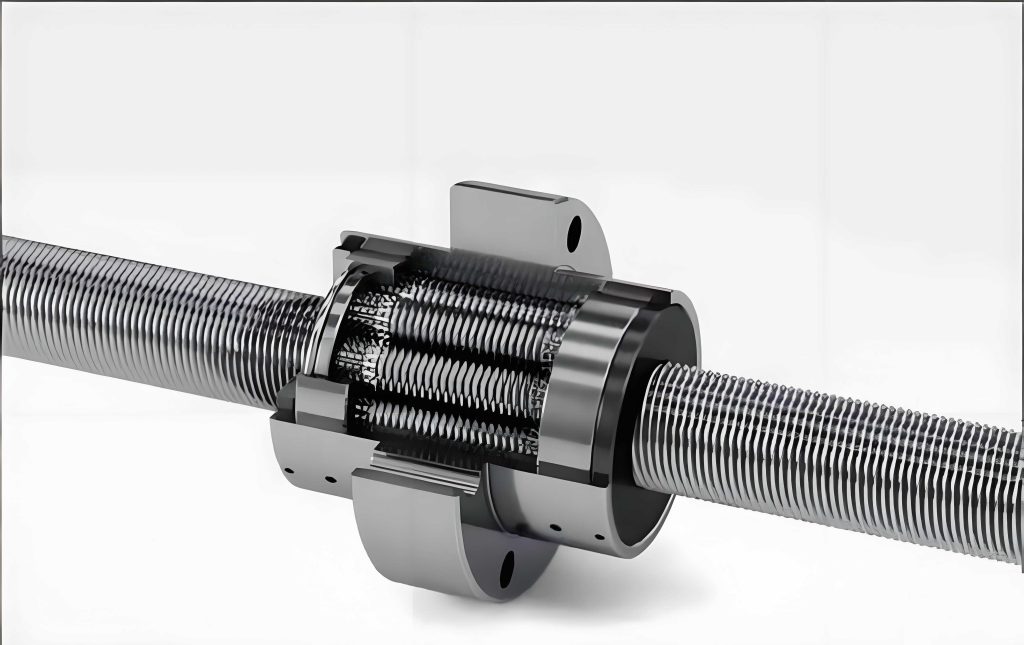
To begin with, let’s explore the kinematic analysis of the recirculating planetary roller screw mechanism. The motion can be described using a simplified diagram where the screw rotates, driving the rollers that in turn move the nut axially. The rollers exhibit both rotation about their own axes and revolution around the screw, akin to planetary gears in a planetary gear system. This dual motion is governed by the geometry of the components, including the pitch diameters of the screw, nut, and rollers, as well as the lead of the threads. By applying fundamental principles of mechanics, we can derive the relationships between angular velocities and linear displacements.
Consider a recirculating planetary roller screw mechanism where the screw is fixed axially but free to rotate, while the nut is constrained to linear motion along the screw axis. The rollers are positioned between the screw and nut, held in place by a carrier that allows them to revolve. The kinematic equations can be formulated based on the relative velocities at the contact points. For instance, the absolute velocity at the contact point between the screw and a roller can be expressed as:
$$ v_O = \frac{\omega_s d_s}{4} $$
where \( \omega_s \) is the angular velocity of the screw and \( d_s \) is its pitch diameter. Simultaneously, this velocity can be related to the orbital motion of the roller:
$$ v_O = \frac{\omega_c d_c}{2} $$
with \( \omega_c \) denoting the angular velocity of the carrier (or the orbital angular velocity of the rollers) and \( d_c \) being the orbital diameter. Equating these expressions yields:
$$ \omega_c = \pm \frac{d_s}{2d_c} \omega_s = \pm \frac{(d_n – 2d_r)}{2(d_n – d_r)} \omega_s $$
Here, \( d_n \) is the pitch diameter of the nut, \( d_r \) is the pitch diameter of the roller, and the sign indicates the direction of rotation (positive for clockwise, negative for counterclockwise). This equation highlights how the geometry influences the orbital speed in a planetary roller screw mechanism.
Furthermore, the rotation of the roller about its own axis can be analyzed using the concept of a planetary gear train. By fixing the carrier, we obtain a transformed system where the transmission ratio between the screw and roller is given by:
$$ i^{H}_{sr} = \frac{\omega_s – \omega_c}{\omega_r – \omega_c} = – \frac{d_r}{d_s} $$
Solving for the roller’s angular velocity \( \omega_r \):
$$ \omega_r = \pm \left[ \left( \frac{d_s}{d_r} + 1 \right) \omega_c – \frac{d_s}{d_r} \omega_s \right] $$
The axial displacement and velocity of the nut relative to the screw are crucial for linear motion applications. For a screw with \( n \) threads and lead \( p \), rotating at angular velocity \( \omega_s \), the nut’s axial displacement \( L_n \) over time \( t \) is:
$$ L_n = \pm \frac{n p \omega_s t}{2\pi} $$
and its axial velocity \( v_n \) is:
$$ v_n = \pm \frac{n p \omega_s}{2\pi} $$
The sign depends on the handedness of the threads and the rotation direction, following the right-hand rule. These kinematic equations form the basis for designing and analyzing the recirculating planetary roller screw mechanism. To consolidate, Table 1 summarizes the key parameters used in the kinematic model, emphasizing their roles in the motion relationships.
| Parameter | Symbol | Description | Typical Units |
|---|---|---|---|
| Screw Angular Velocity | \( \omega_s \) | Rotational speed of the screw | rad/s |
| Nut Axial Velocity | \( v_n \) | Linear speed of the nut along the screw axis | mm/s |
| Roller Angular Velocity | \( \omega_r \) | Rotational speed of the roller about its own axis | rad/s |
| Carrier Angular Velocity | \( \omega_c \) | Orbital speed of the rollers around the screw | rad/s |
| Screw Pitch Diameter | \( d_s \) | Effective diameter for screw thread contact | mm |
| Nut Pitch Diameter | \( d_n \) | Effective diameter for nut thread contact | mm |
| Roller Pitch Diameter | \( d_r \) | Effective diameter for roller groove contact | mm |
| Orbital Diameter | \( d_c \) | Diameter of the roller path around the screw | mm |
| Number of Threads | \( n \) | Number of thread starts on screw and nut | unitless |
| Lead | \( p \) | Axial distance per screw revolution | mm |
Moving beyond kinematics, the dynamic behavior of the recirculating planetary roller screw mechanism is critical for assessing its performance under load. To investigate this, I developed a three-dimensional model based on specific design parameters, as listed in Table 2. The model includes components such as the screw, nut, rollers, carrier, and cam ring, with the nut featuring a 60° non-threaded section to facilitate roller recirculation. The rollers are grooved and lack helical leads, relying on the screw and nut threads for axial constraint. This design ensures smooth engagement and disengagement during operation.
| Component | Quantity | Lead (mm) | Threads | Handedness | Pitch Diameter (mm) |
|---|---|---|---|---|---|
| Roller | 12 | — | — | — | 6.63 |
| Screw | 1 | 1 | 1 | Right | 31.13 |
| Nut | 1 | 1 | 1 | Right | 44.14 |
The dynamic simulation was conducted using a multi-body dynamics software, where the virtual prototype was assembled with appropriate joints and contacts. The constraints applied include fixed joints between the nut and cam ring, a cylindrical joint between the carrier and screw to allow relative rotation and translation, a translational joint between the nut and ground for linear motion, and revolute joints for rotational degrees of freedom. Contacts were defined between the screw and rollers, rollers and nut, rollers and cam ring, and rollers and carrier, using an impact function to model intermittent and continuous interactions. The impact force is calculated as:
$$ F_{\text{impact}} = \max \left\{ 0, K (q_0 – q)^e – C \frac{dq}{dt} \cdot \text{STEP}(q, q_0 – d, 1, q_0, 0) \right\} $$
where \( K \) is the stiffness coefficient, \( q \) is the distance between contact points, \( q_0 \) is the reference distance, \( e \) is the force exponent, \( C \) is the damping coefficient, and \( d \) is the penetration depth. For this simulation, the parameters were set to \( K = 1 \times 10^5 \, \text{N/mm} \), \( e = 1.5 \), \( C = 50 \, \text{N·s/mm} \), and \( d = 0.2 \, \text{mm} \). Friction was incorporated using the Coulomb method with static and dynamic coefficients of 0.3 and 0.25, respectively, and slip velocities of 0.1 mm/s and 10 mm/s. The material for all components was specified as GCr15, a common bearing steel, to ensure realistic material properties.
In the simulation, the screw was driven at a constant angular velocity of \( 4\pi \, \text{rad/s} \) (equivalent to 2 revolutions per second) in the counterclockwise direction, and the analysis was run for 1 second with 400 steps to capture transient effects. The results provide insights into the motion characteristics and force distributions within the planetary roller screw mechanism. For instance, the angular velocity of a representative roller, the orbital angular velocity of the carrier, the axial displacement and velocity of the nut, and the contact forces between components were extracted and analyzed. To validate the simulation, these outcomes were compared with theoretical values derived from the kinematic equations.
Figure 1 illustrates the angular velocity of a roller over time. Initially, due to minor clearances in the model, the screw rotates briefly before engaging the rollers, after which the roller angular velocity stabilizes. The average value during engaged operation is approximately \( 28.28 \, \text{rad/s} \), with fluctuations between \( 27.11 \, \text{rad/s} \) and \( 30.31 \, \text{rad/s} \). Notably, around 0.6 seconds, a sharp change occurs as the roller enters the non-threaded section of the nut and is reset by the cam ring protrusion, causing a temporary drop in angular velocity. This behavior is inherent to the recirculating design of the planetary roller screw mechanism and must be accounted for in precision applications.
The orbital angular velocity of the carrier, which dictates the revolution of the rollers around the screw, averages \( -5.20 \, \text{rad/s} \) (negative indicating counterclockwise direction), with a range from \( -4.22 \, \text{rad/s} \) to \( -5.43 \, \text{rad/s} \). Meanwhile, the nut’s axial displacement after 1 second is 2.00 mm, matching the theoretical displacement for two screw revolutions with a 1 mm lead. The nut’s axial velocity averages \( 1.98 \, \text{mm/s} \), close to the theoretical \( 2.00 \, \text{mm/s} \), but exhibits larger oscillations (from \( -6.23 \, \text{mm/s} \) to \( 10.98 \, \text{mm/s} \)) due to axial clearances and dynamic effects. The screw angular velocity remains steady at \( -12.57 \, \text{rad/s} \), confirming the input condition. A comparison between simulation and theory is presented in Table 3, showing errors less than 5%, which validates the simulation approach for the planetary roller screw mechanism.
| Parameter | Theoretical Value | Simulation Value | Relative Error (%) |
|---|---|---|---|
| Roller Angular Velocity \( \omega_r \) (rad/s) | 29.43 | 28.28 | 3.91 |
| Carrier Angular Velocity \( \omega_c \) (rad/s) | -5.19 | -5.20 | 0.19 |
| Nut Axial Velocity \( v_n \) (mm/s) | 2.00 | 1.98 | 1.00 |
| Nut Axial Displacement \( L_n \) (mm) | 2.00 | 2.00 | 0.00 |
The small discrepancies arise from factors like relative sliding between components, axial clearances in the roller grooves, and frictional influences. These aspects are inherent to real-world planetary roller screw mechanisms and highlight the importance of dynamic simulation for accurate performance prediction. To further explore the dynamic response, I conducted simulations under different external loads applied to the nut: 5 kN, 10 kN, and 15 kN. The contact forces between the screw and rollers, as well as between the rollers and nut, were analyzed, along with collision forces between rollers and the cam ring protrusions, and collision torques between rollers and the carrier.
The contact forces between the screw and rollers, and between the rollers and nut, exhibit intermittent patterns characterized by sinusoidal-like curves during the threaded engagement phase. This periodicity stems from the rollers oscillating within the carrier slots due to slight clearances, leading to alternating contact and separation. As the load increases, the peak contact forces rise proportionally, but the general waveform remains consistent. For example, at 5 kN load, the average contact force between screw and roller is about 0.6 kN, while at 15 kN, it increases to approximately 1.2 kN. Table 4 summarizes the average contact forces under different loads, demonstrating the load-sharing capability of the planetary roller screw mechanism across multiple rollers.
| External Load (kN) | Average Screw-Roller Contact Force (kN) | Average Roller-Nut Contact Force (kN) |
|---|---|---|
| 5 | 0.62 | 0.61 |
| 10 | 0.91 | 0.90 |
| 15 | 1.18 | 1.17 |
Interestingly, the collision forces between the rollers and the cam ring protrusions during the recirculation phase show minimal dependence on the external load. As depicted in Figure 2, the peak collision forces for 5 kN, 10 kN, and 15 kN loads are 113.92 N, 32.31 N, and 54.08 N, respectively, with no consistent trend relative to load magnitude. This is because, in the non-threaded region, the rollers are disengaged from the screw and nut, floating freely until they contact the cam ring. Thus, the collision dynamics are governed by inertial and geometric factors rather than external load. Moreover, for a given load, different rollers exhibit similar peak collision forces, indicating uniform behavior across the planetary roller screw mechanism assembly.
In contrast, the collision torques between the rollers and the carrier are influenced by the external load. As shown in Figure 3, higher loads result in larger peak collision torques, as the rollers experience greater resistance during their orbital motion. For instance, at 5 kN load, the collision torque peaks around 10 N·m, whereas at 15 kN, it reaches up to 15 N·m. However, occasional deviations occur due to sliding friction and clearance effects, underscoring the complexity of interactions within the planetary roller screw mechanism. These findings suggest that while the recirculation collision forces are load-independent, the engagement dynamics are sensitive to load variations, which should be considered in design optimization.
To delve deeper into the kinematic constraints, let’s derive additional formulas for the recirculating planetary roller screw mechanism. The relationship between the orbital diameter \( d_c \) and the pitch diameters can be expressed as:
$$ d_c = d_n – d_r $$
This follows from the geometry of the roller arrangement. Substituting into the earlier equation for \( \omega_c \):
$$ \omega_c = \pm \frac{d_s}{2(d_n – d_r)} \omega_s $$
The axial velocity of the nut can also be related to the roller kinematics. Considering the thread engagement, the linear velocity of the nut is proportional to the relative motion between the screw and rollers. From the principle of virtual work, the power transmission in the planetary roller screw mechanism can be described as:
$$ T_s \omega_s = F_n v_n + \sum T_r \omega_r $$
where \( T_s \) is the torque on the screw, \( F_n \) is the axial force on the nut, and \( T_r \) is the torque on each roller (often negligible due to symmetry). For an ideal lossless system, the efficiency \( \eta \) is given by:
$$ \eta = \frac{F_n v_n}{T_s \omega_s} $$
However, in reality, friction losses reduce efficiency, which can be modeled using the contact forces and friction coefficients. The normal contact force \( F_c \) between the screw and a roller can be approximated as:
$$ F_c = \frac{F_n}{N \cos \alpha \cos \beta} $$
where \( N \) is the number of rollers, \( \alpha \) is the helix angle of the screw thread, and \( \beta \) is the pressure angle of the roller groove. This formula highlights how load distribution among rollers enhances the capacity of the planetary roller screw mechanism.
Regarding dynamic modeling, the equations of motion for a roller can be written as:
$$ I_r \dot{\omega}_r = T_c – T_f $$
Here, \( I_r \) is the moment of inertia of the roller, \( T_c \) is the contact torque from the screw and nut, and \( T_f \) is the frictional torque. Similarly, for the nut:
$$ m_n \dot{v}_n = F_n – F_f – F_{\text{ext}} $$
with \( m_n \) as the nut mass, \( F_f \) as the friction force, and \( F_{\text{ext}} \) as the external load. These differential equations, when solved numerically, replicate the simulation results and provide insights into transient behaviors such as start-up and load changes in the planetary roller screw mechanism.
To further quantify the performance, I analyzed the stiffness of the recirculating planetary roller screw mechanism. The axial stiffness \( k_a \) is a critical parameter for precision applications, defined as the ratio of axial force to axial deformation. It can be estimated from the contact stiffnesses in series:
$$ \frac{1}{k_a} = \frac{1}{k_{s-r}} + \frac{1}{k_{r-n}} $$
where \( k_{s-r} \) and \( k_{r-n} \) are the contact stiffnesses between screw-roller and roller-nut, respectively. Using Hertzian contact theory for curved surfaces, these stiffnesses depend on material properties and geometry. For steel components, typical values range from 100 to 500 N/µm, contributing to the high rigidity of the planetary roller screw mechanism.
In terms of design optimization, several factors influence the performance of the recirculating planetary roller screw mechanism. The number of rollers, for instance, affects load distribution and smoothness of motion. Increasing the number of rollers reduces individual contact forces but may complicate the carrier design. The groove profile on the rollers, often circular or Gothic arc, impacts stress concentration and wear. Additionally, the lead angle influences the mechanical advantage and efficiency; smaller leads provide higher resolution but lower speed. These trade-offs can be explored using parametric studies in dynamic simulations.
Another aspect is the recirculation efficiency, which pertains to how smoothly the rollers transition through the non-threaded section. The design of the cam ring protrusions and the carrier slots must minimize impact forces to prevent noise and wear. From the simulation, the abrupt change in roller angular velocity during recirculation suggests that optimizing the cam profile could reduce dynamic disturbances. For example, a gradual ramp instead of a sharp step might ease the roller’s re-engagement with the screw threads in the planetary roller screw mechanism.
To summarize the dynamic findings, Table 5 compiles key metrics from the simulation under a 10 kN load, including peak forces, velocities, and displacements. This data serves as a reference for engineers designing planetary roller screw mechanism-based systems.
| Metric | Value | Unit |
|---|---|---|
| Peak Screw-Roller Contact Force | 4.85 | kN |
| Peak Roller-Nut Contact Force | 4.83 | kN |
| Average Roller Angular Velocity | 28.28 | rad/s |
| Average Nut Axial Velocity | 1.98 | mm/s |
| Peak Cam Ring Collision Force | 32.31 | N |
| Peak Carrier Collision Torque | 12.5 | N·m |
| Axial Stiffness (Estimated) | 250 | N/µm |
In conclusion, the recirculating planetary roller screw mechanism is a sophisticated transmission device that offers high precision and reliability. Through kinematic analysis and dynamic simulation, I have elucidated its motion characteristics and force interactions. The theoretical and simulation results align closely, validating the models used. Key insights include the sinusoidal nature of contact forces during engagement, the load-independent collision forces during recirculation, and the load-sensitive collision torques. These findings underscore the importance of considering both kinematic and dynamic aspects in the design of planetary roller screw mechanisms. Future work could involve experimental validation, advanced material modeling, and optimization of recirculation profiles to further enhance performance. As technology advances, the planetary roller screw mechanism will continue to play a vital role in high-end mechanical systems, driven by its superior attributes and adaptability.
To facilitate further research, I have included derived formulas and tabulated data throughout this article. The kinematic equations provide a foundation for sizing and selection, while the dynamic results offer insights into real-world behavior. Designers of planetary roller screw mechanisms should pay attention to clearances, friction coefficients, and load conditions to achieve desired performance. With continued innovation, the recirculating planetary roller screw mechanism promises to enable even more precise and efficient motion control solutions across various industries.