
In this study, I delve into the kinematic geometry of a strain wave gear mechanism employing a dual eccentric disk wave generator. My primary objective is to establish the fundamental geometric relationships governing the conjugate action between the flexspline and the circular spline. This analysis aims to provide a rigorous mathematical foundation for designing high-precision strain wave gear drives using standardized, readily manufacturable tooth profiles, specifically the involute form.
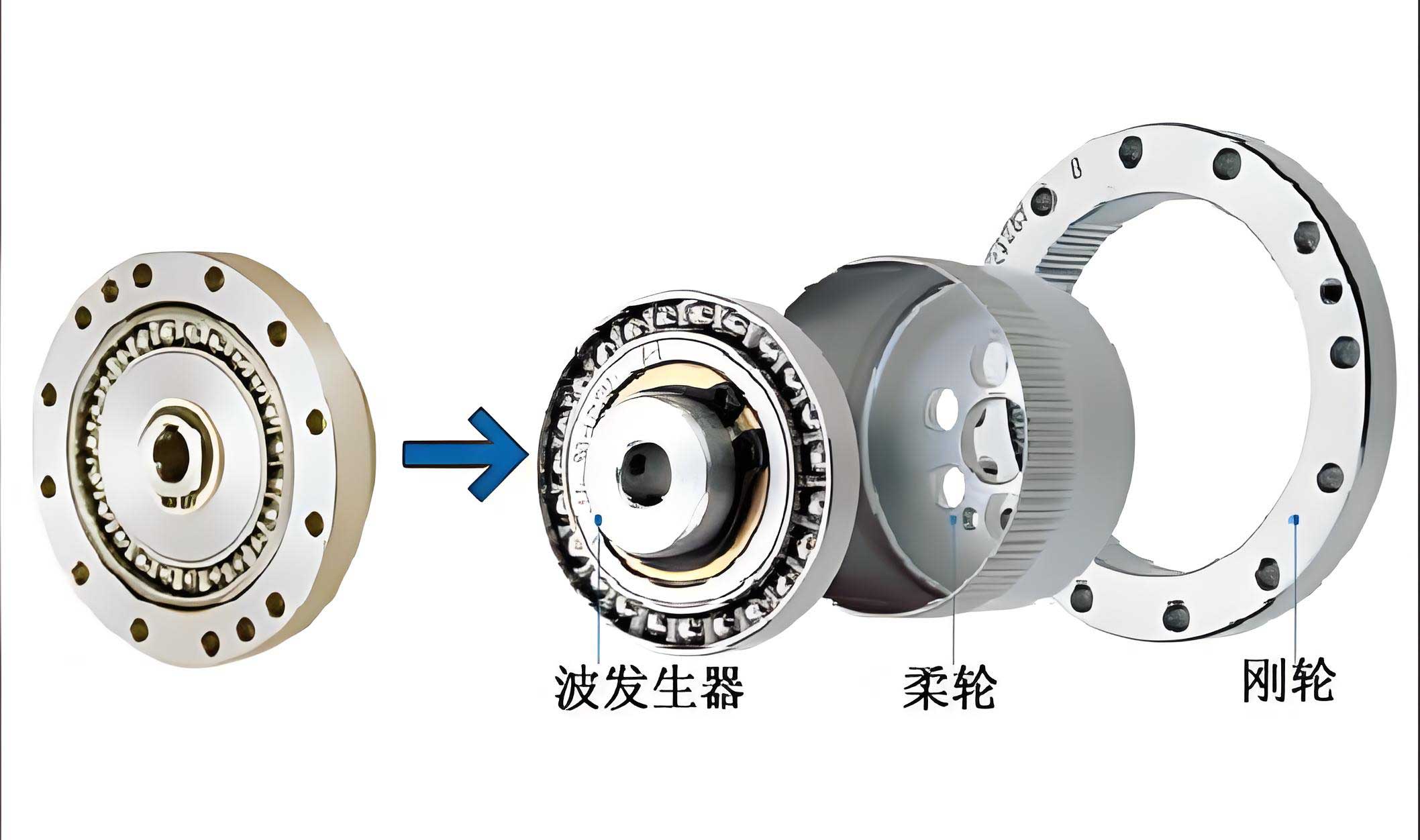
The core principle of a strain wave gear relies on the controlled elastic deformation of a flexible external gear (the flexspline) by a wave generator, causing it to mesh progressively with a rigid internal gear (the circular spline). To simplify manufacturing and leverage existing high-precision production equipment for small-module gears, I have chosen a standard involute profile as the tooth form for both the flexspline and the circular spline. The challenge and focus of my research lie in selecting appropriate meshing parameters to make these standard profiles closely approximate a true conjugate pair, thereby eliminating interference and ensuring efficient motion and torque transmission.
1. Fundamental Parameters and Gear Ratio
The first step in my analysis is to define the basic geometric parameters of the strain wave gear system. These parameters are selected based on desired reduction ratio and physical constraints.
| Parameter | Symbol | Value | Unit |
|---|---|---|---|
| Module | \( m \) | 0.3 | mm |
| Pressure Angle | \( \alpha \) | 20 | ° |
| Number of Teeth on Circular Spline | \( Z_G \) | 172 | – |
| Number of Teeth on Flexspline | \( Z_R \) | 170 | – |
| Number of Waves | \( Z_d \) | \( Z_G – Z_R = 2 \) | – |
With these parameters, I can determine the fundamental gear ratio for the strain wave gear. A common configuration is with the circular spline fixed, the wave generator as the input, and the flexspline as the output. The transmission ratio \( i_{BR}^G \) is given by:
$$ i_{BR}^G = \frac{\omega_B}{\omega_R} = \frac{Z_R}{Z_R – Z_G} $$
Substituting the values:
$$ i_{BR}^G = \frac{170}{170 – 172} = \frac{170}{-2} = -85 $$
The negative sign indicates that the rotational direction of the flexspline is opposite to that of the wave generator. This high reduction ratio is a hallmark of strain wave gear drives.
2. Flexspline Rim Deflection and Deformation Coefficient
The operation of a strain wave gear is predicated on the elastic deformation of the flexspline. A key geometric parameter is the total radial deflection \( \delta \) of the flexspline rim, which is directly related to the wave generator’s geometry and the gear mesh. For a two-wave generator (\(Z_d=2\)), the deflection, often referred to as the diametral deflection, can be derived from the condition for proper meshing.
Considering the pitch diameters, we have \( D_R = m Z_R \) and \( D_G = m Z_G \). The difference is:
$$ \delta = D_G – D_R = m (Z_G – Z_R) = m Z_d $$
Therefore, the required radial deflection of the flexspline rim is simply:
$$ \delta = m Z_d $$
The wave height, which is the radial displacement from the neutral axis, is half of this total deflection: \( \delta/2 \). This wave height is also expressed in terms of the module and a maximum deformation coefficient \( \omega_0^* \):
$$ \frac{\delta}{2} = \omega_0^* m $$
Combining the equations, we can solve for \( \omega_0^* \):
$$ \omega_0^* = \frac{\delta}{2m} = \frac{m Z_d}{2m} = \frac{Z_d}{2} $$
For my specific design with \( m=0.3 \, \text{mm} \) and \( Z_d=2 \):
$$ \delta = 0.3 \times 2 = 0.6 \, \text{mm} $$
$$ \omega_0^* = \frac{2}{2} = 1 $$
This deformation coefficient \( \omega_0^* = 1 \) is a typical value for many strain wave gear designs.
| Quantity | Formula | Calculated Value |
|---|---|---|
| Total Rim Deflection (\( \delta \)) | \( \delta = m Z_d \) | 0.6 mm |
| Wave Height | \( \delta / 2 \) | 0.3 mm |
| Max Deformation Coefficient (\( \omega_0^* \)) | \( \omega_0^* = Z_d / 2 \) | 1 |
3. Mathematical Framework for Conjugate Tooth Profile Analysis
To analyze the meshing of the flexspline and circular spline teeth, I must establish a precise mathematical model. According to the fundamental law of gearing for strain wave drives, the conjugate tooth profiles must maintain continuous contact during motion. A practical approach to using standard involute profiles involves finding specific meshing conditions (like a “stationary point” on the tooth tip to minimize backlash) by solving systems of transcendental equations derived from coordinate transformations.
3.1 Coordinate Systems for Characteristic Curves and Conjugate Profiles
The geometry is described using multiple coordinate systems. First, I define the characteristic curves, which are the neutral curves of the flexspline and circular spline in their deformed and undeformed states, respectively. These are naturally expressed in polar coordinates:
- Flexspline characteristic curve \( S_R \): \( (\rho_R, \phi_R) \)
- Circular spline characteristic curve \( S_G \): \( (\rho_G, \phi_G) \)
For the actual tooth profiles (the involute curves), I use Cartesian coordinate systems:
- Flexspline tooth profile coordinate system \( C_R \): \( (x_R, y_R) \)
- Circular spline tooth profile coordinate system \( C_G \): \( (x_G, y_G) \)
- A fixed global coordinate system \( C_o \): \( (x_o, y_o) \)
Initially, the polar axis \( \rho_R(0) \), \( \rho_G(0) \), and the y-axes of all Cartesian systems \( y_R \), \( y_G \), \( y_o \) are aligned.
| Coordinate System | Type | Description |
|---|---|---|
| \( S_R(\rho_R, \phi_R) \) | Polar | Neutral curve of the deformed flexspline |
| \( S_G(\rho_G, \phi_G) \) | Polar | Neutral curve of the rigid circular spline |
| \( C_R(x_R, y_R) \) | Cartesian | Attached to the flexspline tooth |
| \( C_G(x_G, y_G) \) | Cartesian | Attached to the circular spline tooth |
| \( C_o(x_o, y_o) \) | Cartesian | Fixed global reference frame |
3.2 Coordinate Transformations
The kinematic relationship between the flexspline and circular spline teeth is captured through transformation matrices \( \mathbf{M} \). Different matrices apply depending on which component is fixed and which is driving. My analysis focuses on the configuration where the circular spline is fixed—the most common operational mode for a strain wave gear reducer.
1. Transformation Matrices for Fixed Circular Spline:
When the circular spline (\( G \)) is fixed, and the wave generator (or flexspline) is the input, the transformation from the flexspline system \( C_R \) to the circular spline system \( C_G \) is denoted by \( \mathbf{M}_{RG}^G \). The inverse transformation is \( \mathbf{M}_{GR}^G \). The general form of this homogeneous transformation matrix accounts for both rotation and the translation caused by the radial deflection of the flexspline’s characteristic curve.
For an input rotating counterclockwise, the matrix \( \mathbf{M}_{RG}^G \) is constructed as a sequence of operations: a rotation by an angle \( \psi_G \) and a translation dependent on the radial distance \( \rho_R \) and an angle \( \mu \).
$$ \mathbf{M}_{RG}^G = \begin{bmatrix} \cos(\psi_G) & \sin(\psi_G) & 0 \\ -\sin(\psi_G) & \cos(\psi_G) & 0 \\ 0 & 0 & 1 \end{bmatrix} \begin{bmatrix} 1 & 0 & 0 \\ 0 & 1 & 0 \\ -\rho_R\cos(\mu) & -\rho_R\sin(\mu) & 1 \end{bmatrix} $$
Similarly, the transformation from \( C_G \) to \( C_R \), \( \mathbf{M}_{GR}^G \), for a counterclockwise input is:
$$ \mathbf{M}_{GR}^G = \begin{bmatrix} \cos(\psi_G) & -\sin(\psi_G) & 0 \\ \sin(\psi_G) & \cos(\psi_G) & 0 \\ 0 & 0 & 1 \end{bmatrix} \begin{bmatrix} 1 & 0 & 0 \\ 0 & 1 & 0 \\ \rho_G\cos(\mu’) & \rho_G\sin(\mu’) & 1 \end{bmatrix} $$
Where \( \psi_G \) is the angle between the coordinate axes of \( C_R \) and \( C_G \) when \( G \) is fixed, and \( \mu \) (or \( \mu’ \)) is the angle between the radius vector and the normal to the characteristic curve at the point of interest.
| Matrix | Transformation | Key Angles |
|---|---|---|
| \( \mathbf{M}_{RG}^G \) | \( C_R \rightarrow C_G \) (G fixed) | \( \psi_G, \mu, \gamma \) |
| \( \mathbf{M}_{GR}^G \) | \( C_G \rightarrow C_R \) (G fixed) | \( \psi_G, \mu’, \gamma \) |
2. Relationship Between Angles \( \psi_G \), \( \gamma \), and \( \mu \):
The angle \( \psi_G \) is not independent. It is derived from the fundamental condition that the conjugate characteristic curves \( S_R \) and \( S_G \) roll without slip under the action of the wave generator. This condition requires that the arc lengths from a reference point to the contact point on both curves are equal:
$$ \rho_R \, d\phi_R = \rho_G \, d\phi_G $$
Integrating and considering the gear ratio relationship between the angles \( \phi_R \) and \( \phi_G \) (since the teeth are rigidly attached to their respective rims), we get a difference angle \( \gamma \):
$$ \gamma = \phi_R – \phi_G = \phi_R – \frac{Z_R}{Z_G} \phi_R = \phi_R \left(1 – \frac{Z_R}{Z_G}\right) $$
The angle \( \mu \) is the slope angle of the characteristic curve, defined by:
$$ \mu = \arctan\left( \frac{\rho’}{d\rho/d\phi} \right) = \arctan\left( \frac{\rho_R}{\rho’_R} \right) $$
where \( \rho’_R = d\rho_R/d\phi_R \). Finally, the angle \( \psi_G \) between the coordinate systems is the sum:
$$ \psi_G = \mu + \gamma $$
These interrelated angles are crucial for populating the transformation matrices.
3.3 Equations for Conjugate Profiles
Using the transformation matrices, I can now express the coordinates of a tooth profile from one reference frame to another. For the fixed circular spline configuration:
Flexspline Profile in Circular Spline Coordinates:
A point \( (x_R, y_R) \) on the flexspline tooth profile in its own system \( C_R \) can be found in the circular spline’s system \( C_G \) as \( (x_{RG}, y_{RG}) \):
$$ \begin{bmatrix} x_{RG} \\ y_{RG} \\ 1 \end{bmatrix} = \mathbf{M}_{RG}^G \begin{bmatrix} x_R \\ y_R \\ 1 \end{bmatrix} $$
Where \( \mathbf{M}_{RG}^G \) is the transformation matrix defined previously.
Circular Spline Profile in Flexspline Coordinates:
Conversely, a point \( (x_G, y_G) \) on the circular spline tooth profile can be transformed into the flexspline’s system \( C_R \):
$$ \begin{bmatrix} x_{GR} \\ y_{GR} \\ 1 \end{bmatrix} = \mathbf{M}_{GR}^G \begin{bmatrix} x_G \\ y_G \\ 1 \end{bmatrix} $$
These equations, \( \begin{bmatrix} x_{RG} \\ y_{RG} \\ 1 \end{bmatrix} = \mathbf{M}(R) \begin{bmatrix} x_R \\ y_R \\ 1 \end{bmatrix} \), formally define the conjugate relationship. The condition for conjugacy is that at the point of contact, the profiles share a common normal, which passes through the instantaneous center of relative motion (the pitch point). Enforcing this condition for a standard involute profile across all meshing positions leads to a system of equations that must be solved numerically to determine the optimal profile shift (modification) coefficients for the flexspline and circular spline. This process ensures that the chosen standard involutes behave as closely as possible to the ideal conjugate profiles for the given strain wave gear kinematics, minimizing interference and backlash.
4. Synthesis and Design Implications
Through this kinematic geometrical study, I have established a complete analytical framework for a strain wave gear with a dual eccentric disk wave generator. The process begins with defining basic parameters like module and tooth counts, which directly yield the gear ratio and the necessary flexspline rim deflection. The core of the analysis lies in the sophisticated use of coordinate transformations to model the non-circular, rolling motion of the flexspline’s neutral curve against the circular spline’s inner circumference.
The mathematical tools—polar coordinates for characteristic curves, Cartesian coordinates for tooth profiles, and homogeneous transformation matrices—allow me to derive the precise conditions under which a standard involute tooth form can be successfully applied. The key equations governing the conjugate action are summarized below:
| Concept | Key Formula(s) |
|---|---|
| Gear Ratio (Circular Spline Fixed) | \( i_{BR}^G = \dfrac{Z_R}{Z_R – Z_G} \) |
| Rim Deflection & Wave Height | \( \delta = m Z_d; \quad \dfrac{\delta}{2} = \omega_0^* m \) |
| Characteristic Curve Rolling Condition | \( \gamma = \phi_R \left(1 – \frac{Z_R}{Z_G}\right) \) |
| Transformation Angle | \( \psi_G = \mu + \gamma; \quad \mu = \arctan(\rho_R / \rho’_R) \) |
| Conjugate Profile Transformation (Flexspline to Circular Spline) | \( \begin{bmatrix} x_{RG} \\ y_{RG} \\ 1 \end{bmatrix} = \mathbf{M}_{RG}^G \begin{bmatrix} x_R \\ y_R \\ 1 \end{bmatrix} \) |
This methodology underscores the elegant yet complex geometry inherent in strain wave gear operation. The dual eccentric disk wave generator creates a predictable elliptical deformation mode, which is mathematically tractable. By solving the resulting systems of equations, one can optimize the tooth profile modifications (such as addendum modifications and pressure angle corrections) to achieve a functional and efficient meshing condition. This approach bridges the gap between the ideal theoretical conjugate profiles required for perfect motion transmission and the practical necessity of using standardized, cost-effective manufacturing processes for the tooth profiles. Ultimately, this kinematic geometrical research provides a vital foundation for the precise design and analysis of high-performance strain wave gear drives, ensuring their reliability and accuracy in demanding applications.