
In the realm of precision mechanical transmission systems, the planetary roller screw mechanism stands out for its high load capacity, efficiency, and accuracy. Among its variants, the differential planetary roller screw mechanism (DPRSM) represents a novel integration of ring groove drive and thread meshing, offering unique kinematic and dynamic characteristics. This study delves into the structural composition, motion principles, and dynamic behavior of a DPRSM, employing virtual prototyping and simulation to validate theoretical models and explore its performance under varying loads. We aim to provide a comprehensive analysis that underscores the mechanism’s operational stability and design considerations, with a focus on the planetary roller screw’s role in advanced motion control applications.
The differential planetary roller screw mechanism is engineered to convert rotary motion into linear displacement with a high reduction ratio, making it suitable for robotics, aerospace, and industrial automation. Unlike standard planetary roller screw designs, the DPRSM incorporates a two-segment roller configuration: one segment engages with the screw via threaded meshing, while the other interfaces with the nut through a ring groove design with zero helix angle. This hybrid approach enhances motion stability and reduces wear, but it also introduces complexities in kinematics and dynamics that warrant detailed investigation. In this work, we establish a 3D model of the DPRSM, conduct kinematic simulations to verify motion analysis, and perform dynamic analyses under different load conditions to assess contact forces and wear implications. Our findings contribute to the understanding of DPRSM behavior, aiding in the optimization of planetary roller screw mechanisms for high-performance systems.
Structural Composition of the Differential Planetary Roller Screw Mechanism
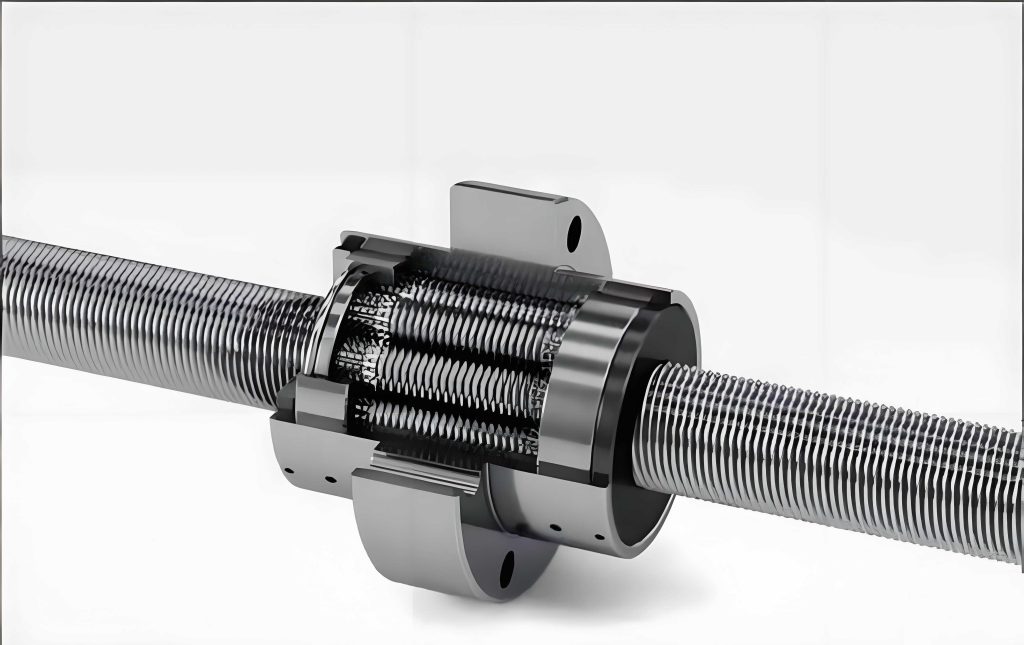
The differential planetary roller screw mechanism comprises several key components: the screw, rollers, nut, cage, and elastic rings. The screw acts as the input member, rotating about its axis to drive the system. The rollers, typically arranged in a planetary configuration around the screw, feature a two-segment design: the screw-contact segment with threads matching the screw’s pitch, and the nut-contact segment with ring grooves that engage the nut. This design ensures that the rollers maintain parallelism to the screw axis during operation, preventing tilting and enhancing alignment. The nut serves as the output member, translating linearly along the screw axis. The cage retains the rollers, facilitating their planetary motion—rotation about their own axes (self-rotation) and revolution around the screw axis (orbital motion). Elastic rings may be used for preloading or securing components, though they are not always present in all designs.
To avoid interference due to the different helix angles between the roller segments, the roller design must account for spatial meshing constraints. For a DPRSM with multiple rollers, the distance \( L_i \) between the screw-contact segment and the nut-contact segment on the \( i \)-th roller is critical. When the thread direction of the screw-contact segment is opposite to that of the screw, the distance is given by:
$$ L_i = L_0 + (i – 1) \frac{\theta}{2\pi} P_s $$
where \( L_0 \) is the distance for the first roller, \( \theta \) is the angle between the axes of two adjacent rollers, and \( P_s \) is the screw lead. Conversely, if the thread directions are the same, the distance becomes:
$$ L_i = L_0 + (i – 1) \frac{3\theta}{2\pi} P_s $$
In practice, opting for opposite thread directions minimizes the blank segments on rollers, increasing the number of engaged thread surfaces and distributing loads more evenly, thereby extending the lifespan of the planetary roller screw mechanism. Table 1 summarizes the design parameters for a typical DPRSM, which we used in our simulations.
| Component | Pitch Diameter (mm) | Pitch (mm) | Ring Groove Spacing (mm) |
|---|---|---|---|
| Screw | 14.6 | 1 | — |
| Roller (Screw-Contact Segment) | 3.2 | 1 | — |
| Roller (Nut-Contact Segment) | 1.6 | 1 | 1 |
| Nut | — | — | 1 |
The roller count in our model is six, ensuring balanced load distribution. The ring groove design on the nut-contact segment eliminates helix angle effects, providing a pure rolling contact that reduces friction and wear compared to threaded engagements. This structural innovation is central to the differential planetary roller screw mechanism’s performance, as it mitigates dynamic instabilities and enhances motion smoothness.
Kinematic Analysis of the Differential Planetary Roller Screw Mechanism
The motion of the differential planetary roller screw mechanism follows principles similar to standard planetary roller screw systems, but with modifications due to the two-segment roller design. When the screw rotates as the input, friction drives the rollers to self-rotate about their axes and orbit around the screw axis, facilitated by the cage. This combined motion induces axial displacement of the rollers, which in turn drives the nut linearly along the screw axis. To derive the kinematic relationships, consider the schematic in Figure 4 (not shown here, but referenced conceptually). Let \( R_s \) be the pitch radius of the screw, \( R_n \) the pitch radius of the nut, \( r_{g1} \) the pitch radius of the roller’s screw-contact segment, and \( r_{g2} \) the pitch radius of the roller’s nut-contact segment. The screw rotates with angular velocity \( \omega_s \), causing the roller to orbit with angular velocity \( \omega_r \) and self-rotate with angular velocity \( \omega_g \).
The tangential velocity at the roller-screw contact point is \( v_g = R_r \omega_g = (R_s + r_{g1}) \omega_g \), where \( R_r \) is the orbital radius. The velocity at the screw surface is \( v_B = R_s \omega_s \). From geometric compatibility, the velocity ratio satisfies:
$$ \frac{v_g}{v_B} = \frac{r_{g2}}{r_{g1} + r_{g2}} $$
Combining these expressions yields the roller’s self-rotation angular velocity:
$$ \omega_g = \omega_s \frac{R_s r_{g2}}{(r_{g1} + r_{g2})(R_s + r_{g1})} $$
The nut’s linear velocity \( v_n \) arises from the relative motion between the screw and roller threads. For a screw lead \( P_s \), the nut velocity is:
$$ v_n = \frac{(\omega_s – \omega_g) P_s}{2\pi} $$
Alternatively, it can be expressed in terms of an effective lead \( P \):
$$ v_n = \frac{\omega_s}{2\pi} P $$
Equating these gives the actual displacement lead of the nut in the differential planetary roller screw mechanism:
$$ P = \left[ 1 – \frac{R_s r_{g2}}{(r_{g1} + r_{g2})(R_s + r_{g1})} \right] P_s $$
This equation highlights the reduction effect inherent in the DPRSM, where the nut’s lead is less than the screw’s lead, enabling precise linear positioning. The kinematic analysis confirms that the roller’s dual-segment design introduces a velocity differential that underpins the mechanism’s functionality. For our model parameters, substituting values yields \( P \approx 0.8 \, \text{mm} \), indicating a significant reduction ratio that enhances control in applications like robotics.
Kinematic Simulation of the Differential Planetary Roller Screw Mechanism
To validate the kinematic analysis, we developed a 3D model of the differential planetary roller screw mechanism and imported it into a virtual prototyping software (e.g., ADAMS). The model includes all components with material properties assigned, and we established appropriate joint connections to simulate real-world motion. The joint configuration consists of 13 revolute joints (one for the screw-ground connection, simulating motor input, and six each for roller-cage connections), 7 cylindrical joints (one for nut-ground connection for linear output, and six for roller-screw connections), and 12 screw joints (six for roller-screw and six for roller-nut engagements). This setup accurately captures the multi-body dynamics of the planetary roller screw mechanism.
We applied a rotational drive of \( 360^\circ/\text{s} \) to the screw, simulating 5 seconds of operation with 2500 steps. The simulation outputs displacement and velocity curves for key components. For instance, Figure 6 shows the displacement of a roller along the x- and y-axes, exhibiting periodic oscillations with an amplitude of 17.8 mm, matching the orbital diameter (sum of screw and roller pitch diameters). The roller’s z-axis displacement (Figure 7) is a steadily decreasing line, indicating uniform linear motion along the screw axis. Velocity plots (Figure 8) reveal constant z-axis velocity and periodic variations in x- and y-axis velocities, corroborating the roller’s combined self-rotation and orbital motion. All rollers display similar patterns, evenly spaced around the screw axis (Figure 9), confirming symmetric planetary motion.
The screw’s displacement along x, y, and z axes remains constant (Figure 10), with only rotation about its axis at a steady angular velocity (Figure 11), validating it as a pure input member. The nut’s displacement (Figure 12) shows linear motion along the z-axis with no significant fluctuations in x or y directions, confirming its role as a linear output. These results align with the kinematic analysis, demonstrating that the differential planetary roller screw mechanism operates as theorized: screw rotation induces roller planetary motion, which drives nut translation. The simulation also verifies the absence of unintended displacements, ensuring design integrity.
| Component | Motion Type | Displacement Characteristics | Velocity Characteristics |
|---|---|---|---|
| Screw | Rotation | No linear displacement | Constant angular velocity |
| Roller | Planetary motion | Orbital displacement in x-y plane, linear in z | Periodic in x-y, constant in z |
| Nut | Linear translation | Steady z-axis displacement | Constant linear velocity |
The kinematic simulation not only validates the motion equations but also provides insights into the smoothness and stability of the planetary roller screw mechanism. The absence of erratic curves suggests minimal vibration or misalignment, which is crucial for high-precision applications. This foundational analysis sets the stage for dynamic investigations under load.
Dynamic Characteristic Analysis of the Differential Planetary Roller Screw Mechanism
Dynamic analysis focuses on the forces and interactions within the differential planetary roller screw mechanism when subjected to external loads. We modified the virtual prototype by replacing some kinematic joints with contacts and applying loads to the nut. The joint configuration for dynamics includes 13 revolute joints, 1 translational joint (nut-ground for linear motion), 2 cylindrical joints (cage-ground for roller orbit), and 12 contact pairs (six for roller-screw and six for roller-nut). Contacts are modeled using the impact function method in ADAMS/Solver, which computes force based on penetration depth and damping. The force \( F \) is given by:
$$ F = \max \left\{ 0, K (q_0 – q)^e – C \frac{dq}{dt} \times \text{STEP}(q, q_0 – d, 1, q_0, 0) \right\} $$
where \( K \) is stiffness, \( q \) the distance between points, \( q_0 \) the reference distance, \( e \) the force exponent, \( C \) the damping coefficient, and \( d \) the penetration depth at full damping. This approach realistically simulates collision dynamics in the planetary roller screw mechanism.
We applied a screw rotational drive of \( 125 \, \text{rad/s} \) and imposed unidirectional forces of 10 kN, 20 kN, and 30 kN on the nut, simulating 0.1 seconds with 100 steps per run. The contact forces along the z-axis (motion direction) between screw-roller and roller-nut pairs were analyzed. For a single roller under 10 kN load, the screw-roller contact force averaged 1.79 kN with fluctuations between 0.92 kN and 2.84 kN (range 1.92 kN). Under 20 kN, the average rose to 3.46 kN with fluctuations from 2.27 kN to 4.72 kN (range 2.45 kN). At 30 kN, the average was 4.68 kN, fluctuating from 3.58 kN to 6.56 kN (range 2.98 kN). Similarly, roller-nut contact forces averaged 1.70 kN (range 3.02 kN), 3.31 kN (range 3.33 kN), and 5.00 kN (range 4.37 kN) for 10 kN, 20 kN, and 30 kN loads, respectively. These results, summarized in Table 3, show that increasing load amplifies contact force fluctuations, indicating heightened internal collisions and potential wear in the planetary roller screw mechanism.
| Load (kN) | Screw-Roller Average Force (kN) | Screw-Roller Force Range (kN) | Roller-Nut Average Force (kN) | Roller-Nut Force Range (kN) |
|---|---|---|---|---|
| 10 | 1.79 | 0.92–2.84 | 1.70 | 0.22–3.24 |
| 20 | 3.46 | 2.27–4.72 | 3.31 | 1.61–4.94 |
| 30 | 4.68 | 3.58–6.56 | 5.00 | 2.73–7.10 |
To examine force variations in the x- and y-axes over a longer duration, we extended the simulation to 0.5 seconds with 500 steps under 30 kN load. The contact forces exhibited sinusoidal patterns (Figures 18 and 19), aligning with the roller’s orbital motion. The roller-nut ring groove design produced more regular force fluctuations compared to the screw-roller threaded engagement, highlighting its stabilizing effect in the differential planetary roller screw mechanism. This regularity reduces stress concentrations and may prolong component life.
Analyzing all six rollers collectively, the sum of average contact forces closely matches the applied load, with errors under 1.5% (Tables 4 and 5), validating simulation accuracy. For instance, under 30 kN load, total screw-roller average force is 30.055 kN (error 0.18%), and total roller-nut average force is 29.906 kN (error 0.31%). However, as load increases, all rollers show escalated force fluctuations, implying that excessive loads can destabilize the system, leading to accelerated wear and possible failure. Thus, operating within rated limits is crucial for the planetary roller screw mechanism’s longevity.
| Applied Load (kN) | Total Average Force (kN) | Error (%) |
|---|---|---|
| 10 | 9.911 | 0.89 |
| 20 | 19.722 | 1.39 |
| 30 | 30.055 | 0.18 |
| Applied Load (kN) | Total Average Force (kN) | Error (%) |
|---|---|---|
| 10 | 9.869 | 1.31 |
| 20 | 19.926 | 0.37 |
| 30 | 29.906 | 0.31 |
The dynamic analysis underscores the importance of the ring groove design in the differential planetary roller screw mechanism. By providing a zero-helix-angle interface, it ensures more predictable force transmission and reduces irregular collisions compared to threaded contacts. This advantage is particularly evident under varying loads, where the planetary roller screw mechanism must maintain precision and durability. Future work could explore material optimizations or preloading strategies to further mitigate force fluctuations.
Conclusion
This study comprehensively analyzes the kinematics and dynamics of a differential planetary roller screw mechanism, combining theoretical derivations with virtual prototyping simulations. We established that the DPRSM’s motion involves screw rotation driving roller planetary motion, which in turn produces nut linear displacement, as confirmed by kinematic simulations. The derived equation for nut lead \( P \) accurately captures the reduction effect, validated through 3D model behavior. Dynamic simulations under loads of 10 kN, 20 kN, and 30 kN reveal that contact forces between screw-roller and roller-nut pairs increase with load, accompanied by heightened fluctuations that can exacerbate wear. The ring groove design on the nut-contact segment offers more regular force patterns than threaded engagements, enhancing stability in the planetary roller screw mechanism.
Our findings emphasize the need to operate the differential planetary roller screw mechanism within specified load limits to prevent excessive force variations and prolong service life. The kinematic consistency and dynamic insights provided here contribute to the design and application of planetary roller screw mechanisms in high-demand fields like robotics and aerospace. Future research could integrate experimental validation with physical prototypes, explore thermal effects, or investigate alternative geometries to optimize performance. Ultimately, the DPRSM represents a sophisticated advancement in motion transmission, with its hybrid design offering a balance of precision, load capacity, and reliability that underscores the enduring relevance of planetary roller screw technology in engineering systems.
In summary, the differential planetary roller screw mechanism exemplifies innovation in mechanical传动, and our analysis provides a foundation for its continued development. By leveraging simulations and theoretical models, we have elucidated key aspects of its behavior, paving the way for enhanced implementations of planetary roller screw mechanisms across industries.