
As a researcher delving into the dynamics of technological innovation, I find the analysis of knowledge evolution not merely an academic exercise but a crucial tool for navigating the complex landscape of scientific and technical progress. Scholarly literature, serving as the primary vessel for codified knowledge, acts as the medium for academic exchange, playing a pivotal role in the dissemination of ideas. Tracing the evolutionary pathways of knowledge within this corpus offers significant strategic value. For research management entities, it aids in identifying disciplinary frontiers and informing policy. For individual scientists and engineers, it provides a map to understand the foundational knowledge and cutting-edge advances within a field, enabling a quicker grasp of its developmental trajectory. The knowledge evolutionary path, which represents the primary flow of ideas through a citation network, encapsulates critical information such as seminal papers and influential contributors. Analyzing these paths within a specific domain, such as medical robot technology, is instrumental in uncovering the underlying logic of progress, identifying potential drivers for change, and anticipating future directions.
Current methodologies for tracing knowledge evolution often fall short of capturing the nuanced semantics of innovation. Probabilistic topic modeling techniques, for instance, excel at identifying correlations between keywords but fail to extract the specific semantic relationships that bind them. Co-occurrence analysis, a bibliometric staple, can chart thematic shifts over time but neglects the causal or evolutionary linkages between those shifting topics. Science mapping based on citation networks can extract critical paths, but the resulting visualizations often present limited information, making it difficult to intuitively discern the direction of knowledge diffusion and the substantive reasons behind specific evolutionary steps. To address these gaps, I propose and elaborate on a method for Knowledge Evolutionary Path Analysis based on Subject-Action-Object (SAO) structures. This approach integrates the semantic mining capabilities of SAO analysis with the network traversal rigor of Main Path Analysis (MPA). It moves beyond keyword correlation to model the actual semantic relationships between concepts and to define the specific types of evolutionary relationships between knowledge states. This allows for the disambiguation of terms and provides a framework to analyze the “why” behind an evolutionary step, offering a clearer view of both the historical lineage and potential future branches of technological development in fields like medical robot design and application.
Theoretical and Methodological Foundation
The proposed methodology rests on two pillars: the extraction of semantic triples and the analysis of citation network flows. A deep understanding of each is necessary before their synthesis.
SAO Structure Analysis: Capturing Semantic Units
Traditional text mining in tech mining often relies on keyword frequency and co-occurrence. While practical, this method discards the relational information between terms. The SAO structure, in contrast, captures a fundamental semantic unit. An SAO triple consists of a Subject (S), an Action or verb (A), and an Object (O). This S-A-O pattern effectively represents a concise technical statement. In the context of analyzing research publications—particularly the conclusion sections of abstracts which summarize the core findings—these triples embody key claims, functionalities, or discoveries.
For the purpose of knowledge evolution analysis, I classify SAO structures into three primary types relevant to technical discourse:
| SAO Type | Semantic Interpretation | Example (S / A / O) |
|---|---|---|
| Technology-Function | Expresses the capability or function of a technology, method, or system. | robotic surgical system / enhances / surgical dexterity |
| System-Component | Describes relationships (e.g., composition, comparison) between components within a system. | da Vinci system / consists of / surgeon console and patient-side cart |
| Problem-Solution | Presents a solution (S) addressing a specific problem or achieving a goal (AO). | sliding-clip renorrhaphy technique / reduces / warm ischemia time |
The extraction process can be represented as a function applied to a corpus of text \( C \) (e.g., paper abstracts):
$$ SAO_{extract}(C) = \{ (S_i, A_i, O_i, \tau_i) \}_{i=1}^{n} $$
where \( \tau_i \) denotes the type of the i-th SAO triple (e.g., \( \tau \in \{TF, SC, PS\} \)). This structured representation mitigates lexical ambiguity. For example, the term “controller” alone is ambiguous, but in the SAO triple “adaptive controller / adjusts / joint torque,” its specific role within a medical robot system becomes clear.
Main Path Analysis: Tracing the Flow of Ideas
Main Path Analysis is a quantitative method for identifying the most significant traversal routes through a directed acyclic graph (DAG), typically a citation network. In such a network, nodes represent publications, and directed edges represent citations from a newer publication (citing) to an older one (cited). The core assumption is that citations signify intellectual influence, and the main paths represent the principal channels of knowledge transmission through the network.
Several algorithms exist to calculate traversal weights for edges. The Search Path Count (SPC) algorithm, often considered the most robust, defines the weight of an edge \( e_{ij} \) (from node \( i \) to node \( j \)) as the number of all possible source-to-sink paths that pass through that edge. Formally, for a DAG:
$$ SPC(e_{ij}) = \sum_{s \in S} \sum_{t \in T} \sigma_{st}(e_{ij}) $$
where \( S \) is the set of source nodes (nodes with no incoming edges), \( T \) is the set of sink nodes (nodes with no outgoing edges), and \( \sigma_{st}(e_{ij}) \) is 1 if edge \( e_{ij} \) lies on a path from source \( s \) to sink \( t \), and 0 otherwise.
Once edge weights are calculated, paths can be extracted. The Key-Route method, an extension of global main path search, is particularly useful. It starts by identifying the top-\( k \) edges with the highest SPC weights (the key routes) and then traces connected paths through these high-weight edges, effectively constructing the backbone of the knowledge flow. This method helps ensure that significant but potentially branching flows are captured. The result is a chronological sequence of pivotal papers: \( P_{MPA} = \{ N_1, N_2, …, N_m \} \), where \( N_k \) represents a key publication node in the evolution.
Synthesizing the Framework: A Procedural Blueprint
The integration of SAO analysis and MPA creates a systematic, multi-stage process for constructing rich, semantically informed knowledge evolutionary paths. The framework proceeds through four sequential stages.
Stage 1: Domain Delineation and Data Acquisition. The target technological domain must be clearly defined. For a field like medical robotics, a comprehensive search strategy is developed using relevant keywords (e.g., “surgical robot,” “robotic surgery,” “rehabilitation robot”). Data, typically bibliographic records with abstracts and references, are retrieved from databases like Web of Science or Scopus. Data cleaning, including the removal of irrelevant records and merging of synonymic keywords, is crucial for a focused analysis.
Stage 2: Identification of the Citation-Based Backbone. Using the cleaned publication data, a citation network is constructed. MPA software (e.g., Pajek, Python libraries) is employed to apply the SPC algorithm and execute the Key-Route search. This yields the main path \( P_{MPA} \), a linear or branching sequence of the most traversed publications. This path serves as the structural skeleton for the detailed evolutionary analysis.
Stage 3: Construction of the Semantic Evolutionary Path. This is the core integrative step. For each key publication \( N_k \) in \( P_{MPA} \), one or more salient SAO triples are extracted from its abstract’s conclusion, representing its core knowledge contribution: \( SAO(N_k) \). The links between nodes in \( P_{MPA} \) now represent connections between these SAO sets.
The critical innovation is defining the knowledge evolutionary relationship between connected SAO triples. By analyzing the semantic content of a citing SAO and a cited SAO, their relationship can be categorized. I propose a three-category taxonomy for technological evolution:
| Evolutionary Relation | Description & Driver | Typical SAO Type Sequence |
|---|---|---|
| Relate (R) | Establishes a logical connection, comparison, or association between technologies, functions, or components. The driver is logical extension or contextualization. | Technology-Function → Technology-Function; System-Component → System-Component. |
| Apply (A) | Demonstrates the practical application or implementation of a technology, function, or system to address a specific problem or in a new context. The driver is practical implementation. | Technology-Function → Problem-Solution; System-Component → Problem-Solution. |
| Update (U) | Provides a new or improved solution for an existing problem, or applies a known solution to a new problem. Represents refinement, improvement, or generalization. The driver is performance enhancement or scope expansion. | Problem-Solution → Technology-Function; Problem-Solution → Problem-Solution. |
This relationship, \( R_{evo}(SAO_i, SAO_j) \), is assigned to each conceptual link along the main path. The final knowledge evolutionary path is thus a directed graph: \( G_{KEP} = (V, E) \), where vertices \( V \) are SAO triples (annotated with their type and source paper year), and edges \( E \) are the evolutionary relations (R, A, U) connecting them in chronological order.
Stage 4: Analysis and Interpretation. The completed \( G_{KEP} \) is analyzed from multiple angles. The distribution of SAO types over time reveals periods dominated by functional exploration, system building, or clinical problem-solving. The sequence of evolutionary relations uncovers patterns: for instance, a prevalent “Relate → Apply → Update” chain suggests a common innovation pattern from conceptual linking, to practical trial, to iterative refinement. The semantic content of triples along the main branches points to the specific technological focus at different times and allows for forecasting potential future directions.
Empirical Exploration: The Trajectory of Medical Robot Technology
To demonstrate the feasibility and utility of this framework, I apply it to the field of medical robotics. This domain, encompassing surgical, rehabilitation, and service robots, has experienced rapid evolution driven by advances in precision engineering, computing, and materials science, making it an ideal case study.
Following the framework, a comprehensive dataset of medical robot-related literature was assembled. The resulting main path, derived via Key-Route MPA, contained 35 pivotal publications spanning from the early 1990s to the mid-2010s. SAO triples were extracted from these papers’ conclusions. The constructed knowledge evolutionary path revealed a clear, semantically rich narrative of the field’s development, which can be segmented into distinct phases.
The early phase (circa 1993-2003) was characterized by foundational medical robot research. SAO triples largely pertained to “Technology-Function” and “System-Component” types. Key evolutionary steps involved establishing the basic relateionships between robotic concepts and surgical tasks. For example, early works described how “robotic enhancement technology / creates / a symbiotic relationship” between surgeon and machine, which was logically linked to the idea that “telecommunication technology / permits / remote surgery.” The dominant evolutionary relationship was Update, as initial proofs of concept (e.g., “robotic system / removes / prostatic tissue”) were refined into more specific functional claims like “telerobotic system / offers / enhanced dexterity and stereovision.”
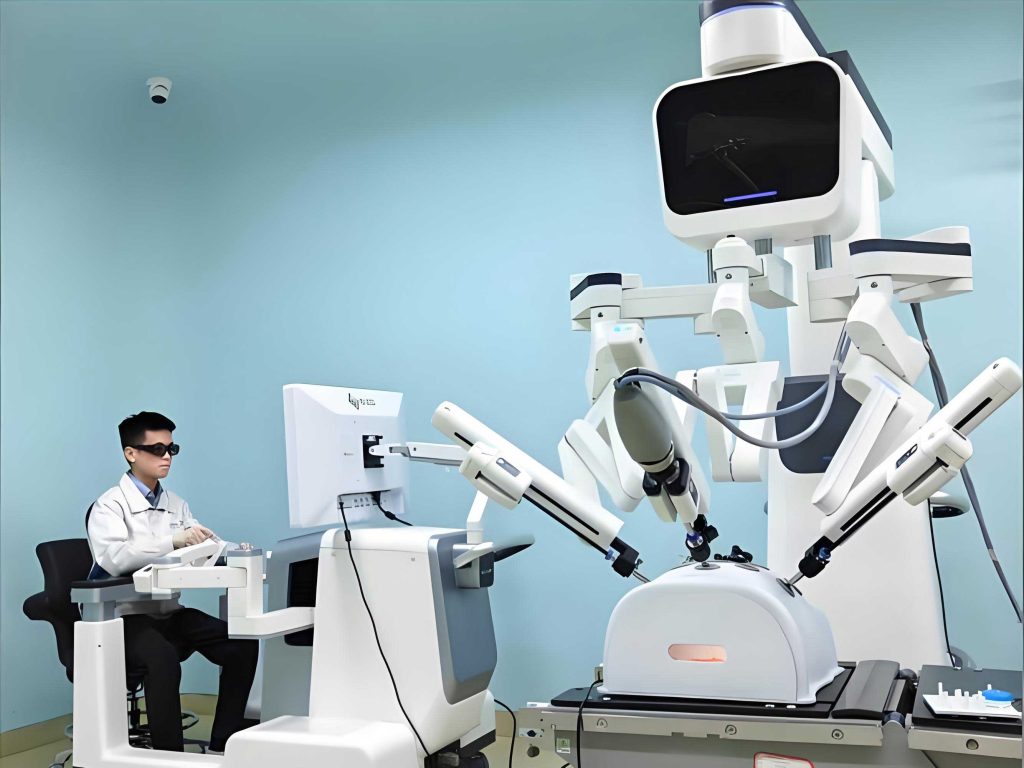
The transition to a clinical application phase became evident around 2004-2008. Here, the “Apply” relationship became prominent. The previously established functional capabilities of medical robot systems were now being actively applied to specific surgical problems. The path shows triples like “robotic technology / is used safely in / creating anastomoses” which directly applyied the platform to complex microsurgical tasks. This phase solidified the value proposition of medical robots in urology and other specialties.
The maturation phase (circa 2009-2014) is marked by a surge in “Problem-Solution” type SAO triples and a mix of Relate and Update relationships. Research shifted from proving feasibility to optimizing outcomes and expanding indications. A clear sequence emerges: studies first related “robot-assisted partial nephrectomy (RAPN)” to comparable outcomes with laparoscopic techniques, then updated the evidence by showing RAPN “provides / excellent functional and oncologic outcomes.” The path further shows the evolution expanding from oncology (e.g., prostate, kidney) into other areas like bladder cancer, with studies comparing outcomes between robotic and open approaches.
The analysis of the SAO triples along the path allows for the identification of key innovation patterns. A recurrent motif is:
$$ \text{[Technology-Function: Capability]} \xrightarrow{Relate} \text{[System-Component: Enabler]} \xrightarrow{Apply} \text{[Problem-Solution: Clinical Use]} \xrightarrow{Update} \text{[Problem-Solution: Improved Outcome]} $$
This pattern suggests that in medical robotics, the identification of a technical capability drives the development of enabling subsystems, which are then applied clinically, leading to iterative updates based on clinical evidence. The semantic content clearly points to an evolution from broad feasibility studies, to procedure-specific validation, and finally to comparative effectiveness research and technique refinement.
Comparative Advantages and Analytical Insights
The SAO-based evolutionary path provides distinct advantages over conventional MPA or keyword-based maps. The following table summarizes the key comparisons:
| Aspect | Traditional Main Path Analysis | Keyword Co-occurrence Timeline | SAO-Based Knowledge Evolutionary Path |
|---|---|---|---|
| Primary Unit | Publication (Node) | Keyword or Topic Cluster | Semantic Triple (SAO) / Knowledge Claim |
| Relationship | Citation (Implicit Influence) | Co-occurrence (Correlation) | Explicit Evolutionary Relation (Relate, Apply, Update) |
| Semantic Content | Limited (Title/Author/Journal) | Lexical, often ambiguous | Rich, structured, disambiguated technical statements |
| Evolutionary Driver | Inferred from network position | Not explicitly modeled | Explicitly categorized (e.g., Application, Refinement) |
| Forecasting Use | Identifying pivotal papers | Identifying trending topics | Identifying innovation patterns and logical next steps |
From the medical robot case, several high-level insights emerge that would be less accessible via other methods. First, the temporal distribution of SAO types acts as a diagnostic of the field’s maturity. An early predominance of Technology-Function and System-Component types indicates a technology-push phase. The subsequent rise and persistence of Problem-Solution types signify a shift to a demand-pull, clinically-driven phase. Second, the sequence of evolutionary relations reveals the innovation mechanism. The frequent “Apply” links following “Relate” links indicate that conceptual associations are quickly tested in practice. The “Update” links that often follow “Apply” demonstrate a robust cycle of clinical feedback and technical iteration, which is hallmark of a maturing medical device field like medical robotics.
Third, the semantic content allows for nuanced trend extrapolation. The path shows a clear expansion from urological applications (prostatectomy, nephrectomy) to other oncological surgeries (cystectomy). The logical next step, visible in the latest branches of the analyzed path and supported by the “Update” dynamic applying solutions to new problems, would be the further diffusion of medical robot platforms into non-oncological, benign, or reconstructive procedures across various surgical specialties. Furthermore, the focus within SAO triples on outcomes like “warm ischemia time,” “positive surgical margins,” and “recovery period” underscores that the driving force of recent evolution is not merely new hardware, but the optimization of surgical quality metrics.
Limitations and Future Directions
While powerful, this methodology is not without constraints. The current bottleneck is the reliable automated extraction of SAO triples from scientific text. While natural language processing (NLP) tools like dependency parsers provide a starting point, the technical jargon and complex sentence structures in engineering and medical literature often necessitate manual review and correction, which can introduce subjectivity and limit scalability. Future work must focus on developing domain-adapted NLP models trained on technical corpora to improve automated SAO parsing accuracy.
Secondly, the Main Path Analysis, especially when using a single global or key-route path, presents a linearized simplification of knowledge flow. It necessarily omits lesser-cited but potentially disruptive ideas that lie outside the dominant trajectory. Future implementations could benefit from integrating multiple local main paths or community detection algorithms within the citation network before applying SAO analysis, thereby capturing parallel or convergent evolutionary sub-streams within the medical robot ecosystem.
Third, the taxonomy of evolutionary relations (Relate, Apply, Update), though intuitive, could be further refined. A more granular set of relations, perhaps inspired by theory of invention or design science (e.g., “Specialize,” “Generalize,” “Substitute,” “Combine”), could provide even deeper insight into the cognitive processes behind innovation steps in medical robot technology.
In conclusion, the integration of SAO structure semantics with the structural analysis of citation networks presents a significant advancement in the toolkit for analyzing technological evolution. By moving beyond keywords and implicit citations to model explicit knowledge claims and the specific relationships between them, this framework generates evolutionary paths that are not just maps of influence, but rich narratives of innovation. The case of medical robotics demonstrates its capacity to disentangle the complex interplay between technological capability, clinical application, and iterative improvement, offering researchers, analysts, and R&D managers a more profound understanding of where a technology has been and, more importantly, a semantically grounded logic for anticipating where it might go next. As text mining and network analysis techniques continue to mature, this synthesis promises to become an increasingly potent instrument for strategic intelligence in fast-evolving fields like medical robotics and beyond.