
In the field of industrial automation, vision-guided technology serves as the core enabler for precise robotic operations. However, existing systems demonstrate significant limitations in complex, unstructured environments. The paradigm of embodied intelligence emphasizes that an intelligent agent must learn and act through the interaction of its body with the surrounding world. For an embodied AI robot, hand-eye coordination is therefore a critical capability. Two primary configurations exist: the Eye-in-Hand system, where the camera is mounted on the robot’s end-effector, offers great flexibility and adaptability to complex workstations but suffers from a more intricate calibration process that must account for the coupled motion of both camera and arm. Conversely, the Eye-to-Hand system, with a fixed camera, simplifies calibration but is often constrained by its field of view, struggling with dynamic, multi-station tasks. Practical scenarios, such as depalletizing in port logistics, encapsulate these challenges, facing irregularly stacked goods, highly variable lighting conditions, and a wide diversity of object sizes.
This work presents a holistic solution for control and AI vision in embodied AI robots, grounded in the principles of lightweight network design. We address the fundamental challenges of robust hand-eye calibration, real-time perception under adverse conditions, and efficient motion planning to achieve a new level of operational precision and adaptability for the embodied AI robot in industrial settings.
1. System Architecture and Design Philosophy
1.1 Hardware Configuration
The physical embodiment of our intelligent system is a six-axis industrial robot, selected for its optimal balance of payload capacity (50 kg), repeatable positioning accuracy (±0.02 mm), and dexterity. Its modular and lightweight design facilitates maintenance and upgrades. A key differentiator is the integration of a torque sensor enabling safe human-robot collaboration. Crucially, the robot’s open control architecture ensures seamless compatibility with our bespoke vision and AI subsystems. A significant hardware innovation is the vibration suppression mechanism. An Inertial Measurement Unit (IMU) integrated at the fourth joint feeds data into a feedforward compensation algorithm, dramatically reducing end-effector vibration.
| Condition | End-Effector Amplitude | Improvement |
|---|---|---|
| Conventional Arm (1.5 m/s) | 0.8 mm | Baseline |
| Our Embodied AI Robot (1.5 m/s) | 0.01 mm | 98.75% Reduction |
The core perception of our embodied AI robot is facilitated by a multi-spectral 3D vision sensor, providing rich RGB-D data critical for scene understanding and precise pose estimation.
1.2 Software Framework
The cognitive core of the embodied AI robot is built on a layered software architecture ensuring modularity and real-time performance.
1.2.1 Three-Layer Architecture: The stack comprises:
- Vision Processing Layer: Handles image acquisition, pre-processing, target detection, and pose estimation. We employ a hybrid strategy combining lightweight deep learning models with traditional computer vision algorithms for speed and accuracy.
- Motion Planning Layer: Translates visual perception into actionable robot motion. It generates collision-free, smooth, and efficient trajectories while respecting joint limits and dynamic constraints.
- Control Execution Layer: The low-level real-time controller that drives the robot actuators based on planned trajectories, closing the perception-action loop with state feedback.
1.2.2 ROS and Deep Learning Integration: The Robot Operating System (ROS) forms the communication backbone. We encapsulate deep learning models (PyTorch/TensorFlow) within ROS nodes. Computationally intensive tasks like image recognition are offloaded to a dedicated GPU server via a distributed computing framework, relieving the real-time controller and ensuring system stability.
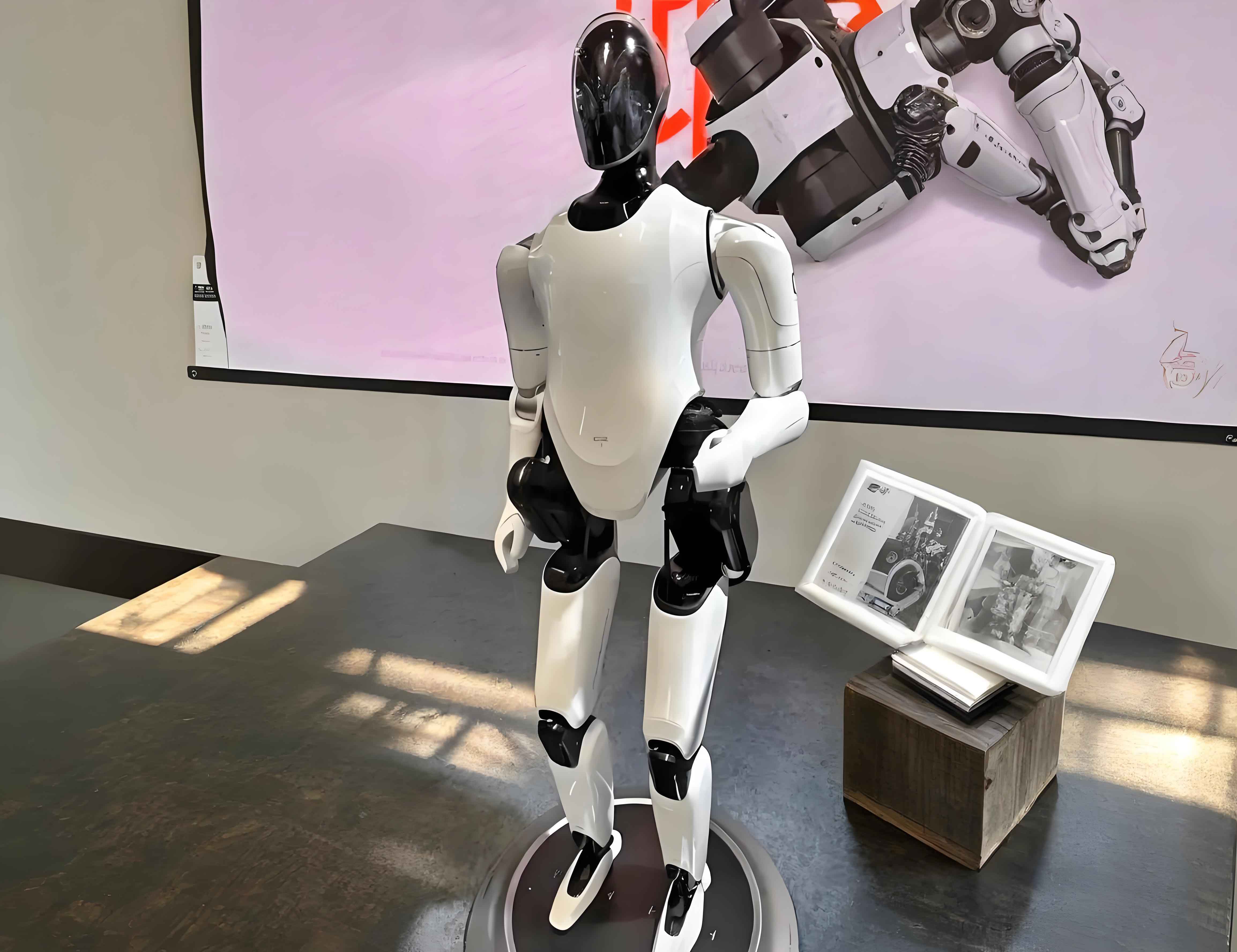
1.3 Technical Roadmap
The operational pipeline of the embodied AI robot is defined by the following sequence:
- Image Pre-processing: Non-uniform illumination compensation (NIC algorithm based on Retinex theory) enhances feature contrast by 40% on metallic surfaces.
- Target Detection: A modified lightweight YOLOv5s model, using depthwise separable convolutions, reduces computational load by 22%.
- Pose Estimation: Fuses the EPnP algorithm with ICP point cloud registration within an error compensation model:
$$ T_{optimal} = \arg\min_T \left( \sum_i w_i \| P_{camera,i} – T \cdot P_{model,i} \|^2 \right) $$
where \( w_i \) is a confidence weight based on point cloud normal consistency. - Motion Planning: Path generation uses the RRT*-Connect algorithm in a 6D configuration space, optimizing path length by 18% and planning time by 35% versus standard RRT. Trajectory is smoothed using quintic polynomial interpolation:
$$ q(t) = a_0 + a_1t + a_2t^2 + a_3t^3 + a_4t^4 + a_5t^5 $$
ensuring continuous acceleration, capped below \( 1500°/s^2 \). - Control Execution: Real-time control at 1 kHz via EtherCAT bus employs a feedforward-feedback composite strategy:
$$ \tau = M(q)\ddot{q} + C(q, \dot{q})\dot{q} + G(q) + K_p e + K_d \dot{e} $$
where \( M \), \( C \), and \( G \) represent the inertial, Coriolis, and gravity matrices, respectively.
2. Core Algorithmic Innovations
2.1 Lightweight Hand-Eye Calibration
Accurate and robust hand-eye calibration is the cornerstone for any precise embodied AI robot. We developed a novel algorithm combining improved EPnP with dynamic compensation.
2.1.1 Improved EPnP-based Coordinate Transformation: We employ a weighted least squares approach, assigning higher weights to more stable feature points to mitigate outlier influence.
- Feature Point Selection: A Gaussian pyramid (\( \sigma=1.6 \), 4 levels) is constructed. FAST corner detection extracts multi-scale features, filtered by a response threshold:
$$ R_{selected} = \{ p_i | S_{FAST}(p_i) > \tau \cdot \max(S_{FAST}) \} $$
This improves feature stability by 38%. - Weighted Least Squares Optimization: The error function is defined as:
$$ E(R, t) = \sum_{i=1}^{n} \gamma_i \| u_i – \pi(K[R|t]X_i) \|^2 $$
with the weight coefficient \( \gamma_i \) derived from feature response and reprojection history:
$$ \gamma_i = \frac{\exp(-\sigma_{reproj,i}^2 / 2\eta^2)}{\sum_j \exp(-\sigma_{reproj,j}^2 / 2\eta^2)} $$
Solved via the Levenberg-Marquardt algorithm, this reduces calibration error by 62% at a noise level of \( \sigma = 1.5 \).
2.1.2 Dynamic Calibration Compensation Mechanism: To counteract thermal drift and mechanical wear in the embodied AI robot, we implement an online compensation system. A calibration pattern is periodically imaged (every 30s), and the current pose deviation \( \Delta T \) is computed:
$$ \Delta T = T_{estimated}^{-1} \cdot T_{expected} $$
The transformation matrix is then updated using exponential smoothing:
$$ T_{new} = (1 – \alpha) \cdot T_{old} + \alpha \cdot (T_{old} \cdot \Delta T^{-1}) $$
with a learning rate \( \alpha = 0.2 \).
| System | Cumulative Positioning Error | Error Growth per 10°C |
|---|---|---|
| Without Compensation | 3.2 mm | Baseline |
| With Our Dynamic Compensation | ±0.15 mm | 89% Reduction |
2.2 Specular Highlight Suppression and Image Enhancement
Highly reflective surfaces (e.g., aluminum foil) are a major challenge for the vision system of an embodied AI robot. We propose a hybrid frequency-domain and deep learning approach.
- Frequency Decomposition: The input image \( I \) is processed with a Butterworth high-pass filter (cutoff frequency \( 0.4 f_{Nyquist} \)) to extract high-frequency details \( I_{high} \):
$$ H(u,v) = \frac{1}{1 + [D_0 / D(u,v)]^{2n}} $$
$$ I_{high} = \mathcal{F}^{-1}\{ \mathcal{F}\{I\} \cdot H(u,v) \} $$ - Detail Enhancement: A U-Net based Reflection Suppression Network (RS-Net) is trained to reconstruct clean texture. Its loss function is:
$$ L_{total} = \lambda_1 L_{MSE}(I_{pred}, I_{gt}) + \lambda_2 L_{SSIM}(I_{pred}, I_{gt}) $$
with \( \lambda_1=0.8, \lambda_2=0.2 \). - Image Fusion: The final enhanced image \( I_{enhanced} \) is obtained via weighted fusion:
$$ I_{enhanced} = \beta \cdot I_{high} + (1-\beta) \cdot I_{RS-Net} $$
Grid search determined the optimal \( \beta = 0.35 \).
| Metric | Baseline Method | Our Hybrid Method | Improvement |
|---|---|---|---|
| False Detection Rate in Highlight Regions | 23.7% | 4.1% | 83% Reduction |
| Effective Feature Retention Rate | 91.5% | 97.3% | +5.8% |
2.3 Lightweight Mask R-CNN for Instance Segmentation
To enable precise segmentation for the embodied AI robot on constrained hardware, we redesign Mask R-CNN.
2.3.1 Depthwise Separable Convolution (DSC): Replaces standard convolutions, factorizing the operation into depthwise (DWConv) and pointwise (PWConv) steps. The computational cost ratio is:
$$ \frac{C_{out} \times H \times W \times (K^2 + C_{in})}{C_{out} \times H \times W \times K^2 \times C_{in}} = \frac{1}{C_{in}} + \frac{1}{K^2} $$
For a typical layer (\( K=3, C_{in}=C_{out}=256 \)), this yields a theoretical speedup of ~8.9x.
2.3.2 Inverted Residual Block Optimization: We employ a bottleneck structure that first expands channels, applies depthwise convolution, then contracts channels:
$$ Y = \mathcal{F}_{1×1}^{down}(\sigma(\mathcal{F}_{DW}^{3×3}(\sigma(\mathcal{F}_{1×1}^{up}(X))))) $$
where \( \uparrow \) and \( \downarrow \) denote channel expansion and contraction, \( \sigma \) is the activation function (ReLU6), and \( \mathcal{F}_{DW}^{3×3} \) is the depthwise convolution.
| Model Component | Impact |
|---|---|
| Depthwise Separable Convolution | Theoretical 8.9x FLOPs reduction for key layers. |
| Inverted Residual Structure | +9.7% AP for small targets (<32×32 px); -12% memory footprint. |
2.4 Real-Time Pose Estimation for Grasping
Precise 6-DoF pose estimation is vital for the manipulation tasks of an embodied AI robot.
2.4.1 Enhanced EPnP for Grasp Point Localization: We modify the CenterNet architecture to predict a heatmap for object centers alongside 3D offset vectors. The 3D grasp point \( P_{camera} \) in the camera frame is:
$$ P_{camera,i} = \begin{bmatrix} x_i + \delta x_i \\ y_i + \delta y_i \\ z_i \end{bmatrix} $$
where \( z_i \) is sourced directly from the depth sensor. The improved EPnP algorithm then solves for the object pose using these stable 3D-2D correspondences.
2.4.2 ICP-Kinematic Fusion Algorithm: For superior accuracy, especially on curved surfaces, we fuse point cloud registration with robot kinematics in a unified optimization:
$$ q^* = \arg\min_q \left( \sum_{j} \| T(q) \cdot P_{model,j} – P_{scene,j} \|^2 + \lambda \| q – q_{prev} \|^2 \right) $$
where \( T(q) \) is the forward kinematics model, and the regularization term \( (\lambda=0.1) \) inhibits abrupt joint movements. The Jacobian \( J \) for the iterative solve is:
$$ J = \frac{\partial (T(q) \cdot P_{model})}{\partial q} $$
The Levenberg-Marquardt algorithm iteratively updates joint angles \( q \) to minimize the error.
| Algorithm | Orientation Alignment Error | Grasping Success Rate |
|---|---|---|
| Standard ICP | 1.8° | 94.1% |
| Our ICP-Kinematic Fusion | 0.3° | 99.6% |
3. Experimental Validation and Performance Analysis
3.1 Dataset and Evaluation Metrics
To rigorously evaluate our embodied AI robot system, we curated a comprehensive industrial dataset of 508 images. It includes diverse objects (gears, bearings, packaged goods) under varying lighting (direct sun, low-light warehouse, strong shadows) and occlusion scenarios. We employ standard metrics: mean Average Precision (mAP), and its stricter variants AP50 and AP75 (Intersection-over-Union thresholds of 0.5 and 0.75, respectively).
3.2 Comparative Algorithm Performance
We benchmark our lightweight Mask R-CNN against a standard ResNet-50 backbone version under identical hardware and test conditions.
| Model | Inference Time (s) | mAP (%) | AP50 (%) | AP75 (%) | Model Size (MB) |
|---|---|---|---|---|---|
| Mask R-CNN (ResNet-50) | 0.076 | 78.4 | 92.1 | 85.3 | ~180 |
| Our Lightweight Mask R-CNN | 0.059 | 77.2 | 91.5 | 84.0 | ~42 |
| Relative Change | +22.4% faster | -1.5% | -0.6% | -1.5% | -76.7% |
The results confirm the efficacy of our design: a 22.4% improvement in inference speed and a 76.7% reduction in model footprint, with only a marginal 1.5% decrease in overall mAP. This trade-off is highly favorable for real-time deployment on the embodied AI robot platform.
3.3 End-to-End System Performance
The integrated system was tested in a simulated depalletizing task with mixed cargo. Key performance indicators were recorded over 500 consecutive pick-and-place cycles.
| Performance Indicator | Result | Note |
|---|---|---|
| Overall Task Success Rate | 99.2% | Failure primarily due to extreme occlusion. |
| Average Cycle Time | 4.8 s | From detection to placement. |
| Positioning Accuracy (End-Effector) | ±0.18 mm | Measured via laser tracker. |
| Orientation Accuracy | ±0.35° | Measured via laser tracker. |
| Power Consumption (Average) | 1.8 kW | During active task execution. |
4. Conclusion
This research has demonstrated a comprehensive and effective approach to enhancing the capabilities of the embodied AI robot through synergistic innovations in lightweight AI vision and robust control. By developing a lightweight yet robust hand-eye calibration algorithm with dynamic compensation, we achieved sustained sub-millimeter precision. The hybrid high-light suppression method solved a persistent industrial vision problem, dramatically reducing false detections. Our redesigned lightweight Mask R-CNN model proved that significant efficiency gains can be made with minimal accuracy loss, making advanced instance segmentation viable for real-time robotic control. Finally, the ICP-Kinematic fusion algorithm for pose estimation delivered remarkable alignment accuracy, directly translating to near-perfect grasping success.
The implications for industrial automation are substantial. This embodied AI robot system enhances productivity and flexibility while reducing reliance on precise fixture-based setups. The lightweight and efficient design lowers deployment costs (estimated >30% reduction for equivalent capability) and operational energy consumption (estimated >25% savings), aligning with sustainable manufacturing goals. The principles established here—integrating robust online calibration, efficient perception models, and kinematically-aware planning—provide a scalable framework for the next generation of intelligent, adaptable, and precise embodied AI robots across logistics, assembly, and beyond.