
As a mechanical transmission device capable of converting rotary motion into precise linear motion, the planetary roller screw mechanism plays a vital role in numerous high-performance applications. My focus in this analysis is to establish a comprehensive computational model for the load distribution among the threads of the rollers, explicitly accounting for manufacturing errors. This is crucial for understanding the mechanism’s true performance, predicting its service life, and guiding its optimal design.
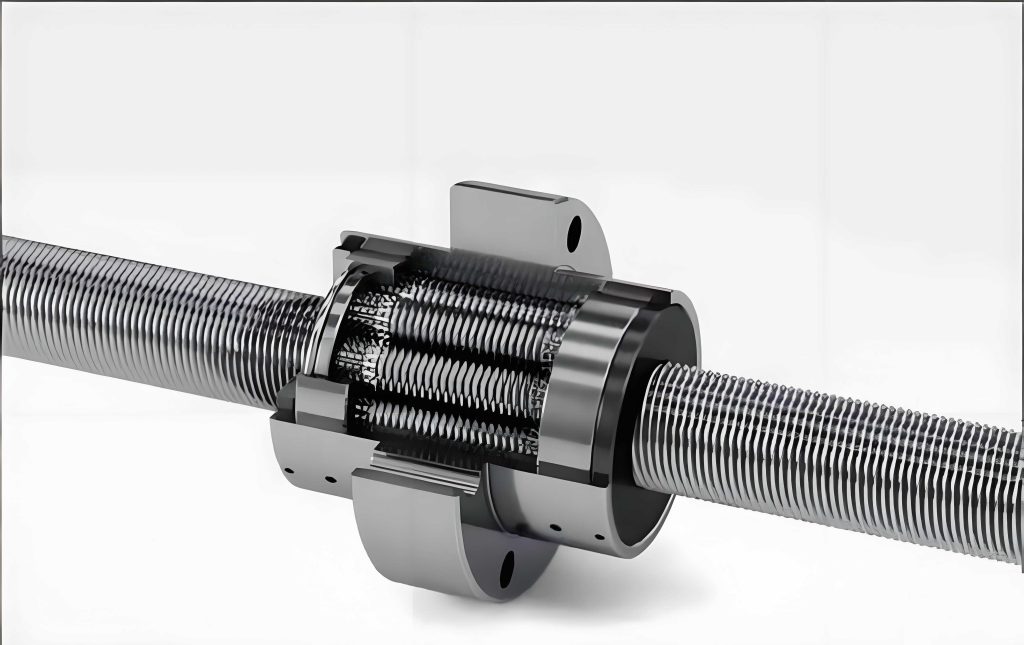
The superior characteristics of the planetary roller screw, including high load capacity, stiffness, and efficiency, stem from its multi-contact nature. Multiple rollers engage with the threads of both the screw and the nut simultaneously, distributing the transmitted force. However, this ideal load sharing is disrupted by inherent geometric errors introduced during manufacturing. Therefore, a model that incorporates these errors is not merely an academic exercise but a practical necessity for accurate performance prediction. I will develop this model based on deformation compatibility, systematically investigate the influence of key parameters, and present the findings through detailed formulas and comparative tables.
Theoretical Model Development
To analyze the load distribution in a planetary roller screw, I begin with a set of necessary and reasonable assumptions to simplify the complex multi-body contact problem without losing essential physics.
Model Assumptions
1. The load distribution is identical across all planetary rollers due to symmetrical arrangement and shared load paths.
2. The load distribution pattern on the screw side is consistent with that on the nut side. Furthermore, the distribution of geometric errors is assumed to be the same on both engagement sides.
3. The screw and nut are made of the same material, while the rollers have distinct material properties.
4. Under axial loading, geometric errors do not induce significant changes in the contact angles between the screw, rollers, and nut.
Governing Equations for Load Distribution with Errors
The core of the planetary roller screw’s operation involves multi-point contacts on the spherical flanks of the roller threads. Consider the equilibrium state of the i-th thread on a roller. The axial forces on the roller from the screw (F_{si}) and the nut (F_{ni}) at this thread must balance the cumulative axial component of the normal loads from preceding threads. This force balance can be expressed as:
$$ F_{si} = F_{ni} = F – M \sum_{j=1}^{i-1} P_j \sin\beta \cos\lambda $$
Here, $P_j$ is the normal load on the j-th thread, $\beta$ is the contact angle, $\lambda$ is the helix angle, $M$ is the number of rollers, and $F$ is the total axial force applied to the mechanism. The total axial force relates to all thread loads by:
$$ F = M \sum_{j=1}^{N} P_j \sin\beta \cos\lambda $$
where $N$ is the number of threads on a single roller.
The heart of my modeling approach lies in the deformation compatibility condition. Under an axial load, the screw stretches, and the nut compresses. This axial displacement between two adjacent threads (i and i+1) must be compatible with the difference in the axial components of the Hertzian contact deformations and geometric errors at those threads. The geometric error for the i-th thread, denoted as $\sigma_i$, manifests as a deviation in the nominal contact position. Its axial component is $\sigma_i / (\sin\beta \cos\lambda)$. Similarly, the axial component of the Hertzian elastic deformation $\delta_i$ at that thread is $\delta_i / (\sin\beta \cos\lambda)$.
According to Hertzian contact theory, the deformation is related to the normal load by:
$$ \delta_{si} = f_s P_i^{2/3}, \quad \delta_{ni} = f_n P_i^{2/3} $$
where $f_s$ and $f_n$ are the contact compliance coefficients for the screw-roller and nut-roller interfaces, respectively, dependent on material properties and thread profile geometry.
The axial strain in the screw (modeled as a rod under tension) and the nut (modeled as a hollow cylinder under compression) between the i-th and (i+1)-th threads is given by:
$$ \varepsilon_{si} = \frac{F_{si} \cdot p}{E_{sr} A_s}, \quad \varepsilon_{ni} = \frac{F_{ni} \cdot p}{E_{nr} A_n} $$
Here, $p$ is the pitch, $E_{sr}$ and $E_{nr}$ are equivalent Young’s moduli for the contacting pairs, and $A_s$ and $A_n$ are the effective cross-sectional areas of the screw and nut involved in load transfer.
Enforcing the compatibility condition—that the sum of axial deformations of the screw and nut equals the net difference in contact deformations (including errors) on both sides—leads to the fundamental recursive equation for load distribution in a planetary roller screw considering errors:
$$ P_i^{2/3} = P_{i+1}^{2/3} + \frac{2(\sigma_i – \sigma_{i+1})}{f_s + f_n} + \frac{M p}{(f_s + f_n)} \left( \frac{1}{E_{sr}A_s} + \frac{1}{E_{nr}A_n} \right) \sin^2\beta \cos^2\lambda \sum_{j=i}^{N} P_j $$
This equation is central to my analysis. The second term on the right-hand side explicitly contains the error difference $(\sigma_i – \sigma_{i+1})$, demonstrating how local geometrical imperfections directly perturb the load distribution from the ideal case. A positive error difference tends to increase the load on the preceding thread. The third term encapsulates the effect of the cumulative axial load from all subsequent threads, which is influenced by the structural stiffness of the screw and nut.
Model Validation and Reference Case
Before proceeding with parametric studies, I must establish the validity of my derived model. I do this by comparing its results, under a zero-error condition, with an established method from literature—the Direct Stiffness Method. The parameters for this validation are listed in the table below.
| Parameter | Value | Unit |
|---|---|---|
| Screw Pitch Diameter | 39 | mm |
| Number of Screw Starts | 5 | – |
| Lead | 5 | mm |
| Helix Angle (Roller/Nut) | 11.5326 | ° |
| Contact Angle ($\beta$) | 45 | ° |
| Roller Pitch Diameter | 13 | mm |
| Nut Pitch Diameter | 65 | mm |
| Number of Rollers ($M$) | 10 | – |
| Number of Threads per Roller ($N$) | 20 | – |
Setting $\sigma_i = 0$ for all threads and solving the recursive model yields the load share for each roller thread, expressed as a fraction of the total axial force $F$. The comparison with the Direct Stiffness Method results shows excellent agreement, particularly in the range of load ratios and the trend for the first few, most heavily loaded threads. This confirms the correctness of my deformation compatibility approach for modeling the planetary roller screw.
Systematic Analysis of Load Distribution Influencing Factors
With the validated model, I now investigate how various operational and design parameters affect the load distribution in a planetary roller screw. For these studies, unless otherwise stated, I assume a random geometric error distribution following a normal distribution with a mean of zero and a standard deviation of 0.0027 µm, as illustrated conceptually earlier. The contact angle $\beta$ is 45° and the helix angle $\lambda$ is 11.5326° for baseline comparisons. The material property ratio $E_s / E_r$ is initially set to 1:1.
Effect of Applied Axial Load ($F$)
The magnitude of the operational load fundamentally influences how errors manifest in the load distribution. I analyzed loads of 5 kN, 10 kN, 20 kN, 50 kN, and 80 kN.
The results are striking: under the same error profile, lower loads produce significantly larger fluctuations in the load share among threads. The first three threads exhibit widely varying load ratios at 5 kN. This is because the inherent stiffness of the contacts dominates over the applied load, allowing small errors to cause large relative load shifts. As the load increases to 50 kN and 80 kN, the distribution stabilizes, and the variation between threads diminishes. The system behaves more predictably under high load, as the elastic deformations become large relative to the fixed geometric errors, effectively “smoothing out” their impact. This characteristic explains why a planetary roller screw often demonstrates high positional accuracy and smooth motion under substantial operational forces.
| Axial Load, $F$ (kN) | Approximate Load Ratio, $P_1/F$ | Observation |
|---|---|---|
| 5 | ~0.055 – 0.070 | High fluctuation, strong error influence. |
| 10 | ~0.040 – 0.050 | Fluctuation remains significant. |
| 50 | ~0.035 – 0.038 | Distribution stabilizes, low fluctuation. |
| 80 | ~0.034 – 0.036 | Very stable distribution. |
Effect of Contact Angle ($\beta$)
The contact angle is a critical design parameter in a planetary roller screw. I examined values of 25°, 30°, 35°, 40°, 45°, and 50° under a constant 50 kN load.
The trend is clear: a smaller contact angle leads to a more uniform load distribution across the roller threads. As $\beta$ increases, the load on the first thread rises noticeably, and the disparity among the first few threads grows. This can be understood from the contact compliance coefficients ($f_s$, $f_n$) and the trigonometric terms in the model. A larger $\beta$ generally reduces the contact stiffness (increases compliance), making the system more sensitive to errors and the cumulative load effect for the leading threads. Furthermore, the $\sin^2\beta$ term in the cumulative load component amplifies its effect as $\beta$ increases. Therefore, from a pure load distribution uniformity perspective, a smaller contact angle is beneficial, though it may trade off against other factors like torque capacity.
| Contact Angle, $\beta$ (°) | Load Ratio Range (Approx.) | Uniformity Trend |
|---|---|---|
| 25 | 0.008 – 0.015 | Most uniform |
| 35 | 0.012 – 0.023 | Moderately uniform |
| 45 | 0.017 – 0.035 | Baseline case |
| 50 | 0.020 – 0.042 | Least uniform, highest peak load. |
Effect of Helix Angle ($\lambda$)
The helix angle, directly related to the lead of the planetary roller screw, influences the kinematic transformation and the load distribution. I analyzed helix angles corresponding to leads (pitch) of 1, 2, 3, 4, and 5 mm (approximately 2.34°, 4.67°, 6.98°, 9.27°, and 11.53°).
The effect of the helix angle mirrors that of the contact angle in terms of distribution uniformity. A smaller $\lambda$ results in a markedly more even distribution of load among threads. For $\lambda = 2.34°$, the load ratios are tightly clustered. For $\lambda = 11.53°$, the range of load ratios is vastly larger, with the first thread carrying a disproportionately high share. The $\cos^2\lambda$ term in the model is responsible: as $\lambda$ increases, this term decreases, reducing the axial component of the contact force for a given normal load, but the recursive relationship shows this actually exacerbates the load concentration on the first few threads. This presents a design compromise: a high helix angle (large lead) provides fast linear speed but worsens load sharing; a low helix angle improves load distribution but reduces speed for a given rotational input.
| Helix Angle, $\lambda$ (°) / Lead (mm) | Typical Load Ratio Range ($P_i/F$) | Comment on Uniformity |
|---|---|---|
| 2.34 / 1 | 0.0054 – 0.0146 | Very uniform distribution. |
| 6.98 / 3 | 0.009 – 0.025 | Moderate uniformity. |
| 11.53 / 5 | 0.0017 – 0.0351 | Poor uniformity, high concentration. |
Effect of Number of Roller Threads ($N$)
Intuitively, increasing the number of engaged threads on each roller in a planetary roller screw should improve load sharing. I modeled rollers with $N = 5, 8, 10, 15,$ and $20$ threads.
The results confirm that as $N$ increases, the absolute load share carried by any single thread decreases, as expected because the total load is divided among more contacts. However, a crucial observation is that the load remains heavily concentrated on the first few threads regardless of the total number. For $N=20$, threads beyond approximately the 8th carry a minimal and nearly constant load, largely immune to the specific error profile. This indicates diminishing returns in adding more threads; they contribute little to carrying load but add to friction, inertia, and size. The error influence is most pronounced on the leading threads and diminishes for threads further back in the load path. An optimal design must balance sufficient threads to handle the load without making the planetary roller screw unduly large or inefficient.
| Threads per Roller, $N$ | Approx. % of Total Load carried by 1st Thread | Notes on Load Carrying Region |
|---|---|---|
| 5 | > 25% | Severe concentration, all threads active. |
| 10 | ~10-15% | High concentration on first ~4 threads. |
| 20 | ~5-7% | Concentration on first ~8 threads; rear threads carry very little. |
Effect of Material Elastic Modulus Ratio ($E_s / E_r$)
Finally, I explore the influence of material selection by varying the ratio of the screw/nut elastic modulus ($E_s = E_n$) to the roller elastic modulus ($E_r$). I consider ratios from 1:10 to 10:1 under a 50 kN load.
This analysis reveals a significant finding: reducing the elastic modulus of the screw (and nut) relative to the rollers—specifically ensuring $E_s / E_r < 1$—can effectively improve load distribution uniformity. When the screw is “softer” than the rollers, it deforms more easily under the cumulative axial load. This increased compliance allows the leading threads to deflect more, redistributing a portion of their load to subsequent threads. Consequently, the peak load on the first thread decreases substantially. Conversely, a very stiff screw ($E_s / E_r > 1$) leads to worse load concentration. This suggests a potential design strategy: fabricate the screw from a material with a moderately lower Young’s modulus than the rollers to promote better load sharing in the planetary roller screw assembly. Care must be taken, as excessive compliance could adversely affect kinematic accuracy and induce other unwanted deformations.
| Modulus Ratio $E_s / E_r$ | Effect on First Thread Load | Recommended for Load Distribution |
|---|---|---|
| 0.1 (Screw much softer) | Lowest peak load, best distribution. | Potentially beneficial, but check other specs. |
| 1.0 (Equal stiffness) | Baseline load concentration. | Standard design condition. |
| 10.0 (Screw much stiffer) | Highest peak load, worst distribution. | Detrimental to uniform load sharing. |
Conclusion
In this comprehensive analysis, I have developed and validated a deformation compatibility model to calculate the load distribution among the threads of a planetary roller screw, explicitly incorporating the influence of geometric errors. The recursive formulation clearly shows how error differentials between adjacent threads directly perturb the load equilibrium. My systematic parametric studies yield the following key conclusions for the design and analysis of planetary roller screw mechanisms:
1. The applied axial load significantly affects distribution sensitivity. Lower loads lead to greater fluctuation due to errors, while higher loads stabilize the distribution, a desirable trait for precision operation of the planetary roller screw.
2. Both contact angle ($\beta$) and helix angle ($\lambda$) have a similar influence: smaller angles produce a more uniform load distribution across threads. Designers must balance this benefit against other performance requirements like torque capacity and linear speed.
3. Increasing the number of threads on each roller ($N$) reduces individual thread load but exhibits strong diminishing returns. Load remains concentrated on the first few threads, with later threads contributing minimally to load-bearing.
4. Material selection offers a potent tool for optimizing performance. Using a screw material with a lower elastic modulus than the roller material ($E_s / E_r < 1$) can effectively improve load distribution uniformity by increasing the screw’s axial compliance, thereby reducing the peak load on the leading threads of the planetary roller screw.
5. The presence of negative geometric errors (where a thread profile is slightly recessed) can be beneficial, as it tends to reduce the load on the critical first few threads compared to the case with positive errors.
This modeling framework and the ensuing insights provide a solid foundation for optimizing the planetary roller screw design to achieve more uniform load sharing, enhanced reliability, and improved performance in demanding applications. The method can be extended to cases where the screw, nut, and rollers all have distinct material properties.