
The planetary roller screw mechanism represents a highly efficient and robust form of translational-rotational motion conversion. Distinguished by its exceptional load capacity, precision, and operational lifespan, the planetary roller screw is increasingly critical in demanding sectors such as aerospace, defense, and heavy industrial machinery. A fundamental characteristic governing its performance and durability is the distribution of axial load across its engaged threads. Uneven load sharing can lead to premature wear, reduced stiffness, and catastrophic failure. This article presents a comprehensive analytical study, from a first-person modeling perspective, on the factors influencing load distribution in a planetary roller screw, with a focus on installation configurations and design parameters.
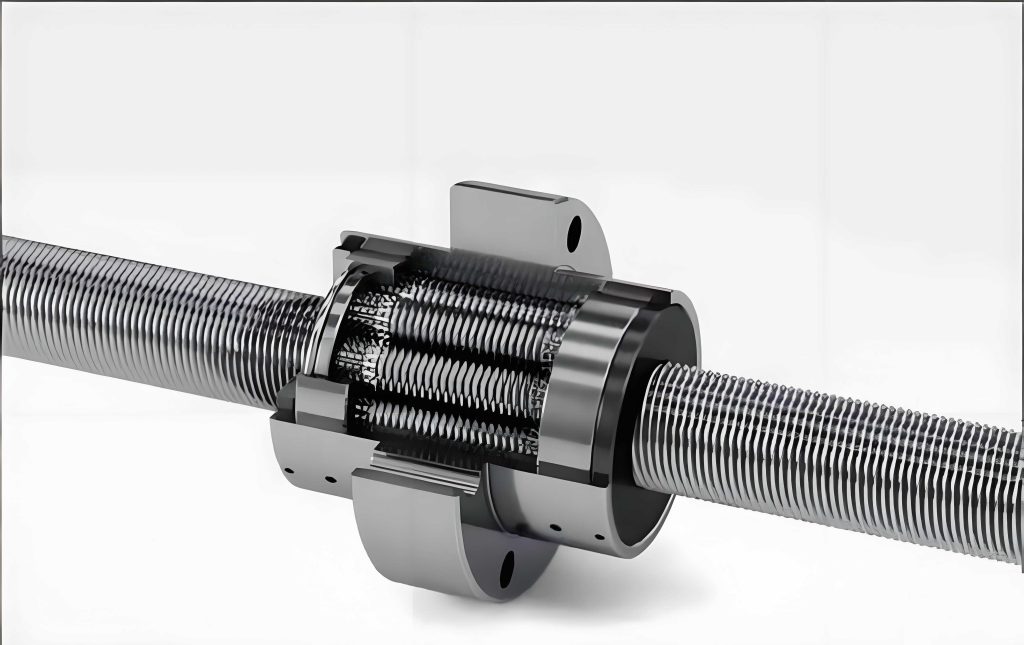
The core structure of a planetary roller screw assembly consists of a central screw, multiple planet rollers, and an enclosing nut. Both the screw and the nut are typically multi-start threaded components, while each planet roller features a single-start thread with a crowned profile to ensure proper contact. The rollers are distributed circumferentially around the screw, meshing simultaneously with the screw and nut threads. To maintain orientation and prevent relative rotation, the ends of the rollers engage with internal gear rings fixed within the nut. A retainer or cage ensures even circumferential spacing of the rollers. The performance of this planetary roller screw system is intrinsically linked to how the external axial force is distributed among the numerous thread contacts along its engaged length.
To analyze this, a detailed stiffness-based model is constructed. The model incorporates three primary sources of elastic deflection under load: the axial compression/extension of the shaft segments between threads, the complex deformation of the threaded teeth themselves, and the localized Hertzian contact deformation at each meshing point. The modeling approach is based on the following key assumptions: (1) Only deformations and loads in the axial direction are considered; (2) The analysis models a single representative planet roller interacting with the screw and nut, assuming symmetrical loading among all rollers; (3) The system operates within the elastic limit of its materials; (4) Manufacturing tolerances and thread clearances are neglected for the fundamental load distribution study.
Modeling Stiffness Components
The total compliance in the load path of a planetary roller screw is the sum of several elastic contributions. The first is the shaft segment stiffness. For the screw and nut, this is the axial stiffness of the material between two adjacent engaged threads, over one pitch length. For the planet roller, which is loaded from both sides (screw and nut), the relevant segment is half a pitch.
Screw/Nut Shaft Stiffness ($k_{XB}$):
$$ k_{XB} = \frac{E_X \cdot A_X}{z \cdot P} $$
where $E_X$ is the elastic modulus, $A_X$ is the minimum cross-sectional area, $P$ is the thread pitch, $z$ is the number of planet rollers, and subscript $X$ denotes $S$ for screw or $N$ for nut.
Planet Roller Shaft Stiffness ($k_{RB}$):
$$ k_{RB} = \frac{E_R \cdot A_R}{P/2} $$
where $E_R$ and $A_R$ are the roller’s elastic modulus and minimum cross-sectional area, respectively.
The second component is the thread tooth stiffness ($k_{XF}$), which accounts for the deflection of an individual thread under load. This deformation is a superposition of several effects: bending ($\delta_1$), shear ($\delta_2$), root tilting ($\delta_3$), base shear ($\delta_4$), and radial compression/expansion ($\delta_5$). The total axial deformation of a thread tooth under an axial load $F_a$ is:
$$ \delta_{XF} = \delta_1 + \delta_2 + \delta_3 + \delta_4 + \delta_5 $$
The thread stiffness is then $k_{XF} = F_a / \delta_{XF}$. The expressions for each deformation component depend on the thread geometry (pitch $P$, tooth height $h$, flank angle $\theta$, root width $a$, etc.). Due to differences in the internal (nut) and external (screw, roller) thread geometries, their stiffness values differ even for identical nominal thread forms. Typically, for a planetary roller screw, $k_{RF} > k_{SF} > k_{NF}$.
The third component is the contact stiffness ($k_{XC}$) at the meshing interfaces between the roller and the screw, and between the roller and the nut. Based on Hertzian contact theory for curved surfaces, the contact deflection $\delta$ under a normal load $F_n$ is:
$$ \delta = \delta^* \left[ \frac{3F_n}{2\Sigma\rho} \left( \frac{1-\mu_R^2}{E_R} + \frac{1-\mu_X^2}{E_X} \right) \right]^{2/3} \left( \frac{2}{\Sigma\rho} \right)^{1/3} $$
Here, $\Sigma\rho$ is the sum of principal curvatures at the contact, $\delta^*$ is a dimensionless parameter dependent on curvature, and $\mu$ is Poisson’s ratio. The normal load $F_n$ is related to the transmitted axial load $F_a$ by the thread geometry:
$$ F_n = \frac{F_a}{\cos\alpha_R \cdot \cos(\theta/2)} $$
where $\alpha_R$ is the helix angle on the roller. The axial contact stiffness is thus:
$$ k_{XC} = \frac{F_a}{\delta \cdot \cos\alpha_R \cdot \cos(\theta/2)} $$
Load Distribution Model Formulation
The load distribution model for the planetary roller screw is built by enforcing compatibility of deformations in closed loops formed by consecutive meshing points on the roller, screw, and nut. Consider a planetary roller screw with $n$ engaged thread pairs on each side (screw-roller and nut-roller). Let $F_{SRi}$ and $F_{NRi}$ be the axial loads on the $i$-th engaged thread pair on the screw and nut sides, respectively.
For a closed loop between the $i$-th and $(i+1)$-th meshing points on the nut side, the sum of axial deformations along the nut path must equal the sum along the roller path, as the nominal distance (one pitch) is the same. This yields a compatibility equation of the form:
$$ \sum_{j=1}^{i} \frac{F_{NRj}}{k_{NB}} + \frac{F_{NRi} – F_{NRi+1}}{k_{NT}} + \frac{F_{NRi}}{k_{NRC}} = \sum_{j=1}^{i} \frac{F_{SRj} – \sum_{j=1}^{i-1} F_{NRj}}{k_{RB}} + \frac{F_{NRi+1}}{k_{RT}} – \frac{F_{NRi}}{k_{RB}} – \frac{F_{NRi}}{k_{RT}} – \frac{F_{NRi+1}}{k_{NRC}} $$
A similar set of equations is derived for the screw-side loops. Furthermore, global force equilibrium requires that the sum of all thread pair loads equals the external axial force $F$ applied to the nut (or screw):
$$ F = \sum_{i=1}^{n} F_{NRi} = \sum_{i=1}^{n} F_{SRi} $$
Combining all compatibility and equilibrium equations leads to a matrix system:
$$ \mathbf{A} \cdot \mathbf{f} = \mathbf{b} $$
where $\mathbf{f} = [F_{NR1}, …, F_{NRn}, F_{SR1}, …, F_{SRn}]^T$ is the load vector, $\mathbf{b}$ is a constant vector containing the external force and zeros from compatibility, and $\mathbf{A}$ is the system stiffness matrix. Since the contact stiffness terms $k_{SRC}$ and $k_{NRC}$ are nonlinear functions of the load $F_{XRi}$ (via the Hertzian formula), the matrix $\mathbf{A}$ is load-dependent. The solution is found iteratively: starting from an assumed uniform load distribution, contact stiffnesses are calculated, the system is solved for a new load distribution, and the process repeats until convergence is achieved.
Installation and Support Configuration Effects
A critical, often overlooked factor in planetary roller screw performance is the mechanical installation, specifically how the screw and nut are supported relative to the applied load. There are two primary classifications: same-side support and opposite-side support. Each configuration leads to distinctly different load distribution patterns, fundamentally affecting the mechanism’s lifespan and stiffness.
In the opposite-side support configuration, the axial supports for the screw and the nut are located on opposite ends of the mechanism. Analysis shows that in this setup, the load distribution trends on the screw side and the nut side are mirror opposites. For instance, if the screw support is at the left end and the nut is pulled to the right, the highest screw-roller load occurs at the leftmost (support-end) threads, decreasing towards the right. Conversely, the highest nut-roller load occurs at the rightmost threads, decreasing towards the left. This opposing trend arises because the cumulative axial compression of the screw and the nut, which governs the load transfer, acts in opposite directions relative to the meshing points.
In the same-side support configuration, both the screw and nut are supported at the same end. Here, the model predicts that the load distribution trends on both the screw and nut sides are similar: the highest loads occur at the threads closest to the support end, decreasing towards the free end. However, the unevenness of distribution is typically more severe in this configuration compared to the opposite-side support. Crucially, under same-side support, a given roller tooth will consistently experience a higher load when engaging the threads at one end of the planetary roller screw and a lower load at the other end. This leads to uneven wear along the length of the roller, potentially causing premature failure at one end.
The following table summarizes the key characteristics of the two installation configurations for a planetary roller screw:
| Configuration | Load Trend (Screw vs. Nut Side) | Load Distribution Uniformity | Impact on Roller Life |
|---|---|---|---|
| Opposite-Side Support | Opposite trends (mirrored) | Generally more uniform overall | More even wear along roller length |
| Same-Side Support | Similar trends | Generally less uniform | Concentrated wear at one roller end |
These findings underscore that the installation scheme is not merely a mounting detail but a fundamental design parameter for optimizing the load-sharing, and thus the reliability, of a planetary roller screw system.
Parametric Analysis of Load Distribution
Beyond installation, the inherent design parameters of the planetary roller screw profoundly influence its load distribution. The model enables a systematic investigation of these factors.
1. Number of Engaged Roller Threads ($n$): The number of active thread pairs on the roller significantly impacts load distribution unevenness. As $n$ increases, the load distribution becomes progressively more non-uniform. This is directly attributable to the increased cumulative axial deformation of the screw and nut shafts over the longer engaged length. With a small number of threads (e.g., $n=10$), the load is nearly evenly shared. As $n$ increases to 50, the first few threads may carry several times the average load, while the last threads carry almost none. This severely limits the benefit of having many engaged threads, as the effective load-carrying capacity does not scale linearly. Interestingly, for larger $n$ ($>30$) under opposite-side support, the nut-side load profile can develop a “saddle” shape (higher at both ends, lower in the middle) due to the complex interaction between the screw and nut deformations, while the screw-side profile remains monotonically decreasing.
2. Thread Form Parameters (Pitch $P$ and Tooth Height $h$): Thread geometry plays a major role. The thread pitch $P$ has a dominant effect on shaft stiffness $k_{XB} \propto 1/P$. A smaller pitch dramatically increases the shaft stiffness, thereby reducing the cumulative axial deformation and leading to a much more uniform load distribution across the threads of the planetary roller screw. The tooth height $h$ primarily influences the thread tooth stiffness $k_{XF}$. While reducing $h$ decreases $k_{XF}$, its effect on the overall load distribution is secondary compared to the pitch. However, simultaneously reducing both $P$ and $h$ (i.e., using a finer, shallower thread) yields the most significant improvement in load-sharing uniformity. The trade-off is a potential reduction in shear strength per thread, requiring careful design optimization.
The influence of key geometric parameters is summarized below:
| Design Parameter | Effect on Load Distribution Uniformity | Primary Mechanistic Reason |
|---|---|---|
| Increase Number of Threads ($n$) | Strongly Decreases | Increased cumulative shaft deformation. |
| Increase Pitch ($P$) | Decreases | Decreases shaft segment stiffness ($k_{XB} \propto 1/P$). |
| Increase Tooth Height ($h$) | Slightly Decreases | Slightly increases thread tooth stiffness. |
| Opposite-Side Support | Increases | Counter-acting screw/nut deformations. |
3. Material Properties: The elastic modulus $E$ of the screw, nut, and rollers directly affects all stiffness components. Higher modulus materials (e.g., premium steels, ceramics) increase shaft, thread, and contact stiffnesses. This generally improves load distribution uniformity by reducing elastic deflections under load. The choice of material also affects the contact stiffness ratio via Poisson’s ratio $\mu$ and the modulus mismatch term in the Hertzian formula.
4. Other Geometric Parameters:
- Roller Diameter ($d_R$): A larger roller diameter increases its cross-sectional area $A_R$, boosting its shaft stiffness $k_{RB}$ and improving load sharing. It also modifies the contact curvatures, affecting $k_{XC}$.
- Number of Starts/Threads: Increasing the number of starts on the screw and nut (while keeping pitch constant) increases the lead. This changes the helix angle $\alpha_R$, which modifies the normal contact force $F_n$ for a given axial load $F_a$, thereby influencing contact stresses and stiffness.
- Flank Angle ($\theta$): The standard flank angle for planetary roller screws is often 90°. Deviating from this affects the radial load component $F_r = F_a \tan(\theta/2)$, which influences the thread tooth deformation $\delta_5$ and the contact conditions.
Extended Analysis: Preload and Dynamic Considerations
While the baseline model addresses static load distribution, practical planetary roller screw applications often involve preload and dynamic operation.
Preload Effect: Applying a controlled axial preload between the screw and nut (often via a dual-nut arrangement) is a common technique to eliminate backlash and increase axial stiffness. In the context of load distribution, preload establishes a base load state across all threads before external operation loads are applied. The superposition of the external load alters this preload distribution. Typically, a properly sized preload can make the load distribution under external load more favorable by ensuring all threads remain in contact, preventing the last threads from unloading completely, which can happen under pure external loading. However, excessive preload increases the constant parasitic load on all threads, raising friction and reducing efficiency and life. Optimizing preload is thus a balance between stiffness/backlash control and lifetime.
Dynamic and Inertial Loads: Under high acceleration or dynamic conditions, inertial forces of the moving masses (screw, nut, attached load) become significant. These forces effectively modify the external load $F$ in the model in a time-dependent manner. The load distribution will therefore fluctuate dynamically. The stiffness model remains valid instantaneously, but the time-varying load can lead to fatigue loading cycles that differ from the static distribution. Threads that see high static loads may also experience the largest dynamic load swings, accelerating fatigue failure. Analyzing the dynamic load distribution requires integrating the stiffness model with the equations of motion for the system.
Design Implications and Guidelines
The insights from this parametric analysis lead to several key design guidelines for optimizing the load distribution and performance of a planetary roller screw mechanism:
- Prioritize Opposite-Side Support: Whenever the system architecture allows, configure the mounting points for the screw and nut on opposite ends of the stroke. This configuration inherently promotes more uniform load sharing and leads to more even wear across the rollers, enhancing overall system life and reliability.
- Optimize Thread Count and Pitch: Do not arbitrarily maximize the number of engaged threads. There is a diminishing return due to worsening load distribution. Use the model to find the optimal $n$ that provides sufficient total contact area and life without excessive distribution unevenness. Favor a smaller pitch to increase shaft stiffness and improve uniformity, accepting a potentially smaller lead per revolution.
- Select High-Stiffness Materials and Geometry: Choose high-modulus materials for all components to maximize overall stiffness. Design for large root diameters on the screw, nut, and especially the rollers to increase their shaft segment stiffness ($A_X$, $A_R$).
- Apply Controlled Preload: Implement and carefully size an axial preload system to maintain thread contact under all operating conditions, improve stiffness, and mitigate the severity of load distribution skew under external load.
- Model Early in Design: Utilize a load distribution model, such as the one described, during the initial sizing and parameter selection phase of a planetary roller screw design. This allows for the quantitative comparison of different design choices rather than relying on rules of thumb.
A consolidated design parameter selection guide based on load distribution optimization is proposed below:
| Aspect | Design Recommendation for Improved Load Distribution |
|---|---|
| Installation | Opposite-side support configuration. |
| Pitch ($P$) | Select a finer (smaller) pitch, balanced with lead requirements. |
| Engaged Length/Thread Count | Optimize via model; avoid excessive length. |
| Roller Diameter ($d_R$) | Maximize within spatial constraints to increase $k_{RB}$. |
| Material | High elastic modulus (e.g., high-grade bearing steel). |
| Preload | Apply moderate, controlled preload to ensure full thread contact. |
Conclusion
In conclusion, the load distribution within a planetary roller screw mechanism is a complex function of its mechanical installation, structural design, and material properties. The primary driver of uneven load sharing is the cumulative axial elastic deformation of the screw and nut shafts under load. The installation configuration—specifically whether the screw and nut are supported on the same side or opposite sides—fundamentally alters the deformation pattern and resulting load distribution, with opposite-side support offering superior uniformity. Key geometric parameters, particularly the thread pitch and the number of engaged threads, have a profound impact, where finer pitches and optimized engaged lengths promote better load sharing. The stiffness of the thread teeth themselves has a secondary, mitigating effect. A comprehensive analytical model that incorporates shaft, thread, and contact stiffness provides an essential tool for understanding and optimizing the performance of the planetary roller screw. By carefully considering support configuration, selecting appropriate geometric parameters, and applying controlled preload, designers can significantly improve the load distribution, thereby enhancing the load capacity, stiffness, operational life, and reliability of these critical mechanical actuators.